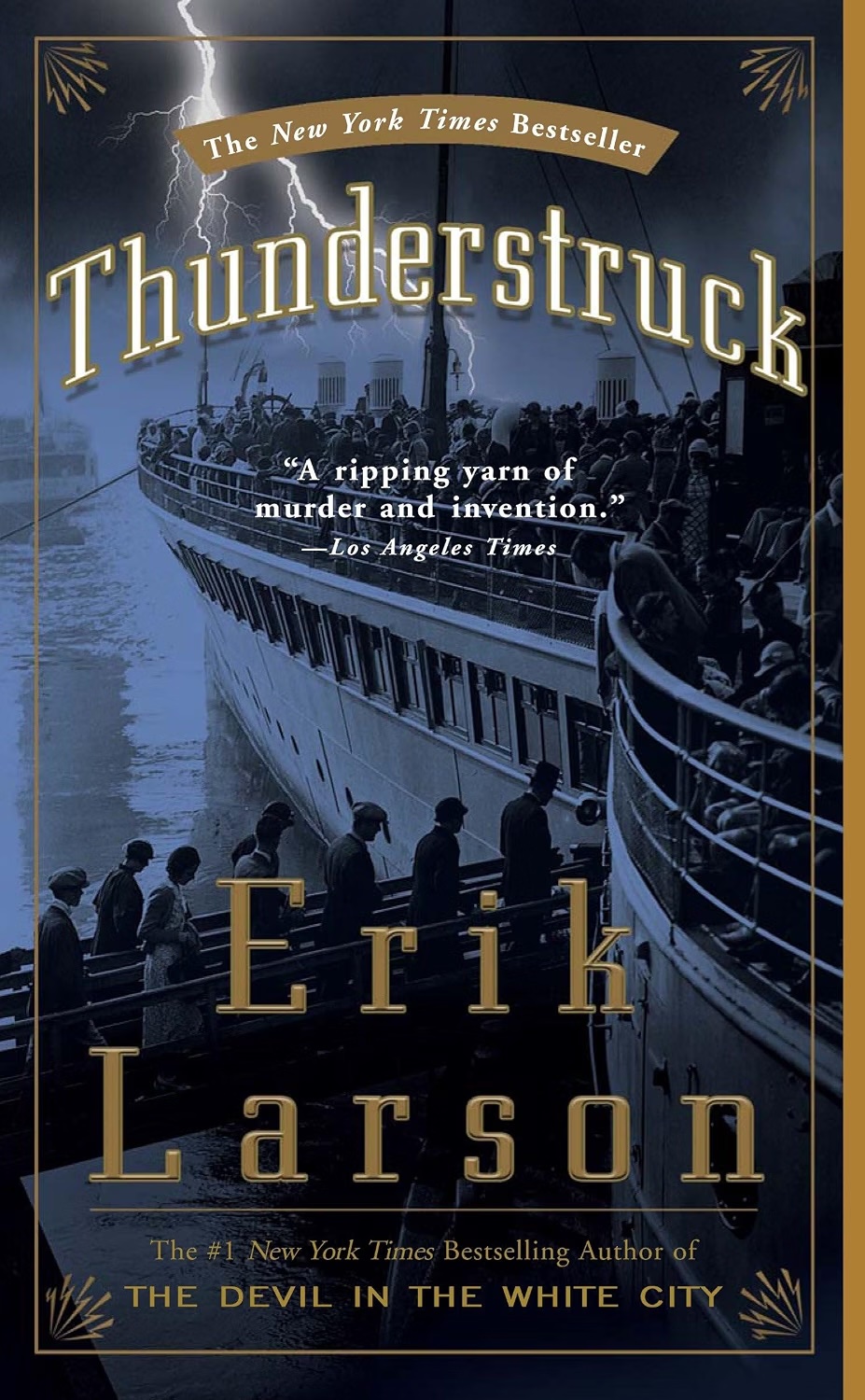
Few writers possess Erik Larson’s extraordinary talent for uncovering fascinating historical narratives and weaving them together into a compelling whole. He really is a master of the craft. In Thunderstruck, Larson takes two highly dramatic but seemingly unrelated stories – Guglielmo Marconi’s quest to establish transatlantic wireless communication and a gruesome murder in Edwardian England – and skillfully interweaves them until they converge in spectacular fashion in the book’s final pages. The result is a remarkable feat of historical storytelling. Indeed, one of the questions I found myself pondering throughout the book was how Larson ever conceived of bringing these two disparate narratives together in the first place.
The two protagonists of Larson’s narrative are Marconi, a largely self-taught electrical engineer and ambitious entrepreneur, and Hawley Harvey Crippen, a mild-mannered homeopathic physician who spent much of his career peddling dubious patent medicines and medicinal elixirs to an unsuspecting public. Both were deeply flawed men, though neither was entirely without redeeming qualities.
Larson argues that Marconi’s greatest advantage was, paradoxically, his ignorance. His lack of formal education and general indifference to the theoretical foundations of invisible electromagnetic waves freed him to pursue experiments that his more highly educated contemporaries dismissed out of hand as physically impossible. Marconi’s most persistent, vociferous, and credible critic was Oliver Lodge, a pioneering British physicist who helped establish the science of electromagnetic waves, experimentally demonstrated their transmission, and made important early contributions to wireless telegraphy before Marconi commercialized the technology.
Lodge’s lifelong susceptibility to distraction, compounded by his deep fascination with the occult, would ultimately undermine his career. Yet his spiritualist convictions were hardly as far outside the mainstream as they might appear today. By 1908, London alone boasted more than 400 Spiritualist societies. It was an era of dizzying technological change, a yawning gulf between rich and poor, declining birthrates, and pervasive anxieties about foreign immigration and porous borders. Much of Larson’s scene-setting felt eerily familiar.
Lodge was, at heart, a scholar whose thinking was guided by theoretical and mathematical models. He belonged to a community of theoretical physicists known as the “Maxwellians,” named for James Clerk Maxwell, whose mathematical equations had predicted the existence of electromagnetic waves. Marconi, by contrast, was more akin to Thomas Edison and William Preece: an inveterate tinkerer who followed wherever the results of his seemingly endless experiments led him, unencumbered by prevailing theoretical assumptions. To Lodge and his fellow Maxwellians, such men were contemptuously dismissed as “practicians.” The irony, as Larson illustrates, was that Marconi’s very ignorance of the theoretical constraints that governed his rivals’ thinking became one of his greatest strengths.
By the summer of 1896, the young Marconi had achieved a transmission range of three hundred yards with his crude prototype wireless apparatus. Just a year later, he had secured a formal British patent and extended his transmission range to nine miles, successfully sending a message across the Bristol Channel. The feat began attracting serious investors, and by the age of twenty-three, Marconi was the founder and CEO of the Wireless Telegraph and Signal Company, with a personal net worth equivalent to roughly $20 million in today’s dollars. He had also become a celebrity.
But Marconi was also accumulating fierce detractors. Lodge bristled at the rapid advances and widespread publicity achieved by the young, largely uneducated inventor, who, in Lodge’s view, was merely capitalizing on his own earlier scientific discoveries. Meanwhile, competitors were moving quickly to replicate Marconi’s achievements, among them Adolf Slaby, a brilliant and determined German scientist working under the patronage of Kaiser Wilhelm II and the German Navy.
From the outset, Larson writes, Marconi was preoccupied with patents, secrecy, and the prospect of amassing a fortune from his invention, all attitudes fundamentally at odds with the open, collaborative ethos of his scholarly rivals, the Maxwellians. “[Marconi’s] outlook was more that of magician protecting his tricks,” Larson observes, “than a scientist unveiling a new discovery to peers.” Indeed, Marconi was not a scientist, his grasp of physical theory was minimal, and his understanding of advanced mathematics nonexistent. To make matters worse, he was a foreigner.
This fiercely proprietary mindset would shroud Marconi’s work in suspicion for more than a decade, fueling skepticism about both his methods and his claims. According to Larson, that cloud would not fully lift until 1910, when wireless technology played a pivotal role in locating and apprehending a murder suspect on the high seas. The dramatic episode provided a public demonstration of the practical value of Marconi’s invention far more persuasive than any of the carefully orchestrated exhibitions with which he had spent years attempting to dazzle the public.
For nearly a decade, Marconi confronted a wall of skepticism. Even after successfully transmitting a message across the English Channel, his fledgling company generated almost no revenue. “Suspicions persisted,” Larson writes, “about his motives and heritage and about the nature of the phenomena he had harnessed and its potential dangers.” Like the steam engine before it, wireless technology seemed destined to languish for decades in a narrow range of commercially marginal applications. For all its extraordinary promise, Marconi’s invention remained little more than a technological curiosity.
Yet the technical advances continued. Before the turn of the century, Marconi had extended the range of his wireless transmissions to sixty-six miles. A few months later, the Royal Navy agreed to install wireless equipment aboard twenty-six ships and at six shore stations, at a cost equivalent to roughly $350,000 per installation in today’s dollars. The contract represented a significant commercial breakthrough, but it also provoked considerable anxiety in the increasingly suspicious Marconi. Under British law, the government could appropriate virtually any technology it deemed necessary for national defense, regardless of whether it was protected by a patent. For an inventor whose ambitions rested as much on proprietary control as on technological achievement, the prospect was deeply unsettling.
Marconi’s commercial strategy was to create what would today be called a “walled garden” around his technology. Marconi wireless stations would communicate exclusively with other Marconi sets, effectively locking customers into his proprietary network and shutting out competitors. At the same time, Marconi went to extraordinary lengths to claim personal credit for each technological breakthrough, deliberately cultivating his name as a brand synonymous with wireless communication. It was this ambition that prompted him to rename his company the Marconi Wireless Telegraph Company. Wireless messages themselves soon became known colloquially as “Marconigrams,” a testament to how thoroughly he had succeeded in associating the emerging technology with his own name.
In the early years of the new century, Marconi became obsessed with establishing a transatlantic wireless service, an achievement that many of the world’s most respected scientists regarded as physically impossible. Radio waves, they believed, traveled in straight lines and would therefore escape into space rather than follow the curvature of the Earth. What these scientists had yet to appreciate, and what Marconi would ultimately demonstrate through dogged experimentation, was that radio waves, particularly at lower frequencies, could be refracted back toward Earth by the ionosphere, allowing signals to travel thousands of miles beyond the horizon.
Marconi began by constructing enormous transmitting and receiving stations at Poldhu, on the southern coast of Britain, and at Wellfleet, on the outer shores of Cape Cod, Massachusetts, each with massive power plants capable of generating 30,000 watts of electricity. These extraordinary installations featured towering wooden masts, each rising some two hundred feet, arranged in circles roughly two hundred feet in diameter; “a Stonehenge of timber,” as Larson memorably describes them. Erected along the exposed shores of the North Atlantic, the massive structures were subjected to relentless winds, sometimes reaching hurricane force, as well as driving rain, sleet, and snow. Eventually, Marconi abandoned the Cape Cod site in favor of Newfoundland, which was closer to Britain but exposed to even more punishing weather. Ferocious storms reduced his elaborate wooden installations to splinters, forcing him to improvise increasingly desperate alternatives, including experiments with kites to suspend his antennas high above the ground. The entire enterprise became a long, painful, and exasperating ordeal, punctuated by repeated failures, engineering catastrophes, and persistent skepticism about the extraordinary claims of the secretive, fiercely ambitious, and increasingly wealthy inventor. In his audacity, relentless self-promotion, appetite for risk, and willingness to defy the scientific establishment, Marconi was something of the Elon Musk of his day.
In December 1901, Marconi announced that his station in Newfoundland had successfully received a test transmission from Poldhu, across the Atlantic. The New York Times hailed the achievement as “the most wonderful scientific development in modern times.” Marconi promptly promised to offer transatlantic wireless service at rates sixty percent below those charged by the established cable companies, sending their share prices tumbling by five to seven points. The Anglo-American Telegraph Company, meanwhile, prepared a lawsuit alleging that Marconi had violated its legal monopoly on telegraphic communication between Britain and Newfoundland.
Yet the announcement was greeted with as much skepticism as enthusiasm. “I don’t believe this story,” Thomas Edison remarked bluntly. Despite the breathless headlines, the commercial excitement, and the apparent technological breakthrough, there remained, Larson writes, “a deep and pervasive skepticism toward him and his claims of success.”
Marconi’s penchant for secrecy did little to dispel the skepticism surrounding his claims. His wireless system suffered from numerous technical limitations and inexplicable failures that neither he nor his engineers fully understood. Yet rather than acknowledge these shortcomings and invite scrutiny from the broader scientific community, Marconi steadfastly refused to disclose them, sacrificing opportunities for collaboration in his determination to protect his proprietary technology.
The system was notoriously unreliable, often for reasons that baffled its inventors. Marconi’s engineers discovered, for example, that daylight dramatically reduced both the range and reliability of wireless transmissions, but they could neither explain the phenomenon nor bring themselves to seek outside assistance. Similarly, they understood that exceptionally long antennas were essential to their long-distance experiments but mistakenly concluded that this meant only long wavelengths could travel great distances. In fact, shorter wavelengths would ultimately prove far more effective for certain forms of long-distance communication.
Marconi also insisted that his wireless transmissions were secure from interception and that his equipment could selectively filter out competing signals. Both claims were dramatically undermined in June 1903, when rivals deliberately disrupted a Marconi demonstration at London’s prestigious Royal Institution, exposing the vulnerability of his supposedly secure system.
Yet through every setback, embarrassment, and public challenge, Marconi maintained an unwavering insistence that everything was proceeding according to plan. He rarely acknowledged the legitimacy of his critics’ objections, even when their criticisms were demonstrably correct. At a time when the public had grown accustomed to tangible, independently verifiable demonstrations of scientific and technological progress, Marconi offered remarkably little transparency. His extraordinary claims demanded trust, but his obsessive secrecy gave skeptics every reason to withhold it.
To make matters worse, the extraordinary pace of technological improvement that had characterized Marconi’s first five years of experimentation had begun to plateau. By 1904, his company had equipped 124 ships with wireless apparatus and established 69 land stations around the North Atlantic, yet its maximum transmission range—1,200 miles by day and 1,700 miles by night—had not increased in more than two years. Marconi responded by constructing ever more powerful transmitting stations, some capable of generating 300,000 watts, more than four times the output of his previous installations. Costs soared, but commercial progress remained elusive.
By 1908, the company was transmitting a mere 896 words per day across the Atlantic. The average message took forty-four minutes to complete, while some required as long as four hours. The technology remained frustratingly unreliable, prohibitively expensive, and commercially underwhelming.
But it worked. Against the confident predictions of some of the world’s most distinguished physicists, Marconi had accomplished what many had considered impossible. In 1909, he was awarded the Nobel Prize in Physics, an extraordinary honor for a man who had never formally studied the discipline. It was a remarkable personal triumph, but one that could scarcely disguise the deteriorating fortunes of his enterprise. Even as Marconi basked in international acclaim, the once high-flying Marconi Wireless Telegraph Company was hurtling toward financial ruin.
Meanwhile, competition was intensifying. Oliver Lodge was emerging as a bona fide commercial rival, while the Germans were breathing down Marconi’s neck. Kaiser Wilhelm II had made wireless telecommunications a national priority, and Germany was spearheading an international effort to establish open standards and interoperability among competing wireless systems, directly threatening Marconi’s proprietary, walled-garden approach. All of this unfolded against a backdrop of mounting British anxiety over the nation’s perceived economic and cultural decline, compounded by an increasingly pervasive fear of imminent invasion by the Germans – the dreaded “Huns.”
“With the technology at last in place,” Larson writes, “the stage was set.” After more than a decade of largely unsuccessful efforts to capture the public imagination and demonstrate the transformative potential of long-distance wireless telegraphy, an unforeseen and tragic event was about to “galvanize the world and rupture the reservoir of doubt once and for all,” as Larson puts it. It is at this moment that the book’s two seemingly unrelated narratives converge in dramatic fashion, transforming a sensational murder case into an extraordinary public vindication of Marconi’s technology.
Thunderstruck’s other storyline, that is woven into the narrative in crisp chapters alternating with the longer and more formal chapters about Marconi’s efforts, involves two obscure individuals: Belle Elmore and Hawley Harvey Crippen. They were the central figures in one of the most sensational murder cases of Edwardian England, a scandal that became a landmark in the history of wireless communication.
Belle Elmore, born Kunigunde Mackamotzki and also known as Cora Crippen, was an American-born music hall performer and aspiring singer who became a fixture in London’s theatrical community. She was also the wife of Hawley Harvey Crippen and, in Larson’s telling, a demanding, selfish, and frequently cruel woman; a domineering termagant who reduced her mild-mannered, hapless husband to the humiliating status of a cuckold and a fool. Crippen endured her infidelities and relentless humiliations with seemingly inexhaustible resignation, until one day, after developing a romantic relationship with his secretary, Ethel Le Neve, he poisoned, dismembered, and eviscerated her. Her mysterious disappearance in 1910 would set in motion an investigation that transformed the obscure couple into figures of international notoriety.
When Belle disappeared in 1910, Crippen’s contradictory explanations aroused the suspicions of Scotland Yard. Police eventually discovered human remains buried beneath the cellar floor of the couple’s London home. By then, Crippen had fled England with his mistress, Ethel Le Neve, traveling first to the Netherlands and Belgium before boarding the steamship Montrose, bound for Quebec. The Metropolitan Police issued a widely circulated bulletin alerting the public – and particularly those employed in transportation – to the fugitives, noting that Le Neve might be traveling disguised as an adolescent boy.
The captain of the Montrose recognized the pair and discreetly alerted Scotland Yard using Marconi’s wireless telegraph system. British authorities promptly dispatched a detective aboard a faster ocean liner, which raced across the Atlantic in an effort to overtake the Montrose and intercept the fugitives upon their arrival in Canada.
What followed was an extraordinary international spectacle. As Larson recounts, audiences around the world became enthralled by the nearly minute-by-minute reports of the pursuit, as ships scattered across the Atlantic relayed wireless updates on the unfolding drama. For the first time, the public could follow a transatlantic manhunt virtually in real time, transforming what might otherwise have been an obscure murder investigation into a global sensation. Crippen was arrested upon reaching Canada on July 29, 1910, subsequently convicted of murdering Belle, and hanged that November.
The episode not only brought a sensational criminal case to its conclusion but also provided the most compelling public demonstration yet of the revolutionary potential of Marconi’s wireless technology. “Anyone who had been skeptical of wireless before the great chase,” Larson writes, perhaps overstating the case somewhat, “now ceased to be skeptical.”
Eighteen months later, the sinking of the Titanic would provide an even more dramatic – and tragic – demonstration of wireless technology’s life-saving potential. A Marconi wireless operator aboard the stricken liner managed to summon assistance, helping to save more than seven hundred lives. In remarks before the House of Commons following the disaster, a British lord declared: “Those who have been saved have been saved through one man, Mr. Marconi and … his wonderful invention.” In the space of less than two years, a technology long regarded with suspicion and skepticism had become indispensable, its value demonstrated not through carefully staged exhibitions or grandiose promises, but through its extraordinary capacity to connect people across vast distances in moments of desperate urgency.
In the end, the great irony of Thunderstruck is that the most likable and relatable character in Larson’s narrative is Dr. Crippen, the man who murdered and dismembered his wife, disposed of her bones in parts unknown, and buried her viscera beneath the floor of his basement. By nearly all accounts, Crippen was an unusually “kind-hearted” man who went to extraordinary lengths to accommodate the endless demands and whims of his selfish, ill-tempered, and somewhat delusional wife. Mild-mannered, patient, and almost pathologically accommodating, he possessed an array of admirable personal qualities that stood in grotesque contrast to the brutality of his crime.
Marconi, meanwhile, was undoubtedly an indefatigable entrepreneur, a technological visionary, and a man of genuine genius. Yet he seemed to possess remarkably few of the qualities that made the murderer he helped apprehend on the high seas so strangely sympathetic. There was little that was kind-hearted, self-effacing, tolerant, or loyal about Guglielmo Marconi. Indeed, one cannot help but suspect that he and the murdered Belle Elmore might have made a rather suitable couple. In temperament, ambition, and sheer capacity for making those around them miserable, they seem almost to have deserved each other.


Leave a Reply