David Hackett Fischer and James McPherson are two of the most distinguished American historians of the past half-century. They also serve as co-editors of Oxford University Press’s Pivotal Moments in American History, a superb series in which each volume explores a critical turning point in the nation’s past, from the presidential elections of 1800 and 1824 to the Supreme Court’s landmark decision in Brown v. Board of Education. Each book is a gem in its own right.
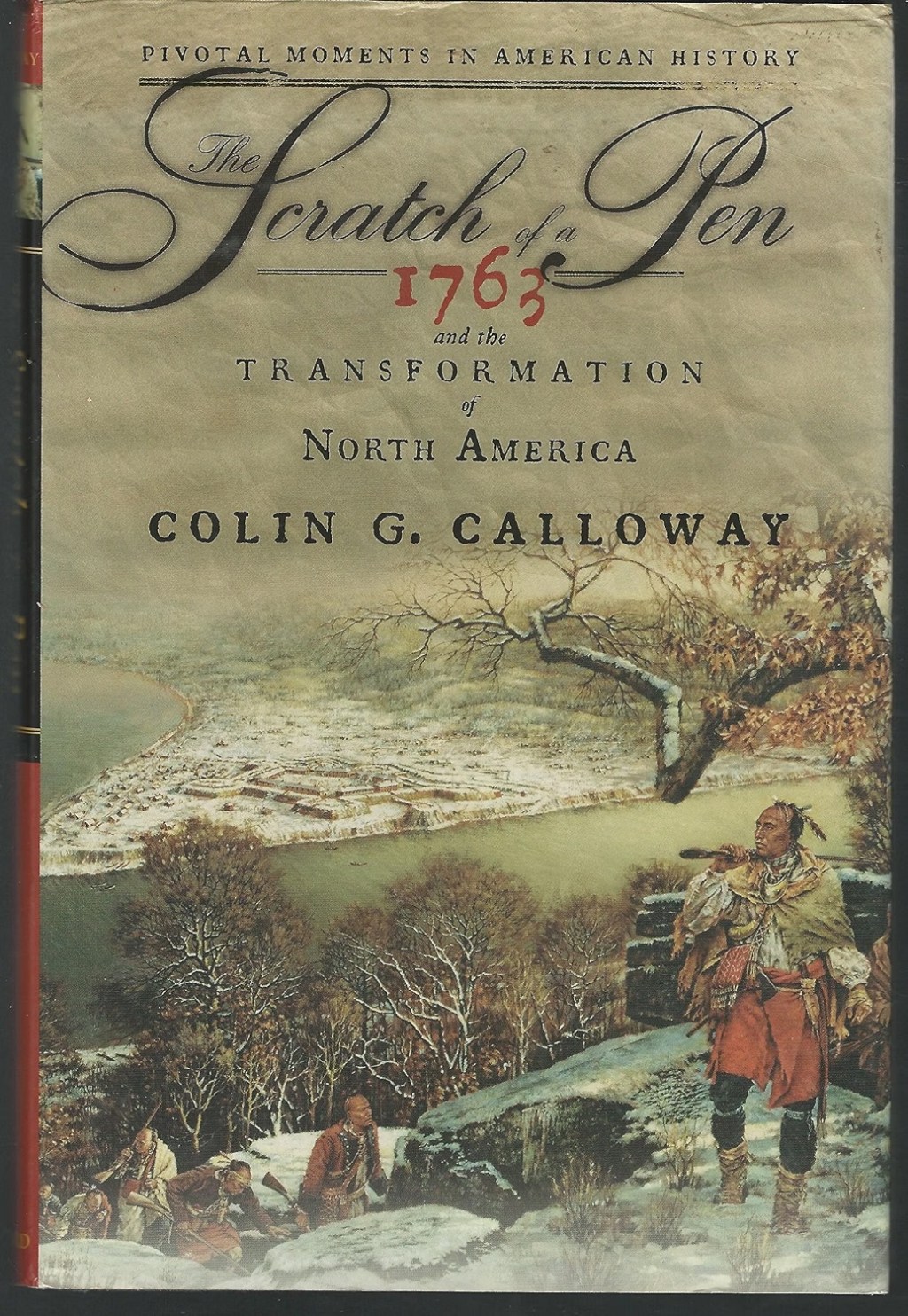
The Scratch of a Pen: 1763 and the Transformation of North America (2006), by Dartmouth College historian Colin G. Calloway, examines the Treaty of Paris that ended the Seven Years’ War and transformed the geopolitical landscape of North America. With the stroke of a pen, Britain acquired dominion over vast stretches of the continent, setting in motion a series of dramatic and largely unforeseen consequences, particularly for the thirteen British colonies along the Atlantic seaboard, whose inhabitants were increasingly consumed by the prospect of acquiring and speculating in lands west of the Appalachian Mountains.
Calloway explores the consequences of this momentous peace settlement primarily through the experiences of those whose lives were most directly affected by its terms. Foremost among them were the numerous Native American nations whose territories stretched from the Gulf Coast through the Mississippi River basin and along the St. Lawrence River to the North Atlantic. For these peoples, the treaty represented far more than a diplomatic rearrangement of European imperial possessions. It threatened to upend the political, economic, and territorial arrangements that had governed their world for generations.
The Treaty of Paris of 1763, which brought the Seven Years’ War to a close, has long been regarded as an epoch-making event. In his preface, David Hackett Fischer describes it as “one of the great moments of contingency in modern history.” Francis Parkman famously observed that “half a continent … changed hands at the scratch of a pen.” Frederick Jackson Turner regarded the settlement as a watershed in American history and a direct catalyst for the American Revolution.
It had been the deliberate policy of William Pitt to reduce France from a global imperial power to a continental European one by stripping away its overseas possessions, particularly in North America. The strategy succeeded almost too well. British victories accumulated across the globe: Gorée in Africa; Guadeloupe, Martinique, and Havana in the Caribbean; Niagara and Quebec in North America; Louisbourg in the St. Lawrence; Minden in Germany; Belle-Île-en-Mer in the Bay of Biscay; Manila in the Philippines; and the Grand Banks off Newfoundland. The sheer geographic sweep of these triumphs was breathtaking.
“The enormity of Britain’s victory seemed to herald a new world order,” Calloway writes. And indeed it did, though in ways that few of the victors could have anticipated. The central irony was that Britain’s triumph had been almost too complete. The empire had acquired too much territory, too much power, and responsibility for too many disparate peoples in too little time. What appeared to be the crowning achievement of British imperial ambition would instead unleash forces that the victorious empire proved increasingly unable to control. “Victory in the great war for empire,” Galloway writes, “generated wars against empire.”
The other great legacy of the Seven Years’ War was a mountain of government debt. In just seven years, Britain’s national debt had ballooned from £75 million to more than £125 million. Against an annual postwar government budget of approximately £8 million, interest payments alone consumed an astonishing £4.5 million. The disparity in taxation between Britain and its American colonies was equally striking. In 1763, the average Briton paid 26 shillings annually in imperial taxes, while the average American colonist paid just one.
From London’s perspective, the conclusion was obvious: the American colonists, who had benefited enormously from the elimination of the French Catholic threat along their western frontier, should now shoulder a fairer share of the financial burden of defending and administering the empire.
Within a year of the war’s conclusion, Parliament began seeking ways to extract additional revenue from the colonies. One of its first measures was to reduce the existing duty on foreign molasses from sixpence to threepence per gallon, while simultaneously committing to enforce its collection in earnest for the first time since the passage of the Molasses Act in 1733. What appeared in London to be a perfectly reasonable exercise in imperial fiscal management would prove to be an opening salvo in the escalating confrontation that culminated in the American War of Independence.
The great irony was that British leaders, having just won a spectacular global war to secure their American empire, were embarking on a course that would ultimately cost them its most valuable colonies. And they never saw it coming.
The fighting in the French and Indian War, as the Seven Years’ War was known in North America, had been exceptionally vicious and intensely personal. Calloway emphasizes the powerful racial animosities that both fueled the conflict and were intensified by its brutality. “Old hatreds crystallized,” he writes, “into explicit new doctrines of racial unity and racial antagonism that shaped Indian-white relations for generations to come.”
It is this dimension of the postwar settlement that lies at the heart of The Scratch of a Pen. The Peace of Paris provides the geopolitical backdrop, but Calloway’s principal concern is with the profound changes it unleashed in the lives of North America’s diverse inhabitants, particularly the Native American nations whose interests were largely disregarded by the European powers negotiating their fate. Above all, his narrative revolves around the increasingly bitter contest for land, as competing peoples and empires struggled to assert control over a continent whose political boundaries had been abruptly redrawn. In short, as Calloway argues, 1763 inaugurated an “era of upheaval that remade America.”
The first major act of resistance was not long in coming. Pontiac’s Rebellion erupted in 1763 as a direct consequence of the Treaty of Paris. Whereas the French had cultivated Indigenous alliances through trade, diplomacy, and gifts, the British increasingly treated these peoples as conquered subjects, restricted trade, and encouraged colonial settlement on their lands. In response, a loose confederation of Indian nations, inspired by the Ottawa leader Pontiac, attacked British forts and frontier settlements, capturing several outposts and besieging Detroit and Fort Pitt. Although the uprising eventually subsided through military resistance and negotiations, it exposed the fragility of Britain’s new empire and helped prompt the Royal Proclamation of 1763, which sought to restrict colonial settlement west of the Appalachian Mountains. This attempt to stabilize relations with Native Americans infuriated land-hungry colonists, adding another grievance to the growing tensions that would culminate in the American Revolution.
Calloway emphasizes the vast distances, relative isolation, and ever-present specter of death that characterized life in colonial North America. Disease was an especially relentless scourge. Devastating epidemics swept through the continent in successive years: influenza in 1761, typhus in 1762, smallpox in 1763, and an unidentified illness in 1764. The ravages of disease were equally apparent in military campaigns. Of the 5,366 British soldiers who perished during the conquest of Havana in 1762, nearly 90 percent succumbed not to enemy fire but to illness.
One consequential feature of this precarious existence was the extraordinary mobility of the continent’s relatively small and widely dispersed population of roughly two million British colonists. Settlement was seldom static, as colonists continually sought new opportunities, greater security, and, above all, access to land. Far from bringing this restless expansion to an end, the elimination of France as Britain’s principal imperial rival in North America only intensified the struggle for territory. The great Anglo-French contest for continental supremacy had ended, but the scramble for the continent itself was only beginning.
Native American nations along the frontier increasingly regarded the British occupation of former French forts as a deliberate strategy to dispossess them of their lands and ultimately reduce them to a condition of servitude, Calloway observes. Their apprehensions were hardly unfounded. The pressure on Indigenous territories only intensified as immigration from Europe tripled in the postwar years. In the decade between the conclusion of the Seven Years’ War and the outbreak of the American Revolution, roughly 125,000 immigrants from the British Isles alone poured into the colonies, many determined to push westward regardless of the legal restrictions intended to restrain them.
The removal of the French military and political barrier to westward expansion unleashed a frenzy of land speculation, as colonial settlers, wealthy investors, and powerful land companies scrambled to claim the vast territories newly opened to British influence. The unprecedented pace of demographic growth and territorial expansion strained relations not only between settlers and Native American communities but also between the increasingly assertive colonies and the imperial government in London.
The central dilemma confronting George III and his ministers was that Britain’s spectacular victory had placed the Crown in the unenviable position of arbitrating between competing constituencies whose ambitions were fundamentally irreconcilable. Native American nations sought to preserve their ancestral lands and political autonomy, while colonial settlers and land speculation companies regarded those same territories as the rightful spoils of victory over France. Both sides were increasingly prepared to resort to violence to defend their claims. In attempting to govern its vastly expanded empire, the British administration found itself caught between these opposing forces, unable to satisfy one without antagonizing the other. The seeds of future conflict were already taking root in the very triumph that had made Britain master of North America.
Another consequential legacy of the French and Indian War was the American colonists’ increasingly uneasy relationship with British regulars. The experience of fighting alongside the king’s redcoats had done little to strengthen colonial affection for the mother country. As Calloway observes, “army officers and common soldiers had done little to endear themselves to the colonial populace.” If anything, the arrogance, condescension, and imperious behavior of British officers had deepened colonial resentments and prompted Americans to question the extent to which they truly shared a common identity with their countrymen across the Atlantic.
These suspicions intensified in 1763, when the British government announced its intention to maintain a standing army of 10,000 troops in North America. Many colonists feared that the force was intended less to defend them against external enemies than to serve as an imperial police force, enforcing London’s authority over an increasingly restless colonial population. The apparent contradiction was difficult to ignore: if Britain had not maintained such a substantial military presence in America when the French posed an existential threat to its colonies, why was so large an army necessary now that France had been decisively defeated and expelled from the continent? To many Americans, the answer seemed increasingly obvious. The army was no longer there simply to protect them; it was there to control them.
From the perspective of the British administration, Calloway argues, Pontiac’s War demonstrated that “boundaries and imperial regulation of the frontier were essential.” With France removed from the continent, Britain had assumed responsibility for governing a vast and diverse collection of Native American nations whose territorial claims and political interests could no longer be ignored. Maintaining peace and stability on the frontier required accommodating those interests, even when doing so meant frustrating the ambitions of British colonists eager to expand westward. In an effort to relieve mounting pressure on Indigenous lands, imperial officials even endorsed plans to redirect British immigration toward Nova Scotia and West Florida.
The Royal Proclamation of 1763 represented the most consequential expression of this new imperial policy. Sometimes described as an “Indian Bill of Rights,” the proclamation established the foundations of a new relationship between the British Crown and the Indigenous nations of North America, one that recognized Native American rights to lands that had not been formally ceded to the Crown. Its principles would have an enduring influence on Canadian constitutional traditions, and the recognition of Indigenous territorial rights remains a prominent feature of public discourse in both Canada and the United States today.
The American colonists, however, had little sympathy for this conception of imperial responsibility. To land-hungry settlers and speculators, the Proclamation Line represented an intolerable restriction on their ambitions, denying them access to territories they believed had been won through British blood and treasure. What London regarded as a necessary accommodation to the realities of governing its newly enlarged empire, many Americans regarded as an arbitrary infringement on their rights and opportunities.
The resulting irony was profound. Britain had fought a costly global war to eliminate France as a rival for control of North America, only to discover that its own colonists were increasingly unwilling to accept the constraints of British imperial authority. As Calloway succinctly observes, “the clash of French and British ambitions gave way to a clash of British and American ambitions.” And in the end, “Britain’s efforts to regulate the frontier and to establish Indian boundaries fueled anti-imperial sentiments that would lead to revolution and field the revolutionaries’ hunger for Indian land.”
For their part, the roughly 80,000 French Canadians could scarcely believe that they had been abandoned by their mother country. Although the Treaty of Paris guaranteed the French inhabitants of Quebec the security of their property and the continued practice of their Roman Catholic faith, approximately 1,600 of the province’s most educated and influential residents—principally civil servants, merchants, and military officers—chose to return to France rather than live under British rule.
Surprisingly, given the centrality of language to Quebec’s modern political and cultural identity, the status of French was not a particularly contentious issue in 1763. Religion was another matter entirely. Under English law, Catholics faced significant civil disabilities, including prohibitions against voting and holding public office. The question of how to govern a predominantly Catholic population within an avowedly Protestant empire presented British officials with an uncomfortable dilemma.
The issue was largely resolved by the Quebec Act of 1774, which guaranteed Catholics the right to practice their religion and established a new oath of office that did not require them to renounce or offend their religious convictions. It was a policy of considerable pragmatism and religious toleration, designed to secure the loyalty of Britain’s newly acquired French Canadian subjects. Yet what appeared to London as an enlightened accommodation to imperial realities struck many of the fiercely Protestant colonists to the south as an outrageous concession to Catholicism.
Perhaps even more inflammatory were the act’s territorial provisions. By extending Quebec’s boundaries westward through the Great Lakes region and southward to the Ohio River, then along the Ohio to its confluence with the Mississippi, Parliament effectively restored much of the territorial reach of the old French imperial domain. In doing so, it placed vast stretches of the continental interior under the jurisdiction of Quebec, seemingly foreclosing the westward expansion so eagerly anticipated by American settlers and land speculators.
Thus, a measure intended to reconcile French Canadians to British rule succeeded in further alienating Britain’s own American colonists. The irony was unmistakable: having fought a costly war to eliminate French power from North America, the British government now appeared to be restoring French influence over the very territories its colonists had expected to inherit as the spoils of victory.
In the process, Britain supplanted France as the principal imperial threat to New Spain. Spain, meanwhile, was remarkably slow to establish effective control over its newly acquired territory of Louisiana, which was intended to serve as a vast buffer against British encroachment upon the immensely lucrative silver mines of Mexico. For several years after the Peace of Paris, the French governor of Louisiana remained nominally in charge, issuing orders in the name of the Spanish king even as the territory formally passed into Spanish hands. Indeed, Galloway notes that more French people settled in Louisiana during the Spanish era than had done so during the French era.
Louisiana itself was an enormous but sparsely populated possession, home to fewer than 12,000 inhabitants, approximately half of whom were enslaved Africans. Its significance lay less in its population or immediate economic potential than in its strategic geography. Stretching across the continental interior, Louisiana constituted an immense defensive frontier separating Spain’s valuable Mexican possessions from the expanding ambitions of rival imperial powers.
Throughout much of the eighteenth century, Louisiana’s geopolitical importance remained remarkably constant, even as the identity of Spain’s principal adversary changed. Before 1763, Spanish officials feared French encroachment upon the northern frontiers of New Spain. After the Treaty of Paris, that anxiety shifted to the British. And following the American Revolution and the Peace of Paris of 1783, the newly independent United States emerged as the greatest threat. The flags and governments changed, but the underlying strategic dilemma remained the same: how to defend the vast, thinly populated northern approaches to Spain’s extraordinarily wealthy American empire against the seemingly insatiable territorial ambitions of its neighbors.
The ultimate irony came in 1803, when the approximately 900,000 square miles of Louisiana—“passed back and forth like an unwanted stepchild since the Peace of 1763,” as Calloway memorably puts it—became American territory for the astonishingly modest sum of $15 million. A vast continental buffer that had passed between European empires as an instrument of imperial defense now became the foundation for the westward expansion of the very republic Spain had increasingly come to fear.
Ultimately, Calloway’s central argument in The Scratch of a Pen is that the Treaty of Paris of 1763 did far more than redraw the imperial map of North America. By eliminating France as a continental rival, Britain inadvertently unleashed a struggle for land, sovereignty, and political authority that it proved increasingly incapable of controlling. Native American nations fought to preserve their territories and independence, American colonists pressed relentlessly westward, and imperial administrators struggled to reconcile fundamentally incompatible ambitions. The great irony was that Britain’s most spectacular imperial triumph helped set in motion the forces that would ultimately unravel its American empire. What appeared to European diplomats as a definitive settlement of the continent’s future was, for the people who actually inhabited it, merely the beginning of a new and profoundly disruptive chapter in its history.


Leave a Reply