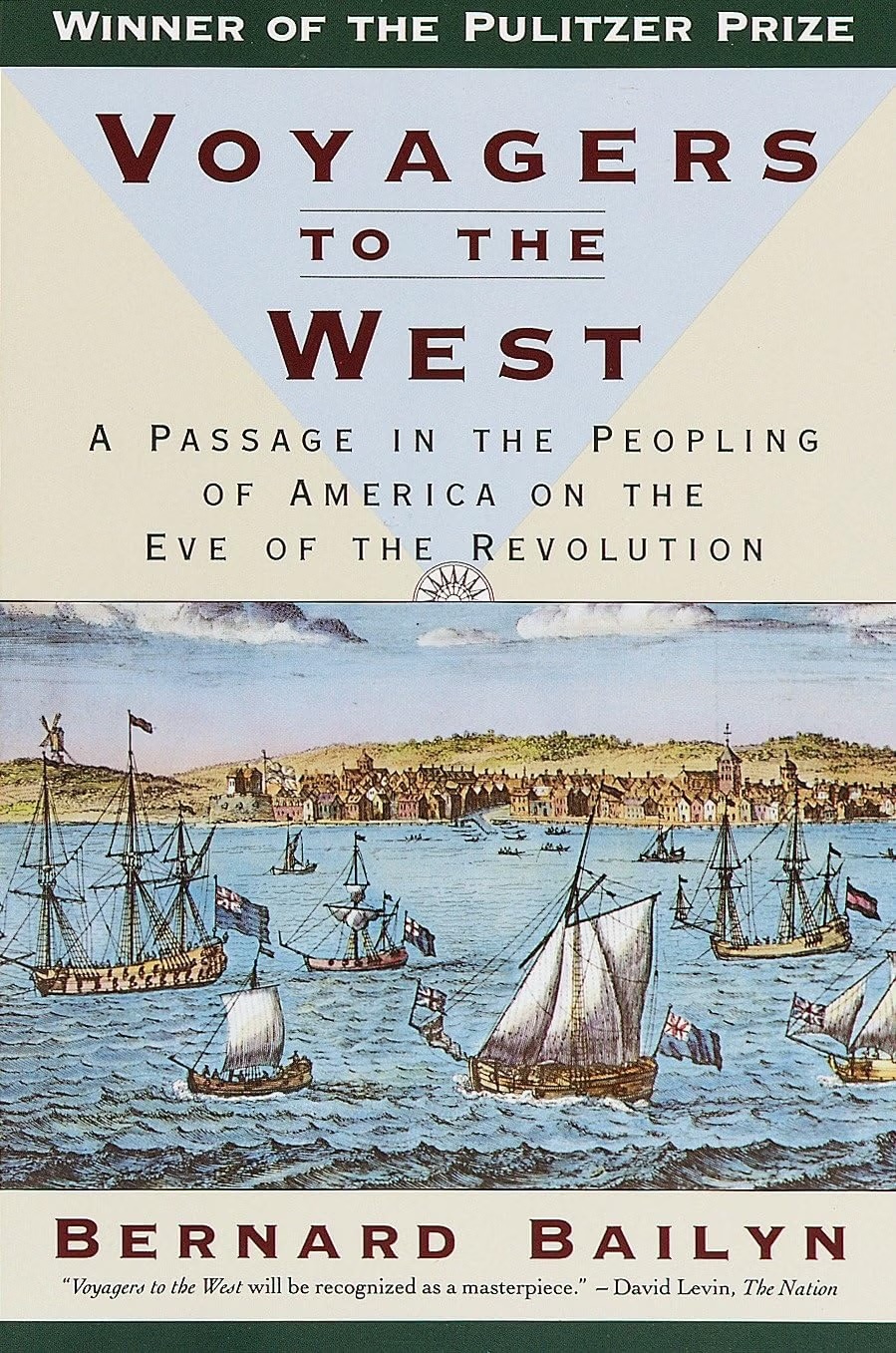
Voyagers to the West: A Passage in the Peopling of America on the Eve of the Revolution (1986), by Harvard University historian Bernard Bailyn, winner of the 1987 Pulitzer Prize for History, is a master class in primary-source research and historical scholarship. It is an extraordinary example of how a gifted historian can transform an obscure collection of bureaucratic records into a compelling narrative that illuminates an entire era.
In the years leading up to the outbreak of the American Revolution in 1775, senior British officials grew increasingly concerned about the accelerating exodus of British subjects from the home islands to the colonies of North America. In an age before passports, modern census-taking, or anything resembling an organized system of immigration statistics, the government had remarkably little understanding of the phenomenon. How many people were leaving? Where did they come from? Where were they going? What occupations and skills did they possess? What were their ages, family circumstances, and social backgrounds? Most important of all, what was their motivation? It clearly wasn’t the usual drivers of population displacement, such as disease, war, political and religious persecution or famine. Even the most elementary questions about the scale and character of this migration remained largely unanswered.
In 1773, the British administration finally decided that it needed answers, and quickly. John Pownall, a senior British colonial administrator who served as Secretary to the Board of Trade and Plantations and subsequently as Under-Secretary of State for the Colonies under Lord Dartmouth, sent instructions to the 94 “head-ports” of embarkation throughout Great Britain (72 in England and Wales, and 22 in Scotland), directing local officials to begin compiling detailed records of emigrants departing for America. Characteristically, the government provided no additional resources to support this substantial new administrative undertaking. Over the following three years, thousands of individual records accumulated in different ports, often employing inconsistent formats and varying degrees of detail. Yet remarkably little effort was devoted to assembling, analyzing, or interpreting the information. The government had commissioned an ambitious statistical investigation without establishing the machinery necessary to make sense of its findings.
Then came Lexington and Concord in April 1775. With the outbreak of armed rebellion and the subsequent disruption of transatlantic migration, the original purpose of the inquiry rapidly evaporated. Understanding why so many British subjects were abandoning the home islands for the American colonies suddenly seemed considerably less urgent than confronting the fact that those same colonies were now in open revolt. The accumulated records were effectively consigned to bureaucratic oblivion, where they remained largely undisturbed for the better part of two centuries.
Enter Bernard Bailyn. Working with a team of research assistants and displaying an almost astonishing command of historical detail, Bailyn painstakingly assembled, organized, and analyzed this enormous body of neglected evidence. From thousands of seemingly mundane entries in eighteenth-century emigration registers, he reconstructed the demographic composition, geographic origins, economic circumstances, personal motivations, and ultimate destinations of the people who crossed the Atlantic on the eve of the American Revolution. The result is a richly textured portrait of a society in motion, one that reveals as much about the changing character of Britain as it does about the emerging world of colonial America.
In the aftermath of the Seven Years’ War in 1763, British North America became a powerful magnet for tens of thousands of settlers drawn by the promise of cheap land and economic opportunity. With France eliminated as a major imperial rival, speculation in the vast territories of the American “West” reached unprecedented heights, fueling a remarkable surge in migration and population growth. Between 1760 and 1776, Georgia’s population tripled, Pennsylvania’s increased by 40 percent, and New England’s expanded by nearly 60 percent over roughly the same period. Along the rapidly advancing frontier of southwestern Virginia, settlements were growing at an astonishing rate of nearly 10 percent annually, doubling in population in less than a decade. The demographic transformation was breathtaking, reflecting a restless, land-hungry society whose appetite for westward expansion seemed almost insatiable.
The scale of British migration to North America after 1760 was unprecedented in the history of European settlement in the New World. Between 1500 and 1650, approximately 437,000 Europeans emigrated to New Spain, an average of roughly 3,000 per year. New France attracted a mere 27,000 settlers between 1608 and 1760, or fewer than 200 annually. The British, meanwhile, had long been the most prolific European migrants to the Americas, sending approximately 700,000 people across the Atlantic between 1607 and 1760, an average of roughly 4,500 per year. During that period 175,000 enslaved Africans were brought to British North America.
Yet even these figures pale in comparison with the extraordinary surge that followed the conclusion of the Seven Years’ War. In the fifteen years after 1760, another 222,000 British emigrants crossed the Atlantic, averaging nearly 15,000 annually. This represented a rate of migration approximately five times greater than Spain’s historical average and an astonishing seventy-five times that of France. What had been a steady transatlantic migration over the preceding century and a half had become a demographic tidal wave. Unlike the immigration patterns that would emerge during the nineteenth century, this great wave of preindustrial migration was overwhelmingly rural rather than urban in character. New arrivals rarely lingered in the bustling Atlantic ports where they first disembarked. Instead, they pressed rapidly into the colonial hinterland, drawn by the promise of inexpensive land, agricultural opportunity, and the prospect of establishing a new life on the expanding frontier. It was widely claimed and believed that America was “the best poor man’s country.”
Wills Hill, the first Earl of Hillsborough, assumed the newly established post of Secretary of State for the Colonies in 1768, an influential office he would hold for the next four years. A staunch opponent of westward expansion, Hillsborough vigorously resisted the settlement of Britain’s newly acquired territories and sought to discourage British subjects from abandoning their ancestral homes in pursuit of new lives across the Atlantic. His concerns reflected a growing anxiety within the British establishment that the accelerating exodus to America was draining the mother country of its population, labor, and productive capacity.
By the time Hillsborough resigned in August 1772, the conviction that emigration was contributing to the virtual depopulation of certain regions of the British Isles – particularly Scotland and the northern English counties around Yorkshire – had become widespread. What had begun as a matter of administrative concern had evolved into a subject of national debate and popular apprehension. “The problem was well known,” Bailyn writes. “It had become part of popular culture, widely considered and generally regretted.”
British administrators struggled to explain the extraordinary exodus unfolding before their eyes. Three explanations emerged as particularly compelling. The first was the dramatic escalation of agricultural rents, which in some regions had tripled within a single generation, placing an increasingly intolerable burden on tenant farmers. The second was the growing prevalence of absentee landlordism. Vast estates were controlled by proprietors who frequently lived far from their holdings, sometimes never visiting them at all, and who invested little in maintaining, much less improving, the lands from which they extracted their income. This problem was especially acute in Scotland, where the destruction of the traditional clan system following the defeat of the Jacobite Rebellion in 1745 had profoundly weakened the social bonds and customary obligations that had long held Highland communities together. The resulting dislocation left many Scots particularly vulnerable to the economic pressures that would ultimately propel them across the Atlantic.
The third explanation was the deteriorating condition of local industries in many of the regions most affected by emigration. By the middle of the eighteenth century, traditional manufacturing sectors were experiencing severe economic distress, with the woolen and linen industries suffering a succession of downturns in the early 1770s. Communities that had once sustained themselves through a combination of agriculture and domestic manufacturing increasingly found both sources of livelihood under threat.
Underlying all three explanations was a pervasive conviction that corruption lay at the root of the problem. To contemporary observers, the rapacity of landlords, the erosion of traditional social obligations, and the apparent indifference of political and economic elites were not merely unfortunate consequences of changing economic circumstances. They were symptoms of a broader moral and institutional decay that was driving ordinary Britons from their ancestral homes in search of opportunity and security in America.
The administration of George III responded to the mounting exodus with a succession of increasingly desperate measures intended to stem the flow of British subjects to America. The Privy Council adopted a resolution suspending new land grants in the colonies for several years, while the Crown publicly expressed its disapproval of emigration and offered vague promises of royal favor to those who remained at home. Parliament went further, enacting legislation that threatened shipmasters with imprisonment if they transported British subjects to the American colonies without first obtaining a special license.
Yet these efforts were frustrated by a fundamental legal and constitutional dilemma: there was no clear consensus that the British government possessed the authority to restrict the movement of its own subjects from one part of the empire to another. The right of British subjects to relocate within the king’s dominions was difficult to reconcile with the government’s determination to prevent them from doing precisely that.
Consequently, the Crown fell back upon the one instrument of control whose legality was beyond serious dispute: its authority to regulate the distribution of colonial lands. By restricting new land grants, British officials hoped to weaken the principal attraction drawing emigrants across the Atlantic. Yet this was an indirect and largely ineffectual response to a demographic upheaval driven by powerful economic and social forces that lay well beyond the government’s control. Thus, in the years immediately preceding the American Revolution, the British administration found itself confronting an unprecedented exodus of its own subjects with a set of administrative powers wholly inadequate to the challenge. The empire could regulate the disposition of its lands, but it could do remarkably little to restrain the ambitions of the people determined to settle them.
In December 1773, John Tompkyns, a veteran assistant inspector general of imports and exports, began the painstaking task of compiling the emigration returns submitted by port officials throughout Great Britain. Over the ensuing two and a half years, Tompkyns produced reports covering 127 weeks, from December 1773 through March 1776, with data missing for only four weeks. The result was a remarkable compilation known as the British Register of Emigration, which sought to establish who was leaving Britain, why they were departing, and where they intended to settle in America.
Bailyn describes the care and diligence with which British officials collected, organized, and preserved this information as truly “extraordinary.” As he observes, “for all its imperfections, the Register of Emigration remains the most comprehensive, most detailed, and most revealing survey of British emigration and of American immigration that has survived from the pre-Revolutionary era.”
The Register forms the indispensable evidentiary foundation of Voyagers to the West. From these painstakingly assembled records, Bailyn reconstructs not merely the scale and demographic composition of the great transatlantic migration, but also the economic pressures, social upheavals, and personal ambitions that propelled tens of thousands of British subjects to seek new lives in America on the eve of the Revolution.
Tompkyns’s reports provide detailed information on 9,868 individuals who emigrated during the period under review, including 5,196 from England and 3,872 from Scotland. Bailyn’s analysis reveals that English and Scottish emigration differed markedly. He calls them “dual emigrations.” Not only were the destinations of those departing different, but so too were their demographic composition, the size of the groups in which they traveled, and the means by which they secured passage across the Atlantic.
Nearly all Scottish emigrants (92 percent) were bound for the thirteen colonies, and they typically departed in relatively large groups composed of entire nuclear families. Ships sailing from Scottish ports carried an average of more than seventy emigrants, frequently aboard vessels specifically chartered for the purpose of transporting settlers to America. English emigration followed a strikingly different pattern. Roughly one-fifth of English emigrants were destined for other parts of the British Atlantic empire, including Canada and the Caribbean. They were disproportionately (84 percent) male, often in their early twenties and traveling independently, often securing passage aboard merchant vessels engaged primarily in the transatlantic cargo trade. The average number of emigrants aboard these ships was just fifteen.
The contrast becomes even more pronounced when examining the size of the vessels and the number of passengers they carried. Bailyn observes that two-thirds of Scottish emigrants traveled aboard ships carrying more than 150 passengers, while fully 40 percent sailed on vessels carrying more than 200. Among English emigrants, by contrast, only 6 percent traveled aboard ships carrying more than 150 passengers, and not a single emigrant sailed on a vessel carrying more than 200.
The implications of these figures are revealing. As Bailyn concludes, “the deliberately organized emigrant traffic as a trade in itself” appears to have been largely confined to Scotland and the northern English ports of Yorkshire. In these regions, emigration had developed into an organized commercial enterprise, with vessels chartered specifically to transport large numbers of settlers across the Atlantic. In southern England, by contrast, migration remained a far more improvised and individual undertaking, as emigrants secured passage wherever they could aboard ships whose principal business was commerce rather than the transportation of people. What emerges from the Register is not a single, uniform movement of British subjects to America, but two substantially different patterns of migration, reflecting the distinct social and economic circumstances of the regions from which these emigrants departed.
Although Great Britain had some 380 potential ports of embarkation – 94 major “head-ports” and another 286 smaller harbors known as “creeks” – Bailyn demonstrates that the overwhelming majority of emigrants departed from a remarkably small number of locations. Fully three-quarters sailed from just six ports, and more than half embarked from only two: London and Greenock, Scotland.
The geographic origins of these emigrants, however, reveal another striking contrast between England and Scotland. Bailyn estimates that as many as half of those departing from London were not native Londoners at all. Rather, they had migrated to the bustling metropolis from elsewhere in Britain, presumably seeking economic opportunities, only to conclude that their prospects might be better still in the American colonies. London thus served as a gathering point for a highly diverse and geographically dispersed population of prospective emigrants. As Bailyn observes, “There is simply no pattern of recruitment of London’s emigrants.”
The situation in Scotland and northern England was markedly different. There, emigration was far more geographically concentrated, with identifiable communities and regions supplying substantial numbers of settlers. Whereas London drew together individuals from across Britain who independently resolved to seek their fortunes overseas, the northern ports served as departure points for more cohesive streams of migration rooted in particular localities. The distinction reinforces one of Bailyn’s central findings: beneath the seemingly uniform movement of British subjects across the Atlantic lay fundamentally different patterns of migration, shaped by the distinctive economic conditions, social structures, and communal relationships of the regions from which they originated.
The demographic composition of these two streams of emigration reveals an equally striking contrast. Nearly three-quarters of English emigrants were between the ages of fourteen and thirty, and fully 85 percent were male. English emigration was thus overwhelmingly a movement of young men, where four out of five were departing on their own in search of opportunity across the Atlantic. Only 20 percent of English male emigrants traveled as part of a family group, and even among those accompanied by their wives, fully one-third were childless.
Scottish emigration, by contrast, more closely resembled a cross-section of the population at large. Only 60 percent of Scottish emigrants were male, and the age distribution of female emigrants was relatively even, reflecting the much greater prevalence of families traveling together. Indeed, only half of Scottish men made the Atlantic crossing alone. The contrast was even more pronounced among women: female emigrants departing from England were nine times more likely to be traveling alone than their Scottish counterparts. Rather than the predominantly youthful, male migration characteristic of England, the Scottish exodus encompassed men, women, and children across a broad range of ages, frequently traveling as intact family units. Where English emigration was largely a movement of individuals seeking new opportunities, Scottish emigration was much more often a collective undertaking in which entire families uprooted themselves to begin new lives across the Atlantic.
The distinction is perhaps best captured by a single comparison: roughly two out of every three emigrants departing England between 1773 and 1776 were young men between the ages of fourteen and thirty. Among Scottish emigrants, the corresponding proportion was only one in three. These were not merely different demographic profiles; they reflected fundamentally different patterns of migration. England was sending predominantly young men seeking to establish themselves in a new world, while Scotland was sending entire families and communities intent on building new lives together.
The Register also sought to establish the occupations and “quality” of individual emigrants, the latter referring to their social rank or standing rather than their economic function. Fewer than 10 percent came from the upper reaches of the social hierarchy, including gentlemen of independent means (2 percent) and merchants (5 percent). The largest contingent, accounting for almost exactly half of all emigrants, consisted of artisans and skilled craftsmen. The remaining 45 percent were divided almost equally between farmers and common laborers.
The extraordinarily diverse group of artisans represented a remarkable range of occupations and specialized skills. Many worked in trades associated with construction, including masons, brickmakers, and carpenters. Others possessed highly specialized skills, such as watchmaking, goldsmithing, and glassblowing. The largest concentration of artisans was employed in the production and distribution of textiles, including weavers, spinners, and tailors. Yet the sheer variety of occupations represented in the Register suggests that the emigrant population possessed a remarkably broad reservoir of practical knowledge and marketable skills.
For Bailyn, these findings challenge the conventional image of eighteenth-century emigration as a desperate flight from poverty and destitution. The occupational data provides, he writes, “at least a vague impression not of a milling mass of destitute unskilled urban slum dwellers and uprooted peasants,” but rather of a population substantially composed of skilled artisans, craftsmen, and tradesmen who possessed the means to earn a livelihood in the colonies. These were not necessarily people fleeing economic ruin, but individuals who recognized that their skills might command greater rewards in a society characterized by abundant land, expanding settlements, and a growing demand for labor. For many, emigration represented “not so much a desperate escape as an opportunity to be reached for.” This pattern holds for both “dual emigrations.”
Yet perhaps the most striking difference between English and Scottish emigration lay in how these two groups financed their passage to America. Nearly 70 percent of English emigrants—and an extraordinary 90 percent of artisans—crossed the Atlantic as indentured servants. Under this system, emigrants agreed to surrender approximately four years of their labor to whoever purchased their indenture contract in exchange for transportation to the colonies, along with their personal belongings and supplies. Among Scottish emigrants, by contrast, only 18 percent traveled under such arrangements.
Indentured servitude was particularly prevalent among young English men traveling alone, especially those whose journey to America represented the final stage of a longer process of geographic and economic displacement. Many had first left their rural communities in search of opportunity in London, only to discover that life in the bustling metropolis offered little prospect of lasting financial security. After months or even years of economic instability, they resolved to try their fortunes across the Atlantic, financing their passage by committing several years of their future labor to an American employer.
The pattern was markedly different among emigrants traveling as family units. These were predominantly farming families from rural England and Scotland who generally crossed the Atlantic without entering into indenture contracts. Their migration was less often an individual gamble financed through the sale of future labor than a collective undertaking in which entire households relocated in pursuit of land and economic opportunity. The distinction underscores another of Bailyn’s central findings: English and Scottish emigrants were not simply drawn from different demographic and occupational backgrounds. They also arrived in America under fundamentally different economic circumstances, with important implications for the lives they would build in the colonies.
The question of what motivated these emigrants to leave Britain, however, remains somewhat more elusive. Bailyn notes that only about one-quarter of the entries in the Register concerning the reasons for emigration contain information sufficiently detailed to be useful. Nevertheless, among those whose motivations were recorded, the overwhelming majority cited economic considerations as the principal impetus for their departure.
These economic motivations can be broadly divided into two categories: the pressures that pushed emigrants away from Britain and the opportunities that pulled them toward America. The former included unemployment, escalating rents, crop failures, outbreaks of disease among livestock, and the oppressive demands of landlords. The latter encompassed the prospect of acquiring land, practicing a chosen trade or occupation, and, more generally, the hope of securing a more prosperous and stable future than seemed possible at home.
Yet the distinction between these push and pull factors is important, for it suggests that emigration was not simply a desperate response to deteriorating economic conditions in Britain. Indeed, Bailyn observes that among the 990 English emigrants who explained their reasons for leaving, only seventeen cited a lack of employment, while not a single individual explicitly identified poverty as the cause of departure. Economic hardship figured more prominently in the motivations of Scottish emigrants, but even there, Bailyn notes that 40 percent specifically indicated that they were not fleeing intolerable conditions at home.
Thus, while economic hardship undoubtedly influenced many decisions to emigrate – Bailyn calls them “threatening but not annihilating difficulties” – the overall evidence suggests a population motivated less by desperation than by ambition, optimism, and the conviction that life in America offered opportunities unavailable in the Old World. For many, the Atlantic crossing represented not an escape from destitution, but a calculated pursuit of greater prosperity, independence, and economic security. These migrants “were enterprising,” the author says, “not defeated.” Indeed, Bailyn concludes that the general tenor of the recorded responses suggests that emigrants embarked upon their journeys “with plans to develop, not catastrophes to escape.” Rather than a mass flight from destitution, the migration appears to have been, for many, a deliberate and forward-looking effort to improve their circumstances and build a more promising future across the Atlantic. In America, Bailyn writes, “wages were high, work plentiful, and provisions cheap – the opposite of all three points to the situation in England.”
In sum, the migration patterns documented between 1773 and 1776 reveal not a single, unified movement of British subjects to America, but two fundamentally distinct streams of emigration. As Bailyn observes, “The emigrants who traveled outward to America from the metropolitan center of Britain in the Thames Valley were different in essential respects from those drawn from the northern British provinces.” These two streams represented what he terms the “metropolitan” and “provincial” patterns of emigration, each characterized by markedly different demographic profiles, economic circumstances, and motivations.
The metropolitan pattern was dominated by young, unmarried men, typically in their early twenties, many of whom were artisans or craftsmen of limited financial means. They generally traveled independently, often financing their passage through indenture contracts that obligated them to several years of labor upon arrival in America. The provincial pattern, by contrast, was characterized by the migration of entire nuclear families, frequently drawn from farming communities in Scotland and northern England. These households tended to be of roughly average size for the period and generally financed their own passage, seeking to establish themselves on the expanding agricultural frontier of North America.
Bailyn next turns his attention to where these two distinct streams of emigrants ultimately settled in America, revealing yet another set of striking geographic differences. Overall, nearly two-thirds of the emigrants recorded in the Register were destined for just three colonies: Maryland, New York, and Pennsylvania. The concentration was particularly pronounced among indentured servants, nearly 90 percent of whom settled in these three colonies. Broadening the geographic scope to include Virginia and North Carolina captures approximately 80 percent of all emigrants. Thus, the great wave of transatlantic migration in the years following the Treaty of Paris in 1763 was overwhelmingly concentrated in the Middle Colonies and the adjoining regions to their north and south.
The differences between English and Scottish settlement patterns were even more remarkable. More than 40 percent of English emigrants during this period were bound for a single colony: Maryland. Nearly all arrived as indentured servants, and most identified the prospect of greater economic opportunity as their principal motivation for crossing the Atlantic. Scottish emigrants, by contrast, gravitated overwhelmingly toward New York and North Carolina, which together attracted more than 70 percent of their number. Unlike their English counterparts, these Scots typically traveled as family units aboard large vessels specifically chartered to transport emigrants. Moreover, only about one-third cited the economic opportunities available in America as their primary reason for leaving. Most were seeking relief from the social and economic dislocation that had disrupted their communities and undermined their traditional ways of life. The inverse settlement patterns were equally striking: almost no Scots settled in Maryland, while comparatively few English emigrants made their way to New York or North Carolina.
Thus, the contrast extended beyond where the two groups settled to the circumstances and motivations that brought them there. English emigrants were predominantly young, independent individuals seeking economic advancement, often at the cost of several years of indentured labor. Scottish emigrants were more frequently entire families uprooted by deteriorating conditions at home, seeking to reestablish their livelihoods and communities in a new land. Even after crossing the Atlantic, the two streams of migration retained the distinctive characteristics that had shaped their departure from Britain.
One of the most powerful forces attracting emigrants to America was the colonies’ chronic shortage of labor. Bailyn notes that the demand for workers was widespread and varied, extending across agriculture, construction, manufacturing, and numerous other occupations. Yet somewhat surprisingly, the most labor-intensive industry in late eighteenth-century America was ironmaking. The production of iron was a grueling, dangerous, and frequently unpleasant undertaking, requiring enormous quantities of physical labor in an economy where willing workers were perpetually in short supply.
Indeed, roughly 70 percent of the cost of producing pig iron was attributable to labor, much of it devoted not to the actual smelting of ore but to the arduous process of converting timber into charcoal to fuel the furnaces and forges. The scale of the industry was remarkable. In the years immediately preceding the Revolution, approximately 250 ironworks operated throughout the thirteen colonies, each employing an average workforce of roughly 150 laborers. Collectively, these enterprises produced some 30,000 tons of iron annually, representing approximately 15 percent of the world’s supply.
The geographic concentration of this trade was equally striking. Nearly half of the colonies’ iron exports passed through a single port: Baltimore, Maryland. This helps explain the extraordinary demand for labor in the Chesapeake region and the disproportionately large number of English emigrants, particularly indentured servants, who made their way to Maryland. The colonial iron industry, with its voracious appetite for workers and its labor-intensive production methods, exemplified the powerful economic opportunities that drew thousands of British subjects across the Atlantic in the years before the American Revolution.
Another major source of labor demand in colonial America was the rapidly expanding construction industry. Throughout the colonies, prisons, workhouses, churches, courthouses, commercial establishments, and, above all, private residences were being erected at a remarkable pace. These projects required a broad range of skilled craftsmen, including stone carvers, masons, bricklayers, carpenters, and plasterers, whose specialized expertise was essential to transforming the colonies’ expanding settlements into functioning towns and communities.
The demand for construction labor was particularly acute in the Middle Colonies and the Chesapeake region, where rapid population growth and economic expansion fueled an extraordinary building boom during the 1770s. This concentration of construction activity helps explain why these regions became the principal destinations for British emigrants, especially the skilled artisans and craftsmen whose services were in such high demand. Like the iron industry, the colonial construction boom offered tangible opportunities for workers whose skills could command substantial value in a society growing faster than its existing labor force could accommodate.
Perhaps the most curious aspect of Voyagers to the West is Section IV, titled “Peopling the Peripheral Lands: The Extremities,” in which Bailyn devotes approximately 150 pages to examining settlement patterns in Nova Scotia and Florida. This extensive treatment almost warrants a separate book of its own. He then dedicates another 100 pages to the settlement of North Carolina, Georgia, and northern New York.
Although these sections contain considerable historical detail and demonstrate Bailyn’s extraordinary command of the archival record, I found them somewhat tangential to the book’s central argument. His meticulous reconstruction of the Register of Emigration and the resulting discovery of two fundamentally distinct patterns of British migration constitute the most original and compelling contributions of the work. The additional 250 pages devoted to regional settlement histories, while undoubtedly valuable in their own right, struck me as an unnecessary detour from that central narrative. I would have preferred a more focused exploration of the Register and its remarkable revelations about the demographic, economic, and social forces driving British emigration on the eve of the American Revolution.
In closing, Voyagers to the West is a remarkable achievement. It is among the most fascinating and illuminating works of Revolutionary-era history I have ever read. I would scarcely have imagined that a 600-page study devoted to roughly three years of transatlantic migration could prove so consistently interesting, let alone genuinely absorbing. Yet Bailyn accomplishes precisely that, demonstrating how meticulous archival research, guided by historical imagination and analytical brilliance, can breathe extraordinary life into the most unpromising of documentary sources.


Leave a Reply