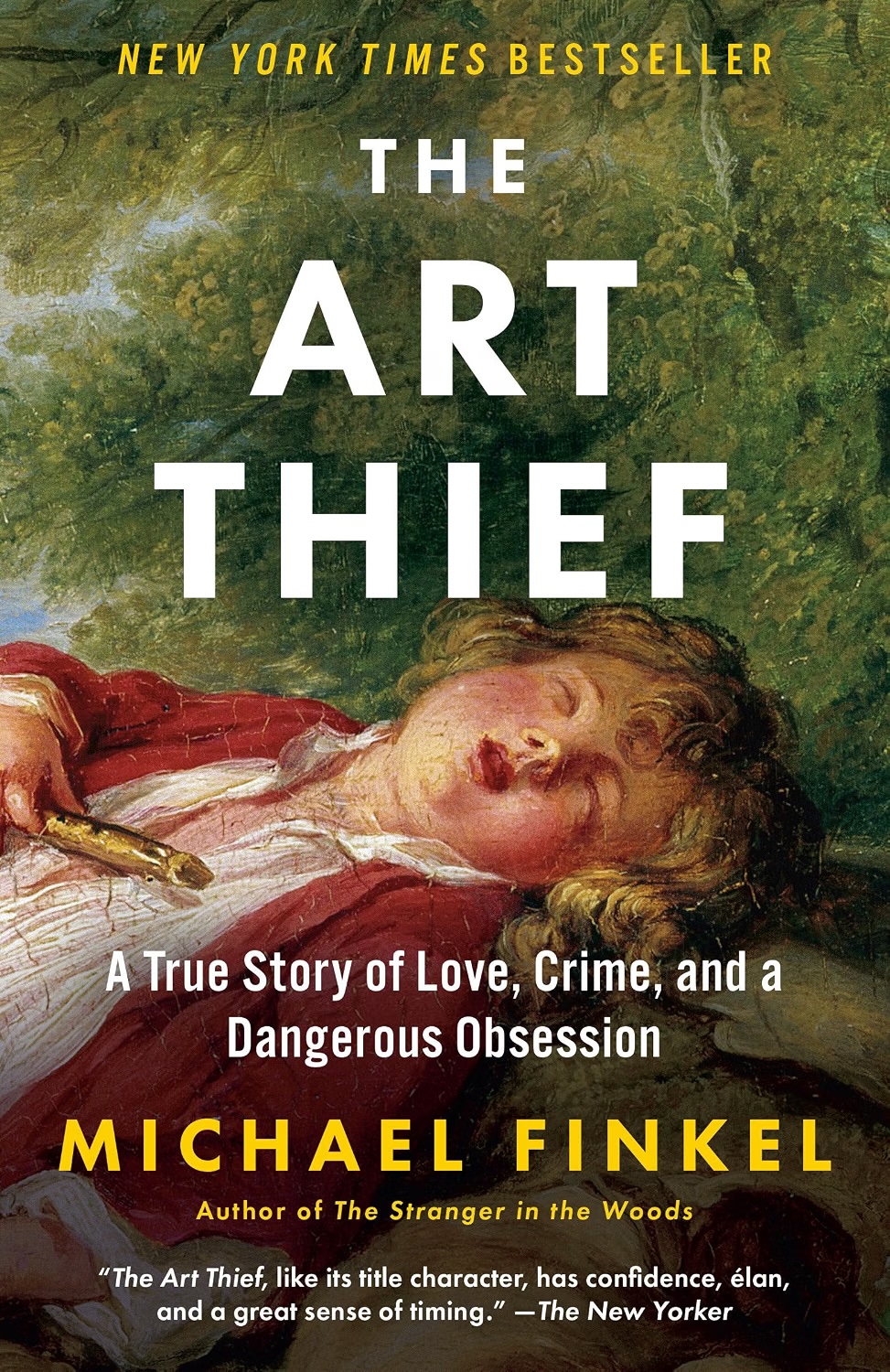
Stéphane Breitwieser is, by almost any conventional measure, a loser. A young Frenchman with little formal education, chronically unemployed and virtually friendless, he would seem an unlikely candidate for distinction in any field. Yet he is also, according to author Michael Finkel, “perhaps the most successful and prolific art thief who has ever lived.” Over an astonishing eight-year crime spree, Breitwieser stole three hundred works of art and historical artifacts with a combined estimated value of as much as $2 billion. In The Art Thief: A True Story of Love, Crime, and a Dangerous Obsession, Finkel recounts this improbable tale of obsession, audacity, and criminal ingenuity with remarkable verve and energy.
Breitwieser insisted that his motivation for stealing was simply a desire to surround himself with beauty. A teetotaler who also abstained from tobacco and caffeine, he declared that “art is my drug.” He never attempted to sell any of his stolen masterpieces, preferring instead to imagine himself rescuing them from the confines of museums, with a special focus on northern European works from the sixteenth and seventeenth centuries. He wanted to be regarded, Finkel writes, as an “art liberator.” In his own mind, he was collecting, not stealing. Moreover, Breitwieser rationalized his actions by appealing to the history of art itself, which he regarded as, in no small measure, a history of theft. From the ancient Romans to Napoleon and the British Empire, countless treasures had changed hands through conquest, plunder, and outright appropriation. Seen through this conveniently self-serving historical lens, his own exploits were merely the latest chapter in a centuries-old tradition. At one point, his small bedroom in the attic of his mother’s house was jammed with over two hundred pieces of fine art.
Yet what emerges from Finkel’s absorbing narrative is a far less romantic figure: a narcissistic kleptomaniac with a striking lack of social intelligence and self-awareness. For all his extraordinary success as a thief, Breitwieser remained, as Finkel observes, little more than “an unemployed freeloader holed up in his mother’s house.” Throughout the book, Finkel variously describes him as “coddled,” “immature,” and “narcissistic,” before dispensing with any pretense of psychological subtlety. “In other words,” he concludes, “he’s a brat.”
His strategy was simple yet remarkably effective. Breitwieser targeted small, regional museums with minimal security, relying on little more than a Swiss Army knife tucked into his pocket to acquire an astonishing array of European art treasures. His longtime girlfriend, Anne-Catherine Kleinklauss, served as lookout while he carried out his thefts with breathtaking audacity. Yet even more remarkable than their methods was the relentless pace of their criminal enterprise. As Finkel recounts, the couple routinely traveled hours to obscure museums with the express purpose of stealing works of art, embarking on these expeditions as often as three weekends a month, year after year. That they managed to sustain such a brazen campaign for so long without being caught simply boggles the mind.
Breitwieser’s extraordinary eight-year crime spree came to an end in November 2001, in Lucerne, Switzerland, when he was arrested following a theft at the Richard Wagner Museum. The circumstances of his capture were remarkably mundane, particularly given the audacity and sophistication of his earlier thefts. On November 19, 2001, Breitwieser returned to the museum where he had recently stolen a rare 16th-century hunting horn. His girlfriend had become concerned that they might have left fingerprints behind, prompting their return to the scene. While Breitwieser lingered outside the museum, a suspicious observer alerted museum staff. An employee recognized him from his earlier visit, and police arrested him. Anne-Catherine escaped.
The consequences were catastrophic for his collection. After learning of his arrest, his mother destroyed dozens of paintings and discarded numerous other stolen objects in the Rhine–Rhône Canal. Many were recovered, but some irreplaceable works were lost forever. The irony is striking: After years of successfully stealing hundreds of artworks, Breitwieser was undone not by a sophisticated police investigation, but by the simple mistake of returning to the scene of a crime.
As a nonviolent offender, Breitwieser escaped relatively lightly given the staggering value of the treasures he had stolen. His first conviction resulted in a prison sentence of little more than three and a half years. Yet it was his conduct after his arrest and incarceration that most clearly revealed the true nature of his character. Despite professing a desire to reform, Breitwieser proved incapable of abandoning his criminal habits. At one point, he even contemplated reinventing himself as an art security consultant, much as the notorious con man Frank Abagnale, portrayed by Leonardo DiCaprio in Catch Me If You Can, had parlayed his criminal notoriety into a career in fraud prevention. But any such ambitions were quickly undermined by Breitwieser’s seemingly irresistible compulsion to steal. Shoplifting arrests and repeated brushes with the law followed, exposing the hollowness of his professed rehabilitation. By the book’s conclusion, Finkel has stripped away any lingering romanticism surrounding his subject, revealing Breitwieser as an incorrigible kleptomaniac, a serial offender seemingly beyond redemption, and a persistent menace to the society whose artistic treasures he professes to adore.


Leave a Reply