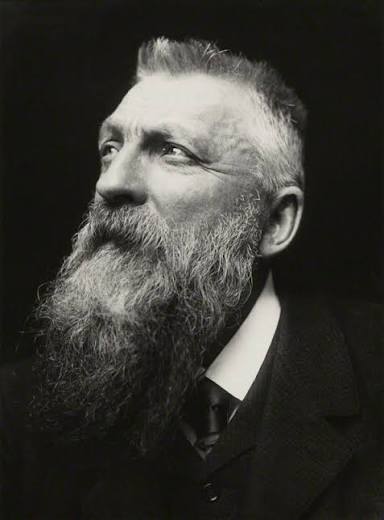
Few artists did more to transform the course of modern sculpture than Auguste Rodin (1840–1917), the French master whose extraordinary ability to capture the human form in all its physical and emotional complexity helped elevate sculpture from a largely decorative art to a powerful medium of individual expression. Yet Rodin’s ascent to artistic greatness was anything but assured. Largely unrecognized until middle age, repeatedly rejected by the French artistic establishment, and working in an era when painting had eclipsed sculpture as the principal arena of artistic innovation, Rodin ultimately emerged as one of the most influential artists of his generation. In The World of Rodin: 1840–1917 (1969), historian and author William Harlan Hale traces this remarkable journey, placing Rodin’s life and work against the backdrop of a rapidly changing France and an art world undergoing profound transformation. Richly illustrated and engagingly written, the book offers a compelling portrait of the man who would come to be regarded as the father of modern sculpture.
Rodin was a remarkably versatile artist who worked in watercolor, drawing, oil painting, and decorative arts before finally achieving widespread recognition as a sculptor at the age of 48, following a joint exhibition with Claude Monet. The two artists were almost exact contemporaries, born just two days apart. While the Impressionists had already revolutionized painting, sculpture remained, in the words of Albert Elsen, America’s leading authority on Rodin, “the stepchild of the arts … relegated to decoration.” The decline of official art commissions had dealt sculpture a particularly devastating blow, far more so than painting, which required comparatively inexpensive materials. Yet Rodin was, as the author observes, “one of the most conservative of radicals,” seeking not so much to reinvent sculpture as to restore it to the artistic heights achieved by Donatello, Michelangelo, and Bernini. In doing so, he became, in Elsen’s memorable characterization, the “Moses of modern sculpture.”
Rodin was born in Paris to devoutly Catholic parents of modest means who had recently arrived from the provinces. He received little formal education and, at the age of 14, enrolled in the Petite École, a vocational school that trained artisans in the cutting and finishing of stone. Nearsighted throughout his life, he may initially have gravitated toward sculpture more out of necessity than passion. At 17, he won first prize for his work in clay and subsequently applied to the prestigious École des Beaux-Arts, only to be rejected three times. Yet Rodin never openly rebelled against the artistic traditions the school represented. Indeed, Hale suggests that these rejections may ultimately have been a blessing, freeing him to develop his own adventurous style. Forced to earn a living, Rodin supported himself by producing an assortment of figurines, small portrait busts, and decorative bric-a-brac. Following the sudden death of his beloved older sister, one of the earliest and most ardent champions of his artistic talent, Rodin abandoned art altogether and entered the Order of the Fathers of the Blessed Sacrament. His religious vocation proved short-lived, however, and after leaving the order, religion would never again play a significant role in his life.
Perhaps even more so than in painting, the “ultraconservative” Académie des Beaux-Arts dictated the standards of artistic and commercial acceptability in sculpture, determining which artists could secure lucrative commissions from wealthy patrons and, more importantly, public authorities. Simply put, the Salon had the “power to make or break an artist.” Its arbiters insisted upon strict adherence to the classical models of ancient Greece and Rome, even prescribing a code of “correct” proportions and formal conventions, including theatrical expressions and rigidly pyramidal compositions.
Rodin returned to Paris in 1877 after spending six years in Brussels, having departed at the outbreak of the Franco-Prussian War. His first two years back witnessed a tumultuous outpouring of creative energy, accompanied by considerable personal upheaval as he distanced himself from his mistress of fourteen years and their eleven-year-old son, who had an intellectual disability.
Rodin’s great contribution to sculpture, much like that of his Impressionist contemporaries in painting, lay not in reproducing reality with photographic precision but in capturing the extraordinary dynamism of movement. Rather than depicting a man precisely as he walks, Rodin sought to convey the very sensation of walking, deliberately departing from anatomical literalism in works such as Saint John the Baptist Preaching and The Walking Man. In doing so, he rejected the rigid conventions of the Academy and suggested that forms were not fixed and immutable but existed in a perpetual state of transformation, much as the Impressionists had demonstrated in painting. Both Rodin and the Impressionists introduced the element of time into their art, seeking to capture not merely a static moment but the movement and vitality that surrounded it. Rodin was to sculpture what Degas, with his celebrated ballet dancers, was to painting. By liberating sculpture from the demands of faithful representation, Rodin helped usher in an era in which artists increasingly insisted that form possessed an expressive language of its own. He eventually attracted the attention of Edmond Turquet, Undersecretary of State for Fine Arts, who secured for him his first—and ultimately most important—public commission in 1880: *The Gates of Hell*, a monumental pair of sculpted bronze doors that Hale describes as his “unfulfilled masterpiece.”
By middle age, Rodin’s work had grown increasingly erotic, though never in a frivolous or merely titillating sense, according to Hale. His sculptures were unabashedly sensuous, suffused with passion and physical intimacy, with women portrayed as full and equal participants in sexual desire rather than the coquettish, bare-bottomed playthings depicted by painters such as Boucher and Bouguereau. Rodin evidently drew upon his own considerable romantic experience in creating these amorous figures. Despite his longstanding relationship with Rose Beuret, “Rodin’s reputation as a redoubtable sexual performer was established,” Hale writes. Perhaps his most passionate lover – and a powerful influence on his increasingly erotic artistic vision – was Camille Claudel, a gifted young sculptor some twenty years his junior. Their tempestuous affair would endure for fifteen years.
There is much about Rodin that reminds me of Manet, who was only eight years his senior and shared many of the same artistic sensibilities. Neither artist consciously set out to foment a rebellion against established conventions. Indeed, both craved the approval of the artistic establishment, yet endured torrents of criticism and public scandal when their early works challenged prevailing notions of artistic propriety. For Manet, the controversy erupted over his provocative Olympia, exhibited at the Salon of 1865. For Rodin, it was The Age of Bronze in 1877, a sculpture whose startling realism and ordinary humanity affronted the cool, idealized perfection of Neoclassicism taught at the École des Beaux-Arts. So lifelike was the figure that critics accused Rodin of having cast it directly from a living model. Its unidealized appearance and apparent lack of a recognizable subject made it “rank heresy” in the eyes of the Salon, Hale writes. Inspired by Michelangelo’s Dying Slave, which Rodin had studied at the Louvre, the sculpture was intended as a subtle evocation of prehistoric humanity emerging from the primitive world of the cave. Yet this deeper symbolism, Hale suggests, was largely lost on critics and the public alike.
Rodin’s most ambitious undertaking was also perhaps his greatest failure: the never-completed and never-used Gates of Hell. Begun in 1880 as a French government commission for the monumental entrance to a proposed museum of decorative arts in Paris that would never be built, the project was originally scheduled for completion in 1885. Instead, Rodin labored over it for an astonishing 37 years, leaving it unfinished at his death, much as Michelangelo had spent four decades struggling with the ultimately unfinished tomb of Pope Julius II. Many of Rodin’s greatest works, including The Thinker and The Kiss, originated among the roughly 180 figures conceived for its elaborate composition. Rodin referred to *The Gates of Hell* as his “Noah’s Ark,” an immense gathering of human figures, each seemingly isolated from the others, some emerging from the sculpted surface while others recede into it. Hale interprets this extraordinary assemblage as an expression of Rodin’s conviction that human beings must ultimately confront their deepest agonies alone.
Rodin’s friend and patron Edmond Turquet helped secure the commission for him and gave the sculptor considerable freedom in choosing its subject. Rodin turned to Dante’s Inferno for inspiration, although specific episodes from the poem would ultimately play only a minor role in the composition, which drew instead upon his own imaginative vision of the human condition. Unlike Dante, whose poem centers on sin and eternal damnation, Rodin was concerned principally with human suffering and anguish. Ghiberti’s celebrated Gates of Paradise also served as an inspiration, though Rodin borrowed little from its actual imagery. For all the excitement and prestige the commission promised, it proved remarkably unrewarding financially. Over the years, Rodin received a total of just 30,000 francs, less than he might ordinarily earn from a single privately commissioned bust. Indeed, The Gates of Hell would not even be cast in bronze until nearly a decade after Rodin’s death in 1917.
Hale suggests that Rodin chose such a brutal and pessimistic composition because rejection and misfortune elicited his deepest artistic responses. Although Rodin’s life was largely free of genuine tragedy or sustained hardship, he was something of a rebel and nonconformist who nevertheless craved social acceptance and suffered from the tensions inherent in that contradiction. Moreover, Hale finds it puzzling that Rodin should have embarked upon so somber a meditation on the human condition in the 1880s, when the stifling authority of the Academy was waning and the colorful Impressionists were at the height of their influence. Rodin’s brooding preoccupation with humanity’s suffering and existential predicaments seemed strikingly at odds with the prevailing artistic spirit of the age.
Beginning in the 1880s, Rodin became embroiled in three overlapping controversies when patrons resisted or outright rejected his unconventional designs for major civic monuments. The first involved the city of Calais, which commissioned him to commemorate the heroism of its citizens during the Hundred Years’ War. Following the Battle of Crécy in 1346, Calais endured a nearly yearlong siege before surrendering to England’s Edward III in 1347. According to tradition, six leading citizens volunteered to sacrifice their lives to spare the city from destruction. Rodin’s response was The Burghers of Calais, a group of six figures conceived for a low platform without a protective railing, placing them at eye level and within intimate reach of the viewer. His intention was to make the men directly approachable, inviting spectators to contemplate each individual’s response to the prospect of imminent death. Rather than presenting the episode as a grandiose allegory of Fortitude and Courage, as the town commissioners evidently expected, Rodin portrayed six ordinary men confronting an extraordinary ordeal. More than a demonstration of technical virtuosity, Hale argues, the monument revealed Rodin’s profound understanding of the human condition, particularly the complex emotions of men brought face to face with their own mortality. The town commissioners were appalled, demanding instead a single heroic figure elevated upon a pedestal, in keeping with the conventions of traditional civic monuments. But Rodin refused to compromise his artistic vision. “Dour and stubborn,” Hale writes, “[Rodin] was not disposed to yield once set on a chosen path.”
Next, in 1886, Rodin received a commission from the French government to create a monument to the recently deceased writer Victor Hugo, intended for the entrance to the Panthéon. Rather than portraying Hugo as a solitary, heroic figure in the conventional manner, Rodin conceived him as a reclining nude surrounded by female nudes, presenting the literary giant as a kind of “French Jupiter.” The composition was startlingly unconventional and widely regarded as offensive, particularly given Hugo’s notorious reputation as a womanizer. The authorities rejected Rodin’s proposal. Two decades later, Rodin finally delivered a marble version depicting Hugo alone, which the French government installed at a discreet distance from the Panthéon’s entrance.
Finally, in 1891, Rodin received a commission from the Société des Gens de Lettres to create a monument to the novelist Honoré de Balzac, who had died in 1850. The undertaking would prove so contentious that the society eventually sought to recover its money from the embattled sculptor. Rodin’s finished work was so radically unconventional that many observers assumed he must be joking or deliberately courting controversy. Unveiled at the Salon of 1898, the statue was soon swept up in the most divisive political controversy of the day: the Dreyfus Affair, surrounding the wrongful conviction of the French army officer Alfred Dreyfus. Rodin’s daring sculpture became an unlikely symbol of the broader cultural struggle, embraced by the Dreyfusards and denounced by the conservative, anti-Dreyfus establishment.
Rodin evidently took these controversies in stride, refusing to allow public disapproval to compromise his artistic convictions. As he once remarked, “When one is preoccupied with pleasing that million-headed monster called ‘the public,’ one loses one’s personality and independence … I know very well that one must fight, for one is often in contradiction to the spirit of the age.” Perhaps Rodin also understood that such dramatic and highly publicized rejections might ultimately work to his advantage, enhancing his reputation as an artist unwilling to bow to convention. And indeed, they did.
By the turn of the century, Rodin, now approaching sixty, had become a celebrity throughout Europe. Determined to capitalize on his growing fame, he boldly financed his own Exposition Rodin just outside the entrance to the 1900 Exposition Universelle in Paris. Despite possessing a personal fortune of only 20,000 francs, he plunged himself into debt to the extraordinary sum of more than 150,000 francs to stage the exhibition. It was an audacious gamble that succeeded beyond even Rodin’s wildest expectations. He sold more than 200,000 francs’ worth of artwork, with many of Europe’s and America’s leading museums among the purchasers. The exhibition not only vindicated his artistic vision but also cemented his standing as one of the most celebrated sculptors of his age.
Rodin’s principal challenges following the triumph of his 1900 exhibition were keeping pace with the extraordinary demand for his work and managing his newfound international celebrity. He employed more than a dozen full-time assistants to produce replicas of his most celebrated sculptures, each technically considered an “original” because it was made from an original mold. Rodin enthusiastically exploited this peculiar convention of sculpture to establish what amounted to a highly profitable “Rodin Factory.” Meanwhile, his fee for a commissioned sculpture soared to 40,000 francs, with such distinguished figures as Joseph Pulitzer, E. H. Harriman, and George Bernard Shaw among his clients. His income from commissioned busts alone exceeded 200,000 francs annually, supplemented by a steady stream of revenue from reproductions of his most famous works. Rodin had become the most celebrated sculptor in the world, and he was determined to make the most of his success. Following the death of James McNeill Whistler, he became president of the International Society of Painters, Sculptors, and Engravers, while the French government elevated him to the third-highest rank of the Legion of Honor. In 1905, his celebrated The Thinker was installed before the Panthéon in Paris, and two years later, he received an honorary doctorate from Oxford University alongside Mark Twain. His studio at Meudon became something of a tourist attraction, drawing admirers and dignitaries from across Europe. In 1908, even King Edward VII of England paid a visit to admire Rodin’s work and commissioned a bust of one of his favorite female companions.
Rodin’s later years were marked by a notable evolution in his artistic style. He gradually turned away from the intense passion and muscular power inspired by Michelangelo, embracing instead the tranquil grace, simplicity, and harmony associated with Phidias and the classical sculpture of ancient Greece. Hale characterizes these later works, many of them no more than six or eight inches tall, as “affirmative but bland.” Rodin also increasingly favored marble over bronze and devoted greater attention to sketching the human figure in motion. “Movement is the soul of all things,” he once remarked. Now in his sixties, he developed a particular fascination with dance, drawing inspiration from such pioneering performers as the American modern dancers Isadora Duncan and Loïe Fuller, as well as the celebrated Russian ballet dancer Vaslav Nijinsky.
Rodin’s final years, as he entered his seventies at the height of his international fame, amounted to something of a slow-motion train wreck, according to Hale. Two ill-advised obsessions threatened to undermine both his fortune and his reputation: the dilapidated Hôtel Biron, which Rodin hoped to transform into a permanent studio and museum devoted to his life’s work, and the American-born Duchesse de Choiseul, a cunning and manipulative socialite who became his last and perhaps most destructive mistress. Hale’s assessment of the duchess is memorably caustic: “Squat, heavily painted, noisy, bursting with animal spirit, she was a distinctive raffish type, something of an international tramp.” She gradually isolated Rodin from his closest friends and family, including his long-suffering companion Rose, and reportedly began stealing from him. Rodin took to drinking heavily, and friendships that had endured for decades fell apart. In 1914, however, he abruptly banished the duchess from his circle, abandoned alcohol, and returned to Rose. His last major literary undertaking was The Cathedrals of France, a celebration of the country’s great medieval churches as architectural masterpieces embodying the distinctive genius of the French nation. The book struck a powerful chord in a country increasingly swept up in patriotic fervor on the eve of the First World War. As German armies threatened Paris, Rodin fled to England, leaving behind a France whose artistic heritage he had spent much of his life helping to redefine.
In his final years, Rodin suffered a series of strokes that left him increasingly impaired, both physically and mentally. Among his last significant acts were bequeathing his remaining works to the French state and finally marrying Rose Beuret, his devoted companion of more than half a century. On the day of their civil ceremony, Rodin was 76 and Rose 72. She died of pneumonia just two weeks later, with Rodin following her in death several months afterward. He left behind an estate valued at approximately 350,000 francs, roughly equivalent to $1.5 million in 2026 dollars.
“Seldom was an artist so prized in his lifetime,” Hale writes, “seldom, also, did one so soon fall into disfavor.” Rodin was among the last great sculptors to draw extensively upon literary and classical themes, and the generation that followed him went to considerable lengths to distance itself from the man who had been the acknowledged master of their craft at the dawn of the twentieth century. Younger artists increasingly rejected his realism, emotional intensity, and reliance on recognizable subjects and narrative themes. Instead, they shattered traditional notions of form, embraced abstraction, and radically simplified the representation of the human figure. Successive movements of modern art – the Cubists, Futurists, Surrealists, and Constructivists – experimented with new materials, forms, subjects, and conceptions of movement, nearly all of them fundamentally at odds with Rodin’s artistic vision. By the time of his death, Hale observes, Rodin had already become “an old master, a museum piece,” revered for his achievements but increasingly eclipsed by the very revolution in modern sculpture he had helped make possible.


Leave a Reply