The American Revolution established the world’s first modern republic, but it did not establish a democracy in the sense that Americans understand the term today. The men who declared independence from Great Britain in 1776 and drafted the Constitution eleven years later were committed to representative government, individual liberty, and the principle that political authority ultimately rested with the people. Yet many of them regarded democracy with considerable suspicion. Popular government, they feared, could easily descend into mob rule, threaten property rights, and undermine the stability of the republic they had fought to create. Political participation remained restricted by property qualifications, race, gender, and longstanding assumptions about the natural authority of society’s wealthier and better-educated citizens.
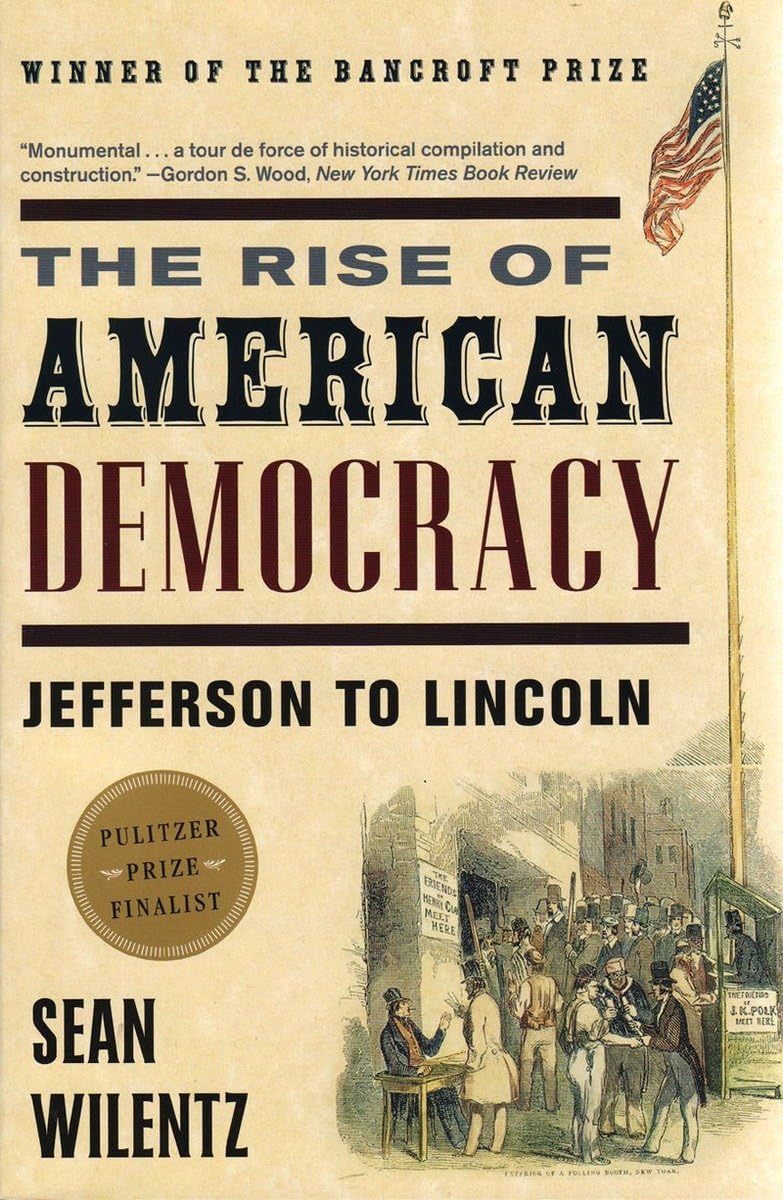
How this comparatively aristocratic republic evolved into a mass democracy during the first half of the nineteenth century is the subject of Princeton historian Sean Wilentz’s monumental The Rise of American Democracy: Jefferson to Lincoln. Published in 2005, this ambitious work traces the development of American democratic politics from the aftermath of the Revolution through the election of Abraham Lincoln and the Civil War. Spanning more than a thousand pages, including extensive notes, the book is both a sweeping narrative of American political history and an argument about the contested meaning of democracy itself. It is also one of the best books I’ve ever read on early American history.
Wilentz’s central thesis is that American democracy was neither the inevitable consequence of the Revolution nor the natural product of the country’s social and economic development. It emerged through decades of bitter political conflict, popular agitation, constitutional reform, and struggles over the distribution of power. Democracy was not simply bestowed upon the American people by enlightened statesmen. It had to be created, defended, and repeatedly redefined by ordinary citizens as well as political leaders.
The resulting story is far more complicated than a steady march toward greater freedom and equality. The expansion of political rights for white men coincided with the dispossession of Native Americans, the continued exclusion of women, and the extraordinary growth of African American slavery. Indeed, the democratic institutions that empowered millions of previously disenfranchised Americans also strengthened the political influence of slaveholders and helped bring the republic to the brink of destruction.
For Wilentz, the history of American democracy is therefore a history of extraordinary achievement, profound contradiction, and recurring crisis.
Wilentz begins with the American Revolution, which profoundly transformed the relationship between government and the governed without resolving the question of who should exercise political power. The Revolution’s language of natural rights, popular sovereignty, and equality challenged the inherited hierarchies of colonial society. Yet the generation that established American independence was deeply divided over the implications of those principles. Many prominent revolutionaries believed that republican government required the leadership of virtuous, independent gentlemen whose property and education supposedly made them better qualified to govern.
To these men, republicanism and democracy were not necessarily synonymous. A republic could derive its legitimacy from the people while limiting their direct influence over political affairs. Democracy, by contrast, suggested a more radical distribution of political authority, potentially placing government in the hands of ordinary farmers, artisans, laborers, and others whom established elites often considered insufficiently independent or informed.
These competing conceptions of popular government became especially apparent during the debates over the Constitution in 1787 and 1788. Federalists argued that a stronger national government was essential to preserve the Union, protect property, and prevent destructive factionalism. Their opponents feared that the proposed Constitution would concentrate authority in the hands of a distant political elite, reproducing the very forms of arbitrary power against which Americans had rebelled.
Wilentz is particularly interested in the democratic impulses that emerged outside the ranks of the most celebrated Founding Fathers. Popular political movements, local associations, and campaigns to reform state constitutions demonstrated that ordinary Americans were increasingly unwilling to defer automatically to their social superiors. The Revolution had made popular sovereignty a fundamental principle of American government, but translating that principle into meaningful political participation would require another generation of struggle.
One of Wilentz’s most important arguments is that this struggle cannot be understood simply by examining the Constitution or the writings of prominent political theorists. Democracy developed through the actual practice of politics: elections, legislative battles, public meetings, newspapers, party organizations, and conflicts over who possessed the right to govern. In this respect, Wilentz’s history provides an illuminating continuation of Bernard Bailyn’s The Ideological Origins of the American Revolution. Where Bailyn explains how Americans came to regard British imperial authority as incompatible with liberty, Wilentz explores the subsequent struggle over what government by the people should mean in practice. The first generation of revolutionaries had challenged the legitimacy of hereditary and imperial authority. Their successors would challenge the legitimacy of political privilege within the republic itself.
After the American Revolution, Thomas Jefferson occupies a central position in Wilentz’s account, although the democracy associated with his name was more complicated than the familiar image of the author of the Declaration of Independence might suggest.
During the 1790s, the policies of Washington and Hamilton provoked growing opposition among Americans who believed that the new federal government was becoming dangerously aristocratic. Hamilton’s financial program, which included federal assumption of state debts, the establishment of a national bank, and closer relationships between government and commercial interests, was intended to strengthen the nation’s credit and economic foundations. But critics interpreted these measures as an effort to create a privileged financial class whose wealth and political influence would undermine republican equality.
Jefferson and James Madison emerged as leaders of this opposition. Their developing Republican movement presented itself as the defender of ordinary Americans against the concentrated power of bankers, speculators, and federal officials. Wilentz emphasizes that Jeffersonian democracy was not simply an abstract political philosophy. It became a practical movement organized through newspapers, local political societies, electoral campaigns, and increasingly sophisticated methods of mobilizing voters. The Democratic-Republican societies of the 1790s were especially significant because they asserted the right of ordinary citizens to assemble, debate public affairs, and criticize elected officials between elections. To Federalist critics, such organizations threatened legitimate authority. To their supporters, they represented the essence of republican citizenship.
The Alien and Sedition Acts of 1798 further sharpened these divisions by raising fundamental questions about freedom of expression and the government’s authority to suppress political opposition. Jefferson’s victory over John Adams in the election of 1800 marked an important milestone. Often described as the Revolution of 1800, it demonstrated that organized political opposition could peacefully displace an incumbent administration through elections. Yet Wilentz resists portraying Jefferson’s presidency as the uncomplicated triumph of democratic principles. Jefferson’s commitment to limited government was repeatedly tested by the practical demands of governing. The Louisiana Purchase dramatically expanded federal authority and national territory, while the Embargo Act of 1807 imposed sweeping economic restrictions that conflicted with his professed preference for restrained national power.
Jefferson also remained a slaveholder whose vision of an independent agricultural republic rested partly on assumptions about westward expansion and the availability of land that disregarded the rights of Native Americans. Nevertheless, Jeffersonian Republicanism helped establish a durable political tradition that celebrated the independence of ordinary citizens, distrusted entrenched privilege, and regarded popular political participation as essential to republican government.
The democratic revolution that Jefferson helped advance was genuine, even if its beneficiaries remained sharply circumscribed.
Perhaps the most consequential political development of the early nineteenth century was the gradual dismantling of property qualifications for voting and officeholding. In the years following independence, many states restricted suffrage to men who owned property or satisfied other economic requirements. The justification was that property ownership demonstrated independence, while men without substantial property were supposedly vulnerable to manipulation by employers, creditors, or wealthy patrons.
As the nation expanded westward and its economy became more commercially dynamic, these assumptions faced mounting challenges. New western states generally adopted more expansive voting qualifications for white men, placing pressure on older eastern states to liberalize their own constitutions. Artisans, wage earners, small farmers, and other previously excluded citizens increasingly demanded political rights based on their status as free men rather than their ownership of property. Wilentz follows these struggles at the state and local levels, where much of the actual democratization of American politics occurred. Constitutional conventions, electoral reform campaigns, and disputes over legislative representation gradually transformed the political landscape.
By the middle of the nineteenth century, property ownership had largely ceased to be a prerequisite for white male suffrage. The implications were enormous. Political parties now had to appeal to a much broader electorate, and ordinary white men increasingly understood voting as a fundamental attribute of citizenship rather than a privilege reserved for the propertied classes.
But the expansion of suffrage exposed one of the central contradictions of American democracy. As economic restrictions on white male voting disappeared, racial restrictions often became more explicit. Free Black men who had previously enjoyed voting rights in some states faced new exclusions, while women remained almost universally disenfranchised. The result was not universal democracy but a more expansive system of white male democracy.
Wilentz makes clear that democratization was a contested political process rather than a single reform. Progress in one dimension could coincide with regression in another. The destruction of property qualifications did not necessarily produce a more inclusive conception of citizenship. Indeed, the increasingly close association between democratic rights and white manhood would become one of the defining characteristics of antebellum American politics.
Andrew Jackson is arguably the most controversial figure in Wilentz’s narrative, and the author’s treatment of the seventh president is among the book’s most provocative features.
Jackson’s election in 1828 is conventionally regarded as the arrival of a new democratic age. A military hero from Tennessee who cultivated the image of a self-made man, Jackson presented himself as the champion of ordinary Americans against entrenched political and economic privilege. Wilentz argues that Jacksonian democracy was much more than a populist style of leadership. It represented a fundamental transformation in the organization and conduct of American politics. Jackson and his supporters helped create the first durable national mass political party, complete with local organizations, party newspapers, conventions, campaign machinery, and methods for mobilizing voters across an expanding republic.
Political participation became increasingly vigorous, partisan, and public. Elections attracted growing popular attention, and the legitimacy of organized political opposition became firmly established. Wilentz gives particular attention to the conflict over the Second Bank of the United States. Jackson regarded the Bank as a privileged institution that concentrated financial power in the hands of wealthy individuals and threatened the independence of ordinary citizens. Its defenders, including Henry Clay and Nicholas Biddle, argued that it provided essential stability to the nation’s currency and credit system.
When Jackson vetoed the Bank’s recharter in 1832, he framed the issue as a contest between the American people and an entrenched financial aristocracy. Wilentz treats the Bank War as a genuine democratic struggle rather than simply an exercise in economic ignorance or presidential demagoguery. The Jacksonians believed that government-created monopolies and special privileges were incompatible with political equality. Their arguments resonated with workingmen, artisans, and small producers who feared the growing influence of concentrated wealth.
At the same time, Jackson’s presidency exposed the dangerous possibilities of democratic majoritarianism. His administration pursued the forced removal of Native American nations from their ancestral lands, culminating in policies that produced immense suffering and death. Jackson’s support for Indian removal demonstrated how a government claiming to represent the will of the people could employ its power against populations excluded from the political community. Moreover, Jackson was also a slaveholder whose conception of democracy did not challenge the institution of slavery.
Wilentz acknowledges these contradictions while insisting that Jackson’s contribution to the development of mass political participation should not simply be dismissed. This interpretation is one of the book’s most debatable arguments. Jackson unquestionably helped transform American politics, but whether his democratic achievements can be meaningfully separated from the racial exclusions and coercive policies that accompanied them remains an important historical question. Wilentz’s answer is that the expansion of democracy must be understood in its historical context, including its limitations, rather than judged solely by the standards of later generations.
One of the book’s most original and persuasive themes is its insistence that political parties were essential institutions in the development of American democracy. The Founding Fathers had generally regarded parties and factions with suspicion. Organized political competition appeared to threaten the common good by encouraging citizens to place partisan loyalties above the interests of the republic. Yet by the 1830s, parties had become indispensable mechanisms for mobilizing voters, organizing political debate, and holding elected officials accountable.
Wilentz argues that the rise of the Democratic Party and the Whig Party transformed political participation into a continuous national enterprise. The Democrats, drawing upon the Jeffersonian and Jacksonian traditions, generally emphasized opposition to concentrated economic privilege, suspicion of federally sponsored economic development, and the political rights of ordinary white men. The Whigs, associated with Henry Clay, Daniel Webster, and other opponents of Jackson, advocated a more active federal role in economic development through banking, transportation improvements, and protective tariffs.
Their disagreements extended beyond specific policies to competing visions of economic opportunity, republican government, and the proper relationship between public authority and private enterprise. The Whigs criticized Jackson’s expansive use of presidential power, accusing him of behaving more like a monarch than a republican chief executive. Democrats responded that Jackson’s electoral mandate gave him the authority to challenge privileged institutions that had escaped meaningful popular control.
Both parties, in different ways, helped normalize mass political participation. Campaigns became elaborate public spectacles featuring rallies, parades, newspapers, slogans, and organized efforts to turn out voters. Political loyalties increasingly became part of ordinary Americans’ social identities. Wilentz’s treatment of the party system is particularly valuable because it challenges the tendency to regard partisan conflict as an unfortunate departure from democratic ideals.
In his account, organized political competition was one of the principal means through which democracy became a functioning system of government. Yet the parties also developed methods of avoiding questions that threatened their electoral coalitions, most notably slavery. The very institutions that expanded democratic participation could also suppress moral debate when political leaders concluded that confronting an injustice would jeopardize their hold on power.
Although Wilentz concentrates on elections, political leaders, and government institutions, he also examines how the democratic impulse spread into American religious, social, and intellectual life. The Second Great Awakening, the great wave of Protestant religious revivalism during the early nineteenth century, challenged traditional forms of religious authority and emphasized the spiritual agency of ordinary individuals. Revivalist preachers appealed directly to common people, often rejecting the notion that religious truth depended upon established churches or formally educated clergy.
The proliferation of evangelical denominations and voluntary religious associations reflected the same distrust of inherited hierarchy that characterized the nation’s political development. Religious enthusiasm also helped inspire reform movements directed against alcohol consumption, prostitution, poverty, and other perceived social evils. Some reformers regarded these movements as extensions of democratic self-government, arguing that free citizens possessed both the right and the responsibility to improve society. Others saw moral reform as a threat to individual liberty, particularly when reformers sought to impose their standards through legislation.
Wilentz also explores the emergence of more radical democratic movements among urban workers and artisans. As the market economy expanded, wage laborers increasingly questioned whether political equality could coexist with substantial inequalities of wealth and economic power.
Workingmen’s parties and other reform organizations challenged monopolies, special privileges, and the influence of wealthy employers. Their demands sometimes went beyond conventional Jacksonian rhetoric, raising questions about the relationship between economic independence and genuine democratic citizenship.
These movements illustrate a recurring theme throughout the book: democracy was not a fixed political doctrine but an evolving set of demands about power, equality, and participation. Different Americans interpreted its principles in different ways, often arriving at conflicting conclusions.
The most profound contradiction in Wilentz’s history is the coexistence of expanding political democracy and the continued growth of slavery. During the decades when millions of white men gained political rights, the population of enslaved African Americans increased dramatically, and cotton cultivation transformed the economic and political power of the slaveholding South.
The invention of the cotton gin, the expansion of plantation agriculture into the Deep South, and the growing international demand for cotton strengthened the institution of slavery at precisely the moment when Americans were celebrating their commitment to liberty and equality. The resulting political system was deeply paradoxical. Southern white men, including many who owned no slaves, participated in an increasingly democratic political culture. Yet that democracy rested upon the systematic exclusion and exploitation of Black Americans.
Wilentz examines how southern political leaders defended slavery not merely as an economic necessity but increasingly as the foundation of a distinctive social and political order. By identifying democratic citizenship with whiteness, slaveholders and their political allies attempted to reconcile popular government with permanent racial subordination. This was a democracy for a privileged racial community, not a democracy grounded in universal human equality. The problem was compounded by the constitutional protections and political advantages enjoyed by the slaveholding states. The Three-Fifths Compromise increased southern representation in Congress and the Electoral College by counting enslaved people for apportionment purposes while denying them political rights. The expansion of slavery into new territories threatened to strengthen southern influence still further.
The Missouri crisis of 1819–1820 revealed the explosive implications of this arrangement. When Missouri sought admission as a slave state, the resulting controversy raised fundamental questions about the future balance of political power and the territorial expansion of slavery. The Missouri Compromise temporarily settled the immediate dispute by admitting Missouri as a slave state and Maine as a free state while restricting slavery in much of the remaining Louisiana Purchase territory north of latitude 36°30′. But it did not resolve the underlying conflict. Instead, it demonstrated that slavery was becoming inseparable from the struggle over the future of American democracy.
Wilentz shows that the problem was not simply a moral disagreement between slavery’s defenders and opponents. It was also a constitutional and political struggle over whether the federal government could restrict slavery’s expansion, whether slaveholders possessed a right to carry enslaved people into federal territories, and whether the republic would ultimately be governed by free-labor or slaveholding interests. These questions would increasingly overwhelm the political compromises that had sustained the Union.
The rise of organized abolitionism during the 1830s introduced a new and increasingly confrontational challenge to the American political system. William Lloyd Garrison and other immediatist abolitionists rejected gradual emancipation and demanded the immediate abolition of slavery. Their movement drew upon evangelical Protestantism, the language of natural rights, and the moral principles of the American Revolution. Yet abolitionists encountered intense hostility in both North and South. Northern mobs attacked antislavery meetings and printing presses, while southern authorities sought to prevent abolitionist literature from circulating within slaveholding states.
The controversy exposed a fundamental inconsistency in American political culture. A society that celebrated freedom of speech and popular government frequently resorted to intimidation and censorship when confronted with demands for racial equality. Wilentz examines the emergence of antislavery politics alongside the limitations of the established party system. Both Democrats and Whigs contained northern and southern constituencies, giving their leaders powerful incentives to avoid positions that might fracture their national organizations. The resulting compromises helped preserve political stability for a time, but they also prevented the parties from confronting the growing incompatibility between slavery and the republic’s democratic aspirations.
The abolitionist movement was itself divided over political strategy. Some activists rejected participation in a constitutional system they believed was fundamentally compromised by slavery. Others concluded that electoral politics offered the most practical means of restricting and eventually destroying the institution. Wilentz places particular emphasis on the latter development, tracing how antislavery sentiment gradually moved from moral agitation into organized political opposition. The significance of abolitionism was therefore not limited to its denunciation of slavery. It helped transform the meaning of democracy by insisting that the republic’s professed principles could not be reconciled indefinitely with human bondage.
Territorial expansion, which had once appeared to promise nearly unlimited opportunities for American republicanism, became the principal source of the nation’s deepening sectional conflict. The annexation of Texas in 1845 and the Mexican-American War of 1846–1848 reopened the question of whether slavery would be permitted in newly acquired western territories. President James K. Polk, a Democrat and admirer of Jackson, pursued an aggressive expansionist agenda that added vast territories to the United States.
For many Americans, Manifest Destiny represented the fulfillment of the republic’s continental ambitions. Expansion promised land, commerce, national greatness, and opportunities for future generations. But for critics, it also threatened to extend the political power of slaveholders. The Wilmot Proviso of 1846, which proposed prohibiting slavery in territory acquired from Mexico, demonstrated the growing difficulty of containing sectional disagreements within traditional party loyalties. Although the proposal failed, it helped crystallize the argument that the federal government should prevent slavery from expanding westward.
Wilentz traces the emergence of the Free Soil movement, which opposed slavery’s extension into the territories while appealing to the economic interests and political independence of free white laborers. The Free Soil Party’s slogan, emphasizing free soil, free speech, free labor, and free men, captured an increasingly influential northern conception of democracy. Its supporters argued that slavery threatened the opportunities of ordinary white workers by allowing wealthy slaveholders to dominate western lands and labor markets. This argument was not necessarily equivalent to a commitment to racial equality. Many Free Soilers opposed slavery’s expansion without supporting equal political or social rights for Black Americans. Nevertheless, their opposition represented an important shift in the nation’s political alignment. The central question was no longer merely how slavery could be accommodated within the Union. It was whether the federal government should actively prevent its expansion.
The Compromise of 1850 temporarily eased sectional tensions, but the political settlement proved increasingly fragile. California entered the Union as a free state, while other provisions addressed the organization of western territories and the enforcement of laws concerning fugitive slaves. The Fugitive Slave Act was especially controversial because it compelled federal authorities and, in important respects, ordinary citizens to assist in the capture and return of people accused of escaping slavery. For many northerners who had previously regarded slavery as a distant southern institution, the law brought its coercive machinery directly into their communities. Harriet Beecher Stowe’s Uncle Tom’s Cabin, published in 1852, further intensified antislavery sentiment by dramatizing the human suffering produced by slavery. The decisive political rupture came with the Kansas-Nebraska Act of 1854.
Sponsored by Democratic Senator Stephen A. Douglas organized the Kansas and Nebraska territories around the principle of popular sovereignty, allowing settlers to determine whether slavery would be permitted. In doing so, it effectively repealed the Missouri Compromise’s restriction on slavery in those territories. Douglas defended popular sovereignty as a democratic solution that would remove the slavery question from national politics and place it in the hands of local settlers. But the result was the opposite. Proslavery and antislavery forces poured into Kansas, where electoral fraud, competing governments, and political violence demonstrated the inadequacy of popular sovereignty as a means of resolving the dispute. The conflict known as Bleeding Kansas exposed the fundamental problem with treating slavery as an ordinary matter of local democratic preference.
If slavery was a legitimate form of property, its defenders argued, slaveholders should enjoy constitutional protection wherever federal authority extended. If slavery violated the natural rights upon which the republic rested, its opponents argued, no local majority could legitimately impose it. The Kansas-Nebraska Act shattered the Whig Party and contributed to the emergence of the Republican Party, which united various northern political groups around opposition to slavery’s expansion.
For Wilentz, the collapse of the Second Party System represented more than the breakdown of an electoral arrangement. It demonstrated that the existing national parties could no longer contain the contradiction between expanding white democracy and the political power of slavery. The institutions that had helped create American mass democracy were being reorganized around the question of whether that democracy could survive the slaveholding interest.
Abraham Lincoln emerges in the final portion of Wilentz’s narrative as the political leader who most successfully connected the democratic inheritance of Jefferson and the Revolution with the growing northern opposition to slavery. Lincoln’s political philosophy rested upon the conviction that the Declaration of Independence expressed a universal principle of human equality, even if the nation had failed to apply that principle consistently. He did not initially advocate immediate nationwide abolition or full racial equality. His central political objective during the 1850s was to prevent slavery’s expansion into the federal territories.
But Lincoln increasingly argued that slavery was incompatible with the fundamental principles of free government. His debates with Stephen Douglas in 1858 exposed competing understandings of democracy. Douglas maintained that local majorities should decide the slavery question for themselves. Lincoln insisted that slavery involved a moral principle that could not be reduced to ordinary majority preference. A democratic majority, in Lincoln’s view, could not transform an injustice into a legitimate institution merely by voting to preserve it.
Wilentz portrays Lincoln’s emergence as the culmination of decades of political struggle over the meaning of republican equality. The Republican Party combined elements of the older Whig commitment to economic development with the antislavery conviction that free labor and political independence were essential to the nation’s future. Lincoln’s election in 1860, achieved without carrying a single slave state, demonstrated the extent to which the old national political consensus had disintegrated. Southern secession followed, as slaveholding states rejected the legitimacy of a federal government controlled by a party committed to preventing slavery’s expansion. The Civil War that began in 1861 was therefore not simply a struggle over constitutional interpretation or the preservation of the Union. It was also a conflict over whether the American republic could remain democratic while accommodating a powerful slaveholding order. The Emancipation Proclamation of 1863 transformed the Union war effort into an explicit struggle against slavery in the rebelling states. The eventual adoption of the Thirteenth Amendment in 1865 abolished slavery throughout the United States.
Wilentz concludes his narrative with the recognition that the destruction of slavery opened possibilities for a far more inclusive democracy than had existed before the war. Yet emancipation did not automatically produce political equality. The subsequent struggle over citizenship, voting rights, and racial justice would demonstrate that the democratic revolution remained unfinished.
The most important contribution of The Rise of American Democracy is Wilentz’s insistence that democracy was not an inevitable destination toward which the United States had been moving since 1776. It was a political achievement produced by conflict. Property qualifications disappeared because citizens challenged them. Political parties became instruments of mass participation because politicians and voters created them. Slavery’s expansion became a national political issue because antislavery activists and political leaders refused to accept its permanence.
At each stage, competing groups offered different interpretations of what democratic government required. For Jeffersonians, democracy often meant resisting the concentration of financial and governmental power. For Jacksonians, it meant challenging entrenched privilege and defending the political authority of ordinary white men. For abolitionists, it demanded confronting the contradiction between human bondage and the principles of liberty and equality. For slaveholding Democrats, it could mean defending the right of white communities to determine their own institutions, including slavery. For Lincoln and the emerging Republican Party, it increasingly meant preserving a republic in which free labor and the possibility of individual advancement would not be subordinated to the expansion of slavery. These competing definitions reveal why democracy cannot be reduced to the existence of elections or the numerical expansion of the franchise. Democratic institutions are shaped by assumptions about citizenship, equality, property, race, and the legitimate exercise of political power.
Wilentz also demonstrates that democratic development was neither continuous nor irreversible. Political rights could expand for one group while contracting for another. Popular majorities could defend liberty or sanction oppression. Institutions designed to represent the people could become instruments of entrenched privilege. The American experience was therefore characterized by simultaneous democratization and exclusion, progress and regression, political innovation and institutional failure.
Wilentz’s greatest achievement is his rehabilitation of political history as an essential means of understanding the development of American society. During the late twentieth century, historians increasingly emphasized social structures, economic transformations, gender, race, religion, and the experiences of ordinary people. These approaches relegated elections, parties, and political leaders to a secondary position. Wilentz demonstrates that political institutions were not merely reflections of deeper social forces. They helped determine how those forces developed.
The expansion of suffrage, the organization of political parties, the Bank War, the Missouri Compromise, the Kansas-Nebraska Act, and the emergence of the Republican Party were consequential events that changed the trajectory of American democracy. His extensive attention to state politics is particularly valuable. By following constitutional conventions, local reform movements, and regional political organizations, Wilentz shows that democratization was not simply a series of decisions made by presidents and congressmen in Washington.
The book is also impressive in its refusal to portray the antebellum period as a straightforward contest between democratic heroes and aristocratic villains. Jefferson and Jackson advanced important democratic principles while remaining deeply implicated in slavery and racial exclusion. The Whigs defended economic arrangements that critics considered privileged while also advancing important arguments about constitutional restraint and public development. Antislavery politicians themselves differed sharply over the meaning and extent of racial equality.
In conclusion, Sean Wilentz’s The Rise of American Democracy: Jefferson to Lincoln is an ambitious and deeply researched account of how the United States evolved from a republic governed largely by political elites into the world’s most expansive experiment in mass electoral democracy. Its central argument is both straightforward and compelling: American democracy was not created in a single revolutionary moment; rather, it emerged through generations of political struggle over who could participate in government, how political authority should be exercised, and whether the principles of liberty and equality could coexist with entrenched forms of privilege.
Jefferson helped establish the legitimacy of organized popular opposition. Jackson and his followers transformed mass political participation and party organization. Reformers challenged property qualifications and economic privilege. Abolitionists exposed the moral and constitutional contradictions of slavery. Lincoln ultimately brought the republic’s democratic ideals into direct confrontation with the institution that most fundamentally denied them.
The book offers an important corrective to the familiar assumption that American democracy emerged fully formed from the Revolution and subsequently expanded through a natural process of social progress. The American Revolution established the principle that legitimate government rested upon the consent of the governed. The political struggles of the following eight decades determined, often violently, who would be counted among those governed and what their consent would mean.
Wilentz’s most enduring insight is that democracy is neither a permanent condition nor an inevitable historical achievement. It is a political system whose character depends upon the people who participate in it, the institutions through which they exercise power, and the principles they are willing to defend. By the time Abraham Lincoln entered the White House in 1861, the United States had become a far more democratic society than the one inherited from the Founding Fathers. But it had also reached the point where its deepest contradictions could no longer be resolved through ordinary political compromise. The resulting Civil War would determine whether the republic could survive and whether its democratic promise might finally extend beyond the boundaries of race and slavery.
In tracing that turbulent evolution, Wilentz has produced a major work of American political history, one that demonstrates that the rise of democracy was not merely a consequence of the nation’s founding but one of the central struggles that defined its first century.


Leave a Reply