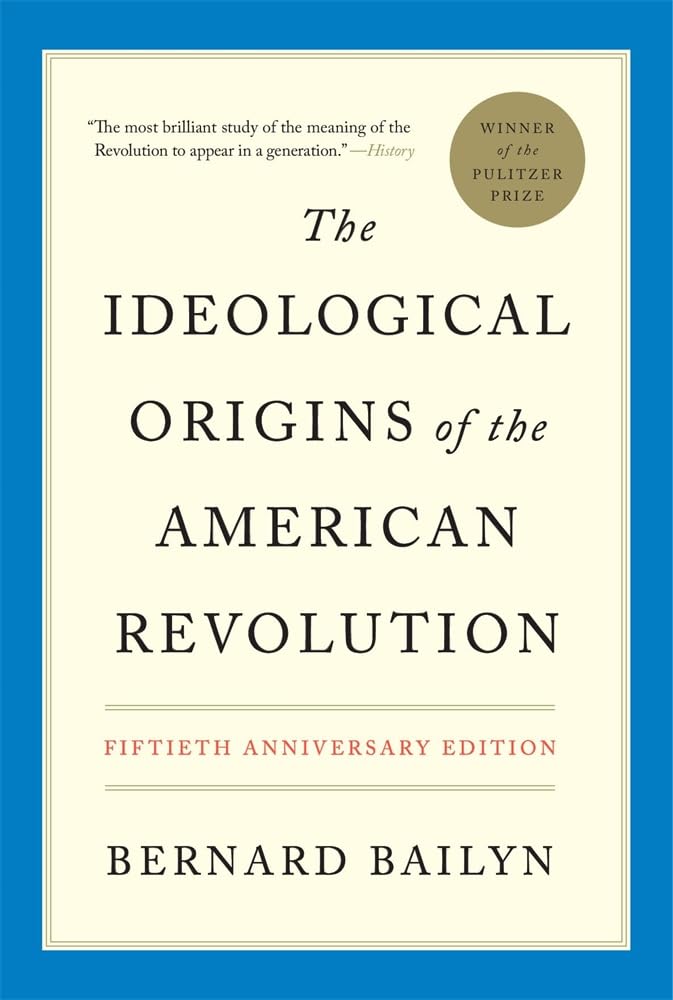
Few events in modern history have been studied, debated, and reinterpreted as extensively as the American Revolution. Historians have variously explained the break with Great Britain as a struggle over taxation and parliamentary sovereignty, a conflict between competing economic interests, a revolt against imperial mismanagement, or the emergence of a distinct American national identity. In The Ideological Origins of the American Revolution, first published in 1967, Harvard historian Bernard Bailyn offers a fundamentally different interpretation. The Revolution, he argues, cannot be adequately understood without taking seriously the political ideas, intellectual traditions, and deeply held convictions of the men who brought it about. Far from being convenient slogans invented to justify rebellion, the colonists’ repeated invocations of liberty, tyranny, corruption, and conspiracy reflected a coherent understanding of how political power operated and why it posed a constant danger to human freedom.
Bailyn’s book was a landmark in the historiography of the American Revolution. Awarded both the Pulitzer Prize and the Bancroft Prize in 1968, it challenged prevailing interpretations that emphasized economic self-interest, social conflict, and political manipulation at the expense of ideology. Its central insight was deceptively simple: the revolutionary generation meant what it said. When American colonists warned that British ministers were conspiring to enslave them, they were not merely employing overheated rhetoric to disguise their material interests. They were expressing genuine fears rooted in a long and sophisticated tradition of English political opposition. To understand why Americans came to regard independence as necessary, Bailyn insists, we must first reconstruct the intellectual world through which they interpreted the actions of Parliament and the Crown.
Bailyn begins with the remarkable body of political literature produced in British North America during the decades preceding independence. His original research grew out of an ambitious project to collect and edit pamphlets published during the revolutionary era. In examining hundreds of these often obscure publications, he discovered a striking consistency in their language, assumptions, historical references, and political arguments.
The pamphlet was an especially important medium of eighteenth-century political discourse. Longer and more substantial than a newspaper article but shorter and more accessible than a conventional book, pamphlets could be produced relatively quickly, circulated widely, and devoted to a single political controversy. They provided an ideal vehicle for sustained constitutional argument. Some responded directly to imperial measures such as the Stamp Act and Townshend duties. Others were written as exchanges between rival political commentators, while still others originated as sermons, commemorative addresses, or public orations.
What impressed Bailyn was not simply the volume of this literature but its intellectual seriousness. Colonial pamphleteers repeatedly engaged questions of constitutional authority, political representation, natural rights, and the relationship between liberty and power. Their writings were frequently argumentative, occasionally repetitive, and often alarmist, but they were rarely devoid of substance. Indeed, Bailyn discovered that the political language employed by the revolutionaries was remarkably consistent across different colonies and controversies.
This observation led him to challenge an influential school of historical interpretation.
Progressive historians, most notably Charles Beard and his intellectual successors, had emphasized the economic interests and social ambitions that lay behind revolutionary politics. From this perspective, appeals to liberty and constitutional principle could be understood largely as propaganda designed to mobilize public support for objectives that were fundamentally material or political.
Bailyn does not deny that economic interests, personal ambitions, and local grievances influenced the Revolution. Rather, he argues that historians had made a serious mistake in treating revolutionary ideology as little more than a rhetorical disguise. The pamphlets revealed a shared set of convictions that shaped how colonists perceived events, interpreted British policies, and ultimately justified resistance. The ideas themselves were an essential part of the historical explanation.
Having established the importance of revolutionary political literature, Bailyn turns to the intellectual traditions from which it emerged. Here he makes one of the book’s most important contributions: the discovery that the revolutionaries’ political thinking owed considerably more to the radical opposition literature of seventeenth- and eighteenth-century England than historians had generally recognized.
To be sure, the American revolutionaries drew upon an extraordinary variety of intellectual sources. Classical antiquity supplied examples of republican virtue, civic responsibility, and the dangers of political corruption. Roman historians and political figures, particularly Cicero, Cato, and the defenders of the Roman Republic, provided a rich vocabulary for discussing tyranny and the decline of free government. Enlightenment philosophers, most notably John Locke, contributed theories of natural rights, consent, and the legitimate foundations of political authority. English common law offered a body of legal precedent and constitutional tradition through which colonists understood their inherited rights as British subjects. Protestant theology, particularly the covenant traditions of New England Puritanism, reinforced the belief that authority was conditional and that rulers could be held accountable for violating their obligations.
Yet Bailyn argues that the most immediate and pervasive influence came from a less familiar source: the radical Whig, or Commonwealth, tradition of English political thought.
This tradition emerged from the political struggles surrounding the English Civil War, the execution of Charles I, the Restoration, and the Glorious Revolution of 1688. Its adherents were deeply suspicious of concentrated political authority, especially the tendency of monarchs and ministers to expand their power at the expense of representative institutions and individual liberty. Their ideas survived into the eighteenth century through a loose collection of opposition writers who criticized the corruption, patronage, and centralization of British government.
Among the most influential were John Trenchard and Thomas Gordon, whose enormously popular Cato’s Letters, published in the early 1720s, became a foundational text for American political writers. Other important figures included Algernon Sidney, James Harrington, and Viscount Bolingbroke. These authors did not necessarily share a single political program, but they possessed a common suspicion of arbitrary power and a conviction that liberty could survive only through constant vigilance.
The irony, as Bailyn demonstrates, is that ideas developed by Englishmen criticizing the British political establishment became the intellectual foundation of a revolution against British rule. Americans did not initially imagine themselves rejecting English constitutional traditions. On the contrary, they believed they were defending those traditions against a corrupt government that had abandoned them. In this sense, the American Revolution began not as a rejection of their British political inheritance but as an effort to preserve what the colonists understood to be its most essential principles.
At the heart of Bailyn’s argument lies a particular conception of political power. To the revolutionary generation, power was not a neutral instrument that could be trusted to serve the public good. It was inherently expansive, aggressive, and potentially corrupting. Those who possessed authority would naturally seek to increase it, while those subject to that authority had to remain constantly vigilant against its encroachments.
Liberty and power, in other words, existed in a state of perpetual tension. Political freedom could survive only when governmental authority was restrained by law, representative institutions, and the active resistance of an independent citizenry.
This understanding of politics explains the extraordinary importance the colonists attached to seemingly technical constitutional disputes. A new tax, an expanded customs office, or a change in the appointment of colonial judges might appear relatively insignificant when considered in isolation. But to Americans steeped in radical Whig political thought, each represented a potential step toward the concentration of arbitrary authority.
Bailyn devotes considerable attention to the concept of corruption, which carried a meaning substantially broader than it does today. Corruption was not simply bribery or the misuse of public office for personal enrichment. It described the gradual destruction of a free political system through patronage, favoritism, standing armies, dependent officeholders, and the manipulation of representative institutions. A government could preserve the outward appearance of constitutional legitimacy while systematically undermining the independence of the institutions that made liberty possible.
The British system, as the colonists understood it, was particularly vulnerable to such corruption. The Crown possessed extensive powers of appointment and patronage, which could be employed to influence Parliament and reward political loyalty. A standing army could be used to intimidate the population. Government officials whose salaries depended upon the Crown rather than elected assemblies might place imperial interests above those of the communities they governed.
These concerns were not entirely imaginary. Eighteenth-century British politics was characterized by an elaborate system of patronage and influence. Yet Bailyn’s central concern is less whether every colonial accusation was justified than how the colonists understood the political significance of what they observed.
The concept of political slavery was especially important. When American writers warned that Parliament intended to reduce the colonies to slavery, they were generally referring to subjection to arbitrary political authority rather than the institution of racial chattel slavery that existed throughout British America. To be politically enslaved was to live under laws imposed without consent, subject to the will of rulers whose authority could not be meaningfully restrained.
This distinction exposes one of the great contradictions of revolutionary ideology. Colonists who passionately defended their own liberty frequently owned enslaved Africans whose freedom they denied. Bailyn recognizes this tension, particularly in his discussion of the revolutionary movement’s wider consequences. Nevertheless, the distinction between political liberty and actual enslavement is essential to understanding the language of the period.
Perhaps the most striking implication of Bailyn’s analysis is that the colonists’ fears were not merely responses to individual British policies. They arose from an entire theory of politics in which liberty was always precarious and power always threatening. The revolutionaries did not need to invent a new language of resistance when the imperial crisis began. They already possessed one.
Bailyn next examines how this inherited political ideology shaped the colonists’ interpretation of events after the Seven Years’ War. Here the book moves from intellectual history into an explanation of why a series of constitutional disputes escalated into open rebellion.
Following Britain’s victory over France in 1763, the imperial government embarked upon a series of measures intended to strengthen its authority over the North American colonies and extract additional revenue to help finance the empire. The Sugar Act, Stamp Act, Townshend duties, expansion of customs enforcement, and subsequent coercive measures each generated colonial resistance.
Viewed individually, these policies might be understood as attempts by British ministers to address legitimate fiscal and administrative problems. Britain had accumulated substantial debts during the Seven Years’ War and believed that its American colonies should contribute more toward the costs of imperial defense.
But the colonists interpreted these developments through an entirely different framework. To them, the successive measures appeared not as isolated attempts at administrative reform but as components of a deliberate campaign to extinguish their constitutional liberties.
This is one of Bailyn’s most important and provocative arguments. The widespread colonial belief in a conspiracy against liberty was sincere, deeply rooted, and politically consequential.
Americans saw connections between developments that British ministers often regarded as separate matters. Parliamentary taxation, customs enforcement, the maintenance of standing armies, the appointment of royal officials, and the payment of judges from imperial revenues all appeared to advance the same underlying objective: the elimination of colonial self-government.
The more British officials insisted upon Parliament’s unlimited authority, the more they seemed to confirm the colonists’ worst suspicions. And the more vigorously Americans resisted, the more British ministers interpreted their behavior as evidence of lawlessness and disloyalty.
The resulting crisis was therefore not simply a disagreement over money. It was a collision between incompatible understandings of constitutional authority.
Bailyn is especially effective in explaining why the colonists became increasingly convinced that compromise was impossible. Each successive confrontation seemed to validate the political assumptions they had inherited from the radical Whig tradition. British concessions were welcomed but rarely restored confidence, while new assertions of imperial authority appeared to reveal the true intentions of the government.
The result was an escalating cycle of suspicion and resistance. What began as opposition to particular taxes developed into a broader challenge to Parliament’s authority and eventually to the legitimacy of British rule itself.
Bailyn’s argument does not require us to accept that British ministers were actually engaged in a coordinated conspiracy to destroy American liberty. Indeed, the evidence suggests that British policy was often inconsistent, improvised, and driven by immediate fiscal and political pressures. Rather, the significance of the conspiracy theory lies in its power to organize the colonists’ understanding of events.
By interpreting British actions as manifestations of a common design, Americans transformed a series of discrete political controversies into a fundamental struggle over the preservation of liberty.
Perhaps the most intellectually demanding section of The Ideological Origins of the American Revolution concerns the transformation of constitutional ideas during the imperial crisis.
Bailyn argues that the revolutionaries did more than defend inherited English liberties. In attempting to justify their resistance to Parliament, they were compelled to rethink some of the most fundamental assumptions of British constitutional government.
One of these concerned representation. British political theory rested upon the concept of virtual representation, under which members of Parliament represented the interests of the entire realm, including individuals who had no direct voice in choosing them. Indeed, large portions of the British population could not vote, yet Parliament was understood to possess legislative authority over them.
American colonists increasingly rejected this conception. They maintained that legitimate taxation required representation through assemblies whose members were actually chosen by the people being taxed. The issue was not simply whether Americans possessed seats in Parliament. It concerned the very nature of political consent and the relationship between representatives and the communities they governed.
A second transformation involved the meaning of a constitution. In Britain, the constitution was generally understood as an evolving collection of statutes, precedents, customs, and institutional arrangements. It was not a single written document standing above ordinary legislation.
Americans gradually developed a different conception. The constitution came to be understood as a fundamental body of law that established and limited the powers of government. Legislatures were not themselves sovereign in an unlimited sense; their authority existed within boundaries that they could not legitimately transgress.
This distinction would eventually become one of the defining features of American constitutional government. Rather than treating Parliament as the ultimate source of legal authority, the colonists increasingly located legitimate political power in the people, whose consent gave government its authority.
The third and perhaps most difficult problem concerned sovereignty. Traditional British constitutional theory held that sovereignty must be ultimate and indivisible. Parliament could not be supreme in some matters while subordinate in others without creating confusion about where final authority resided.
Yet the practical experience of the American colonies suggested a different possibility. For generations, colonial assemblies had exercised substantial authority over taxation and domestic legislation, while the Crown and Parliament retained responsibility for broader imperial affairs.
During the imperial crisis, Americans attempted to give this arrangement a coherent constitutional foundation. Some argued that Parliament might properly regulate imperial commerce while lacking authority to tax the colonies for revenue. Others advanced the more radical proposition that the colonies and Great Britain were separate political communities united by allegiance to the same monarch.
These arguments were not always consistent, and Bailyn makes clear that the colonists were often improvising constitutional theories to defend arrangements that had developed through historical practice rather than deliberate design. Nevertheless, the implications were profound. The revolutionaries were moving toward the possibility that sovereignty could be divided among different levels of government, each possessing legitimate authority within its own sphere. This was an intellectual development of enormous importance. Although the colonists did not immediately produce a fully coherent theory of federalism, their arguments anticipated the constitutional problems that would confront the United States after independence and ultimately shape the federal system established in 1787.
In Bailyn’s interpretation, the imperial controversy thus became an extraordinary laboratory of constitutional innovation. Americans began by defending the traditional rights of Englishmen but ended by developing political principles that challenged the foundations of the British constitutional order itself.
The final major theme of Bailyn’s book concerns the revolutionary consequences of ideas that initially had much narrower objectives. The American Revolution, he argues, was not originally intended as a comprehensive social revolution. Its leaders did not generally seek to overthrow the existing structure of property ownership, eliminate established social hierarchies, or reconstruct society along radically egalitarian lines. Their immediate purpose was to preserve political liberty against what they perceived as the encroachments of arbitrary imperial authority.
Yet the language and principles employed to justify resistance possessed implications that extended far beyond the original dispute with Britain. Bailyn describes this process as the “contagion of liberty.” Once Americans began insisting that legitimate government rested upon consent, that arbitrary authority was inherently dangerous, and that inherited privilege required justification, these principles could not easily be confined to the relationship between Parliament and the colonies. Indeed, they raised uncomfortable questions about nearly every form of established authority in American society.
One consequence was the growing challenge to religious establishments. If liberty of conscience was a fundamental right, on what grounds could governments compel citizens to support particular churches through taxation or restrict the religious practices of dissenters? The revolutionary emphasis on freedom and consent strengthened arguments for religious toleration and, eventually, the separation of church and state.
Another consequence concerned social hierarchy and political deference. Colonial society had been organized around substantial inequalities of wealth, status, and political influence. Elite families dominated many provincial governments, while ordinary citizens were expected to defer to their social superiors. Revolutionary ideology challenged the legitimacy of these inherited distinctions. The insistence that political authority derived from the people encouraged a more assertive and independent political culture, even if the full implications of popular sovereignty remained contested.
The most profound contradiction, however, concerned slavery. The revolutionary generation’s repeated denunciations of political slavery inevitably invited scrutiny of the actual enslavement of Africans and their descendants. How could a society justify rebellion against British tyranny while perpetuating an institution that deprived human beings of virtually every liberty the revolutionaries claimed as their birthright?
Bailyn recognizes that the Revolution did not resolve this contradiction. Slavery remained deeply entrenched, particularly in the Southern states, and the new republic failed to extend its professed principles of universal liberty to much of its population. Nevertheless, revolutionary ideology helped create a language through which slavery could be challenged. The contradiction between the principles of the Declaration of Independence and the realities of American bondage would become one of the central moral and political struggles of the nation’s subsequent history.
The same ideological tensions extended to the political standing of women, the distribution of political rights, and the legitimacy of inherited privilege. The Revolution did not produce equality in any modern, comprehensive sense, but it weakened many of the intellectual foundations upon which traditional inequalities rested. For Bailyn, this was one of the Revolution’s most consequential achievements. Ideas originally mobilized to resist British authority acquired a life of their own, generating expectations and demands that many of the Revolution’s leaders neither anticipated nor necessarily welcomed.
The radicalism of the American Revolution therefore lay not simply in the achievement of independence but in the enduring implications of the principles employed to justify it. In the substantial postscript added to later editions of the book, entitled “Fulfillment,” Bailyn carries his argument beyond independence and into the debates surrounding the ratification of the United States Constitution.
The central problem confronting Americans after 1776 was how to reconcile the need for effective government with their deeply ingrained suspicion of political power. The Articles of Confederation had created a national government whose authority was severely limited. The weaknesses of this arrangement became increasingly apparent during the 1780s, particularly in matters of taxation, interstate commerce, foreign relations, and national defense.
Yet efforts to strengthen the central government raised precisely the fears that had animated resistance to British rule. If concentrated power was inherently dangerous, how could Americans establish a government sufficiently powerful to preserve the republic without recreating the tyranny against which they had rebelled?
The ratification debates of 1787–1788 brought these questions into sharp focus. Federalists argued that a stronger national government was necessary to secure the achievements of the Revolution, while Anti-Federalists warned that the proposed Constitution threatened to concentrate authority in a distant political establishment beyond the effective control of ordinary citizens.
Bailyn interprets this debate as a continuation of the ideological struggles of the revolutionary era rather than a departure from them. The Constitution represented an effort to construct institutions capable of exercising substantial political authority while remaining subject to constitutional restraints, divided powers, representative government, and popular consent.
In this sense, the American constitutional experiment sought to resolve the fundamental dilemma that had preoccupied revolutionary thinkers: how to harness the necessary powers of government without allowing those powers to destroy liberty.
Bailyn’s interpretation of the Constitution as a fulfillment of revolutionary ideology is compelling, although it is also open to criticism. Anti-Federalists, after all, believed that the proposed national government endangered precisely the liberties for which Americans had fought. Their objections remind us that the meaning of revolutionary principles remained contested long after independence. Nevertheless, Bailyn persuasively demonstrates that the debates over the Constitution cannot be separated from the intellectual transformation of the preceding decades. The language of power, corruption, representation, consent, and liberty continued to shape American political thought even as the new nation struggled to establish a workable system of government.
The great strength of The Ideological Origins of the American Revolution lies in its ability to reconstruct the intellectual world of the revolutionary generation without treating its political language as either self-evidently true or fundamentally insincere. Bailyn asks readers to approach the colonists’ arguments on their own terms. Their fear of conspiracy may appear exaggerated to modern observers, but it was not irrational within the political framework they had inherited. Their insistence upon the dangers of corruption and arbitrary power reflected an understanding of government shaped by centuries of English constitutional conflict.
The book also helps explain why the imperial crisis escalated so rapidly after 1763. British ministers and American colonists were not simply disagreeing over the appropriate level of taxation or the administration of colonial affairs. They were operating from fundamentally incompatible assumptions about the nature of legitimate political authority. What British officials considered an assertion of parliamentary sovereignty, American colonists increasingly understood as evidence of a conspiracy against their liberty. What the colonists regarded as the defense of constitutional rights, British ministers interpreted as an unacceptable challenge to the foundations of imperial government.
Bailyn’s interpretation is especially valuable when read alongside more conventional political narratives of the Revolution. A historian such as Nick Bunker, in An Empire on the Edge, helps explain the decisions, personalities, institutional failures, and economic pressures that drove Britain and its colonies toward war. Bailyn, by contrast, explains why those decisions provoked such extraordinary resistance and why Americans interpreted the unfolding crisis as a struggle for their very freedom. The two approaches are complementary. One illuminates the mechanics of imperial collapse; the other reveals the intellectual assumptions that transformed imperial disputes into revolutionary confrontation.
Similarly, Jon Butler’s Becoming America provides an important broader context. Butler emphasizes the profound demographic, economic, political, religious, and cultural transformations that reshaped colonial society between 1680 and 1770. His argument is that the emergence of a recognizably modern American society preceded the Revolution by nearly a century. Bailyn is concerned with a narrower but equally important question: how did Americans come to understand their relationship with Britain in terms that made political independence conceivable and ultimately necessary?
Read together, these works suggest that the Revolution emerged from the interaction of long-term social transformation, an increasingly distinctive colonial political culture, and the immediate constitutional crisis of the 1760s and 1770s.
Yet Bailyn’s emphasis on ideology also has limitations. His sources consist predominantly of the writings of politically engaged, literate, and generally educated colonial Americans. Pamphlets, sermons, and constitutional essays provide extraordinary insight into the thinking of revolutionary leaders, but they tell us less about the motivations of ordinary farmers, artisans, laborers, not to mention women, enslaved Africans and Native Americans.
The ideas articulated by colonial intellectuals undoubtedly influenced broader political mobilization, but the relationship between elite political discourse and popular revolutionary participation was more complicated than the pamphlet literature alone can establish.
Likewise, Bailyn’s emphasis on intellectual conviction sometimes risks underestimating the importance of material interests and social conflict. Merchants who opposed imperial trade restrictions, colonial assemblies defending their fiscal authority, land speculators seeking western expansion, and ordinary colonists resentful of British soldiers all possessed interests that cannot be explained exclusively through political ideology.
The challenge is not to choose between ideas and interests but to understand how they interacted. Economic grievances became revolutionary precisely because Americans interpreted them through an ideological framework that endowed them with broader constitutional significance.
There is also the question of how representative the revolutionary ideology was of colonial society as a whole. Loyalists, who remained committed to Britain, often drew upon the same English constitutional traditions as their revolutionary opponents but reached very different conclusions. Their existence reminds us that the radical Whig inheritance did not dictate a single inevitable political response.
None of these qualifications, however, substantially diminishes the importance of his central achievement. Bailyn demonstrated that the American Revolution was an intellectual event of the first order and that its ideas were not incidental to its history but fundamental to its origins and consequences.
The Ideological Origins of the American Revolution is a demanding but immensely rewarding work of historical scholarship. Unlike more conventional histories of the Revolution, it offers relatively little sustained narrative of parliamentary debates, colonial protests, military preparations, or the personalities who dominated the imperial crisis. Instead, Bailyn immerses the reader in the political arguments and intellectual traditions through which Americans understood their rapidly changing world.
The result is a book that fundamentally alters how one thinks about the origins of the United States. Its most important insight is that the American Revolution was not simply a rebellion against particular taxes, ministers, or imperial policies. It was the culmination of a profound intellectual transformation in which Americans came to believe that political liberty was incompatible with the unrestricted authority claimed by Parliament and the Crown.
Bailyn also demonstrates that the Revolution’s consequences extended far beyond the immediate achievement of independence. In defending their inherited liberties, Americans developed increasingly radical conceptions of representation, constitutional government, popular sovereignty, and the legitimate limits of political power. These ideas would shape the Constitution, challenge established social hierarchies, and provide the intellectual foundation for subsequent struggles over slavery, religious freedom, and political equality.
Perhaps most remarkably, the revolutionaries did not fully anticipate the implications of the principles they embraced. What began as an effort to preserve traditional English liberties ultimately produced a political experiment that challenged many of the assumptions upon which eighteenth-century European society rested.
Bailyn’s book is especially valuable for readers already familiar with the chronology of the American Revolution who wish to understand the deeper intellectual forces that gave the conflict its distinctive character. His prose can be dense, and his extended analysis of constitutional arguments occasionally requires considerable patience. Yet the intellectual rewards are substantial. Even readers who have spent years studying the revolutionary period will likely encounter unfamiliar thinkers, neglected political traditions, and fresh explanations for seemingly familiar events.
Published nearly sixty years ago, The Ideological Origins of the American Revolution remains one of the essential works for understanding why the American colonies rebelled against Great Britain and how that rebellion transformed the political imagination of the modern world. Its enduring contribution is to remind us that ideas have consequences, often far beyond those envisioned by the people who first give them expression.
The American Revolution was fought with armies and decided on battlefields, but Bailyn persuasively demonstrates that its origins lay just as profoundly in the political convictions, constitutional arguments, and fears of arbitrary power that had been developing in the minds of Americans for generations.


Leave a Reply