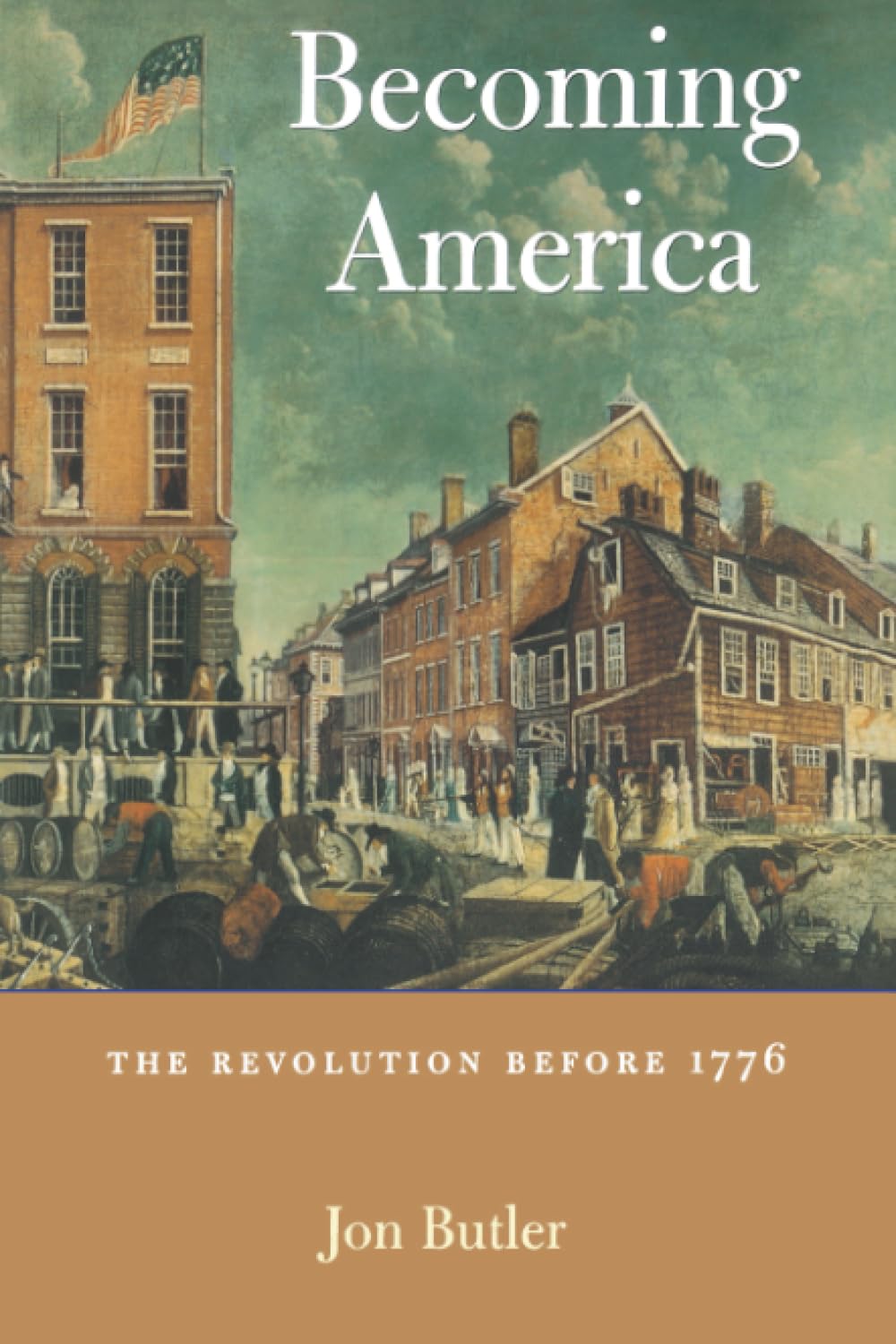
It has been argued that the United States was the world’s first modern society—a pioneering, large-scale experiment in organizing an entire nation around the defining ideals of modernity: nonhereditary political authority, religious pluralism, commercial capitalism, and individual achievement rather than inherited privilege as the principal determinant of social status. In this sense, the United States began its national existence embracing political and social principles that much of the Western world would only gradually adopt over the following two centuries. In Becoming America: In The Revolution Before 1776, Yale historian Jon Butler argues that the foundations of modern American society were laid between 1680 and 1770, a transformative, nearly century-long period that has received surprisingly little attention from scholars and the general public alike. It is, he says, an overlooked chapter of American history that the he likens to the colonial era’s “dark age.”
Butler aims to answer two questions. First, how do you synthesize colonial history after the Puritans? And, second, what is the American, this man that emerged as a distinctive character by the mid-eighteenth century? His central argument is that, beginning around 1680, the mainland British colonies underwent a remarkable transformation. They became increasingly ethnically diverse, developed a more sophisticated and internationally integrated economy, embraced broader forms of political participation, exhibited a distinctly modern preoccupation with authority, power, and control, and fostered a degree of religious pluralism virtually unmatched elsewhere in the world. The principal features of modernity still missing were widespread urbanization and rapid technological innovation.
According to Butler, these developments produced two profound and interrelated transformations across the thirteen colonies. First, they gave rise to a society with its own distinctive economic institutions, political practices, secular culture, and religious traditions, one that differed fundamentally from contemporary Europe. Second, they forged an entirely new cultural identity, which Butler characterizes as “simultaneously aggressive and willful, materialistic as well as idealistic, driven toward authority and mastery.” This transformation, unfolding between 1680 and 1770, created the society that would fight the American Revolution in 1776 and endowed the emerging nation with many of the defining characteristics that would shape its identity for generations to come.
Butler examines five dimensions of colonial American life to identify the forces driving this remarkable transformation. The first is “Peoples.” Between 1680 and 1770, numerous Native American communities were devastated or disappeared altogether, while Indigenous populations declined precipitously. At the same time, the colonies experienced a substantial influx of non-English immigrants, most notably French Huguenots, Jews, Scots, Germans, and enslaved Africans. The first two groups arrived in relatively modest numbers – perhaps 4,000 Huguenots and as many as 1,500 Jews – but their prominence in commerce and trade gave them an influence on colonial economic and social life far exceeding their numbers, such as Andre Faneuil in Boston and Peter Manigault in Charleston. Scottish and German immigrants arrived in far greater numbers, perhaps 100,000 from each group during the period under review, dramatically reshaping the demographic landscape of eighteenth-century America.
Meanwhile, an estimated 250,000 enslaved Africans were forcibly transported to the mainland colonies, where people of African descent came to constitute a majority of the population in some parts of the South. The year 1680 marked a turning point in this demographic transformation for two interrelated reasons. First, the supply of European indentured servants began to decline as economic opportunities improved in England and elsewhere in Europe. Second, the transatlantic slave trade expanded dramatically following the Royal African Company’s receipt of a monopoly over English participation in the African slave trade in 1672. Although the company’s monopoly was effectively ended in 1698, the growing demand for enslaved labor in North America had already encouraged the development of a competitive and increasingly expansive transatlantic slave trade.
By comparison, approximately 200,000 English migrants arrived in the colonies during this same period, accounting for only about one-third of the total influx. The result was a profound demographic transformation: a colonial society once dominated by English settlers was becoming an increasingly diverse, multicultural, and multireligious society, albeit one in which much of that diversity emerged through conquest, displacement, and forced migration rather than voluntary immigration alone. “No other Old or New World Society knew such remarkable mixtures of people,” Butler writes. “What they created in America after 1680 proved equally astonishing.”
The second dimension Butler examines is “Economy.” While the preceding chapter demonstrates that the colonial population expanded rapidly throughout the eighteenth century, the American economy grew even faster. According to Butler, the pace of economic expansion was unprecedented by the standards of both the Old and New Worlds. Yet this extraordinary growth was accompanied by an equally remarkable widening of the gap between rich and poor, at a rate Butler suggests may have been unmatched in any other period of American history. For instance, in Boston, the top ten percent of the city’s taxpayers owned 46 percent of its wealth in 1687 but 63 percent in 1771. What makes this transformation particularly striking is that the colonial economy remained overwhelmingly dependent on agriculture and fishing, with relatively little technological innovation. Apart from the introduction and cultivation of new cash crops such as rice and indigo, significant advances in agricultural productivity were uncommon between 1680 and 1770.
Nevertheless, the growth in agricultural exports was staggering. Between 1698 and 1740, rice exports increased from approximately 10,000 pounds to an astonishing 44 million pounds, an annual growth rate exceeding 20 percent. Indigo production likewise expanded at more than 10 percent annually during the mid-eighteenth century. Much of this extraordinary growth, however, resulted not from technological innovation or improved efficiency but from the expansion and intensification of enslaved labor. By the eve of the American Revolution, the thirteen colonies had developed a substantial export economy, generating more than £2.5 million annually.
Equally striking were the pronounced regional differences in agricultural production and economic specialization. The Lower South, consisting of Georgia and South Carolina, exported approximately £500,000 annually, with rice accounting for roughly two-thirds of the total and indigo another 20 percent. The Upper South – North Carolina, Virginia, and Maryland – dominated colonial exports, generating approximately £1.1 million annually, or 42 percent of the colonial total. Nearly three-quarters of this revenue came from tobacco, with wheat contributing another 20 percent.
The Middle Colonies of Pennsylvania, New Jersey, and New York had a considerably smaller export economy, valued at approximately £525,000 annually, comparable to that of the Lower South and derived primarily from a variety of grains. New England, meanwhile, accounted for the smallest share of colonial exports, approximately £450,000, or 17 percent of the total, but boasted by far the most diversified economy. Fishing accounted for roughly 35 percent of the region’s exports, while whaling contributed another 15 percent. The remaining half consisted of a varied assortment of timber, grains, potash, and other commodities.
Taken together, these developments reveal a colonial economy that was expanding at an extraordinary pace, becoming increasingly specialized by region and deeply integrated into international markets. Yet this prosperity was distributed highly unevenly, with much of the growth – particularly in the southern colonies – resting on the exploitation of enslaved labor rather than technological progress. Consequently, on the eve of the American Revolution, per capita wealth in the southern colonies (£92.3) was roughly twice that of the Middle Colonies (£45.8) and nearly two and a half times that of New England (£38.8). Significantly, approximately one-third of all southern wealth consisted of the assessed monetary value of enslaved Africans, underscoring the extent to which the region’s extraordinary prosperity depended on human bondage and the incredible economic output and wealth that system generated. When Charleston’s Peter Manigault died in 1774, his estate, which included 270 slaves, was assessed at £32,700, a staggering figure for the time and twice the value of the second wealthiest colonial to die that year.
This period also witnessed the strong growth of merchant trades. American seaport cities like Boston, Philadelphia and Charleston saw the number of merchants in their cities grow by a factor of six between 1680 and 1770, which helped create the first real merchant class in America with the top echelon emerging as a powerful political, economic and social elite.
In Butler’s telling, the economic foundations of modern America were already taking shape decades before the Revolution, complete with the dynamism, regional specialization, commercial ambition, and profound inequalities that would continue to characterize the nation long after independence.
I found “Peoples” and “Economy” to be by far the most informative and insightful of the five dimensions Butler explores. The third is “Politics.” Outside New England, colonial government was largely characterized by appointed rather than elected officials, with political authority concentrated at the colony-wide rather than local level. Nevertheless, the basic institutions and practices of government were remarkably similar across the colonies, regardless of how their leaders were selected. Where elections were held, the franchise was generally restricted to white orthodox Christian men who met certain property qualifications, perhaps half of the adult white male population. Butler notes, however, that these property requirements were often surprisingly flexible, sometimes calculated using highly inflated colonial paper currency. Voter turnout was also remarkably low, frequently ranging from just 10 to 20 percent of eligible voters and rarely exceeding 40 percent. This limited political participation is particularly striking given the colonies’ relatively high literacy rates, which may have reached 70 percent in New England.
Yet from these seemingly unpromising beginnings – a hierarchical, largely deferential society characterized by restricted suffrage and limited popular participation – a more open and increasingly democratic political culture gradually emerged between 1680 and 1770. According to Butler, what most distinguished colonial politics after 1680 “was the organization of loosely gathered, reasonably persistent political interest groups.” These groups generally operated within individual colonies and tended to be Whiggish in their political outlook, favoring representative government, constitutional liberties, and resistance to arbitrary or unchecked authority.
Central to this transformation was the growing power and assertiveness of the colonial assemblies. Butler describes how the office of speaker evolved into an increasingly influential political position, supported by organized factions of assemblymen united by common interests and shared opposition to royal authority. These emerging political coalitions frequently clashed with increasingly assertive, royally appointed governors, who retained formidable powers of their own. Governors could veto legislation passed by colonial assemblies, dismiss judges, prorogue legislative sessions at will, distribute lucrative patronage appointments, and unilaterally establish a wide range of government fees. The resulting struggles between governors and assemblies helped foster a more contentious, organized, and participatory political culture, even as political power remained concentrated among a relatively narrow segment of colonial society.
Colonial attitudes toward political authority were also profoundly shaped by Britain’s imperial policies and recurring military conflicts. Four major wars directly affected the colonies during this period: King William’s War (1689–1697), Queen Anne’s War (1702–1713), King George’s War (1744–1748), and the Seven Years’ War (1756–1763). The last of these brought approximately 25,000 British soldiers to North America, where their presence frequently generated friction with colonial communities. Differences in customs, attitudes, and expectations underscored the growing cultural distance between the colonists and their British counterparts. The war also exacted a substantial human toll, with approximately 5,000 colonists killed or wounded. These experiences, Butler argues, “produced a quiet but decidedly negative view of the empire and the nation that managed it.”
The hardships of war, combined with the cultural tensions accompanying the arrival of British troops, prompted what Butler describes as a “subtle shock of recognition” among many colonists. Increasingly, they developed “ambivalent views of the empire’s benefits and costs,” questioning the advantages of imperial membership even as they continued to identify themselves as loyal British subjects. As Butler observes, “Feelings of unease typified almost everyone’s thoughts about the imperial transatlantic relationship between 1680 and 1770.” Long before the revolutionary crisis erupted, the political and psychological foundations of colonial resistance to British authority were already taking shape.
The fourth dimension Butler examines is “Things Material,” perhaps the book’s most unusual chapter and the one whose connection to the eventual American Revolution is least apparent. Here we learn that colonists generally enjoyed a healthier and more varied diet than their counterparts across the Atlantic, contributing to an average height advantage of more than three inches. Like Europeans, Americans also experienced a “consumer revolution” during the eighteenth century, as rising prosperity fueled an expanding appetite for material goods. Imports into the colonies increased steadily, but so too did the ability of colonial artisans to produce high-quality goods domestically, particularly clothing and furniture. Although American furniture makers never developed a distinctly American style, their craftsmanship became increasingly sophisticated, eventually rivaling that of their European counterparts. Indeed, Butler argues that by the end of the colonial period, American manufacturers were often every bit as skilled as their British peers. Meanwhile, colonial homes grew substantially in both size and architectural sophistication, reflecting the rising wealth, evolving tastes, and increasingly refined material culture of eighteenth-century American society.
The fifth and final dimension Butler examines is “Things Spiritual,” where two central themes emerge: religious pluralism and revivalism. First, the religious landscape of colonial America became dramatically more diverse and dynamic between 1680 and the Revolution. The religious pluralism and vitality that would eventually become defining characteristics of American culture were firmly established during the century preceding independence. Before 1680, approximately 90 percent of all congregations established in the mainland British colonies were either Anglican or Congregationalist. This remarkably homogeneous religious landscape was transformed over the following century. By the eve of the Revolution, fully 85 percent of American congregations had been established after 1700, reflecting an extraordinary proliferation of religious institutions. The number of congregations increased from approximately 360 in 1680 to 2,300 by 1770, a more than sixfold expansion, which even outpaced the rapid population expansion. This explosion of religious activity carried the colonies well beyond their predominantly Anglican and Congregationalist origins. Religious and ethnic diversity became so pronounced, particularly in the Middle and Southern Colonies, that no single denomination could claim a majority. The result was a religious landscape more pluralistic than virtually anything found in contemporary continental Europe.
Second, the period witnessed the emergence of powerful religious revivalist movements, particularly the Calvinist-inspired Great Awakening in the North during the 1740s and the spread of Baptist revivalism in the South during the 1760s. These movements introduced forms of popular religious enthusiasm and mass participation that were unprecedented in colonial America. Perhaps the most influential figure was George Whitefield, the celebrated Anglican evangelist who conducted seven preaching tours across British America between 1738 and 1770. His emotionally charged sermons, often centered on the fundamental question “Are you saved?”, attracted enormous crowds and transcended traditional denominational boundaries. Whitefield’s innovative use of newspapers, publicity, and mass gatherings also made him one of the earliest practitioners of modern religious evangelism. Butler argues that Whitefield’s nondenominational, media-savvy approach anticipated the methods of later American evangelists, from Charles Finney and Billy Sunday to Billy Graham and Robert Schuller. In this sense, the religious culture that would become such a distinctive feature of American society was already taking shape decades before the nation achieved political independence.
Butler concludes with a sweeping assessment of America on the eve of independence. In his telling, the America of 1776 bore little resemblance to the society that had existed just fifty years earlier, much less the colonial world of 1680. The emerging nation was a diverse, dynamic, and often uneasy amalgamation of peoples, distinguished by a degree of religious pluralism virtually unmatched anywhere else in the world. The impending rupture with Great Britain would produce what Butler characterizes as the first modern revolution in the first modern society. Unlike earlier political upheavals, the American Revolution emphasized individual rights, natural liberties, human equality, and broad-based popular mobilization. Yet it also differed fundamentally from the great revolutions that would follow in France, Russia, and China, notably in the absence of the pronounced class conflict that would become central to those later upheavals.
Butler is careful to distinguish the profound social transformations of 1680–1770 from the immediate causes of the American Revolution. The changes that reshaped colonial society did not, in themselves, make independence inevitable. Rather, the Revolution emerged from a specific sequence of political confrontations following the Seven Years’ War, when a heavily indebted British government sought to raise revenue and tighten imperial control by imposing new taxes and regulations on its North American colonies. In Butler’s interpretation, the imperial crises of 1763–1776 precipitated the Revolution, but the transformations of the preceding century determined its essential character.
This distinction helps explain one of the Revolution’s most remarkable features: the ability of thirteen colonies, with widely differing political institutions, economic interests, religious traditions, and historical experiences, to unite in opposition to British authority. From South Carolina to Massachusetts, colonial assemblies found common cause despite their substantial differences. Over the preceding century, all had experienced variations of the same fundamental transformations: explosive population growth and increasing ethnic diversity; the maturation of colonial political institutions; the expansion of slavery into a deeply entrenched economic and social system, extending well beyond the plantation South; extraordinary growth in domestic production and international commerce; the emergence of a sophisticated secular and material culture; and the proliferation of religious denominations and revivalist movements that fostered an increasingly pluralistic spiritual landscape.
By 1776, these shared experiences had produced something more consequential than thirteen prosperous and increasingly contentious British colonies. They had created a recognizably distinct American society, one whose institutions, values, ambitions, and contradictions would profoundly shape the Revolution and the nation that emerged from it. The political break with Britain may have occurred in 1776, but the deeper revolution that made modern America possible had been unfolding for nearly a century.


Leave a Reply