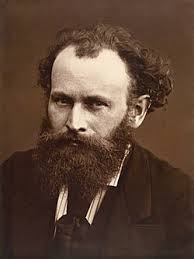
Author Pierre Schneider makes a compelling case that Édouard Manet was one of the most revolutionary artists in history. In the mid-nineteenth century, Manet almost single-handedly upended the conventions of Western painting in a manner comparable to Giotto’s transformation of art in the fourteenth century. His revolution was not so much a matter of style as a fundamental rethinking of the purpose of painting itself. From Giotto to Manet, the prevailing assumption had been that a painting’s primary function was to represent its subject, with artistic achievement measured largely by the fidelity of that representation to reality. Manet challenged this centuries-old convention by asserting that a painting was not merely a representation of something else, but an independent work of art that existed on its own terms. This marked a profound reversal in the relationship between the subject depicted and the act of depiction itself. Manet’s most illustrious contemporaries recognized the magnitude of his achievement. Cézanne declared that Manet had ushered in “a new state of painting,” while Gauguin went further, proclaiming simply that “painting begins with Manet.”
The author emphasizes that there was nothing particularly revolutionary about Manet himself. In his tastes, manners, and sensibilities, he was thoroughly upper-middle-class, embodying little of the stereotypical bohemian artist. His lifestyle was, in fact, remarkably conventional, standing in stark contrast to the radical nature of his artistic innovations. Schneider likens this curious duality to an artistic version of Dr. Jekyll and Mr. Hyde: the respectable bourgeois gentleman whose paintings challenged the very foundations of the artistic establishment.
Manet was born in Paris in 1832, the eldest son of an upper-class family with a long tradition in the legal profession. His father, a well-connected judge, fully expected his son to follow in the family’s footsteps. Manet resisted these expectations from an early age, displaying a strong affinity for art during his teenage years, much to his family’s disapproval. After an unsuccessful attempt to steer his son toward a naval career, his father reluctantly agreed to support his artistic ambitions. Rather than enroll at the prestigious École des Beaux-Arts, however, Manet chose to study in the studio of Thomas Couture, beginning at age eighteen. Almost immediately, the headstrong young artist clashed with his instructor. Manet desperately wanted to achieve recognition and acceptance within the artistic establishment of his day, yet he instinctively rebelled against the rigid academic conventions that dominated Parisian art schools and studios in the mid-nineteenth century. It is one of the great ironies of art history that this outwardly conventional yet fiercely independent son of the French bourgeoisie would go on to overturn centuries of Western artistic tradition.
No artist exerted a greater influence on Manet than the Spanish master Diego Velázquez (1599–1660), whose boldness, freedom of expression, and technical simplicity he deeply admired. Velázquez embodied Manet’s artistic credo: “Instantly paint what you see.” Building on the Spanish master’s bold contrasts and economy of technique, Manet introduced what might be called direct discourse in painting: an art that confronts the viewer immediately through flattened space, visible brushwork, contemporary subjects, and figures who gaze directly outward, rather than concealing the painting behind the illusion of a self-contained narrative world. “It was as if he had removed from the viewers’ noses the smoked glasses with which they were used to looking at pictures,” Schneider observes. Ultimately, Manet’s revolutionary contribution to Western art can be distilled into one deceptively simple idea: the discovery of the present.
Manet’s first painting to fully realize his artistic vision was Music in the Tuileries (1862), which Schneider hails as “the first truly modern painting.” Depicting a fleeting moment of contemporary Parisian life without an overarching narrative or moral commentary, the work marked a radical departure from established artistic conventions. It also revealed Manet’s instinctive preference for bold composition, striking contrasts, and the expressive power of color over traditional storytelling. Rather than using painting to illustrate a narrative, Manet made the immediate experience of modern life the subject of art itself.
Next came Luncheon on the Grass (1863), which Schneider describes as marking a decisive “crack in the history of art” and provoking “the first scandal of modern art.” The painting heralded a fundamental rupture between tradition and originality, between the artistic conventions of the past and the emerging sensibilities of the modern age. On the one hand, it was audaciously bold, startlingly original, and deeply controversial. On the other, as Schneider points out, its composition drew unmistakably on Renaissance precedents, notably Giorgione’s Fête champêtre (c. 1510) and Raphael’s Judgment of Paris, known through an engraving by Marcantonio Raimondi. This paradox lay at the heart of Manet’s genius: he did not so much reject the artistic traditions of the past as appropriate and transform them, using the familiar visual language of the Old Masters to create something radically new.
Luncheon on the Grass was one of three Manet paintings exhibited at the famous Salon des Refusés of 1863, an exhibition authorized by Napoleon III to showcase works rejected by the official Paris Salon. Featuring hundreds of artists and more than 1,000 rejected works, the exhibition attracted enormous public attention and became a watershed moment in the history of modern art. Among the participating artists were Camille Pissarro, James McNeill Whistler, and Paul Cézanne. Schneider declares that the Salon des Refusés “marks a capital date in the history of painting.” Its significance extended far beyond the controversy surrounding individual works: it challenged the unquestioned authority of the academic establishment and helped establish an enduring division within the French art world between the traditional “academics,” who upheld established conventions, and the “independents,” who asserted their freedom to pursue new forms of artistic expression. The monopoly of the official Salon over artistic legitimacy had begun to fracture.
The first step in the artistic revolution that swept nineteenth-century France was the emergence of Realism in the 1850s, a reaction against the idealized classical subjects of Neoclassicism and the emotional grandeur of Romanticism. Realist painters such as Gustave Courbet, Jean-François Millet, Honoré Daumier, Eugène Boudin, and Camille Corot turned their attention to the world around them, depicting ordinary people, working-class life, and unembellished natural landscapes. Schneider argues that these artists, particularly Courbet, came “right up to the brink of the 19th century’s major artistic revolution”: the transformation of painting from an illusionistic window onto the world into an autonomous work of art whose surface and formal qualities asserted their own significance. The crucial distinction between Courbet and Manet, Schneider suggests, was one of artistic self-awareness. Courbet pushed painting toward this revolutionary threshold without fully recognizing the radical implications of his approach, whereas Manet consciously embraced and exploited them.
Manet’s contribution to the celebrated Salon of 1865 “still ranks as one of the greatest scandals in art history,” Schneider contends. Although Manet exhibited two paintings, it was the provocative nude Olympia that unleashed a torrent of “insult, sarcasm, and indignation.” The outrage stemmed not merely from what Manet depicted, controversial as the subject was, but from how he depicted it. His bold, conspicuous application of paint made the painting itself seem almost as naked as its subject. For centuries, Western artists had sought to conceal the mechanics of painting through techniques such as sfumato, linear perspective, and subtle gradations of light and shadow, creating the illusion of a three-dimensional world beyond the canvas. Manet deliberately subverted these conventions, employing flattened forms, stark contrasts, and unapologetically visible brushwork that drew attention to the painted surface itself. Rather than inviting viewers to look into an illusionistic world, Olympia compelled them to look at the painting as an object in its own right. In doing so, Manet challenged the primacy of three-dimensional illusionism that had dominated Western painting since the Renaissance, helping to dismantle one of its most deeply entrenched artistic conventions.
Schneider argues that Manet’s “revolutionary discovery” was his recognition that capturing the immediacy and vitality of a subject required spontaneity and improvisation. The painstaking, analytical methods taught at the École des Beaux-Arts were simply too rigid and cumbersome to convey the fleeting experience of the present moment. The only effective method, paradoxically, was to abandon method altogether, trusting instead in the artist’s instincts and the spontaneous act of creation. What mattered was not the meticulous reconstruction of reality but the direct, unmediated encounter between the artist, the subject, and what Schneider evocatively calls the “here-and-nowness of paint.”
The reaction to Manet’s revolutionary style, both from the academic establishment and the general public, was swift and overwhelmingly hostile. “Insults are pouring down on me as thick as hail,” the beleaguered artist wrote to a friend following the Salon of 1865. Amid the torrent of ridicule and condemnation, one of Manet’s most steadfast and influential defenders was the novelist and critic Émile Zola, who not only championed his work but made a serious effort to understand and articulate the radical artistic vision that so many of his contemporaries dismissed outright.
There was little of the conventional rebel in Manet’s character, Schneider observes. Modest, affable, and sociable, he was “the very embodiment of the carefree, idle son of a ‘good’ family.” In 1862, at the age of thirty, he inherited the equivalent of roughly $350,000 in today’s dollars from his father, only to exhaust the inheritance within a few years. Accustomed to the comforts and respectability of bourgeois society, Manet was deeply wounded by the relentless and often merciless criticism directed at his paintings. Nor did he possess any appetite for personal scandal, preferring to avoid public scrutiny of his private life, particularly the circumstances surrounding his son, born out of wedlock to his former piano teacher. The irony was striking: a man who craved social acceptance and recoiled from controversy had become one of the most controversial figures in the history of Western art.
Manet was not, however, universally reviled. Quite unintentionally, and not always to his liking, the “unassuming and undogmatic” artist emerged as the reluctant hero and mentor of a younger generation of avant-garde painters in Paris, including Renoir, Monet, Sisley, Degas, Cézanne, and Pissarro. This loosely affiliated circle, which came to be known as the Batignolles School, gathered regularly on Thursdays at the Café Guerbois to debate art, exchange ideas, and challenge the prevailing orthodoxies of the artistic establishment. Schneider describes them as “a motley, explosive crew,” whose members differed dramatically in temperament, social background, political convictions, and artistic ambitions. What united this disparate collection of personalities was less a coherent artistic doctrine than a shared determination to pursue new forms of expression, reinforced by their solidarity in the face of near-universal hostility from the academic establishment and the broader art-going public.
Manet regarded himself as a Realist, Schneider says, albeit one who had advanced well beyond the artistic innovations of Courbet. Following the Franco-Prussian War, his small and eclectic circle of admirers would emerge as a distinct artistic movement: the Impressionists. Yet Schneider emphasizes an important philosophical distinction between Manet and his younger contemporaries. Whereas Manet sought to capture the essential character of his subjects, the Impressionists were primarily concerned with rendering the fleeting appearance of reality at a particular instant in time. Both embraced a richer palette of light and color, but their underlying purposes differed. For Manet, throwing open the studio windows and allowing sunlight to flood the canvas was a means of revealing reality more directly and honestly, stripping away the artificial conventions that obscured its fundamental nature. For the Impressionists, by contrast, the interplay of light and color became an end in itself, a means of faithfully recording the transient visual sensations of a particular moment. Where Manet sought the enduring essence of what he saw, the Impressionists pursued the ephemeral experience of seeing it. In their hands, the search for the moment became the method.
Another crucial catalyst in the emergence of Impressionism was the advent of photography, which surged in popularity across Paris during the 1840s and 1850s. Photography offered something unprecedented: the ability to capture an instantaneous, fleeting impression of reality and preserve it seemingly outside the passage of time. This fascination with the transitory moment would become one of the defining preoccupations of the Impressionists. The new medium profoundly disrupted the established art world, driving hundreds of miniature portrait painters out of business while simultaneously revitalizing painting itself. By the middle of the nineteenth century, photography could reproduce the visible world with a fidelity that no painter could consistently rival, compelling artists to reconsider the very purpose of their craft. Increasingly, the value of painting lay not in its ability to replicate reality but in its capacity to express the artist’s individual perception of it. Photography thus helped create a new appreciation for artistic interpretation over mere representation. Indeed, some leading painters welcomed the new technology, recognizing that it could relieve them of the commercial burden of portraiture and free them to pursue more imaginative compositions, ambitious themes, and personal forms of expression. Paradoxically, a technology that initially appeared to threaten painting’s very existence helped liberate it from centuries of representational convention.
It is difficult for modern readers to fully appreciate just how radical the Impressionists appeared to their contemporaries. Landscape painting, for one, occupied a decidedly inferior position in the hierarchy of academic art, dismissed by Schneider as “the proletarian among the genres of painting.” Even more astonishing to the artistic establishment was the notion of abandoning the studio altogether and setting up an easel outdoors, amid fields and forests, to paint directly from nature. “Light is the principal personage of a painting,” Manet remarked, and capturing its full expressive power demanded firsthand observation of its constantly shifting effects. The resulting works, with their loose brushwork, increasingly abstract forms, and unconventional treatment of color, seemed to many critics an affront to the very principles of painting. Schneider describes these pioneering artists as “the pariahs of the art world,” whose rejection of established conventions invited suspicions of pantheism, socialism, or both. Yet within a generation, these once-marginalized painters would transform the artistic landscape of Paris, overturning the very standards by which their work had initially been condemned and establishing Impressionism as one of the defining movements of the late nineteenth century.
In 1874, several leading members of the Batignolles circle—including Monet, Renoir, Sisley, Pissarro, and Degas, many of whom struggled with chronic financial insecurity—joined forces to establish the Anonymous Cooperative Society and organize their first independent exhibition. The show featured 165 works by 30 artists, with ten percent of sales proceeds earmarked for a collective fund. Schneider likens the event to a reprise of the Salon des Refusés, as the exhibition became another lightning rod for public ridicule and critical condemnation. It was here that the term Impressionism was born, initially coined as an insult by a hostile critic mocking Monet’s Impression, Sunrise. The artists soon adopted the derisive label as their own, transforming a term of contempt into the name of a movement that would revolutionize Western painting.
Manet famously declined to participate in any of the eight Impressionist exhibitions, despite his status as the movement’s principal inspiration and acknowledged master. He continued to crave acceptance by the established Parisian art world, and in 1873 his painting Le Bon Bock, reminiscent of the work of Frans Hals, had been enthusiastically received at the official Salon, bringing him a measure of the mainstream recognition he had long sought. Having finally achieved a degree of conventional success, Manet had little desire to invite renewed scandal by formally associating himself with the emerging Impressionist movement. Yet Schneider argues that his reluctance reflected something more fundamental than a concern for social respectability: Manet “had never really been converted” to the artistic philosophy of the movement he had helped inspire. He never fully embraced the Impressionists’ prismatic palette, continuing to employ black prominently in his compositions, nor did he share their conviction that painting should systematically capture the fleeting optical sensations of a particular moment. To Manet, Impressionism risked becoming yet another prescribed method, violating his most deeply held artistic principle: freedom from convention and routine. For him, “there could be no method, no scientific truth, no foolproof style.” Painting was ultimately a matter not merely of sight, but of insight; the act of painting could never be confused with the act of seeing. Schneider suggests that, in their pursuit of optical fidelity, the Impressionists had inadvertently returned to a central assumption of Renaissance art: that painting was fundamentally an exercise in accurately representing the visible world, albeit through a supposedly more perceptive understanding of light and color. The Neo-Impressionists Georges Seurat and Paul Signac carried this logic still further, developing Pointillism as a systematic, quasi-scientific approach to color and perception, an innovation that temporarily attracted even Pissarro. Manet’s “real revolution,” Schneider contends, lay elsewhere. He recognized that the paint itself – its texture, application, and presence on the canvas – was as essential to the work of art as the subject it represented. Painting was not simply a means of reproducing what the eye perceived, but an independent act of artistic creation. In this distinction between seeing and painting lay the true radicalism of Manet’s achievement.
Although Manet and the Impressionists are closely associated with Argenteuil, the picturesque suburb along the Seine that became an important center of Impressionist painting during the 1870s, Schneider emphasizes that Manet himself was “Parisian to the marrow,” reveling in the capital’s energy, sophistication, and cultural vitality. His personal tastes and social ambitions remained curiously at odds with the revolutionary character of his art. He delighted in elegant dinners, fashionable parties, and grand balls, and well into middle age continued to yearn for fame, respectability, and acceptance by Parisian high society. Schneider even suggests that Manet might gladly have painted in a more conventional manner had he known how to achieve the acclaim he so desperately desired. But artistic conformity seemed fundamentally beyond his nature. Instead, he approached each canvas without rules, calculations, or precautions, relying on instinct rather than established technique. For Manet, every new painting was an entirely fresh encounter with the act of creation, as though he were picking up a brush for the very first time.
Schneider notes that Manet and Degas shared several superficial similarities. Both were born into the bourgeoisie, possessed an instinctive love of Parisian life and a corresponding disdain for the countryside, and frequently gravitated toward similar subjects, including horse races and fashionable summer gatherings. Yet beneath these commonalities, the two men were almost complete opposites, both in temperament and artistic philosophy. Where Manet was sociable, affable, and instinctively spontaneous, Degas was famously misanthropic, reserved, and methodical. His artistic approach was disciplined, deliberate, and remarkably consistent, the very antithesis of Manet’s improvisational style and his conviction that every painting should begin as an entirely new act of discovery.
Many art historians have argued that Manet’s work of the 1860s was fundamentally Realist in character, drawing its subjects from the everyday life of modern Paris—locomotives, prostitutes, crowded cafés, and manual laborers—while stripping away incidental details to reveal their essential character and imbue them with broader moral significance. By the 1870s, however, Manet is said to have gravitated toward Naturalism, retaining his fascination with contemporary life but depicting it more directly, as it appeared to the artist’s eye. His compositions increasingly incorporated recognizable details that situated their subjects within a specific time and place, allowing viewers to identify the circumstances of the scene through clear, unambiguous visual clues. By around 1875, Manet’s exploration of modern reality had crystallized around two increasingly important themes: the erosion of individual identity amid the swelling crowds of modern urban life, and the progressive dissolution of traditional subject matter and recognizable imagery as painting asserted its independence from representation. The latter development, in particular, pointed toward one of the most consequential transformations in the history of modern art: the gradual elevation of the act of painting itself over the subject being depicted.
The final five years of Manet’s life were overshadowed by a prolonged, agonizing, and ultimately debilitating struggle with neurosyphilis, specifically a degenerative neurological condition known as *tabes dorsalis*. The disease caused excruciating, shooting pains in his legs, progressive difficulty walking, and a gradual loss of balance and coordination. Schneider, writing in the 1960s, attributes Manet’s physical decline to *locomotor ataxia*, a term describing the characteristic impairment of movement rather than a distinct disease unrelated to syphilis. Today, the condition is generally understood as a manifestation of advanced neurosyphilis. Whether this difference in terminology reflects advances in medical understanding or simply a greater willingness to acknowledge that one of France’s most celebrated artists succumbed to complications of a sexually transmitted infection is difficult to say. In April 1883, after gangrene developed in his left leg, doctors amputated the limb below the knee in a desperate attempt to save his life. The operation proved unsuccessful. Manet died on April 30, 1883, at the age of fifty-one, just eleven days after the amputation and on the eve of the opening of the annual Paris Salon.
Schneider captures the magnitude of Manet’s achievement in one of the book’s most memorable phrases, describing his work as nothing less than “paint’s rebellion against its age-old role as a mirror.” For centuries, Western painting had been judged largely by its ability to reproduce the visible world, concealing the artist’s hand behind the illusion of reality. Manet shattered that convention, asserting the independence of painting as an art form whose power resided as much in the application of paint itself as in the subject it depicted. In doing so, he fundamentally expanded the possibilities of artistic expression, breaking the centuries-old dominance of representation and opening the door to the revolutionary experiments of modern art. As Schneider concludes, Manet stretched the boundaries of artistic technique “and catapulted painting into the 20th century.” The supreme irony is that this quiet, conventionally bourgeois gentleman, who craved acceptance by the very establishment he scandalized, became one of the most consequential revolutionaries in the history of Western art.


Leave a Reply