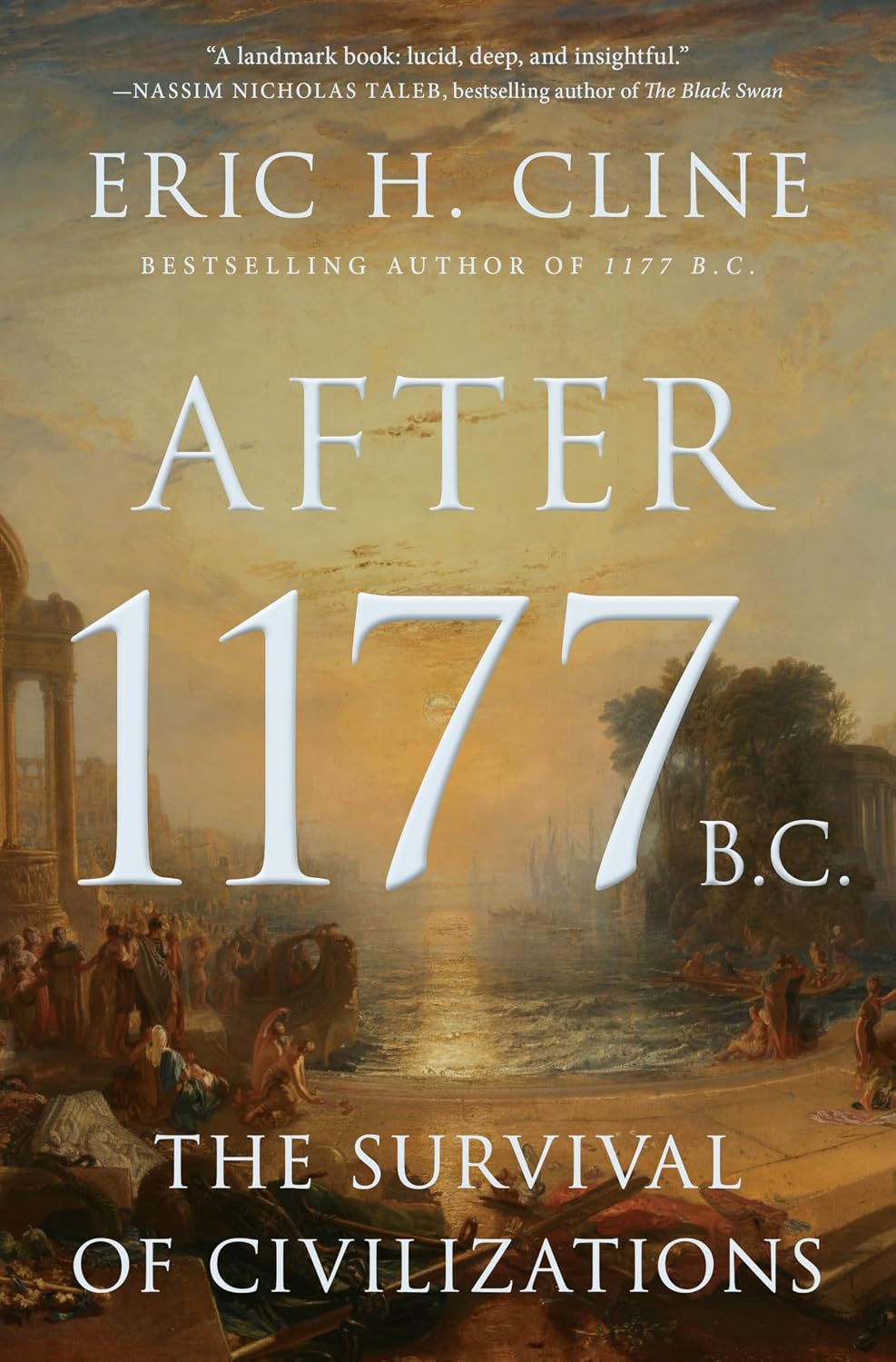
Eric Cline achieved something of a surprise commercial success with 1177 B.C.: The Year Civilization Collapsed, an early volume in the Turning Points in Ancient History series. In After 1177 B.C., he returns to answer the obvious next question: What happened between the collapse of the Late Bronze Age, beginning around 1200 BC,, and the emergence of Classical Antiquity roughly seven centuries later? Much of this intervening period was once characterized as a “Dark Age.” But Cline and other scholars of the period argue that this label obscures as much as it illuminates. The centuries from roughly 1000 to 500 BC are better understood as the Iron Age, a period that witnessed important innovations, including the spread of ironworking and iron tools and weapons, the development of coinage, the introduction of the Phoenician alphabet and mass literacy, and the creation of the Greek city-states. “In short,” Cline concludes, “it was overall more a period of rebirth and renewal than it was of darkness and despair.”
One thing, however, is clear: many of the kingdoms and civilizations that dominated the sophisticated, interconnected, and heavily trade-dependent world of the Late Bronze Age did not survive into Classical Antiquity with anything resembling their former power. Some emerged as shadows of what they had once been; others disappeared almost entirely. The megadrought and ensuing famine, social unrest, population displacement, and economic disruption that began around the opening decades of the twelfth century BC fundamentally – and sometimes devastatingly – altered the political, economic, and social order of the eastern Mediterranean and Near East. In After 1177 B.C., Cline tells the story of what came next, moving roughly one civilization and community at a time through the upheaval, adaptation, and recovery that followed the Bronze Age collapse.
Cline uses the “adaptive cycle” from Resilience Theory as a framework for categorizing and explaining the fate of Late Bronze Age societies after the Collapse. Visualized as an infinity loop, the model seeks to explain the recurring rise, decline, and renewal of complex societies through four phases plotted along two dimensions: potential and connectedness. The cycle begins in the lower left, with low potential and low connectedness, in what is called the “growth and exploitation” phase, labeled “r.” For the Bronze Age, Cline associates this phase roughly with the period from 1700 BC to 1300 BC. The cycle then moves upward and to the right, toward high potential and high connectedness, into the “conservation” phase, labeled “K.” This corresponds to the apogee of the Late Bronze Age, roughly 1300 BC to 1200 BC. Conservation eventually gives way to “chaotic collapse and release,” labeled “Omega,” characterized by low potential but still high connectedness. Cline associates this quadrant with the core Collapse and its aftermath, from roughly 1200 BC to 1000 BC. Finally comes a “reorganization” phase, characterized by high potential but low connectedness, during which innovation and the exploitation of new opportunities can set the stage for renewed growth. Cline notes that this reorganization can proceed either quickly or slowly and is often the period of greatest experimentation and innovation. In his model, the core reorganization of the Late Bronze Age into the Iron Age occurred from roughly 1000 BC to 750 BC. Overall, however, I found the adaptive-cycle model to be, at best, a modest aid in conceptualizing and visualizing the historical processes Cline is attempting to understand and explain.
Cline groups the Late Bronze Age communities into several categories that are, as he acknowledges, open to debate. Somewhat surprisingly, his account produces both winners and losers. He divides the latter into three broad groups: societies that essentially vanished; those that were destroyed as political entities but retained some cultural continuity; and a former superpower that survived, but only by its fingertips. Despite the devastating consequences of the twelfth-century BC collapse, Cline places only two civilizations in the first category: the Hittites of central Anatolia and the Canaanites of the Levant. Two other important societies came close to complete destruction but maintained elements of cultural continuity through their successors: the Mycenaeans of Greece and the Minoans of Crete. Neither managed to cope, adapt, or transform sufficiently to preserve their Bronze Age civilizations, yet their cultures did not disappear as completely as those of the Hittites and Canaanites. Cline reserves his third category, “resilient but just barely,” for ancient and magnificent Egypt. Egypt survived into the Classical period, but it never regained the power, wealth, or importance it had enjoyed during the Late Bronze Age. Pharaonic rule, centralized administration, and traditional religion endured, but Egypt emerged from the upheaval a diminished society, with living standards almost certainly falling substantially from their Late Bronze Age heights.
Cline identifies just two categories of relative winners in After 1177 B.C. The first consists of societies he describes as “very resilient” – those that adapted, and even transformed to varying degrees, to meet the challenges of a radically altered world. He places two civilizations in this category: Assyria and Babylonia. Both were located in Mesopotamia, between the Tigris and Euphrates Rivers, and were therefore relatively removed from the seafaring world of the eastern Mediterranean and, presumably, from the marauding of the semi-legendary Sea Peoples. According to Cline, neither Assyria nor Babylonia suffered a serious disruption to its central administrative institutions or religious traditions. Both were undoubtedly affected by the megadrought and broader upheavals of the Collapse, and it may have taken them two centuries to recover fully, but they largely did. Finally, Cline identifies two societies that he characterizes as “antifragile”: Cyprus and Phoenicia, the latter emerging from the broader Canaanite culture of the Levant and taking advantage of not only Ugarit’s destruction but also the retreat of Egyptian and Hittite hegemony in the region. Rather than merely surviving the economic, political, and climatic upheaval, both appear to have capitalized on the disorder and fundamentally transformed themselves. Among the innovations associated with these societies were the standardization and spread of the alphabet, the large-scale production of highly prized purple dye, and advances in ironworking for tools and weapons. Both also looked outward, establishing far-reaching networks of overseas trade, settlement, and colonization that would extend their influence across the Mediterranean.
In closing, After 1177 B.C. is far less insightful and dramatic than its predecessor. At times, the book feels like an essay stretched with considerable effort to fill more than two hundred pages. Its central insight is relatively straightforward: different societies responded to the collapse of the Late Bronze Age in very different ways, with dramatically different outcomes. Perhaps Cline’s most important argument is that the centuries between 1200 BC and the rise of Classical Greece around 500 BC should not be understood simply as a Dark Age, but rather as a prolonged period of recovery, reorganization, adaptation, and innovation in the aftermath of catastrophic climate change and the social and economic upheaval that followed. How a civilization recovers, Cline suggests, depends largely on how it responds to crisis. There is no obvious reason, for example, why Cyprus should have recovered so much more successfully than Crete, or why the Phoenicians exploited the vacuum left by the decline of the Hittites and Egyptians so much more effectively than the Mycenaeans. If there is a broader lesson in After 1177 B.C., it is that catastrophe does not determine what comes next. Even amid collapse, there is opportunity for societies resilient and adaptable enough to recognize and seize it.


Leave a Reply