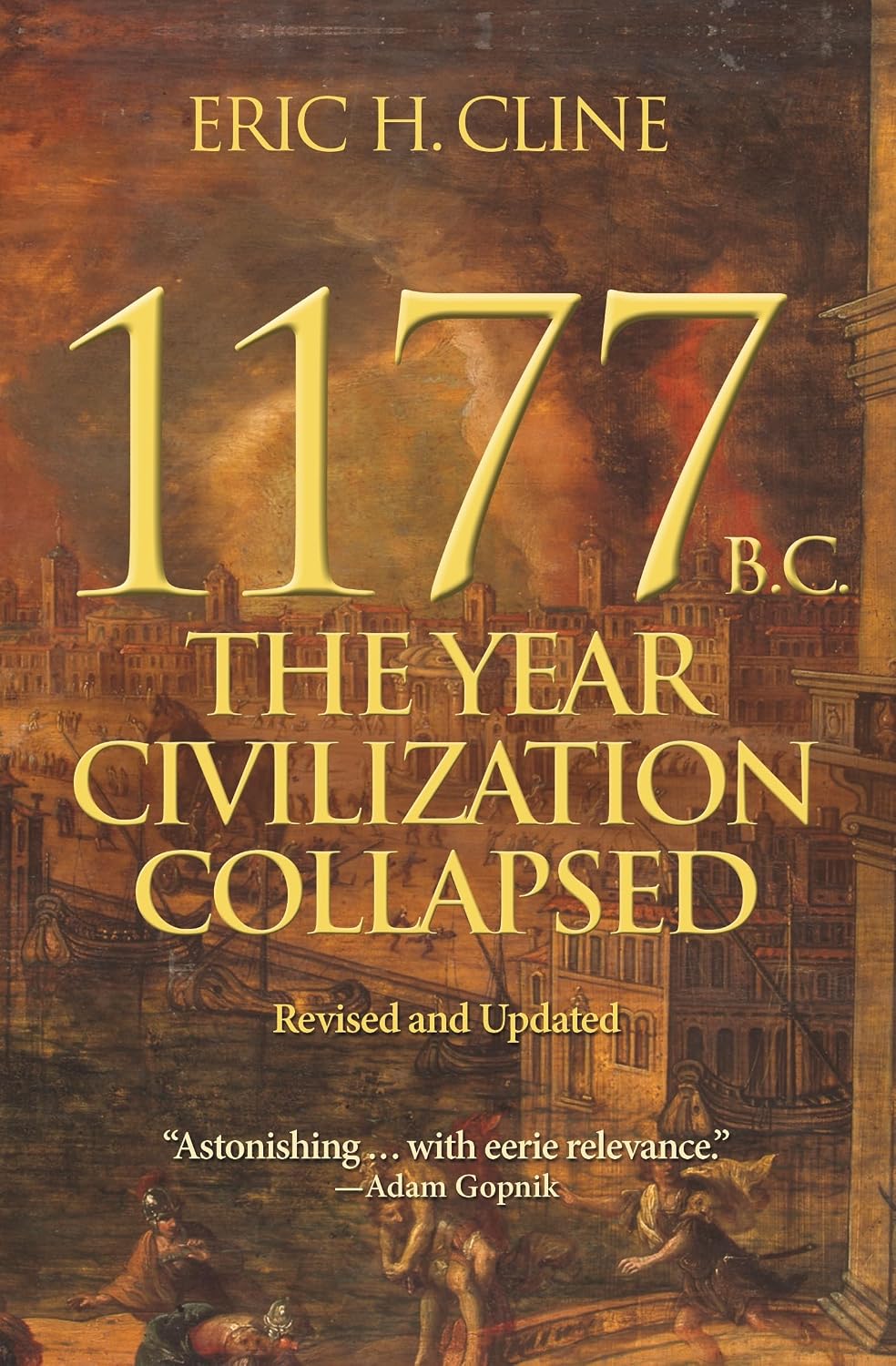
I have read widely about Classical Antiquity and have even dabbled a bit in ancient Egypt, including taking a course on hieroglyphics, so I was somewhat stunned to encounter the fascinating story Eric H. Cline tells in 1177 B.C.: The Year Civilization Collapsed. I’m embarrassed to admit that I had never fully appreciated the scale of the widespread and systemic collapse that swept across much of the eastern Mediterranean at the end of the Bronze Age in the twelfth century BC, or the centuries of disruption and relative decline that followed. I had always regarded events such as the biblical story of the Exodus, traditionally placed by some chronologies to the time of Pharaoh Ramses II around 1200BC, as little more than legend. I had no idea how deeply such traditions might be rooted in the historical upheavals surrounding the sweeping collapse of a sprawling, highly interconnected, and remarkably sophisticated Bronze Age world. There are inevitably many assumptions, uncertainties, and informed speculations in Cline’s brisk narrative, but as an introduction to this remarkable episode in ancient history, the book is both fascinating and highly readable.
The Bronze Age in the eastern Mediterranean (roughly 3300–1200 BC) produced a remarkably interconnected, affluent, and flourishing international system. At its height, it encompassed what might be thought of as the “G8” of the ancient world: the Mycenaeans in Greece, the Minoans on Crete, the Hittites in Anatolia, the Cypriots, the Canaanites along the Levantine coast, the Egyptians, the Babylonians in Mesopotamia, and the Assyrians farther north. These centralized kingdoms and societies conducted extensive trade with one another; copper from Cyprus, tin from Afghanistan, gold from Egypt and silver from Greece traveled far and wide across a region stretching from modern day Italy to Iran. Three shipwrecks discovered off the coast of southern Turkey and dating to around 1300 BC contained goods originating from at least seven different kingdoms, regions, and empires, offering remarkable evidence of the extent of Bronze Age trade. Among the most important commodities aboard were copper and tin – the essential ingredients of bronze – which Cline describes as the “crude oil of the Bronze Age.” As he puts it, “This really was the first truly global age.”
These centralized societies maintained sophisticated networks of communication, diplomacy, transportation, and cultural exchange. Yet the very interconnectedness that underpinned their prosperity may also have made the entire system unusually vulnerable to disruption. “This very internationalism may have contributed to the apocalyptic disaster that ended the Bronze Age,” Cline writes. “The cultures of the Near East, Egypt, and Greece seem to have been so intertwined and interdependent by 1177 BC that the fall of one ultimately brought down the others, as one after another, the flourishing civilizations were destroyed by acts of man or nature, or a lethal combination of both.”
Cline’s use of 1177 BC as the symbolic endpoint of the Bronze Age is analogous to the conventional use of AD 476 to mark the fall of the Western Roman Empire; both dates, he explains, are “simply chronological placeholders” assigned to complex processes of decline and collapse that unfolded over many years. One thing is certain, however: “the Mediterranean and Near Eastern world of 1200 BC was quite different from that of 1100 BC and completely different from that of 1000 BC.”
Cline stresses that the collapse was neither linear nor attributable to any single cause; nevertheless, a broadly coherent narrative emerges of a “perfect storm” of natural and manmade disasters that converged and multiplied to bring down the Bronze Age world. First, the ecological record from palynology (pollen studies) suggests that significant climatic changes produced a prolonged drought across the Aegean and eastern Mediterranean beginning around 1200 BC and lasting between 150 and 300 years, triggering widespread famine that is also attested in the written record. Cline suggests that this “megadrought” was a “climatological cataclysm” (known academically as “3.2 ka BP event”) and the resulting famine was likely the “major driver” in the unfolding crisis. Volcanic eruptions on Santorini and Iceland may have further exacerbated these changes. Second, a series of major earthquakes destroyed or severely damaged palaces and cities throughout the region, the physical evidence of which can still be seen today. Third, hunger, economic disruption, and political instability contributed to internal revolts and large-scale population movements, which may help explain the mysterious invaders remembered as the Sea Peoples. Finally, as many as ten different diseases – including smallpox, dysentery, bubonic plague, typhoid, and malaria – may have further destabilized societies already under severe strain, although Cline emphasizes that no archaeological evidence of mass-casualty epidemics, such as mass graves, has been discovered dating to the period in question.
Cline argues that none of these forces, acting in isolation, would necessarily have been sufficient to destroy an entire civilization. Their convergence, however, produced a cascading or “multiplier effect,” in which each crisis intensified the others: drought contributed to famine; famine encouraged migration and unrest; warfare disrupted trade; and the breakdown of trade further weakened economies and political institutions. What ultimately brought down the Bronze Age world, in Cline’s telling, was therefore not a single catastrophe but the interaction of multiple stresses within a highly interconnected system, an ancient example of what we now call systemic collapse, which Colin Renfrew of Cambridge University first suggested back in 1978.
Renfrew suggested that the systemic collapse of complex empires and civilizations often exhibits the same general features: the breakdown of central administrative authority; the disappearance of traditional elites; the collapse of centralized economic systems; and major shifts in settlement patterns accompanied by an overall decline in population. The collapse of the Late Bronze Age displayed all of these characteristics, as did, in different periods and circumstances, the collapses of the Maya, Egypt’s Old Kingdom, and the Western Roman Empire. Such transformations need not occur suddenly; the process may unfold over a century or more. In their wake, the scattered and increasingly isolated communities that survive decompose into smaller entities and typically emerge with substantially lower levels of political, economic, and social integration.
It was precisely the complexity and interconnectedness of this system that made it so vulnerable, Cline argues. In his telling, Bronze Age civilization had become too interconnected and interdependent: disruption in one part of the system could quickly reverberate throughout the rest. He likens it to throwing a wrench into the workings of a highly sophisticated automobile engine. Cline turns to Complexity Theory as one possible framework for understanding this phenomenon, though he readily concedes that it may amount to little more “than a fancy way to state a fairly obvious fact, namely that complicated things can break down in a variety of ways.” As a modern analogue, he points to the study of traffic jams, in which relatively small disruptions can propagate through a complex system, producing consequences far out of proportion to the original disturbance.
The story of the lost city and kingdom of Ugarit, rediscovered only in 1929, provides a vivid illustration of what happened during the systemic collapse of the twelfth century BC. Located on the Levantine coast in what is now northern Syria, Ugarit had a population of roughly 8,000 and was a major trading entrepôt of the eastern Mediterranean as well as a vassal of the Hittite Empire. The city was destroyed sometime between 1190 and 1185 BC. Cline explains the fall of Ugarit as a concatenation of related and unrelated events that gradually overwhelmed what had been a prosperous and resilient society. At the outset, Ugarit was a thriving, cosmopolitan center of commerce, trading throughout the Levant and across the wider Mediterranean. An earthquake then struck the city, damaging but not destroying it. Ugarit initially remained prosperous enough to send food aid to the Hittites, but famine eventually descended on the city as well, prompting Egypt in turn to send assistance. Enemy ships subsequently appeared off the coast, and Ugarit was ultimately destroyed in battle, leaving a layer of destruction debris six feet deep. The city was abandoned and would not be substantially repopulated for centuries.
Significantly, Cline notes, international trade and diplomatic contacts appear to have remained robust almost until the very end, a striking indication of how abruptly a flourishing and interconnected society could unravel. The ruins bear evidence of catastrophic fire and warfare, including arrowheads and sling stones.
Ugarit’s final destruction may have come at the hands of the “enigmatic and elusive” Sea Peoples, although Cline argues that these mysterious groups were probably not so much the cause of the wider collapse as victims of the same forces that produced it: desperate populations displaced by prolonged drought, famine, and political instability rather than simply bands of bellicose invaders. Nor was Ugarit an isolated case. Cities and palatial centers across the eastern Mediterranean – including Troy, Hattusa, Mycenae, Pylos, Knossos, and Tiryns, as well as settlements on Cyprus – were destroyed, abandoned, or severely disrupted during this extraordinary period of upheaval.
The combination of cataclysmic climate change, global pandemics, political instability, foreign invasions, disruptions to international trade, and massive population movements makes the collapse of the Late Bronze Age feel eerily familiar, an uncomfortable resonance that may help explain the astonishing commercial success of 1177 B.C. Cline’s larger lesson is not that history inevitably repeats itself, or that our own civilization is destined to suffer the same fate, but that highly complex and interconnected societies can possess vulnerabilities precisely because of the networks and interdependencies that make them prosperous. A drought can produce famine; famine can generate migration and political unrest; instability can lead to warfare; warfare can disrupt trade; and the breakdown of trade can further weaken already fragile states. Each shock magnifies the effects of the others until a system that had appeared remarkably resilient suddenly ceases to be so.
At what point might the similar convergence of stresses in our own time – a “perfect storm of calamities”, Cline says – push a complex and deeply interconnected global system across the threshold from disruption into genuine societal collapse? 1177 B.C. offers no easy answer. Instead, Cline leaves the reader with the more unsettling realization that civilizations rarely collapse because of a single catastrophic event. They collapse when enough things go wrong at once, each crisis feeding upon the others, until a system that once seemed durable can no longer absorb the strain. That is perhaps the most sobering lesson to emerge from the ruins of the Bronze Age world and the reason Cline’s account feels less like ancient history than a warning from a surprisingly recognizable past.


Leave a Reply