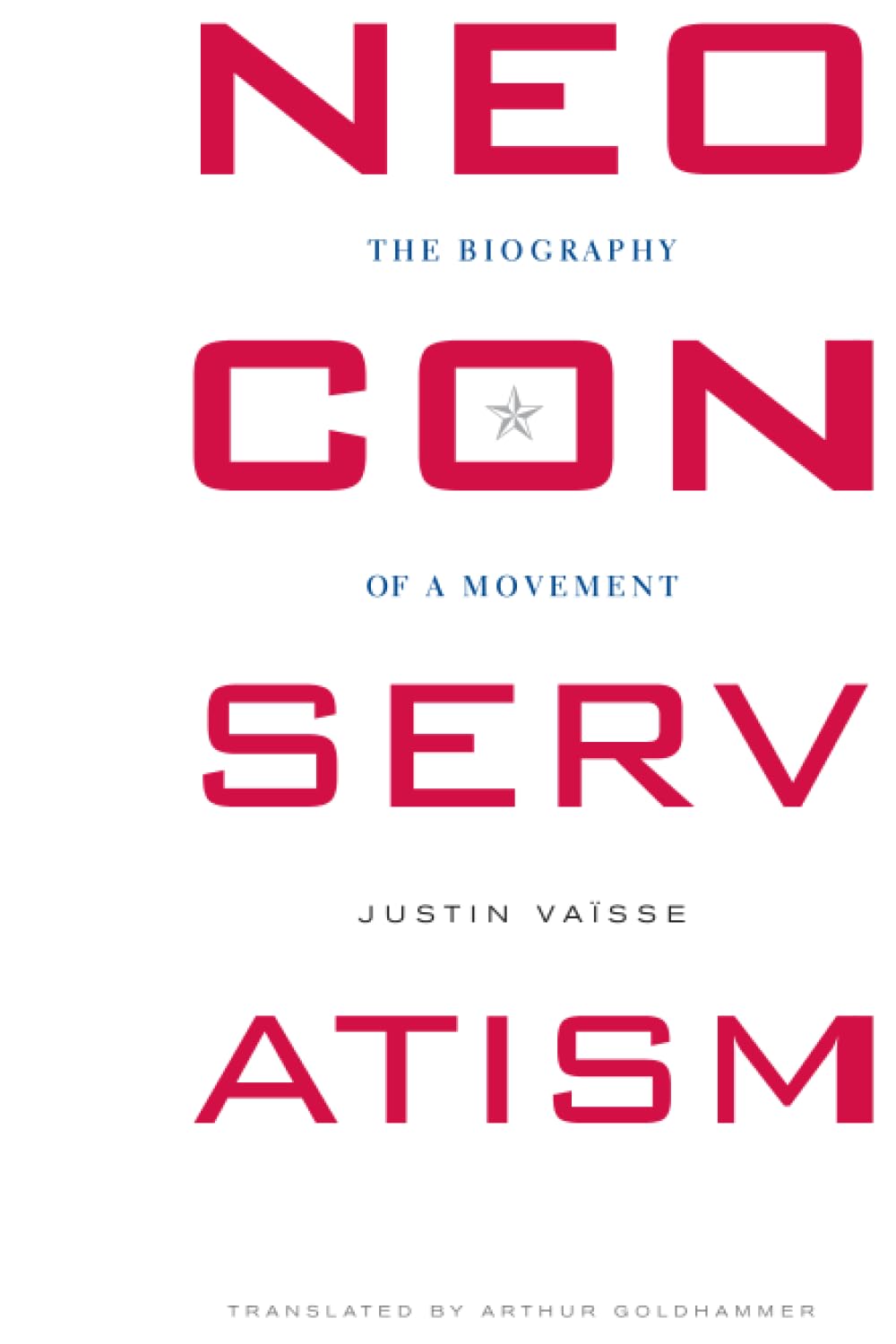
“Neoconservative” is one of those political labels that many people recognize but relatively few understand. French political scientist Justin Vaïsse has therefore done a great service in writing this deeply researched, admirably objective, and well-balanced history of a movement that has exerted an outsized influence on American foreign policy over the past half century, particularly during the early years of the Ronald Reagan and George W. Bush administrations. If you’ve read and enjoyed James Mann’s Rise of the Vulcans: The History of Bush’s War Cabinet (2004), which might be thought of as “Neocon 101,” Vaïsse’s Neoconservatism: The Biography of a Movement (2010) is more akin to an advanced graduate seminar. The adjectives “authoritative” and “definitive” seem entirely appropriate.
“Neoconservatism was a reaction,” Vaïsse writes; “it was born in a battle over the legacy of liberalism.” It was a battle the neoconservatives ultimately lost, prompting their gradual migration to the political right and, eventually, the Republican Party. But according to Vaïsse, this was a long, circuitous, and often contentious journey. Indeed, “The story of neoconservatism cannot be told in any simple, linear way … discontinuity, heterogeneity, and contradiction are an integral part of [it].” So diverse and internally contradictory was the movement, he argues, that the term “neoconservative” has at times approached the point of meaninglessness.
It has no clearly identifiable electoral, economic, or religious base; no formal political organization; and no universally recognized leader. Rather, it is better understood as an intellectual outlook – or, more nebulously, a political “tendency” or “persuasion.” At its core, Vaïsse argues, neoconservatism emerged largely in reaction to a series of political and cultural developments associated with the American left in the decades following the Second World War: the student protest and counterculture movements of the 1960s; the rise of the New Left; disillusionment with aspects of the Great Society and War on Poverty; the emergence of Black Power and other forms of identity-based radicalism; and, in foreign policy, détente and accommodation with the Soviet Union and Eastern bloc. In this sense, neoconservatism was defined at least as much by what its adherents opposed as by any single, coherent political doctrine.
Vaïsse argues that neoconservatism developed gradually over the course of half a century, passing through three distinct phases. The first was dominated by left-wing Jewish intellectuals, many of them Trotskyists or recent immigrants, who gathered in Alcove One at the City College of New York. This first generation of neoconservatives included figures such as Irving Kristol, Daniel Bell, and Daniel Patrick Moynihan and was concerned primarily with domestic policy, particularly what its members regarded as the shortcomings of state-administered social reform. Their principal journal was The Public Interest, founded in 1965, which pursued a highly technocratic and deliberately nonideological line and soon emerged as an intellectual mouthpiece for the incipient neoconservative movement. Its contributors dissected the shortcomings of government anti-poverty programs and developed an increasingly skeptical view of what social policy could realistically accomplish. Three ideas in particular emerged: that the state was severely limited in its ability to remake society; that government could create instability by raising expectations beyond what public policy could reasonably deliver; and that the fundamental obstacles to successful state intervention were often cultural and moral rather than simply social or economic.
At roughly the same time that these disaffected liberals – many of them Jewish – were losing faith in the efficacy of government activism and social reform, the Six-Day War of 1967 helped foster an increasingly strong identification with Israel. Domestic and foreign-policy concerns thus began to converge. This first generation of neoconservatives increasingly advocated a morally confident and militarily strong United States, actively engaged in world affairs, supportive of democracy abroad, and particularly committed to the defense of Israel. It was also the Six Day War, along with between Black and Jewish groups in Brooklyn known as the Ocean Hill-Brownsville Affair, that pushed the journal Commentary, founded in 1945 by the American Jewish Committee, and led by Norman Podhoretz in the late 1960s, with help from his wife, Midge Decter, to move into the neoconservative camp.
This first generation of neoconservatives continued to see themselves very much as liberals and Democrats, faithful to the central tenets of the New Deal but increasingly alienated from the New Left and its turn away from traditional concerns with economic inequality and organized labor toward questions of race, identity, and the politics of the counterculture. Vaïsse identifies seven main pillars of this first age of neoconservatism. First, America was in crisis, and the most urgent task on the political agenda was restoring stability rather than pursuing further reform. Second, this crisis was fundamentally one of culture, values, and moral standards. Third, much of the upheaval originated with the emerging “new class” of college-educated Baby Boomer intellectuals, academics, bureaucrats, social workers, consultants, and lawyers, whom the neoconservatives regarded as privileged and increasingly detached from mainstream American society. Fourth, the state had fallen victim to inflated expectations about what government reform could accomplish, particularly in its pursuit of equality of outcomes among different racial and social groups. Fifth, the state’s capacity to shape society and effect lasting change was inherently limited, making ambitious social programs prone to disappointment and unintended consequences. Sixth, “intellectuals” were not synonymous with “experts,” and intellectual sophistication did not necessarily confer practical wisdom. Finally, freedom of thought was increasingly under threat, particularly on American university campuses. “New Left orthodoxy brooked no challenge,” Vaïsse writes, “and anyone who proposed a ‘deviant’ idea was branded a racist or fascist” – a critique that, whatever one thinks of its merits, has proved remarkably durable in American political and cultural debate.
Vaïsse dates the beginning of the second age of neoconservatism to George McGovern’s victory in the 1972 Democratic presidential primaries and his subsequent landslide defeat by the incumbent and embattled Richard Nixon. In response, the neoconservatives rallied around Washington Senator Henry “Scoop” Jackson and the newly formed Coalition for a Democratic Majority (CDM), which sought to pull the Democratic Party back toward the “vital center” of postwar liberalism, with its traditional emphasis on economic issues, organized labor, and family values. “The goal was nothing more or less than to recapture the soul of the Democratic Party,” Vaïsse writes. In their view, the New Left had gained control of the party through a series of reforms to presidential candidate selection and other party rules that were intended to break the power of party bosses and traditional Democratic power brokers and make the nominating process more open, democratic, and inclusive. The problem, from the perspective of the Old Left, was that these reforms disproportionately empowered the emerging “new class” – radicalized students, intellectuals, and representatives of previously underrepresented groups – rather than the “ordinary citizen” of the Democratic Party’s traditional working-class base. The result, Vaïsse writes, was that “the Democratic Party’s efforts to democratize itself actually had the effect of radicalizing the party and circumventing the principle of majority rule.”
The CDM’s manifesto, issued just a month after McGovern’s disastrous defeat in the 1972 presidential election, centered on four broad themes. First, the emerging “new class” of politicians and intellectuals had lost touch with ordinary voters by presuming to know what was best for them, while many of the policies they championed had, in the CDM’s view, failed to deliver their promised results. Second, the “good class” of ordinary working class people valued social order and respected mainstream moral values. Third, while the pursuit of greater fairness and equality remained a worthy liberal objective, racial and other quotas were not the proper means of achieving it. Finally, in foreign policy, the isolationism and defeatism that the CDM believed were emerging in the aftermath of the Vietnam War had to be resisted in favor of continued American engagement abroad. McGovern’s appeal to the American people in 1972 had been “Come Home, America.” The CDM’s pointed rejoinder – and the title of its manifesto – was “Come Home, Democrats.”
The CDM remained a relatively small organization whose outsized influence owed much to the intellectual and political prominence of its modest membership. During the mid-1970s, it concentrated on “reforming the reforms” that had transformed the Democratic Party between 1968 and 1972, particularly those governing delegate selection, while also staking out an increasingly forceful position on foreign policy, one of the principal distinctions Vaïsse draws between the first and second ages of neoconservatism. The New Left tended to regard the threat of global communism as exaggerated and embraced “No more Vietnams” as a guiding principle of foreign policy. The neoconservatives, by contrast, continued to view the Cold War as an ideological and geopolitical struggle with an expansionist Soviet Union and operated from a very different historical lesson: “No more Munichs.” Among the leading figures in this emerging neoconservative, anti-détente foreign-policy movement were a collection of “Scoop Jackson Democrats,” including former Yale Law School dean Eugene Rostow, Admiral Elmo Zumwalt, Daniel Patrick Moynihan, Jeane Kirkpatrick, AFL-CIO president George Meany, foreign-policy establishment figure Paul Nitze, and Jackson aide Richard Perle.
The CDM’s neoconservative vision rested on five main elements, Vaïsse argues. First was the promotion, rather than merely the defense, of democracy as a central objective of American foreign policy. The CDM took Woodrow Wilson’s aspiration of making the world “safe for democracy” a step further, seeking instead to make the world safer through the spread of democracy itself. Second, and closely related, was an unabashed commitment to the defense of human rights. In doing so, the CDM sought to redraw the traditional boundaries of American foreign policy by making the internal conduct of other governments a legitimate concern of the United States. The remaining three elements were largely subordinate to, and supportive of, these first two: the maintenance of overwhelming American military power, an unwavering commitment to the defense of Israel, and a deep suspicion of the United Nations.
A watershed moment in the second age of neoconservatism was the passage of the 1974 Jackson–Vanik Amendment, which tied favorable U.S. trade treatment for communist countries to their willingness to permit free emigration. Aimed primarily at the Soviet Union, which severely restricted emigration – particularly among Soviet Jews looking to emigrate to Israel – the amendment sought to use American economic leverage to advance human rights behind the Iron Curtain. This approach stood in sharp contrast to the more traditional realpolitik of Henry Kissinger, who, as national security advisor and secretary of state under Presidents Nixon and Ford, emphasized détente, strategic stability, and the management of great-power relations over attempts to influence the Soviet Union’s internal political practices.
The election of Jimmy Carter in 1976 proved a decisive moment for the CDM and placed many neoconservatives in an increasingly awkward political position. Although they remained nominally loyal Democrats, and many had enjoyed highly distinguished careers in government, academia, and public policy, only a small handful were offered positions in the Carter administration. When one relatively minor CDM member was offered the ambassadorship to Micronesia, the neoconservatives joked: “They wouldn’t give us Polynesia or Macronesia, only Micronesia.” More consequentially, they were deeply troubled by Carter’s nomination of former McGovern foreign-policy adviser Paul Warnke to head the Arms Control and Disarmament Agency, regarding him as insufficiently hawkish toward the Soviet Union. Over the course of Carter’s tumultuous single term, their estrangement from the Democratic administration steadily deepened. As Vaïsse writes, “The CDM moved from circumspection to overt criticism to a spectacular divorce in 1980 that took the Cold War Democrats straight into the orbit of Ronald Reagan.”
That growing estrangement from the Democratic foreign-policy establishment soon found another institutional outlet in the revival of the Committee on the Present Danger (CPD). The CPD was revived in 1976 by a bipartisan group of prominent Cold War national-security figures, led particularly by Eugene Rostow and Paul Nitze, who believed détente and arms-control policies were allowing the Soviet Union to gain a dangerous strategic advantage over the United States. Drawing many members from the same circle of anti-détente Democrats associated with the CDM, the committee mounted a highly visible campaign for increased defense spending, a tougher approach toward Moscow, and opposition to SALT II. Its significance extended beyond the Carter years: Ronald Reagan joined the CPD, and many of its members subsequently entered his administration, helping provide an intellectual and personnel bridge between the hawkish Democratic foreign-policy establishment of the 1970s and Reagan’s more confrontational Cold War strategy in the 1980s, which sought not military equivalence but superiority, and not defense or containment, but victory. Over Reagan’s two terms, 65 of the CPD’s directors received more than 100 appointments of one kind or another.
The third age of neoconservatism, as Vaïsse describes it, began in 1995 with the founding of The Weekly Standard by William Kristol, Fred Barnes, and John Podhoretz, with financial backing from Rupert Murdoch’s News Corporation. Two years later, Kristol and Robert Kagan established the Project for the New American Century (PNAC), whose stated purpose was to promote American global leadership, a strong military, and a more assertive foreign policy. The Weekly Standard provided this new generation of neoconservatives with an influential intellectual and journalistic platform, while PNAC offered an institutional vehicle for translating many of the same foreign-policy ideas into concrete policy advocacy. At roughly the same time, neoconservatives became increasingly influential at the long-established American Enterprise Institute (AEI), founded in 1938 by business leaders opposed to expanding federal intervention in the economy. Meanwhile, the institutions of the second age were disappearing: the CPD effectively dissolved with the end of the Cold War, while the CDM gradually faded from relevance and was eclipsed within Democratic politics by the more effective centrist Democratic Leadership Council (DLC), which played an important role in Bill Clinton’s rise to the presidency in 1992.
Unlike their predecessors in the first two ages, Vaïsse argues, the neoconservatives of the third generation did not begin their political journey on the left. They also embarked on their project with the confidence – or perhaps hubris – of a movement that believed it had just “won” the Cold War. Vaïsse criticizes these post-Cold War neoconservatives for embracing a worldview that, in his telling, remained largely frozen in the great-power rivalries and ideological struggles of the 1930s. From this outlook emerged several basic principles that guided their approach to foreign policy.
First, the United States had both an interest and a responsibility to play an active role in maintaining and defending an American-led international order. The post-Cold War “peace dividend” presented a historically rare opportunity to shape the world in the direction of liberal democracy and market-oriented capitalism, and that opportunity should not be squandered through American retrenchment. Second, Vaïsse argues that third-age neoconservatives placed particular importance on the character of political regimes, believing that democracies were inherently more likely to be friendly toward the United States and that a world containing fewer dictatorships would therefore be safer for both America and the international community, a worldview often associated with Leo Strauss, a political philosopher at the University of Chicago under whom many leading third age neoconservatives, such as Paul Wolfowitz, Abram Shulsky, and Francis Fukuyama, had studied. Third, they tended to regard American power as fundamentally benevolent. Multilateral action might be desirable and generally preferable, but unilateral action could be both necessary and legitimate when required to advance vital American interests. Fourth, consistent with the second age of neoconservatism, they regarded the United Nations not merely as ineffective but as fundamentally flawed, particularly because its institutional structure allowed authoritarian governments to constrain the actions of democratic powers. Finally – and perhaps most consistently across all three ages of the movement – third-age neoconservatives favored robust military spending and, equally important, the political willingness to use military power when circumstances demanded it. “Not all hawks are neoconservatives,” Vaïsse quips, “but all neoconservatives are hawks.”
The twin neoconservative pillars of democratic peace and American power ultimately emerged as central elements of the Bush Doctrine. George W. Bush’s second inaugural address in 2005 amounted to a full-throated expression of the third-age neoconservative worldview: “It is the policy of the United States to seek and support the growth of democratic movements and institutions in every nation and culture, with the ultimate goal of ending tyranny in our world.” It is partly for this reason that prominent neoconservatives associated with the Bush administration, including Perle and Wolfowitz, came to be labeled – often derisively – the “architects of the Iraq War.” Vaïsse, however, assigns primary responsibility for the war’s execution to Defense Secretary Donald Rumsfeld, who the author labels an “aggressive nationalist,” arguing that he embraced neoconservative ends (the overthrow of Saddam Hussein and establishment of representative democracy) without providing what Vaïsse regards as the necessary neoconservative means (overwhelming military force from the outset). The resulting debacle helped produce a rupture within the American right analogous, in Vaïsse’s telling, to the divisions that had fractured the Democratic foreign-policy establishment after Vietnam. “Conservative [Republicans] were driven to apoplexy by the insolence and rashness of the neocons,” Vaïsse writes, “by their readiness to play the role of social engineers and sorcerer’s apprentice.”
In closing, Vaïsse’s biography of the neoconservative movement is impressively deep, textured, and fair-minded. He summarizes its evolution across three distinct ages. The first was primarily a reaction against the perceived drift of American liberalism during the 1960s, particularly around domestic policy, and what neoconservatives regarded as the New Left’s increasingly systematic denigration of the United States. The second was, above all, a repudiation of the defeatism they believed had followed the Vietnam War and the accompanying assault on America’s moral legitimacy. The third, emboldened by the collapse of the Soviet Union and America’s emergence as the world’s sole superpower, embraced what George W. Bush later called “the transformative power of freedom,” seeking to use American power actively to promote the spread of democracy throughout an international system dominated by the United States. In the end, Vaïsse’s most serious criticisms of neoconservatism fall on two fronts. First, he argues that “alarmism and exaggeration of the threat have indeed been a constant feature of the neoconservative worldview.” Second, he regards the movement’s faith in democratic peace as overly dogmatic and idealistic; an ultimately naïve confidence that the spread of democracy would necessarily produce a more peaceful, secure, and American-friendly world.


Leave a Reply