In 1888, James Bryce, a British historian, jurist, and future ambassador to the United States, published The American Commonwealth, a sweeping three-volume study of American government, politics, and society. Bryce sought to do for the United States what Alexis de Tocqueville’s Democracy in America had done half a century earlier: explain how American democracy actually worked and what its experience revealed about democratic government more broadly. Among the dangers Bryce identified was the possibility that representative democracy could elevate a leader who claimed popular support as license to disregard institutional and legal restraints. “A bold president who knew himself to be supported by a majority in the country, might be tempted to override the law, and deprive the minority of the protection which the law affords,” Bryce warned. “He might be a tyrant, not against the masses, but with the masses.”
For much of American history, that particular danger never fully materialized at the presidential level. The country certainly produced powerful demagogic figures, particularly during periods of fear, dislocation, and uncertainty. Louisiana governor and senator Huey Long built a formidable populist movement amid the economic desperation of the Great Depression, while Wisconsin senator Joseph McCarthy exploited fears of Communist infiltration during the early Cold War. Yet neither reached the presidency nor even came close. The idea that a candidate widely characterized by critics as a wild-eyed demagogue could nevertheless win the nation’s highest office through the established electoral process remained largely hypothetical. Then, in 2016, Donald Trump won the presidency, bringing renewed attention to the kind of danger Bryce had described nearly 130 years earlier.
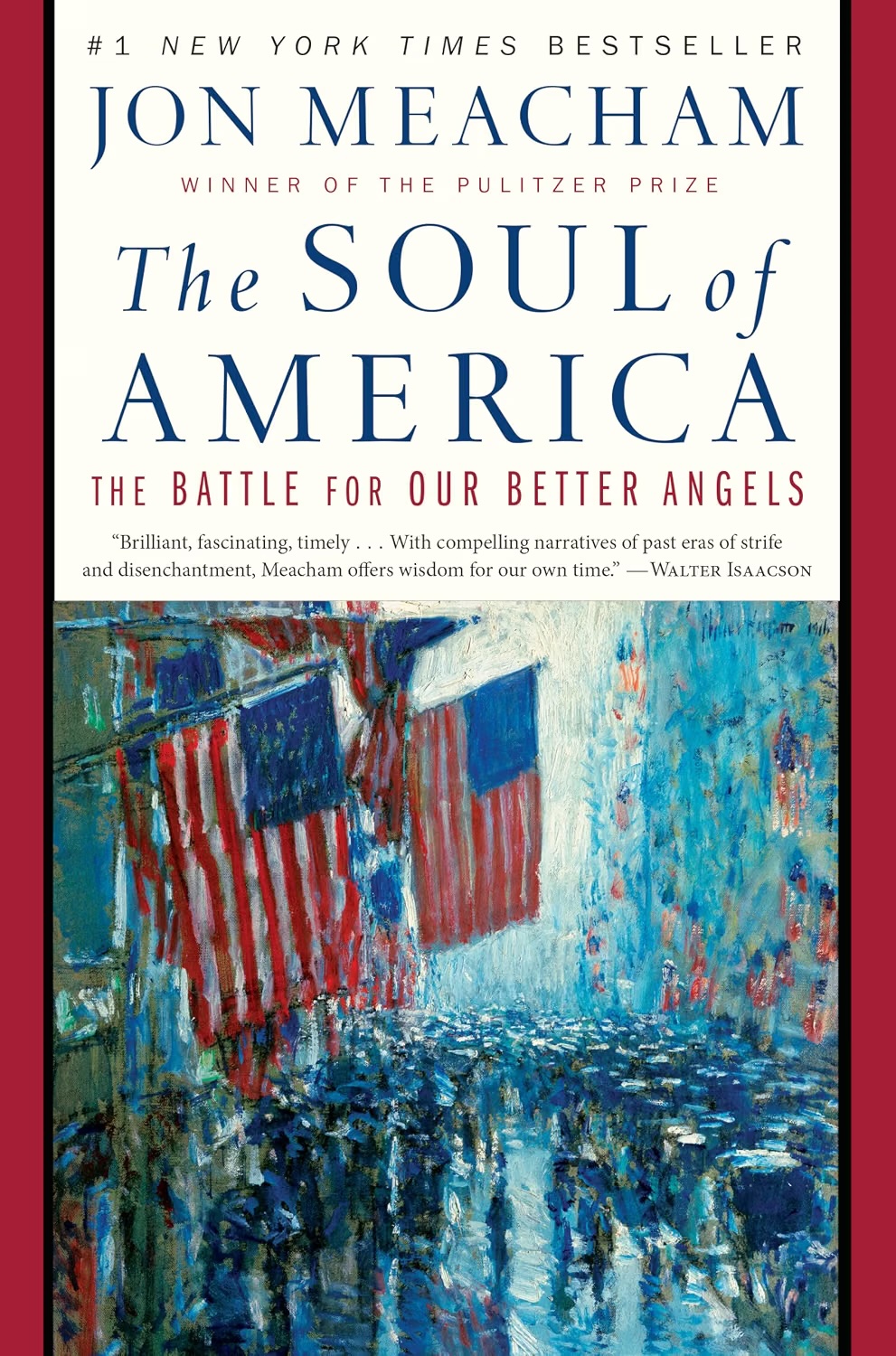
Unfortunately, how and why this happened when it did is not the focus of Jon Meacham’s The Soul of America: The Battle for Our Better Angels (2018). If you are looking for an incisive explanation of what changed in American politics over the preceding half century to create the conditions for Trump’s election, Ezra Klein’s Why We’re Polarized (2020) is a more useful place to start. Klein examines the question in depth, tracing the structural, psychological, and identity-driven forces that have increasingly sorted Americans into opposing political camps. Meacham’s book has a different purpose. It is less an explanation of our present predicament than a historical morale booster. “Every generation tends to think of itself as uniquely challenged and under siege,” he writes, but his larger point is that Americans have been wrestling with hatred, intolerance, racism, xenophobia, and class conflict since the nation’s inception. The struggle is not confined to any particular time or place but is, as Meacham puts it, an “eternal struggle.” Within Meacham’s argument, Trump represents the latest manifestation of these recurring forces, one that gives particular urgency to his appeal for Americans to summon what Abraham Lincoln famously called the “better angels of our nature.” The United States, Meacham concedes, has demonstrated only “sporadic adherence to its finest aspirations,” and he places responsibility on ordinary citizens as well as political leaders to bring the country closer to those ideals. It is a fine and noble aim. As history, however, the book falls flat, committing several of the historiographical sins Gordon S. Wood identifies in The Purpose of the Past (2008) – most notably presentism and the tendency to enlist the past in the service of a contemporary political argument.
The last sentence of the introduction is: “What follows is the story of how we have endured moments of madness and injustice … and how we can again.” The Soul of America is less a conventional narrative history than an extended argument about the ugly recurring rhythms of American political life. Meacham’s core theme is that America has repeatedly succumbed to fear, exclusion, and political extremism, but it has also repeatedly found the capacity to overcome them. Progress is neither automatic nor irreversible. Meacham uses a series of historical crises – from Reconstruction through the civil-rights era – to argue that the American political tradition contains both darkness and light, and that the country’s “soul” consists largely in the continuing struggle between them.
The central tension in Meacham’s interpretation is fear versus hope. American history, in his telling, repeatedly oscillates between periods in which political figures exploit fear – of Black political power, immigrants, Catholics, communists, economic collapse, or social change – and periods when Americans broaden their understanding of who belongs within the promise of “We the People.” Meacham does not claim that history inevitably bends toward justice. Rather, his optimism rests on the historical observation that expansions of American liberty have survived repeated attempts to reverse them. As he later summarized his argument, the country has tended to become stronger as it has widened the circle of people entitled to participate fully in American life.
One of Meacham’s most important case studies is the aftermath of the Civil War. Appomattox did not settle the political meaning of emancipation. Reconstruction briefly created an extraordinarily expanded conception of American citizenship, including Black political participation, but it generated a violent counterrevolution. The Ku Klux Klan attempted through terror to restore white political supremacy and destroy the new order.
Here Meacham emphasizes presidential leadership. Ulysses S. Grant used federal power aggressively against the Klan, supporting enforcement legislation and federal prosecution of white supremacist terrorism. It is an example of what Meacham considers one of the presidency’s essential functions: a president can legitimize either the country’s inclusive impulses or its exclusionary ones.
Yet the story also illustrates the limits of Meacham’s optimism. Reconstruction collapsed, federal protection receded, and Jim Crow followed. Black Americans were systematically disenfranchised across much of the South. Progress, therefore, was not linear; victories could be followed by decades of regression.
Theodore Roosevelt provides Meacham with a deliberately complicated example. Roosevelt believed strongly in national unity and used what he famously called the presidential “bully pulpit” to shape public opinion. His invitation of Booker T. Washington to dine at the White House in 1901 provoked an extraordinary racist backlash, yet Roosevelt refused to apologize for it. He also resisted political pressure in cases involving Black federal officeholders.
But in a classic example of presentism, Meacham faults Roosevelt for failing to meet the standards of a modern racial egalitarian. Roosevelt unquestionably held assumptions about racial hierarchy common among white Americans of his era and embraced both Anglo-Saxon nationalism and imperialism, views that Meacham seems either unable or unwilling to assess within the context of Roosevelt’s own time.
The contradiction matters because it reinforces a larger point in the book: historical progress frequently comes through imperfect people rather than morally immaculate heroes. Presidents respond to political pressures, prejudices, movements, and opportunities. The real litmus test, Meacham argues, is whether, at critical moments, they enlarge or narrow the boundaries of American citizenship.
Meacham next turns to the early twentieth century, when remarkable democratic expansion coexisted with intense reaction. The ratification of the Nineteenth Amendment in 1920 dramatically expanded political participation by granting women constitutional protection for the right to vote. Meacham highlights activists such as Alice Paul and Carrie Chapman Catt as evidence that political change rarely originates solely with presidents; citizens and movements create the pressures that make presidential action possible.
But the same period witnessed the Red Scare, intense anti-immigrant sentiment, and the rebirth of the Ku Klux Klan. The second Klan was not merely a southern organization directed against Black Americans. It became a mass national movement attacking Catholics, Jews, immigrants, and others deemed insufficiently “American.” By the 1920s, its membership numbered in the millions.
The juxtaposition is quintessential Meacham: the expansion of democracy and the politics of exclusion can occur simultaneously. Advances toward equality frequently provoke counter-movements from people who believe that social change threatens their status or conception of the country.
The Great Depression supplies another test. Economic catastrophe created fertile ground for political extremism, represented in Meacham’s narrative by figures such as Huey Long and Father Charles Coughlin. Both demonstrated how economic anxiety could be transformed into populist resentment and, in Coughlin’s case, antisemitism. The isolationist America First movement later provided another manifestation of the temptation to retreat from the wider world.
Franklin Roosevelt serves as Meacham’s principal counterexample and is plainly one of his personal heroes. FDR responded to economic fear not simply through New Deal programs but through rhetoric designed to restore confidence in democratic government. The famous injunction that Americans had “nothing to fear but fear itself” captures almost perfectly Meacham’s larger thesis: fear itself can become a political force capable of undermining democratic institutions.
But again Meacham complicates his hero. Roosevelt’s administration interned Japanese Americans during World War II, demonstrating that even a president whom Meacham regards as a quintessential defender of democratic values could succumb to precisely the politics of racial fear that the book condemns.
Joseph McCarthy is perhaps Meacham’s clearest illustration of how fear can be weaponized politically. Genuine concern about Soviet espionage and communism provided the raw material. McCarthy converted that concern into a politics of accusation, insinuation, and spectacle, attacking figures including George Marshall and Dean Acheson while portraying political opponents as enemies within.
Meacham is especially interested in the interaction between McCarthy and the emerging medium of television. Television initially magnified McCarthy’s influence, but it ultimately exposed him. During the nationally televised Army-McCarthy hearings of 1954, Army counsel Joseph Welch famously confronted him with the question, “Have you no sense of decency, sir?” The episode helped crystallize public revulsion against McCarthy, and the Senate censured him later that year.
The episode reinforces two of Meacham’s recurring themes: demagogues flourish when respectable political leaders are unwilling or afraid to confront them, and new communications technologies are politically neutral, capable of both amplifying demagoguery and exposing it. The latter has obvious resonance in today’s fragmented media environment of social media and partisan news.
The culmination of Meacham’s historical argument comes with the civil-rights movement. Here the interaction between citizen activism and presidential leadership is clearest.
Martin Luther King Jr., Rosa Parks, John Lewis, and countless activists forced racial injustice onto the national political agenda. Their protests confronted Americans with the contradiction between the country’s democratic ideals and Jim Crow. But social movements alone could not enact federal legislation. Eventually, they found a formidable political partner in Lyndon Johnson, whom Meacham clearly seeks to rescue from the historical shadow cast by Vietnam.
Johnson is especially important to Meacham because he illustrates the constructive possibilities of presidential power. A white southerner with an imperfect record on race, Johnson nevertheless decided to expend enormous political capital on civil rights. His administration helped secure the Civil Rights Act of 1964 and Voting Rights Act of 1965.
The title of Meacham’s chapter on Johnson – “What the Hell’s the Presidency For?” – captures his conception of political leadership. Presidential power is valuable not merely for winning elections or preserving popularity but for accomplishing difficult things that advance the national promise. Meacham portrays the combination of King’s moral pressure and Johnson’s mastery of institutional politics as one of the clearest examples of America choosing its “better angels.”
Although The Soul of America spends considerable time on presidents, Meacham does not ultimately argue that presidents save America by themselves. His model is more reciprocal: leaders shape public opinion, but public opinion also determines what leaders believe is politically possible.
This is why figures outside government – suffragists, civil-rights activists, journalists, lawyers such as Joseph Welch, and ordinary voters – occupy an important place in the book. As Meacham explained while discussing the book, the historical moments Americans most admire tend to occur when “the powerless have ultimately attracted the attention of the powerful.”
That insight helps resolve an apparent tension in the book. Meacham sometimes writes as though presidential character determines the fate of the republic, yet his historical examples repeatedly demonstrate that presidents often move only after citizens create sufficient political pressure. Leadership therefore runs in both directions.
The book’s immediate context is impossible to miss. The Soul of America grew partly from Meacham’s response to the 2017 Charlottesville violence, and Donald Trump serves as the implicit – and sometimes explicit – contemporary reference point for Meacham’s discussions of nativism, racial politics, demagoguery, and presidential rhetoric. His purpose in The Soul of America was to put the politics of his own moment into a longer and larger historical context.
The strength of The Soul of America is therefore also its principal weakness. Meacham writes history as moral instruction. That makes the book highly readable but occasionally reductive. Complex historical developments are compressed into a recurring drama of fear versus hope, exclusion versus inclusion, demagoguery versus leadership. Structural forces, such as economic change, institutions, class conflict, regional interests, and demographic shifts, sometimes receive less attention than personalities and presidential rhetoric.
Perhaps the deepest lesson of The Soul of America is not that America’s “better angels” inevitably prevail. It is that they win only intermittently, incompletely, and because people make them win. Meacham’s America has no permanently settled soul. It contains competing traditions: equality and hierarchy, pluralism and nativism, generosity and fear. Every generation inherits both. The historical pattern he traces from Grant through Theodore Roosevelt, Franklin Roosevelt, and Lyndon Johnson suggests that national crises do not resolve themselves through some automatic mechanism of American exceptionalism. Progress occurs when citizens organize, institutions hold, and leaders decide that preserving or expanding democratic inclusion is worth the political cost.
That makes The Soul of America ultimately less a celebration of American goodness than an argument for historically informed vigilance. Meacham’s optimism is conditional: America has survived dark periods before, but principally because earlier Americans eventually chose to confront them. The “battle for our better angels,” in his telling, is not a battle America once won. It is a battle each generation has to fight again.
Meacham concludes with a short list of largely platitudinous recommendations for how contemporary Americans might summon and sustain the nation’s “better angels.” He urges citizens to “enter the arena” by becoming involved in politics at the local or national level; resist the tribalism that has consumed modern political discourse; respect facts and apply reason; seek balance and embrace compromise rather than view politics as a zero-sum contest; and, finally, keep history in mind, remembering that the present generation is merely the latest participant in a much longer struggle over the character of the American soul. On one level, each of these recommendations is unobjectionable, even self-evidently sensible. On the other hand, they are so earnest, obvious, and reassuringly “mom-and-apple-pie” that they border on the banal.
Meacham concludes The Soul of America this way: “History … shows us that we are frequently vulnerable to fear, bitterness, and strife. The good news is that we have come through such darkness before.” I have little doubt that he is right. The problem is that I knew as much before opening The Soul of America, and nothing in the book substantially deepened my understanding of why these darker impulses periodically gain ascendancy, why they recede, or what might prevent their return. Meacham offers reassurance where explanation is needed, leaving the reader comforted perhaps, but not much wiser.
 What's Tim Reading Now?
Leave a comment