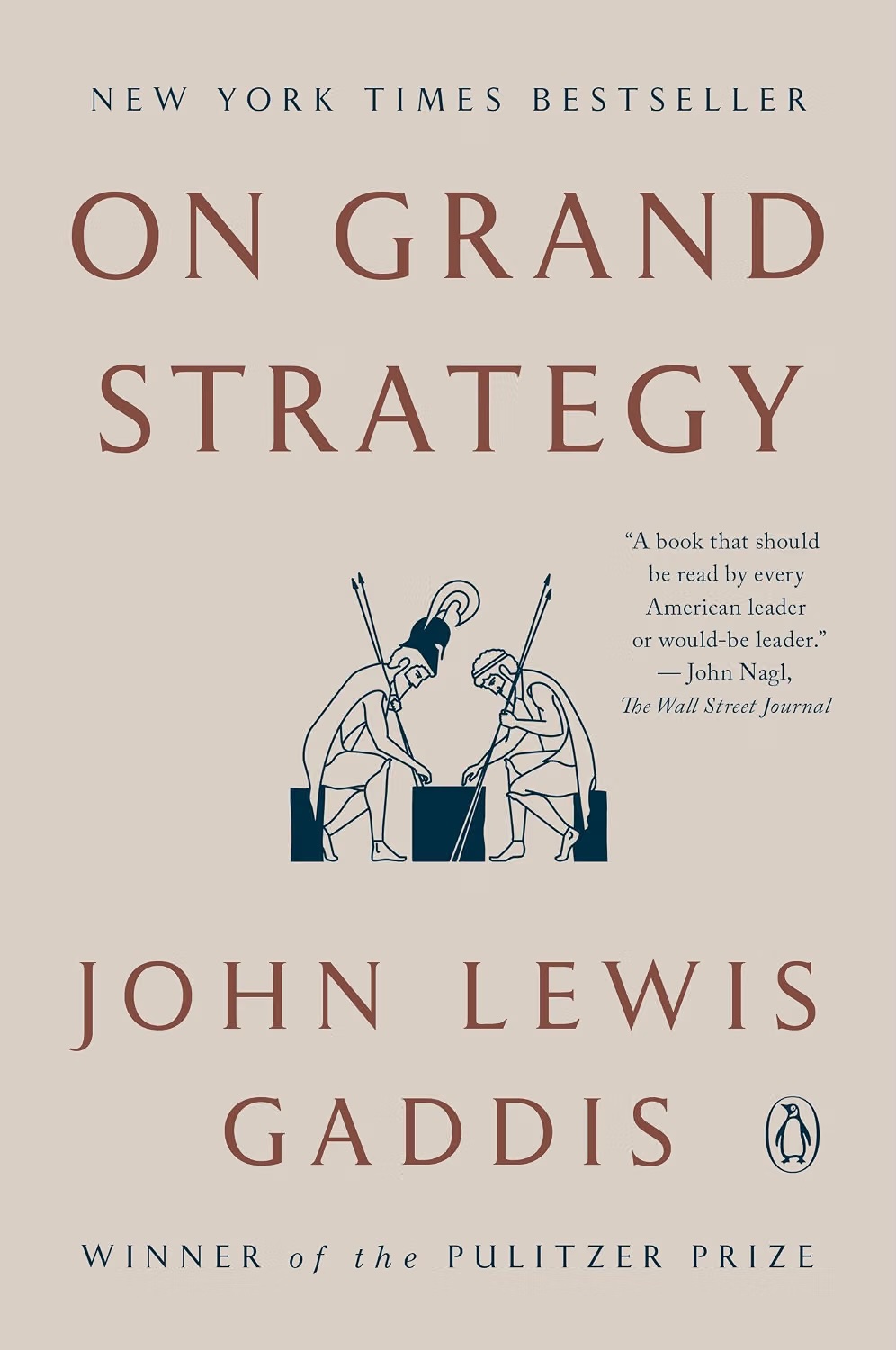
John Lewis Gaddis, the distinguished Yale historian of the Cold War, begins On Grand Strategy (2018) with a deceptively simple definition. Grand strategy is the alignment of “potentially infinite aspirations with necessarily limited capabilities.” We are constantly tempted to want more than we possess the resources, time, knowledge, or power to obtain. Strategy is therefore fundamentally about connecting ends with means: deciding what matters most, understanding what resources and capabilities are actually available, and adjusting one to the other. The core thesis that Gaddis develops in On Grand Strategy is that the best strategist is neither the person with the grandest ambitions nor the one with the greatest capabilities, but the one who best maintains the relationship between the two.
This idea of proportionality runs throughout the book. Gaddis invokes Edmund Burke’s observation that “the thing bought must bear some proportion to the purchase paid.” Every objective carries a cost, and strategy fails when the value of the objective becomes disconnected from the resources required to obtain it. A victory can therefore become a strategic defeat if achieving it costs more than it is worth. Conversely, abandoning a secondary objective can represent strategic success if doing so preserves resources needed for something more important. Strategy requires continually asking not simply, Can we do this?, but Is what we hope to gain worth what we must expend to obtain it?
The difficulty is that successful strategists must simultaneously possess qualities that seem contradictory. Here Gaddis draws upon F. Scott Fitzgerald’s famous observation that “the test of a first-rate intelligence is the ability to hold two opposed ideas in the mind at the same time, and still retain the ability to function.” Grand strategy demands precisely this intellectual flexibility. Leaders must possess conviction without rigidity, ambition without losing sight of limitations, and long-term direction while remaining capable of adapting to circumstances they could never have anticipated.
This tension leads Gaddis to the ancient Greek poet Archilochus’s famous observation that “the fox knows many things, but the hedgehog knows one big thing.” Isaiah Berlin transformed this fragment into an influential distinction between two intellectual temperaments. Hedgehogs organize the world around a single overarching idea, while foxes draw upon many different experiences and explanations without attempting to fit everything into a unified theory. Political scientist Philip Tetlock subsequently provided empirical support for something resembling Berlin’s distinction in his book Expert Political Judgment: How Good Is It? How Can We Know? (2017). In his research, Tetlock found that fox-like thinkers – eclectic, skeptical, adaptable, and willing to revise their assumptions – generally made better predictions than hedgehogs committed to a single explanatory framework. There is much about Tetlock’s findings that I find shallow and almost tautological: is it really all that surprising that people who consistently hedge their bets will win more of them over time? Yet Gaddis does little to interrogate the argument, perhaps because it aligns so neatly with the broader case he is trying to make. Ironically, this leaves him open to precisely the kind of confirmation bias that Tetlock’s work warns against.
Russian novelist Leo Tolstoy occupies a particularly important place in Gaddis’s argument because he complicates the otherwise tidy distinction between foxes and hedgehogs. Isaiah Berlin famously described Tolstoy as a fox who desperately wanted to be a hedgehog: he sought universal laws capable of explaining the movement of history, yet his extraordinary powers of observation continually revealed a world governed by innumerable personalities, circumstances, accidents, and unintended consequences that resisted such simplification. Gaddis turns this apparent contradiction into a virtue. The successful grand strategist must possess the hedgehog’s ability to keep an ultimate destination in view while retaining the fox’s sensitivity to everything encountered along the way. Tolstoy’s genius in War and Peace was precisely his ability to move constantly between these perspectives; to see both the sweeping movement of armies and nations and the confused experiences of individuals caught within them. In this sense, Tolstoy helps Gaddis move beyond Berlin’s dichotomy: the greatest strategists are neither foxes nor hedgehogs, but people capable of being both and, crucially, knowing when to be which.
Gaddis turns the fox and hedgehog into archetypes of strategic leadership. Hedgehogs possess clarity of purpose. They know where they want to go and can pursue that objective with extraordinary determination. Their great weakness is that they can become so attached to their destination that they fail to notice when circumstances have changed, costs have become prohibitive, or the road they have chosen no longer leads where they expected. Foxes, by contrast, possess what Gaddis calls a “compass”: they know their general destination but are willing to alter their route as obstacles and opportunities appear.
There is an interesting modern parallel that Gaddis does not mention. Amazon founder Jeff Bezos has repeatedly described effective leadership as being “stubborn on vision” but “flexible on details.” The formulation could almost serve as a contemporary summary of Gaddis’s argument. Strategy requires something of the hedgehog’s stubbornness about ultimate objectives combined with the fox’s flexibility about how to achieve them. The best strategist, therefore, is not purely a fox or a hedgehog but someone capable of knowing when to behave like each, a concept that Graddis embraces in the end.
This helps explain another of Gaddis’s recurring themes: effective strategy often requires indirectness, deception, patience, and the willingness not to act. Sun Tzu captured the principle more than two millennia ago in On War: “When capable, feign incapacity; when active, inactivity.” Power need not always announce itself, and possessing a capability does not require immediately using it. Sometimes weakness should be concealed; sometimes strength should be concealed; sometimes the wisest action is to wait. The strategist who responds predictably to every challenge allows an adversary to determine his behavior. The strategist who preserves ambiguity retains freedom of action. It is precisely this kind of “it depends” perspective that may frustrate armchair strategists searching for a didactic guidebook, which On Grand Strategy most certainly is not. If anything, it is something of an “anti-guidebook,” emphasizing judgment, adaptability, and context over universal rules or tidy prescriptions.
Gaddis finds a related lesson in Saint Augustine, although in a very different moral context. Augustine confronted the unavoidable tension between the obligations owed to God and those owed to Caesar; between transcendent moral principles and the imperfect necessities of political life. Absolute commandments provide essential direction, but governing requires judgment about how principles should be applied amid conflicting obligations and imperfect choices. Augustine therefore approached questions such as war and peace through something resembling a checklist rather than a single absolute rule: Is the cause just? Is the authority legitimate? Is the intention proper? Are the means proportionate to the objective? The recurring principle is once again proportionality. Moral purpose cannot be entirely separated from practical consequences.
Prussian officer and war theorist Carl von Clausewitz provides Gaddis with perhaps the clearest military expression of this principle of proportionality. As articulated in On War, military conflict is not an end in itself but an instrument employed to achieve a political objective; consequently, the resources expended in fighting must remain proportionate to the value of the objective being sought. Yet Clausewitz also understood why maintaining this balance is so difficult. War is permeated by “friction” – fear, exhaustion, uncertainty, logistical problems, chance, and innumerable other forces that steadily erode capabilities – and offensives eventually approach a “culminating point” beyond which continued advance produces diminishing and ultimately negative returns. The great strategist must therefore continually reassess the relationship between objectives and resources rather than assuming that an initially successful strategy will remain successful indefinitely. In this sense, Clausewitz provides the theoretical foundation for Gaddis’s larger argument: strategy fails when leaders become so fixated on what they want to accomplish that they lose sight of what their available means can realistically sustain.
Gaddis illustrates these principles through a gallery of historical leaders, dividing them implicitly between failed or deeply flawed hedgehogs and more successful foxes. Among his hedgehogs are the elder Pericles, Julius Caesar, Philip II of Spain, George III, Napoleon, and Woodrow Wilson. These were hardly stupid or unsuccessful men. Indeed, several possessed extraordinary intelligence, courage, administrative ability, and political skill. Their problem was precisely the strength of their convictions. They pursued large objectives with such determination that they gradually lost the ability to adjust their ambitions to their capabilities.
The elder Pericles provides Gaddis with his opening cautionary example. Pericles understood that Athens could defeat Sparta only by refusing to fight the kind of land war Sparta wanted. His strategy was therefore to shelter the Athenian population behind the city’s walls, rely upon naval superiority, and exhaust the enemy. Yet circumstances – including plague and the psychological pressures of watching Attica ravaged – undermined the strategy. The larger lesson is that even a logically coherent plan can fail when it insufficiently accommodates human behavior, chance, and changing circumstances.
Julius Caesar represents a more spectacular version of the hedgehog problem. His extraordinary confidence, audacity, and military genius allowed him repeatedly to overcome obstacles that would have destroyed lesser commanders. Yet success itself encouraged him to assume that the normal constraints governing political behavior no longer applied to him. He accumulated power without adequately considering how Roman political culture would respond to its concentration in a single individual. His assassination was therefore not simply a failure of security but a failure of grand strategy: Caesar’s ambitions ultimately outran the political system’s capacity to tolerate them.
His adopted nephew, Octavian – later Augustus – learned precisely the lesson Caesar did not. He wanted much the same thing Caesar had sought: supremacy over the Roman world. But rather than openly destroying republican forms, he preserved them while quietly accumulating the substance of imperial authority. Caesar advertised his power; Augustus disguised his. The objective remained remarkably ambitious, but the method was flexible, patient, and exquisitely sensitive to political circumstances. Augustus was, in Gaddis’s terminology, the ultimate fox.
Philip II of Spain provides another classic hedgehog. He possessed immense resources and an equally immense sense of religious and dynastic mission, yet repeatedly committed those resources to objectives whose costs exceeded their strategic value. The Spanish Armada epitomized the problem. Philip’s ambitions – to defend Catholicism, suppress rebellion, defeat England, and preserve Spanish supremacy – continually outran even the enormous capabilities of his empire and his insistence on micromanaging all aspects of his empire, from the formulation of grand strategy to pedestrian tasks of bureaucratic administration.
Philip II’s great rival, Queen Elizabeth I, by contrast, embodied fox-like restraint. She understood that England was weaker than Spain and therefore avoided unnecessary commitments, manipulated ambiguity, supported allies indirectly, employed privateers, and delayed confrontation when delay served her purposes. Her policies could appear inconsistent because consistency of method was never her objective. What remained consistent was the preservation and strengthening of England. Elizabeth understood the distinction between maintaining a destination and insisting upon a particular route. Moreover, despite having a much smaller empire and administration, she readily delegated many responsibilities to a wide range of subordinates.
The same contrast appears between George III and the American Founders. Britain possessed vastly greater military and economic capabilities than its colonies, yet George and his ministers repeatedly failed to ask whether retaining political control over America was worth the escalating price required to impose it. The Americans, meanwhile, proved remarkably flexible about means. Washington could retreat repeatedly without abandoning the ultimate objective of independence. Franklin could seek assistance from an absolute French monarchy on behalf of a republican revolution. The Founders maintained extraordinary consistency about the destination while displaying considerable pragmatism about how to reach it.
Napoleon represents perhaps the ultimate hedgehog. His military genius repeatedly allowed him to overcome the limits that constrain ordinary leaders, encouraging him to believe that such limits did not apply to him. Each success enlarged his ambitions until his objectives exceeded even the enormous capabilities at his disposal. The invasion of Russia in 1812 became the ultimate demonstration of the failure to maintain proportionality between ends and means. Tactical brilliance could not rescue a grand strategy whose ambitions had become effectively unlimited. Napoleon hurled an army of some 600,000 men across thousands of miles of hostile and forbidding territory in pursuit of the comparatively modest objective of compelling Tsar Alexander I to adhere to his Continental System against British trade – a classic violation of Burke’s dictum that “the thing bought must bear some proportion to the purchase paid.” Not only was the objective not worth the price, but Clausewitzean friction also steadily destroyed the available means, and Napoleon failed to recognize that his campaign had passed its culminating point.
Abraham Lincoln, in contrast, ranks among Gaddis’s great foxes. Lincoln possessed an unwavering strategic objective – the preservation of the Union – but demonstrated remarkable flexibility about the means necessary to achieve it, a theme explored in some depth in Steven Spielberg’s award-winning film Lincoln (2012). His approach to slavery evolved as circumstances changed. He replaced unsuccessful generals, tolerated political contradictions within his coalition, adjusted policies to military realities, and understood that timing mattered. His genius lay not in possessing a detailed blueprint in 1861 for everything he would eventually do, but in maintaining a clear sense of direction while learning continuously from events.
Woodrow Wilson again demonstrates the danger of the hedgehog. His vision of a new international order after the First World War was extraordinarily ambitious and in many respects prescient. Yet Wilson became increasingly unwilling to compromise over the means required to realize it. His refusal to accommodate Senate opponents over American membership in the League of Nations allowed commitment to principle to undermine the very objective he sought. He knew what the destination should be but became rigid about the route.
Franklin Roosevelt may be Gaddis’s supreme fox. FDR could appear inconsistent, improvisational, secretive, and even contradictory because he was willing to pursue multiple approaches simultaneously and abandon those that failed. Yet beneath this tactical flexibility lay remarkably consistent strategic objectives: preserving American democracy through the Depression, defeating the Axis powers, and constructing a postwar international order capable of preventing another catastrophe. Roosevelt rarely allowed ideological consistency or attachment to a particular method to interfere with those larger purposes. He could cooperate with Stalin to defeat Hitler while simultaneously preparing for a world in which Soviet power would present a new challenge. He embodied Fitzgerald’s capacity to hold contradictory ideas simultaneously while retaining the ability to function.
The central lesson of On Grand Strategy, then, is not simply that foxes are wiser than hedgehogs. Pure foxes have their own weakness: endless flexibility without an overriding objective can degenerate into opportunism and drift. Grand strategy requires both temperaments. Leaders need the hedgehog’s ability to identify and maintain fundamental objectives and the fox’s capacity to adapt methods to circumstances. They must, in Bezos’s formulation, remain stubborn about the vision while flexible about the details.
This returns Gaddis to his deceptively simple definition of grand strategy as aligning potentially unlimited aspirations with necessarily limited capabilities. Burke supplies the discipline: what we seek must remain proportionate to what we are willing and able to pay for it. Fitzgerald supplies the intellectual temperament: contradictory ideas must coexist without paralyzing action. Archilochus, Berlin, and Tetlock supply the cognitive distinction between hedgehogs and foxes. Sun Tzu supplies flexibility, indirection, and deception. Augustine supplies the recognition that even moral objectives must be pursued through judgments involving competing obligations and proportionality.
The common thread is an acceptance of limits. Great strategists possess ambitions, principles, and destinations, but they never forget that resources are finite, circumstances change, adversaries react, chance intervenes, and even the strongest leaders cannot bend reality indefinitely to their will. The hedgehog’s recurring mistake is to force the world to conform to the plan. The fox’s great advantage is the ability to change the plan without losing sight of the purpose.
Perhaps the simplest distillation of Gaddis’s argument, therefore, is that grand strategy requires a fixed compass but an adjustable route. The destination provides direction; circumstances determine how one gets there. A hedgehog follows his compass no matter where it leads; a fox adheres to the general direction, but is pragmatic about his approach around inhospitable terrain. The leaders Gaddis most admires – Augustus, Elizabeth I, the American Founders, Lincoln, and above all Franklin Roosevelt – understood that distinction. His great hedgehogs – Caesar, Philip II, George III, Napoleon, and Wilson – too often did not. (Deng Xiaoping and Mao Zedong offer another classic historical pairing of the successful fox and the disastrous hedgehog, though Gaddis never mentions them.) Their failures arose not from insufficient ambition or ability, but from allowing their aspirations to escape the constraints imposed by their capabilities. And that is ultimately what grand strategy exists to prevent.
 What's Tim Reading Now?
Leave a comment