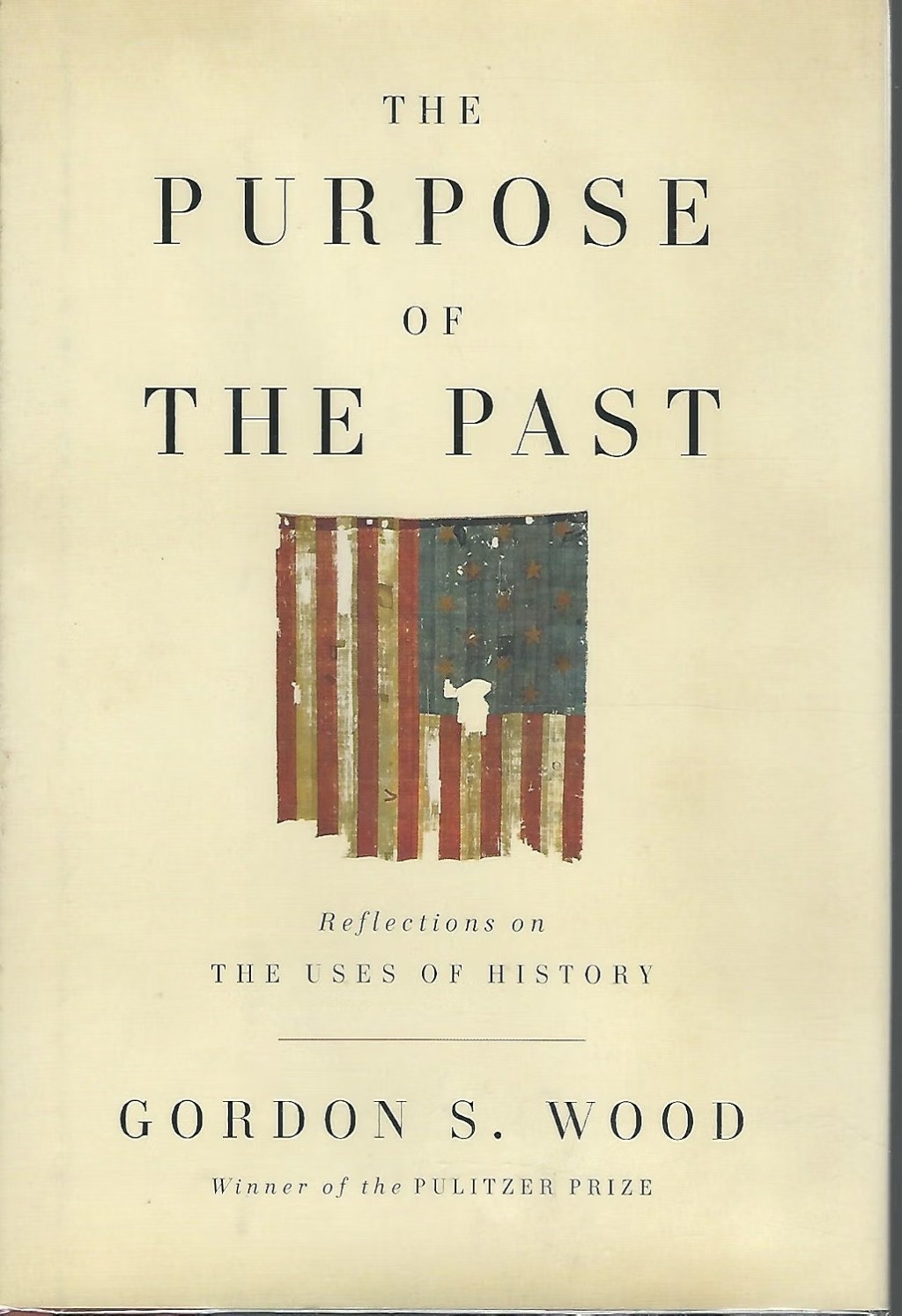
Gordon S. Wood, who died a few months ago at the age of 92, is one of my all-time favorite academic historians. His work is so insightful and consistently well written that I try to read virtually everything he has published, even when the subject falls outside my immediate interests. It was primarily Wood’s name, therefore, that led me to pick up The Purpose of the Past: Reflections on the Uses of History (2008), although I have also become increasingly interested in historiography and the historian’s craft as I have waded more deeply into the richness and complexity of historical subjects.
The first thing any prospective reader of The Purpose of the Past should understand is that it is not really a sustained treatise on historiography. Rather, it is a collection of 21 lengthy reviews Wood wrote between 1981 and 2007, supplemented by an introduction and retrospective commentary. The apparent intent is for Wood’s philosophy of history to emerge indirectly from the arguments he repeatedly advances while assessing – and often sharply criticizing – the work of other historians. The reader is therefore asked to do a fair amount of heavy lifting to extract the book’s core lessons and insights from this pastiche of critical essays.
I would distill the book into six core propositions, with one overarching message tying them together. The first, and arguably most important proposition, is that the historian’s primary obligation is to understand the past on its own terms. Simply put, Wood writes, “Historians attempt to recover a past world as accurately as possible and try to show how that different world developed into our own.” People in the eighteenth century, for example, did not simply hold primitive versions of twenty-first-century ideas; they inhabited a genuinely different intellectual, social, political, and moral world. The historian’s task is therefore an imaginative act of reconstruction: to understand what people believed, what choices appeared available to them, and why their actions made sense to them at the time. This is what Wood means by possessing a “historical sense” – the power to see reality from four dimensions. That is, recognizing the essential strangeness of the past rather than turning historical actors into honorary participants in contemporary political debates.
Second, and closely related to the first, Wood consistently warns against the temptation of presentism: judging and interpreting the past through the values and assumptions of the present. Wood allows that contemporary concerns can legitimately shape the questions historians ask, but insists that they should never determine the answers they find. Again and again, he criticizes historians who begin with a contemporary concern – such as race, gender, inequality, democracy, foreign policy, or capitalism, for example – and then organize the past principally to illuminate or advance that concern. His objection is not that historians should avoid subjects such as slavery, women, race, or class simply because they resonate with contemporary debates. Indeed, he explicitly acknowledges the enormous contributions these fields have made to our understanding of history. Rather, his objection is to allowing contemporary moral and political categories to dictate the interpretation of the evidence, thereby imposing the concerns of the present upon a past that operated according to very different assumptions. “Much of the work of these present-minded historians thus does violence to what ought to be the historian’s central concern,” Wood writes, “the authenticity of the past.”
Third, Wood consistently argues that history is a distinct discipline, fundamentally different from political theory, moral philosophy, or politics; it is not simply a version of those pursuits conducted through another medium. He is particularly critical of historians who use historical actors primarily as evidence in contemporary arguments. A historian may personally admire or condemn Jefferson, Adams, Hamilton, Lincoln, slaveholders, abolitionists, or revolutionaries, but the historian’s professional responsibility is first to understand and explain them. This conviction accounts for some of Wood’s sharpest reviews. He criticizes James MacGregor Burns, for example, for treating history as essentially “politics by other means.” For Wood, historians become less useful when they turn historical writing into prosecution briefs, defenses, or political manifestos. This does not require moral neutrality: Wood is certainly not arguing that historians cannot condemn slavery as evil. His point is methodological rather than moral; historical judgment should follow understanding, not substitute for it.
Fourth, contingency and unintended consequences lie at the heart of historical explanation. This may be the most interesting substantive lesson buried beneath Wood’s broader historiographical arguments. Historical actors rarely understand all the forces they are unleashing, and outcomes routinely diverge from intentions. Wood’s own history of the American Revolution exemplifies this principle: the revolutionaries may have intended to create one kind of republican society, yet their actions helped produce something considerably more democratic, commercial, individualistic, and egalitarian than many of them envisioned. Wood is consequently deeply suspicious of historical narratives that make outcomes appear inevitable. Indeed, one of the few genuine lessons he believes history offers is that “[History] teaches only one big thing: that nothing ever works out quite the way its managers intended or expected.” This amounts to something like Wood’s anti-theory of history: historical outcomes are extraordinarily difficult to predict because human intentions continually collide with institutions, circumstances, the intentions of others, and unforeseen consequences. Thus, he argues, history tends to “inculcate skepticism” about our ability to purposefully manipulate and control purposefully our destinies.
Fifth, history has limited value as a practical instruction manual but enormous value in shaping our consciousness. Wood is skeptical of the familiar claim that we study history primarily so that we will not repeat its mistakes. Historical circumstances are simply too unique and complex to yield straightforward lessons such as “Munich teaches X” or “Vietnam teaches Y.” Indeed, attempts to use historical analogies as guides to contemporary policy frequently distort our understanding of both the past and the present. History instead offers something broader and more subtle: perspective, judgment, and wisdom. “History is like experience and old age,” Wood writes; “wisdom is what one learns from it.”
Thus, the study of history is far from useless; its purpose is simply deeper than providing practical lessons for the present. Historical understanding expands our consciousness by revealing how the world we inhabit came into existence and how easily it might have developed differently. “History is a supremely humanistic discipline,” Wood writes, “it may not teach us particular lessons, but it does tell us how we might live in the world.” History may not tell us what decision to make tomorrow, but it can profoundly shape our understanding of ourselves and the society in which we live. Hence one of Wood’s most revealing observations: “What we need more than anything is a deeper and fuller sense of the historical process”; a clearer sense of where we came from and how we became what we are. Put simply, the purpose of the past is not prediction, but perspective.
Finally, Wood makes a forceful plea for historians to communicate with ordinary educated readers rather than writing exclusively for a tiny audience of academic specialists. This theme appears almost obsessively throughout the reviews. Wood has little patience for jargon-heavy, theory-driven academic history, particularly that influenced by postmodernism and literary theory, which he claims has made history “esoteric and inward directed.” He acknowledges that concepts such as deconstruction, textuality, essentialism, and Foucauldian analysis have occasionally produced valuable insights, but argues that they have too often encouraged historians to write primarily for one another.
Jacques Derrida, best known for deconstruction, and Michel Foucault, whose central concern was the relationship between knowledge and power, were enormously influential French thinkers associated with the broader intellectual movement commonly known as post-structuralism. By the 1970s, their ideas had begun to exert considerable influence on the study of history in the United States, contributing to a broader shift away from traditional narratives centered on major political events and prominent historical actors. By the 1980s, Wood argues, such classical historical narratives had been largely pushed out of the American academy—a development he consistently and forcefully bemoans. Although Derrida and Foucault differed considerably in their theories and methods, both challenged the notion that language, knowledge, and historical interpretation could provide straightforward, neutral descriptions of reality. Their influence encouraged historians to move beyond simply asking, “What happened?” to consider additional questions: Who created the categories through which people understood what happened? Whose perspectives survive in the historical record? What assumptions are embedded in the language of the sources? And how did institutions and relationships of power shape what could be said, known, or recorded? Their legacy is therefore visible throughout contemporary social and cultural history, even among historians who reject much of postmodern philosophy itself. “[Post-modernism] denies that there is a reality in the past beyond that described by language,” Wood writes,” and this barrier of language forever prevents historians from telling the truth about the past.”
For Wood, this is more than a stylistic problem; it threatens the broader social purpose of history. As professional historians retreat into increasingly specialized conversations inaccessible to ordinary readers, the discipline itself becomes ever more fragmented. “Like some vast protoplasm that divides and subdivides again,” Wood writes, “history seems to be in the process of self-destruction.” The popular historians have inevitably occupied the territory they have abandoned. Wood therefore respects writers such as David McCullough, Stacy Schiff, and Ron Chernow rather than dismissing them as mere popularizers. Above all, he believes that narrative matters. Good history should explain change over time through intelligible stories involving people, ideas, institutions, circumstances, causes, and consequences. History cannot simply become another branch of literary criticism, sociology, political science, or cultural theory.
Taken together, Wood’s core argument in The Purpose of the Past is that history is valuable precisely because it is not the present. The historian’s task is to recover that foreign world as faithfully as possible, understanding historical actors within the intellectual, social, and moral circumstances of their own time rather than judging or reorganizing them according to contemporary concerns. Approached in this way, history teaches humility: outcomes are contingent, change is unpredictable, people routinely produce consequences they neither intended nor anticipated, and the world we inhabit today was neither inevitable nor permanent. History therefore rarely offers straightforward policy prescriptions or easily transferable “lessons.” Instead, it provides something more valuable: a deeper understanding of how the present came into being and an expanded capacity to imagine just how different human societies have been and might yet become.
This also resolves an apparent contradiction in Wood’s argument. He insists that historians must resist presentism while simultaneously maintaining that history is indispensable to understanding the present. Yet there is no real contradiction. Paradoxically, history becomes most useful to the present when historians stop trying to make it useful to the present. The more faithfully we confront the past in all its strangeness, complexity, and difference, the more perspective it provides on our own time and ourselves.
In sum, Wood argues that good history creates historical distance, while bad history collapses the distinction between past and present. This fundamental principle underlies his thinking about presentism, postmodernism, political activism, narrative, contingency, objectivity, popular history, and, ultimately, the very purpose of studying the past. Perhaps the greatest takeaway from this book is that writing history is far more complex and demanding than it might first appear. Or, as Wood suggests Yogi Berra might have put it, “It is difficult to write history, especially about the past.”
 What's Tim Reading Now?
Leave a comment