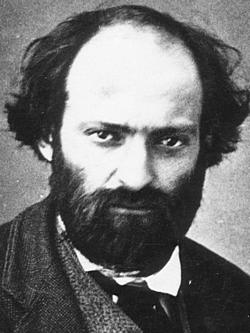
Cézanne was a giant of European art, with well-developed ideas about what painting should – and should not – be. He rejected the notion that paintings should merely capture impressions of nature, illustrate stories, provide decoration, or offer social commentary. Instead, he believed that painting should express the emotions evoked in the artist through the underlying forms—the cylinder, sphere, and cone—and colors of the natural world. His vision helped set Western art on the path toward abstraction and established him as one of the most consequential artists in the Western tradition, often described as the father of modern art. His influence would prove fundamental to the development of Symbolism, Fauvism, Cubism, and Expressionism. The World of Cezanne: 1839-1906 (1968) by Richard W. Murphy from the Time Life series on great artists tells Cezanne’s story with passion and skill.
Cézanne brought together two seemingly incompatible traditions that had long divided French art: Classicism, which prized structure and order, and Romanticism, which celebrated color and emotion. At its mature best, Cézanne’s art combined the emotional intensity of Romanticism with the clarity, discipline, and restraint of the Classical tradition. In this sense, he became a father of modern art and, as the author argues, “one of the giants of European painting.” Yet Cézanne was also unusual in the remarkable breadth of his work, with his oeuvre divided almost evenly among still lifes, landscapes, figure paintings, and portraits.
Cézanne grew up the son of a father who had finally lifted the family out of impecunity and obscurity and an overprotective mother. The result was a man of profound insecurity, marked by antisocial and misanthropic tendencies. Alternately arrogant and servile, Cézanne could be convinced of his own genius yet simultaneously crippled by self-doubt. He was wary of women, hated being touched, and remained emotionally volatile and socially inept throughout much of his life.
His exposure to good painting in his youth was slight and his early academic performance was limited. He had an early enthusiasm for art, but no particular aptitude for it. He was a childhood and lifelong friend of the novelist Émile Zola, who helped him establish himself as an artist, though Cézanne would eventually come to disapprove of Zola’s bohemian lifestyle. Their friendship ruptured permanently in 1886 with the publication of Zola’s L’Œuvre, a novel partly inspired by Cézanne in which a talented but ultimately unsuccessful artist, Claude Lantier, hangs himself before his unfinished masterpiece. Cézanne was acutely sensitive and self-conscious about the stark contrast between his boyhood friend’s extraordinary national success and his own continuing artistic obscurity.
Like Delacroix, Cézanne studied law for a time to appease his overbearing father, but abandoned it after two years. And, like Delacroix’s father before him, Louis-Auguste Cézanne eventually yielded to his son’s artistic ambitions. The parallels continued: neither Cézanne nor Delacroix was a precocious talent, and both were rejected by the prestigious École des Beaux-Arts. Cézanne also shared Delacroix’s reverence for the Old Masters, declaring, “The Louvre is the book from which we learn to read.” By the age of twenty-three, Cézanne had committed himself fully to a career as an artist.
His earliest works were characterized by loose draftsmanship, dark colors, and sharply contrasting highlights, often depicting scenes of violence, sex, and death, including his graphic 1870 painting The Murder. The author argues that Cézanne yearned intensely for artistic recognition and validation, yet was repeatedly spurned by critics and the public alike.
Cézanne was heavily influenced by Delacroix, whom he regarded as a symbol of liberation from the dominant tradition of French academic art, with its emphasis on line over color. Delacroix inspired Cézanne by connecting French painting to the great colorists of the past – Titian, Veronese, Tintoretto, and Rubens – and, perhaps more importantly, by providing a kind of moral sanction for painting as an expression of artistic individuality.
Cézanne was also deeply intimidated by his father, Louis-Auguste, a self-made financier who supported his artist son with a 200-franc monthly allowance well into adulthood. For years, Cézanne lived in fear that his father would discover the existence of his mistress, Hortense Fiquet, and their son, whom he kept secret from his family. When Louis-Auguste eventually learned of them, he responded much as Cézanne had feared, cutting his allowance in half.
An artist by disposition, he hovered on the fringes of the so-called Batignolles group, an informal circle of avant-garde artists, writers, and critics who gathered around Édouard Manet in Paris during the 1860s and early 1870s. Many of its members would become leading figures of Impressionism, although Manet himself never exhibited in the independent Impressionist exhibitions. The circle included Claude Monet, Pierre-Auguste Renoir, Edgar Degas, Frédéric Bazille, Alfred Sisley, and, more loosely, Camille Pissarro, as well as writers and critics such as Émile Zola and Zacharie Astruc.
What united them was not a formal artistic program but a shared dissatisfaction with the conservative French Academy and official Salon system, along with an interest in depicting modern life – Parisian cafés and streets, leisure, contemporary dress, landscapes, and ordinary people – rather than the historical, mythological, and religious subjects favored by academic painting. Cézanne was artistically and intellectually attuned to the group’s rebellious spirit, but his misanthropic temperament and social awkwardness kept him largely on its fringes.
Cézanne is often regarded as the first Post-Impressionist, reacting against Impressionism’s emphasis on immediate visual sensation by placing greater importance on the deliberate construction of a painting and imbuing it with greater psychological depth. The author notes that Cézanne is routinely grouped with Gauguin, Van Gogh, and Seurat under the broad umbrella of Post-Impressionism, even though he harbored serious reservations about all three. Then again, there was scarcely an artist alive whom Cézanne fully approved of, not even Delacroix, whom he deeply admired but whose reliance on literary narrative as a source of subject matter he distrusted.
Cézanne developed a highly distinctive style and approach to art, seeking a union between abstraction and reality. His paintings, particularly the landscapes of his native Aix-en-Provence, were not intended as faithful imitations of nature but as attempts to capture the essential forms and expressive character of a scene. The visible world was only his starting point: his paintings remained rooted in nature while becoming something other than straightforward representations of reality—what he called “constructions after nature.” Hence his famous exhortation to “see in nature the cylinder, the sphere and the cone.” Taken to its logical conclusion, Cézanne’s approach pointed toward the radical abstraction of the Cubists and beyond. His equally strong conviction that painting should express the artist’s individual vision would have profound implications for twentieth-century art as it became increasingly personal and subjective.
His quest to “realize” the essential nature of his subjects led him deliberately to reject the precise linear perspective developed by Brunelleschi in the fifteenth century. He did not want his paintings to function as windows onto an illusionistic three-dimensional world; instead, he embraced the two-dimensional surface of the canvas and treated it as an integral part of the composition. He was similarly skeptical of aerial perspective, in which colors and forms are softened or blurred to create the illusion of distance. This relative equality among the elements of a composition is one of the most striking features of Cézanne’s work: objects may occupy different depths, but distant forms are not necessarily less detailed or sharply defined than those in the foreground. Likewise, the light in Cézanne’s paintings often seems internal or sourceless, allowing him to preserve the continuity of form and color he valued so highly. In this respect, he was deeply influenced by the seventeenth-century painter Nicolas Poussin. Cézanne had little interest in Poussin’s battle scenes and heroic narratives, but greatly admired the balance, unity, and coherence of his compositions. As Cézanne famously declared, “I want to do Poussin again after nature.”
In place of linear and aerial perspective, Cézanne relied on sharp contrasts between warm and cool colors – reds, oranges, and yellows that appear to advance, and blues and greens that appear to recede – as well as overlapping forms to suggest depth, a technique he described as “modulation.” In this way, Cézanne used color not merely to adorn objects but to construct them, effectively giving color the structural role traditionally assigned to drawing. This emphasis on color’s form-building properties distinguished Cézanne not only from the academic painters of his day but also from the Impressionists, who generally used broken color to capture the effects of light rather than to build solid volumes. In essence, Cézanne asked color to perform three overlapping tasks: create depth, give objects solidity through modulation, and preserve a strong two-dimensional pattern across the canvas. These competing objectives help account for the extraordinary variety and complexity of color in his mature paintings, as well as their characteristic sense of stillness. The author argues that Delacroix’s exploration of the structural potential of color, or “color-division,” influenced Cézanne more profoundly than the work of any other artist and helped make him one of the most self-conscious and intellectually deliberate painters of his age.
His unique style of painting was at once complex and beautifully simple, highly intellectual yet deeply intuitive. He sought to capture nature by revealing its underlying structures while never denying the flat, two-dimensional surface of the canvas—an effect sometimes described as “flat depth.” For Cézanne, drawing and color were ultimately inseparable: the more harmoniously colors were combined, the more clearly forms and contours emerged. And what might initially appear to be a random use of color was in fact carefully balanced across the entire composition, with Cézanne often repeating a color in one part of a painting because he had introduced it elsewhere.
Cézanne’s mature approach to still life took years to perfect, but ultimately had a profound impact on French art, restoring the genre to a prominence it had not enjoyed since the eighteenth century and inspiring an entire generation of artists, particularly Gauguin and Matisse. As the author writes, Cézanne inherited the traditional form but transformed it dramatically. Like his work in other genres, his still lifes were largely devoid of intimacy or narrative meaning; instead, they focused on the solidity of forms, underlying structure, and the pursuit of order and harmony. Over the course of his career, Cézanne would paint roughly 200 still lifes.
The artist’s personal life was austere and complicated. He married Hortense Fiquet, the mother of his fourteen-year-old son, Paul, in 1886, when he was forty-seven years old. His domineering father died six months later, leaving Cézanne an inheritance that made him financially independent for the first time in his life. He gave two-thirds of the inheritance to his new wife and son, who moved to Paris, while Cézanne increasingly lived apart from them and saw them only infrequently.
The most striking feature of Cézanne’s brilliant and unconventional portraits is their striking absence of emotion and personality, as though he had transformed portraiture into still life, which, in many respects, was precisely his intention. More broadly, he sought to integrate the great genres of painting, particularly the human figure and landscape, as exemplified by The Great Bathers (1906). Cézanne had little interest in revealing the character or inner life of his subjects. He produced roughly forty portraits of his mistress and later wife, Hortense, yet almost none gives the viewer much sense of what she actually looked like or how she felt.
Cézanne produced more than 300 landscape paintings, most depicting his native Provence, including some sixty views of Mont Sainte-Victoire, arguably the single most important recurring subject of his career. Roughly half of these landscapes were painted between 1883 and 1895. What distinguished Cézanne from both earlier generations and many of his contemporaries was his overriding emphasis on structure rather than mood or atmosphere. His landscapes contain almost no figures picnicking or lounging, little suggestion of movement in the trees or clouds, and few clues as to the time of day or even the season. Instead, Cézanne concentrated on what he regarded as essential, solid, and enduring in nature. His deliberate aim was not to capture a fleeting moment, as the Impressionists sought to do, but to reveal what was permanent and unchanging beneath it.
Cézanne’s final decade was marked by illness (he suffered from diabetes) deepening isolation, and bitter ruptures with longtime friends, including not only Zola but also fellow artists Monet, Renoir, Pissarro, and Degas. Increasingly paranoid, suspicious, and easily wounded by perceived slights, he became an isolated and deeply unhappy figure in his early sixties, his emotional instability perhaps suggesting more serious psychological troubles. Among his more striking eccentricities was a seemingly pathological aversion to being physically touched.
This final period also marked Cézanne’s last great phase of artistic innovation, in which color became increasingly dominant. Outlines grew more diffuse, forms less sharply defined, and colors more intense. Many of these late works were watercolors rather than oils, and they brought Cézanne closer than ever before to abstraction in the modern sense. The author notes that this gradual dissolution of form and intensification of color also characterized the late work of such masters as Titian, Rembrandt, and Monet.
Cézanne remained largely unknown until the 1890s, his reputation lagging far behind that of other artists associated with the Batignolles circle, including Manet, Monet, Renoir, Degas, and Pissarro. That changed dramatically in 1895, when the young art dealer Ambroise Vollard mounted Cézanne’s first major one-man exhibition in Paris, bringing together more than a hundred of his works. It was his first substantial showing in the capital in roughly twenty years and transformed his reputation almost overnight. Cézanne suddenly emerged as a major figure, recognized not only for the originality of his own work but also for his influence on artists who had already achieved greater recognition, including Pissarro, Van Gogh, and Gauguin.
When Zola died suddenly under mysterious circumstances from carbon monoxide poisoning in 1902, his art collection, which included ten early works by Cézanne, eventually went to auction. Some of the paintings commanded remarkable prices: The Rape, for example, sold for 4,200 francs, whereas Cézannes at another collector’s auction just seven years earlier had averaged only about 750 francs. Yet Zola’s association with the Dreyfus Affair also had an unintended consequence for his old friend. Because Cézanne’s works figured prominently in Zola’s collection, Cézanne himself came to be associated with the Dreyfusard cause, prompting many in his deeply conservative native Aix-en-Provence to turn against an artist their city had only recently begun to embrace.
Cézanne’s reputation – and the value of his paintings – soared following his death in 1906 from pneumonia, complicated by diabetes. By 1914, his work was being exhibited at the Louvre, while paintings such as Boy in a Red Vest commanded as much as 56,000 francs, a remarkable testament to how quickly his stature had grown in the years after his death. In 1958 the painting would be purchased by American financier Paul Mellon at Sotheby’s for $616,000 (about $7 million in 2025 dollars), which was a record for a modern painting at that time and roughly double what any of his contemporary’s art was selling for.
“Few figures in the history of art have been claimed by so many movements, looked to for inspiration by so many artists, anatomized and eulogized by so many,” the author writes. Paul Gauguin and Henri Matisse were the contemporary artists most significantly and directly affected by Cézanne. His work led directly to the Fauvist movement shortly after his death, and even more profoundly influenced the Cubists, particularly Pablo Picasso and Georges Braque, although they moved beyond his grounding in nature toward an increasingly conceptual reconstruction of the visible world. Their innovations, in turn, helped give rise to movements such as Orphism, an early abstract movement associated with artists including Jacques Villon and Robert Delaunay that used vivid color and geometric forms to create a sense of rhythm and movement. In short, the thing seen was becoming less important than the way the artist saw and represented it. From Cézanne, it was only a short step toward an art in which the creative act itself became the primary subject of painting.
In closing, Cézanne’s importance lies in the bridge he created between the art of the nineteenth century and the modernism of the twentieth. Rooted firmly in nature and deeply indebted to masters such as Poussin and Delacroix, he nevertheless dismantled many of the conventions that had governed Western painting for centuries. Perhaps most of all, he imbued art with a central focus on individualism and personal expression. By subordinating traditional perspective to the flat surface of the canvas, using color to construct form and depth, reducing nature to its essential structures, and insisting that a painting express the artist’s individual vision rather than simply reproduce the visible world, Cézanne fundamentally altered what a painting could be. His “constructions after nature” opened the way directly to Picasso and Braque’s Cubism and, from there, to increasingly abstract movements in which the artist’s way of seeing became as important as the thing being seen. Few artists did more to shift painting away from the imitation of reality and toward the independent creation of one. It is in this sense that Cézanne, an obscure and often ridiculed painter for much of his life, ultimately earned his reputation as the father of modern art.


Leave a comment