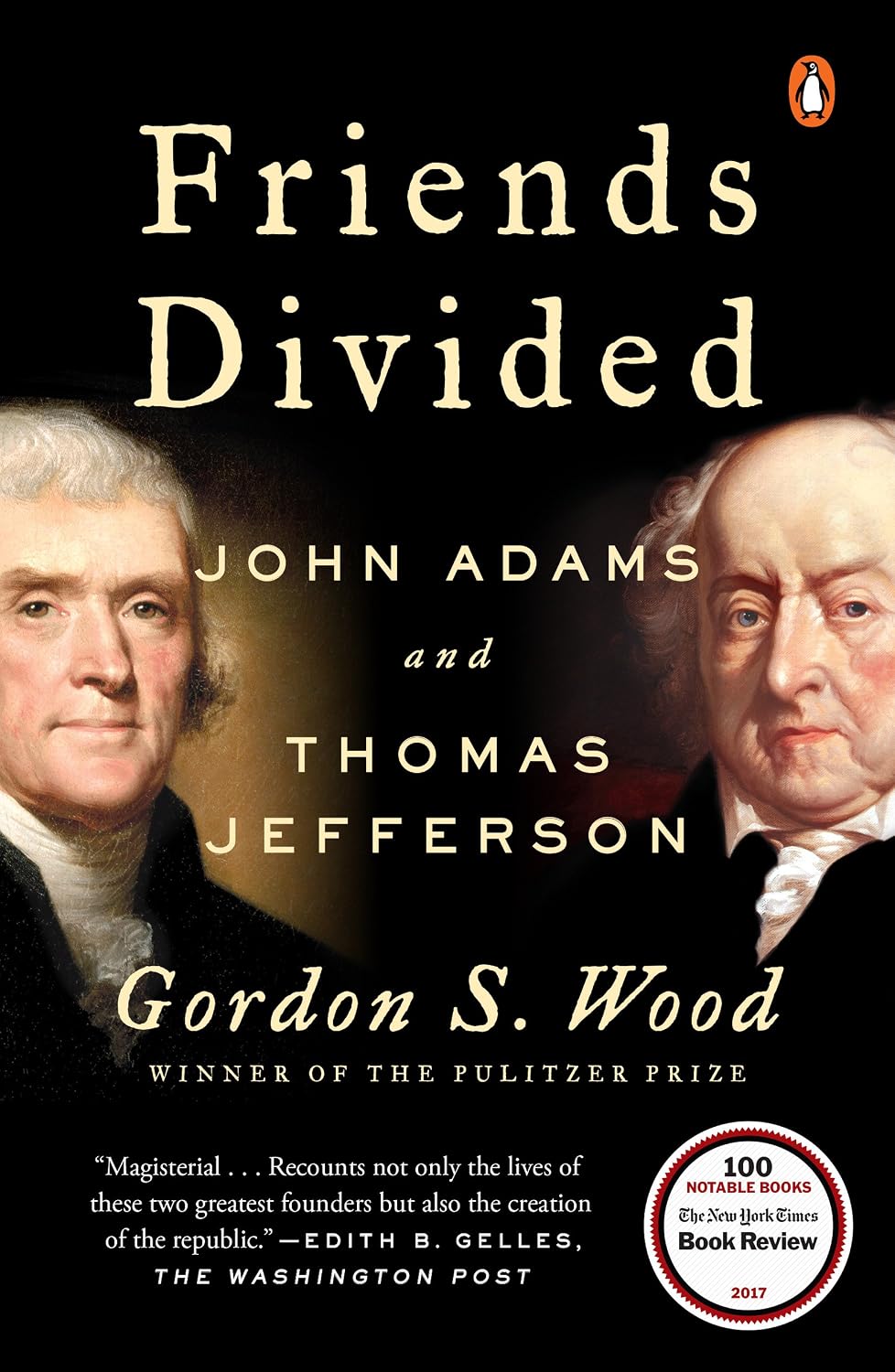
Gordon S. Wood’s Friends Divided: John Adams and Thomas Jefferson (2017) is less a conventional dual biography than an extended examination of two radically different ways of understanding America, politics, and human nature. Adams and Jefferson were, Wood writes, divided “in every single thing that mattered”: in temperament, their assumptions about human nature, their ideas about government and society, their attitudes toward religion, and ultimately their conceptions of what the new American republic could and should become. The differences were so profound that Wood poses a deceptively simple question at the heart of the book: “These two men were so different from each other. How could they ever have become friends?”
The lives of the two men was intertwined for decades, beginning with their close collaboration in the Continental Congress and continuing, under increasingly strained political circumstances, through the Washington administration and Adams’s single term as president, during which Jefferson served as the opposition vice president. Their friendship was perhaps most deeply forged, however, during their years in Europe, particularly the nine months they spent together in Paris from August 1784 to May 1785, when they served alongside Benjamin Franklin, whom Adams had come to detest, as commissioners charged with negotiating commercial treaties for the new United States. Their relationship remained close even after Adams moved to London and Jefferson remained in Paris, as the two continued serving on separate diplomatic missions in Europe until Adams returned to the United States in April 1788. Their friendship may have blossomed in the mid-1780s precisely because Jefferson, though thoughtful and intellectually formidable, was reserved and deferential toward Adams, who was eight years his senior and considerably more experienced. As Adams later recalled, for many years Jefferson “was but a boy to me.”
Their temperaments were completely different. Adams is presented as inherently negative in outlook: high-strung, cynical, irascible, sarcastic, and blunt to the point of obnoxiousness. He was thoroughly and self-consciously middle class in origin, seeing himself as both a self-made man and a perpetual outsider in Boston society. He simultaneously despised and envied the luxurious lifestyles of Massachusetts’s old families, whose members never made him feel entirely welcome or their social equal. As a man who had risen through sheer hard work and talent, Adams remained acutely self-conscious and insecure around his social “betters,” even as he dismissed their pretensions. “For all of his intelligence and learning,” Wood writes, “Adams was easily mocked, and he was often his own worst enemy.”
Where Adams was high-strung, insecure, and perpetually conscious of social hierarchy, Jefferson was easygoing, sophisticated, serene, and self-confident. Above all, he was unfailingly polite, so much so that some contemporaries interpreted his excessive propriety and civility as evidence of duplicity or deceit. Unlike the emotionally transparent Adams, who poured his heart out into a diary that he kept for decades, Jefferson revealed remarkably little of his inner life. There is scant evidence that he was particularly self-critical or introspective, and he rarely chastised himself for his considerable personal shortcomings, whether indiscreet love affairs or chronically improvident financial management.
Even Adams’s resistance to British rule was, in important ways, personal. He had repeatedly felt slighted or passed over for positions by Massachusetts’s colonial elite, experiences that reinforced his sense of exclusion and resentment toward the established order. Jefferson’s opposition to Great Britain, by contrast, was far more intellectual and ideological. For Adams, the Revolution was therefore not merely a struggle over political principles; it was also intertwined with his lifelong struggle against hierarchy, privilege, and the social establishment that had never fully accepted him.
Jefferson, by contrast, was a born aristocrat who carried himself with the easy confidence of someone accustomed to privilege. He emerged from a Virginia society in which there was virtually no middle class, although Wood notes that Jefferson nevertheless regarded himself as something of an outsider within the aristocracy into which he had been born. He liked to emphasize his relatively “frontier” origins in the Piedmont and his father Peter Jefferson’s rough-hewn background, while downplaying the patrician Randolph lineage of his mother. The reality of his social position, however, was unmistakable. Jefferson inherited 11,000 acres and 135 enslaved people from his father-in-law’s estate; combined with the 52 enslaved people he inherited from his father, this made him one of the wealthiest planters and the second-largest slaveholder in Albemarle County.
Their contrasting temperaments reflected fundamentally different understandings of human nature. Unlike Adams, Jefferson was a true believer in the French Revolution, regarding its success as intimately connected to the fate of the American experiment itself. He possessed an abiding faith in the inherent goodness and perfectibility of ordinary people and embraced Lockean sensationalism – the idea that human beings entered the world as a tabula rasa and that their character and moral development were largely products of environment and education. This optimism also underlies Jefferson’s nearly unlimited faith in democracy and his preference for limited government. If mankind’s natural condition was essentially one of harmony and cooperation, then the people could be trusted with all facets of government, which would be needed to intervene relatively little in human affairs.
Adams regarded such a sunny view of human nature as foolishly naive. Although he had declared as early as 1766 that all men were born equal, he had completely changed his mind by the 1780s. He came to believe that men were actually born decidedly unequal. Nature, not nurture, is what mattered. Moreover, a fundamental desire for distinction was rooted in human nature. He believed that men were fundamentally driven by darker impulses, especially jealousy, envy, ambition, and competition. Together, these forces inevitably produced an aristocracy of wealth and achievement, as the most talented, ambitious, and industrious members of society vaulted ahead of their less gifted or less driven fellow citizens. Based on his extensive reading of history, Adams believed that this aristocracy inevitably became both the most powerful and potentially the most dangerous segment of society. For the rest of his life, Adams remained a devoted advocate of bicameral legislatures that embodied the two principal “powers of society” – the elites and the masses – a conviction that would become a cornerstone of his political philosophy.
Jefferson and Adams also looked to very different historical traditions for inspiration. The Protestant Reformation held little appeal for Jefferson and played no significant role in his interpretation of the settlement of America, as it did for Adams. Instead, Jefferson was fascinated by an obscure and highly romanticized period of English history in which independent Saxon landowning farmers supposedly enjoyed a kind of democratic freedom before the Norman Conquest of 1066 destroyed it.
Jefferson expressed this interpretation most forcefully in A Summary View of the Rights of British America (1774), which Wood describes as “the most radical statement of American rights yet to appear.” Jefferson argued that the English settlers of North America had established their colonies in the seventeenth century much as the ancient Saxons had settled England a millennium earlier: through their own initiative and at their own expense, rather than at the expense of the British state. The colonists therefore owed Parliament no inherent political allegiance.
From this premise, Jefferson reached a strikingly radical constitutional conclusion. By the late eighteenth century, he maintained, the North American colonies were effectively independent of Parliament and remained connected to Great Britain only through their voluntary allegiance to the king. The empire, in this conception, consisted not of colonies subordinate to Parliament but of distinct political communities sharing a common monarch, an interpretation that anticipated what would much later emerge as the “Dominion” conception of the British Empire.
Political constitutions – and eventually constitution-making itself – were among the dominant concerns of American political life from the Stamp Act crisis of 1765 through the Constitutional Convention of 1787. This was especially true in the fateful year of 1776, when eleven of the thirteen original colonies set about creating new state constitutions. On May 10, 1776, Congress adopted a resolution, strongly promoted by Adams, recommending that colonies whose governments still derived their authority from the British Crown establish new governments resting instead on the authority of the people. In effect, Congress was urging the colonies to replace their royal or proprietary governments with independent republican ones.
In Adams’s mind, this resolution marked the true moment of American independence, with Jefferson’s subsequent Declaration of Independence serving almost as frosting on the revolutionary cake – or, as Wood puts it, “a belated legal recognition of what had already taken place.” Adams later called the May 10 measure “the most important Resolution that ever was taken in America.”
Wood goes even further in emphasizing the centrality of constitution-making to the revolutionary generation: “Nothing in 1776 – not the creation of the confederation of the states, not an alliance with France, not even the war – engaged Americans more than did the framing of their new constitutions.” Jefferson himself demonstrated the importance he attached to the process, pleading with his Virginia colleagues to recall him from Philadelphia so that he could participate in drafting Virginia’s new constitution, even as he was being given the task for which history would remember him: drafting the Declaration of Independence.
To begin with, Americans developed a conception of constitutional government fundamentally different from that of the British. In the traditional British understanding, most famously articulated by the legal scholar William Blackstone, there was no meaningful distinction between “the constitution” and the broader “system of laws.” The constitution was not a separate document standing above ordinary government; rather, it was embedded within the laws, institutions, customs, and practices through which the government operated. Acts of Parliament could therefore become part of the constitution, and there was no American-style distinction between ordinary law and a higher, fundamental constitutional law.
The Americans developed a radically different conception. For them, a constitution was a written instrument standing above and apart from ordinary government, simultaneously creating political institutions, defining their powers, and limiting their authority. This distinction helps explain why Americans increasingly insisted that constitutions be drafted and ratified by special conventions separate from ordinary legislatures. If a constitution represented the fundamental authority of the people and established the rules under which the government itself operated, it could not simply be treated as another legislative act passed by the very institutions it was intended to govern, but rather as something perpetual and unalterable. And unlike ordinary laws, a constitution had to be submitted to the vote of the sovereign people to be ratified.
Adams’s home state of Massachusetts led the way in developing this new approach in 1779–1780, producing the longest and most detailed of the early state constitutions. Many of the Founders, particularly Adams and James Madison, had learned from what they regarded as the mistakes of the hastily drafted state constitutions of 1776, which had generally created weak executives and overwhelmingly powerful legislatures. These state-level “democratic despotisms,” as their critics came to regard them, often pursued aggressively parochial policies, including debtor-relief measures and the issuance of paper money at the expense of creditors.
The Massachusetts Constitution, which came the closest to the English constitution, sought to correct these perceived excesses by restoring greater balance among the branches of government. It strengthened the executive by granting the governor a veto over legislation as well as the authority to appoint a wide range of government officials, providing an important institutional check on legislative power.
Jefferson and Adams looked to very different historical traditions for inspiration in this process. The Protestant Reformation held little appeal for Jefferson and played no significant role in his interpretation of the settlement of America, as it did for Adams. Instead, Jefferson was fascinated by an obscure and highly romanticized period of English history in which independent Saxon landowning farmers supposedly enjoyed a kind of democratic freedom before the Norman Conquest of 1066 destroyed it.
Jefferson expressed this interpretation most forcefully in A Summary View of the Rights of British America (1774), which Wood describes as “the most radical statement of American rights yet to appear.” Jefferson argued that the English settlers of North America had established their colonies in the seventeenth century much as the ancient Saxons had settled England a millennium earlier: through their own initiative and at their own expense, rather than at the expense of the British state. The colonists therefore owed Parliament no inherent political allegiance.
From this premise, Jefferson reached a strikingly radical constitutional conclusion. By the late eighteenth century, he maintained, the North American colonies were effectively independent of Parliament and remained connected to Great Britain only through their voluntary allegiance to the king. The empire, in this conception, consisted not of colonies subordinate to Parliament but of distinct political communities sharing a common monarch, an interpretation that anticipated what would much later emerge as the “Dominion” conception of the British Empire.
In this respect, Adams departed from the classical interpretation of the English political system most famously associated with the French philosophe Montesquieu’s The Spirit of the Laws (1748). Montesquieu saw the House of Lords, embodying aristocratic wisdom, as a mediating force between the Crown, which supplied political energy, and the people, who supplied popular virtue. Adams, however, was heavily influenced by the Swiss jurist Jean Louis De Lolme’s critique of Montesquieu in La Constitution de l’Angleterre, first published in French in Amsterdam in 1771 and translated into English (The English Constitution) in 1775.
De Lolme argued that the fundamental struggle in English political history was not between the monarch and the people but between the two great social powers represented by Parliament: democracy in the House of Commons and aristocracy in the House of Lords. A strong executive – the Crown – was therefore necessary to serve as an independent balancing force between them. Adams embraced this interpretation, calling De Lolme’s work “the best defence of the political balance of the three powers that ever was written.” In Adams’s own political system, an elected executive would assume the balancing role traditionally performed by the monarch, serving as the essential referee between the aristocracy and the people and preventing either from dominating the other.
The more difficult question was how to identify and institutionalize the aristocratic element in an American republic. Ideally, the upper house would represent society’s wisdom, talent, and learning, but such qualities were inherently difficult to measure. Property and wealth, by contrast, were readily identifiable and therefore became a somewhat dubious proxy for determining who belonged to what Adams regarded as the “senatorial part” of society.
Adams laid out his political vision in Thoughts on Government, Applicable to the Present State of the American Colonies (April 1776), a pamphlet Wood calls “the most important and influential essay that Adams ever wrote” and “the most important pamphlet affecting the drafting of state constitutions in 1776.” The central message was that liberty depended on a balanced republican government governed by laws rather than men, with separated powers, a bicameral legislature, and an independent executive and judiciary capable of checking one another. Adams’s famous definition of a republic as “a government of laws, and not of men” led him to the controversial conclusion that even the British monarchy possessed a republican character, since the king himself remained bound by established laws that the people, through their representatives, had a role in making. Adams was never able to persuade his fellow Americans to accept this interpretation, however. Wood argues that the resulting confusion over Adams’s true views of the British monarchical system led many, including Jefferson, to regard him as a “crypto-monarchist,” a perception that “plagued him for the rest of his life.”
These instincts and his interpretation of history help explain Adams’s deep and growing suspicion of democracy. In his view, the greatest danger unleashed by the American Revolution was the possibility of social and political disorder, something Jefferson never feared, at least in 1776. “For Jefferson, the people themselves could never become oppressive,” Wood writes; “only their elected agents were capable of tyranny.” Jefferson’s remedy for democratic despotism was therefore, paradoxically, more democracy: broader suffrage, more frequent elections, and greater popular participation.
Adams drew almost precisely the opposite conclusion. He favored a more restricted suffrage, stronger executive authority, and longer terms of office, eventually embracing lifetime tenure for certain positions. To Adams, the fundamental defect of the hastily drafted state constitutions of 1776 was their excessive concentration of power in popularly elected legislatures. These assemblies had accumulated not only legislative authority but significant executive and judicial powers as well, creating precisely the kind of unchecked political dominance that Adams believed a properly balanced constitution was designed to prevent.
This conviction was reinforced by Adams’s extraordinarily deep and wide-ranging reading of history – “more, surely,” Wood writes, “than any other American of his generation.” Whether he examined ancient Greece and Rome, Renaissance Italy, or eighteenth-century England, Adams saw the same pattern repeating itself: patricians inevitably distinguished themselves from plebeians, and every society eventually produced an elite based on wealth, talent, ambition, or achievement. Adams had, in effect, developed his own “iron law of oligarchy,” a historical interpretation reinforced by his personal encounters with snobbery, privilege, and inequality in colonial Boston. “To the end of his life,” Wood writes, “Adams always felt a deep need to emphasize the natural inequality of people. Somehow or other it had become an explanation and a vindication of his own extraordinary rise from mediocrity.” Jefferson, of course, felt no such need.
Consequently, Wood argues that no other Founding Father believed less in American exceptionalism than Adams. He regarded America as subject to the same enduring forces of human nature and social hierarchy that had shaped Western societies throughout history, a view emphatically rejected by Jefferson. Indeed, Wood says, “in all of American history, no political leader of Adams’s stature, and certainly no president, has ever so emphatically denied the belief in American exceptionalism.”
What distinguished the emerging American aristocracy from those of the ancient world, he believed, was primarily its preoccupation with money and the accumulation of wealth. Yet Adams did not seek to exclude ordinary people from political participation. Rather, he wanted to balance their political power against that of the inevitable aristocracy, a small segment of society, perhaps 10 percent or less, that nevertheless controlled a disproportionate share of its wealth and property. The purpose of constitutional government, in Adams’s view, was not to eliminate either social force but to recognize both and prevent either from dominating the other.
The problem, Wood argues, was that Adams failed to recognize how dramatically American constitutional thinking was changing during the 1780s. His fellow Americans increasingly rejected the idea that society was naturally divided into distinct estates or powers that had to be represented and balanced against one another within a mixed constitution. In its place emerged a new conception of republican government in which every branch of government – the legislature, executive, and eventually even the judiciary – derived its authority, directly or indirectly, from the sovereign people. The branches were no longer understood as representing competing social orders but as different institutional expressions of the same popular authority.
“It was Adams’s unfortunate fate never to fully grasp this new development,” Wood writes. Adams remained enamored of the British constitution for too long and clung too tightly to the traditional theory that the three great powers or orders of society were necessarily embodied in any properly balanced government possessing a bicameral legislature and an independent executive. He clearly articulated these beliefs in A Defence of the Constitutions of Government of the United States of America, first published in 1786. The work became important – and controversial – because many Americans interpreted Adams’s admiration for elements of the British constitutional system as evidence that he harbored aristocratic or even monarchical sympathies, a charge that would follow him throughout the 1790s. As American constitutional thought moved toward popular sovereignty and the separation of governmental functions, Adams continued to interpret political institutions through the older framework of social balance. Moreover, Defense of the Constitution gave fuller expression to beliefs that would have shocked many of Adams’s fellow Americans had the book not been so long and impenetrable as to be virtually unreadable. Adams declared that Americans were gripped by a mania for luxury and social distinction; he rejected notions of both American equality and American exceptionalism; and he championed strong executive authority. Fortunately for Adams, the book’s difficulty ensured that few readers fully grasped just how dark, forbidding, and distinctly un-American a portrait of their society he had drawn.
These differences were hardened by the French Revolution, which Wood argues divided the two men perhaps more profoundly than any other issue. Adams regarded it as a catastrophe almost from the beginning and as further evidence that ordinary people could not ultimately be trusted with unchecked political power. Increasingly skeptical of democracy, he favored longer terms of office and eventually embraced lifetime appointments as a means of insulating government from popular passions. Jefferson drew almost precisely the opposite lesson. As Wood writes, “Jefferson’s enthusiasm for the French Revolution knew no bounds; it even matched the revolutionary zeal of Thomas Paine.” Nor did Jefferson waver in his conviction that revolutionary France was a sister republic whose success and survival were essential to America’s own security and prosperity. “The liberty of the whole earth” was at stake, he declared, and “rather than it should have failed, I would have seen half the earth desolated.” Wood describes such views as “extraordinary,” observing that Jefferson’s “naive faith in the future was breathtaking.” Adams, for his part, tended to see Jefferson’s motives as “dark and dirty” and suspected that his unbounded enthusiasm for the French Revolution was rooted, at least in part, in the burden of his personal debts.
This contrast between an almost reverential regard for the past and an unshakable faith in progress and the future was one of the fundamental differences between Adams and Jefferson. This profound divide in worldview explains their sharply divergent perspectives on so many of the political questions of their age. For Adams, “the wisdom of the past trumped the promises of the future,” Wood writes, “nothing could have been more contrary to Jefferson’s outlook on the world.”
In this regard, too, Adams and Jefferson drew very different lessons from their extended stays in Europe. Adams returned convinced that America was fundamentally no different from Europe and already possessed the same inherent flaws that had made European society corrupt and decadent. Government, therefore, had to be designed with those weaknesses in mind, creating institutions capable of containing and mitigating them. Jefferson, by contrast, believed that America remained largely uncorrupted and that its great challenge was to preserve that virtue by avoiding, at all costs, the path Europe had taken.
In his Discourses on Davila (1790–91), Adams used the history of revolutionary France to further his now familiar argument that inequality, ambition, and the human desire for distinction were permanent features of society, making strong, balanced government, including checks on both popular majorities and powerful elites, essential to preserving republican liberty. The essays further reinforced the opinion of Jefferson and other emerging Republicans that Adams admired aristocracy and monarchy, helping cement his reputation among opponents as a dangerous “crypto-monarchist,” despite Adams’s insistence that he was simply defending republican constitutional balance rather than hereditary rule. Wood argues that this inability to read his fellow Americans or anticipate how they might interpret his views revealed Adams at his most myopic and naive.
The relationship between Jefferson and Adams openly ruptured during the early 1790s. Wood argues that, had Jefferson ever bothered to systematically catalog his beliefs about human nature and government, the result would likely have closely resembled Thomas Paine’s radically progressive The Rights of Man, which appeared in America in 1791 and caused a sensation. Tempers were further inflamed when the pamphlet appeared with an unauthorized endorsement from Jefferson, then the sitting secretary of state, praising The Rights of Man as a welcome counterweight to “the political heresies that have sprung up among us” – a remark widely interpreted as a direct attack on Adams’s Discourses on Davila.
The Federalist and Democratic-Republican parties emerged during this period, though neither accepted the legitimacy of the other or imagined itself as part of a permanent two-party system. Wood argues that the political turmoil between these nascent parties was further inflamed by partisan newspapers that “were truly scandalous.” “Indeed,” he writes, “never in American history has the press been more vitriolic and more scurrilous than it was in the 1790s,” while the culminating presidential election between Jefferson and Adams in 1800 “was a brutal campaign, perhaps the most vicious and scurrility-ridden in American history” – striking claims for anyone living amid the political rancor of the early twenty-first century. Compounding this bare-knuckle political warfare were the very real threats of war and invasion from either Britain or France, which together made the decade “perhaps the most frightening moment in all of American history – something most historians have not appreciated.” It is another remarkable claim from Wood, and one that underscores just how precarious he believes the survival of the young republic actually was.
The Federalists regarded themselves simply as the government trying to prevent a social revolution propelled by the evils of Jacobinism, while the Republicans viewed themselves as a temporary movement organized to dislodge the “monocrats” they believed had usurped the principles of American republicanism. Jefferson was, from the start, the beating heart of the Democratic-Republican opposition to the first Federalist administrations. He was, Wood claims, “a superb politician and a party leader.” In contrast, Wood notes, Adams was never a High Federalist in the mold of the so-called Essex Junto in his native Massachusetts, nor was he a follower or admirer of Alexander Hamilton, the intellectual leader and guiding force of the Federalist Party. Rather, Wood says, it was Adams’s suspicion of France, admiration for the English constitution, dread of social disorder, and strong belief that public officials were owed respect that made the emerging Federalist Party his natural political home. Yet even there Adams remained something of an outsider, never fully accepted by the party as one of its own, even when he occupied the presidency. Retaining Washington’s staunch Federalist cabinet virtually intact proved to be the worst decision of Adams’s presidency, if not of his entire life. “Adams was no politician and certainly no party leader,” Wood writes, “and he had very little political sense.”
In March 1801, Jefferson forwarded to Adams a private letter concerning the recent and embarrassing death of his son Charles from alcoholism that had mistakenly been sent to him; it would be the last direct correspondence between the two men for eleven years. Jefferson and Abigail Adams, however, exchanged a famous series of letters in 1804, initiated by Abigail’s note of condolence following the death of Jefferson’s daughter Polly. What began as a gesture of sympathy soon deteriorated into a bitter exchange of accusations over Adams’s appointment of the so-called “midnight judges” before Jefferson’s inauguration and Abigail’s fury at Jefferson’s pardon of the disreputable newspaperman James Callender. The hostile relationship between the two families simmered at a low boil for the next half decade.
Adams’s defeat in the election of 1800 left him humiliated, angry, and depressed, and he spent much of the following decade mired in self-pity while growing increasingly alienated from the strident Federalism that had overtaken New England. In his later years, Adams became something of a lonely exile and stranger in his own homeland, lamenting that Boston had become as much “Enemies Country” to him as Paris and London had once been during his diplomatic service. Yet it was precisely this political isolation – including his son John Quincy’s defection from the Federalists to the Republicans in 1807 – that helped pave the way for a reconciliation with Jefferson. Their mutual friend Benjamin Rush played a pivotal role in bringing the two former presidents back together, shrewdly pointing to their shared antipathy toward banks as a source of common ground and opening wedge for direct communication. Jefferson and Adams finally resumed their correspondence on New Year’s Day 1812.
Over the next fourteen years, the two men exchanged 158 letters, although Adams wrote nearly three times as many as Jefferson, sometimes sending as many as six in succession without receiving a reply. Jefferson, however, remained far more prominent and considerably busier than Adams, who had become marooned in a kind of political wilderness. The volume of correspondence each received in 1822 is illustrative: Jefferson received (and answered) 1,267 letters, compared with just 123 for Adams. Wood argues that Adams dominated their correspondence and seemed to enjoy it more, but that Jefferson worked harder to sustain it. “Where Jefferson was sincere and earnest,” Wood says, “Adams was ironic and facetious.” He credits Jefferson’s patience and courtesy with preserving the exchange despite Adams’s frequent affronts and flippant provocations, many of them aimed at the disastrous fate of Jefferson’s beloved French Revolution under Napoleon and the subsequent Bourbon restoration. “Jefferson knew that beneath outward irascibility lay a warm and amiable heart,” Wood writes. Jefferson also surely understood that by then his historical reputation was considerably more secure than Adams’s, and Wood suggests that he may have viewed the correspondence partly with posterity in mind, carefully presenting himself to future generations as the more patient and magnanimous of the two men.
For Wood, the enduring significance of Adams and Jefferson relationship lies in its tension between opposites. Each represented competing tendencies that have remained embedded in American political culture ever since: realism and idealism, restraint and optimism, skepticism about popular passions and faith in democratic possibilities. Jefferson ultimately proved far more successful at shaping the country’s understanding of itself. As Wood memorably concludes, “Jefferson told the American people what they wanted to hear – how exceptional they were. Adams told them what they needed to know – truths about themselves that were difficult to bear.”
Throughout most of his life, Adams was a pessimist, even a cynic. He long believed that without an active and powerful government to constrain, control, and balance the human passions of ambition, envy, and jealousy, society would fall apart. In short, all forms of society, including marriage, were impossible without authority, and authority itself had to be continually reinforced through titles, ceremonies, and rituals – in other words, through much of the traditional paraphernalia of monarchy. Yet in his final years, he became increasingly confident about America’s future, convinced that many of his earlier warnings had been vindicated. His skepticism about the French Revolution, his prediction that an aristocracy of wealth would inevitably emerge in the United States, and his doubts about the caliber of men whom popular democracy would elevate to public office all seemed, in his mind, to have been borne out by events. “Adams had always had qualms about Jefferson’s dreams and illusions,” Wood writes, “and at last events had vindicated him.” Adams relished the sense that time had demonstrated that he was on the right side of history – and the world celebrated polymath genius Thomas Jefferson wrong.
Jefferson followed almost precisely the opposite trajectory. An optimist throughout most of his life – at times almost a dreamer in his faith in human progress – he believed that society was naturally harmonious and benevolent and therefore required relatively little government. It was this faith in the natural sociability and benevolence of human beings that underlay Jefferson’s confidence in modern republican government. For Jefferson and other Enlightenment thinkers, these natural social affections became a new source of republican virtue, replacing the austere, self-denying Spartan and Roman conception of virtue associated with the republics of antiquity. He became considerably less sanguine in old age. By his final years, Jefferson increasingly feared that the American experiment might end in failure, with the growing sectional conflict over slavery posing perhaps the greatest threat to the survival of the republic.
Friends Divided is therefore ultimately about more than the friendship between two Founding Fathers. It is an exploration of two rival interpretations of America itself – one embracing exceptionalism, the other emphasizing shortcomings – and of why Jefferson’s optimistic vision captured the national imagination while Adams’s darker assessment of human nature and political power may have contained truths that Americans have found much harder to accept. Overall, it is one of the most illuminating and edifying books on the American Revolution and the early Republic that I have ever read.
 What's Tim Reading Now?
Leave a comment