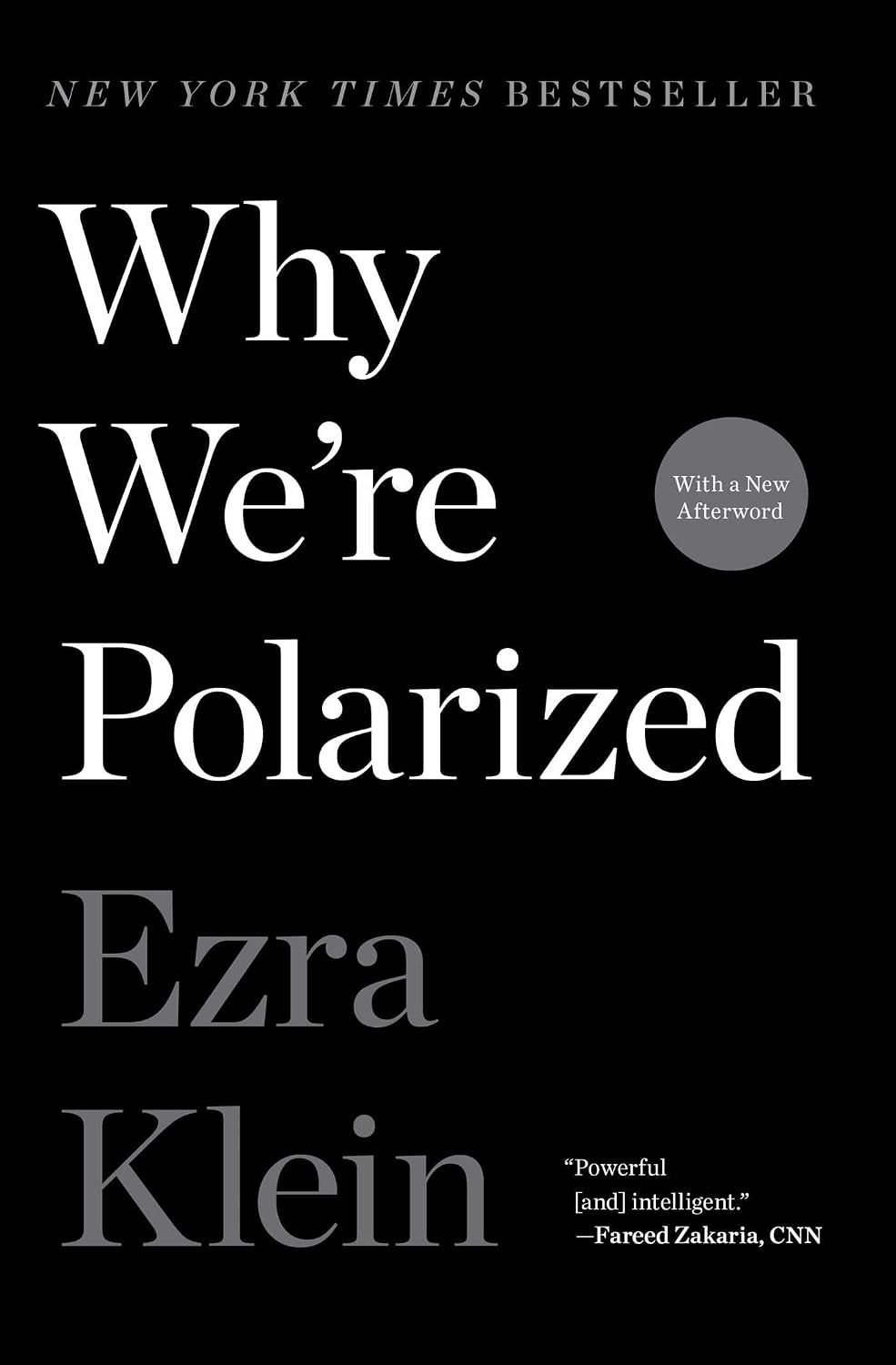
Like many Americans, political journalist and commentator Ezra Klein was stunned by Donald Trump’s victory over Hillary Clinton in the 2016 presidential election. In the aftermath, countless pundits and political scientists searched for the elusive explanation: the black swan event or October surprise that could account for what many regarded as an unprecedented political upset. But after extensive research and a healthy measure of self-reflection, Klein came to a different conclusion: Trump’s victory was not nearly as improbable as it first appeared. Viewed through the broader trajectory of American politics since the turn of the twenty-first century, it was, in many respects, business as usual. What Klein ultimately discovered was that “We are so locked into our political identities there is virtually no candidate, no information, no condition, that can force us to change our minds,” he writes. “We will justify almost anything or anyone so long as it helps our side, and the result is a politics devoid of guardrails, standards, persuasion or accountability.”
It is a sobering diagnosis. The more important question, however, is how Americans became so deeply entrenched in this cycle of partisan hostility. Answering that question is the central aim of Why We’re Polarized (2018). While not every one of Klein’s conclusions is equally convincing – some occasionally feel reflexive and overlook potentially mitigating evidence, especially his views on demography of the Republican party and its inherent vulnerability – the book is consistently thoughtful, deeply researched, and well worth reading, regardless of one’s political leanings. Why We’re Polarized reminds me very much of a book Malcolm Gladwell might have written: it takes a thought-provoking question, examines it from multiple angles, synthesizes the most important research, and presents the findings in a highly engaging, unified, and coherent narrative.
Klein employs systems thinking to arrive at the central insight of Why We’re Polarized: that American politics in the early twenty-first century has become “a collection of functional parts whose efforts combine into a dysfunctional whole.” That dysfunctional whole is now trapped in a polarization doom loop. To appeal to an increasingly polarized electorate, political institutions and actors adopt more polarized behavior, which in turn further polarizes the public. Over time, the system has evolved into a kind of political Frankenstein, a creation so sprawling and self-perpetuating that it now operates according to its own logic, feeding on the very divisions it produces. As Klein puts it, “We don’t just use politics for our own ends. Politics uses us for its own ends.”
Klein begins by reminding readers of a fact that will likely surprise many contemporary Americans: the Democratic and Republican parties have only recently become neatly aligned as the nation’s liberal and conservative parties. As late as 1976, credible public opinion polls found that nearly 30 percent of Americans saw no meaningful ideological differences between the two parties, while only 54 percent believed that the Republican Party was more conservative than the Democratic Party. One consequence was that “ticket-splitting” – voting for a presidential candidate from one party while supporting a congressional candidate from the other – was once commonplace. Between 1972 and 1980, the correlation between a voter’s choice for president and for the House of Representatives was just 0.54. By 2018, it had risen to 0.97. That is an astonishing transformation. And it’s even true at the state level. From 1974 to 1984, the average difference between how a state voted in one presidential election and how it voted in the next was 7.7 percentage points. From 2000 to 2012 it was 1.9 points.
American politics has always been polarized, Klein argues. What is fundamentally new is the neat sorting of those polarized views into two implacably hostile parties. This ideological realignment has transformed the nature of American politics. When both parties contained substantial liberal and conservative wings, disagreements were often managed through a mixture of compromise, coalition-building, and, at times, suppression. But once those divisions became concentrated between the parties rather than within them, political competition increasingly took the form of zero-sum conflict. As Democrats and Republicans have grown more visibly and unmistakably distinct, the common ground for compromise has steadily eroded while the animosity between them has intensified. To that extent, Klein concludes, “We are living through something genuinely new,” where there is almost no ideological overlap, fewer of us are caught in the middle, and there is more tension between the poles. In short, Klein says, we’ve self-sorted and polarized with “stunning comprehensiveness.”
Klein traces the origins of today’s neatly sorted polarization to the civil rights era. In his telling, two figures were especially influential in redirecting the trajectory of American politics: South Carolina Dixiecrat Strom Thurmond and Arizona Republican Barry Goldwater. For nearly a century, the Democratic Party in the former Confederate states functioned as a populist, authoritarian political machine, ruling the South with little meaningful opposition while maintaining what Klein describes as “foreign relations” with the United States via its durable governing coalition with the national Democratic Party.
That one-party dominance translated into extraordinary power in Washington. Thanks to the congressional seniority system, Southern Democrats exercised outsized influence for decades. Between 1896 and 1932, Southerners accounted for roughly two-thirds of the Democratic caucus in the House of Representatives, and they never comprised less than 40 percent between 1933 and 1953. As a result, they controlled many of the most powerful committee chairmanships and leadership positions in both chambers of Congress throughout much of the mid-twentieth century. Notable examples include: Wilbur Mills (D-AR), chairman of the House Ways & Means committee for 17 years (1958–1974); James Eastland (D-MS), chairman of the Senate Judiciary committee for 22 years (1956–1978); Richard Russell (D-GA), chairman of the Senate Armed Services committee for 16 years (1951–1969) followed by John Stennis (D-MS) for another 12 years (1969–1981); Harry Byrd (D-VA), chairman of the Senate Finance committee for 22 years (1937–1955), and Sam Rayburn (D-TX), Speaker of the House for 17 years (1940-1947 and 1953-1961). Via these leadership positions, the South held an effective veto over any policy or nominee they deemed hostile to southern interests.
Klein is careful not to romanticize this era. The alliance between the national Democratic Party and the Dixiecrats, he argues, is “a powerful reminder that there are worse things than polarization.” That coalition began to unravel in the 1960s over civil rights. When national Democrats embraced civil rights legislation and the Republican Party rallied behind its 1964 presidential nominee, Goldwater – a staunch conservative who opposed the Civil Rights Act – it opened the door for Southern conservatives to abandon the Democratic Party and realign with the Republicans. “And that set the stage for all that followed,” Klein writes.
This process of political sorting has been reinforced by the growing rural-urban divide. Today, the average American lives in a community that is almost as politically homogeneous as the parties themselves. The trend is especially evident in the rise of “extreme landslide” counties (i.e. those in which the winning presidential candidate prevailed by more than 50 percentage points). In 1992, only 4 percent of voters lived in such counties; by 2016, that figure had climbed to more than 20 percent. In less than a quarter century, the share of Americans living in communities where nearly everyone shared their political views increased from one in twenty to one in five. Much of this geographic sorting reflects the widening divide between rural and urban America. The shift is striking. Of the nation’s roughly 3,100 counties, Bill Clinton carried about 1,500 in both 1992 and 1996. Barack Obama won only about 600 in 2012, and Hillary Clinton carried fewer than 500 in 2016. As Klein observes, “The more sorted we are in our differences, the more different we grow in our preferences.” The divide is now so pronounced that House Democrats represent districts containing 78 percent of all Whole Foods stores but only 27 percent of Cracker Barrel locations.
This process of sorting and polarization is further amplified by a deeply ingrained human tendency toward tribalism. Klein highlights the seminal 1970 paper “Experiments in Intergroup Discrimination” by Henri Tajfel (1919–1982), the founder of social identity theory. A Polish-born British social psychologist, Tajfel developed one of the most influential frameworks for understanding how people form group identities, cultivate loyalty toward their own groups, and sometimes discriminate against outsiders – often “gratuitously,” meaning without any tangible benefit or advantage. Klein uses Tajfel’s research to show how neatly sorted and polarized political parties can become subject to these same psychological dynamics.
Human beings evolved over hundreds of thousands of years to survive and thrive in groups. Given those conditions, is it surprising that we developed such powerful instincts around belonging, loyalty, and social status? Klein suggests that contemporary humans’ passionate devotion to local college and professional sports teams provides an outlet for these deeply rooted impulses and emotions. “Sports are such a powerful force in human society,” Klein writes, “precisely because they harness primal instincts that pulse through our psyche.” Politics can activate those same instincts. When it comes to political identity, how we feel often matters far more than how we reason. And those feelings are frequently strongest when directed against members of the opposing party. This dynamic is the foundation of negative partisanship – the tendency to define one’s political identity less by affection for one’s own party than by hostility toward the other – which has become a powerful force driving contemporary political engagement and loyalty.
Klein further argues that human beings often outsource critical thinking to the groups with which they identify. Collectively, a group can possess more knowledge and reason more effectively than any one individual, a trait that likely conferred an evolutionary advantage. As he writes, “Reasoning is often something we do in groups in order to serve group ends.” To illustrate the power of social conformity, Klein points to Solomon Asch’s landmark 1951 experiment, which demonstrated that people will often conform to a group’s obviously incorrect judgment rather than risk standing apart. He applies this insight to the Republican Party’s unified opposition to the Affordable Care Act, despite the law incorporating ideas that Republicans themselves had championed in the 1990s and that had already been implemented by Republican Governor Mitt Romney in Massachusetts. Increasingly, Klein argues, political parties help people navigate a vast array of complex policy issues by providing ready-made conclusions that members can simply adopt. This dynamic also undermines the comforting belief that better-informed voters necessarily make better decisions. There is little reason, Klein contends, to expect new information to change a partisan’s mind when it conflicts with the consensus of the group. “Partisanship has a way of short-circuiting intelligence,” he writes. Rather than reasoning to discover the truth, we often reason our way toward the answer we want to be true. The legal scholar Dan Kahan calls this “identity-protective cognition”: our beliefs about the facts become expressions of who we are. Because political identity has become so central to many Americans’ sense of self, the parties have made this tendency even more powerful, exploiting our greatest cognitive vulnerability – the instinct to defend our core identities when they are threatened.
This deep-seated tribalism is reflected in how Americans increasingly view members of the opposing party. Klein cites survey data showing that in 1960, only 5 percent of Republicans and 4 percent of Democrats said they would be upset if their child married someone from the other party. By 2010, those figures had surged to 50 percent among Republicans and 33 percent among Democrats. Partisan affiliation was no longer merely an expression of underlying disagreements; it was becoming a source of identity, division, and conflict in its own right.
Klein next turns to the role of race in America’s political realignment. For much of the nation’s history, white racial identity remained largely implicit and politically unremarkable because whites constituted an overwhelming majority of the population. As that majority has gradually diminished, however, white identity has become a more salient political force, a trend Klein argues has been reinforced by economic insecurity. Immigration has been a major driver of this demographic change. As recently as the 1970s, only about 5 percent of the U.S. population was foreign-born. By 2016, that figure had nearly tripled to 14 percent, its highest level since the great wave of immigration at the turn of the twentieth century. One consequence has been the continued consolidation of white voters within the Republican Party. These demographic shifts, Klein argues, have given Democrats greater incentives to make explicit appeals on behalf of racial equality while encouraging Republicans to rely more heavily on messages that resonate with voters anxious about the country’s changing racial and cultural makeup. One limitation of Klein’s analysis, however, is that he largely overlooks the long history of predictions that demographic change would soon render the Republican Party electorally uncompetitive. Such forecasts have circulated for decades, yet the party has repeatedly adapted its coalition. As of 2026, Republicans hold the presidency, majorities in both houses of Congress, and a conservative majority on the Supreme Court, suggesting that demographic trends alone are not destiny.
The changing media landscape has conspired to harden these identities. For much of the twentieth century, major-city newspapers operated as local monopolies, while national television news was essentially a three-way oligopoly, with the networks competing for viewers in fixed time slots each evening. That structure encouraged each outlet to appeal to the broadest possible audience rather than to a narrow segment of viewers intensely interested in politics. In the early twenty-first century, however, the rise of limitless, on-demand content has transformed the economics of the news business. There are no longer three national news programs competing head-to-head each night. Instead, a vast array of news and commentary programs compete not only with one another but with everything else available on Netflix, TikTok, YouTube, and countless other platforms. This abundance of choice has pushed media organizations toward increasingly narrow audiences, encouraging them to appeal to smaller groups of highly engaged and ideologically committed consumers. And to be deeply interested in politics increasingly means choosing a side. That shift has also changed how newsrooms decide which stories to pursue. The old journalistic maxim was “If it bleeds, it leads.” Today, Klein argues, the mantra of explicitly partisan media is closer to “If it outrages, it leads.” Polarized media amplifies differences, depicts the opposing group as an existential threat, and turns political identity into a source of constant conflict. In the process, Klein argues, journalists increasingly move from observers of politics to participants in it, helping set the political agenda rather than merely reporting on it. The explosion of choice has also widened the gap between those intensely interested in politics and everyone else. As Klein puts it, “Greater choices let the junkies learn more and the disinterested know less.”
This sorting, polarization, and increasingly partisan media environment has fundamentally changed how the major parties campaign for office. As recently as 2000, the core strategy of both parties was to appeal to independents, the voters who could plausibly go either way and were often turned off by ideological zealotry. But Klein observes that this “man in the middle” has largely disappeared from the American political landscape. According to Matthew Dowd, George W. Bush’s campaign strategist, the share of “true independents” – voters genuinely open to either party – has fallen from more than 20 percent of the electorate to almost 5 percent. There simply aren’t enough persuadable voters left to make winning them the central campaign strategy. Instead, candidates have an incentive to focus on energizing and mobilizing their own bases. Bush in 2004, Obama in 2008 and 2012, and Trump in 2016 and 2024 all succeeded in part by turning out their supporters at extraordinarily high rates.
The result, Klein argues, is a paradox: modern political parties have become intensely partisan while simultaneously growing weaker as institutions. They can no longer reliably command the loyalty of their own voters or enforce the preferences of party leaders as they once did. Candidates who appeal directly to the party’s ideological base – most notably Obama and Trump – have been able to defeat more conventional establishment candidates in primary contests, something that would have been difficult to imagine just a few decades ago. Klein argues that this dynamic has made parties weaker, partisans stronger, and the political system more vulnerable to demagogues. The idea that populists such as Father Coughlin or Huey Long could have captured a major-party presidential nomination once seemed absurd; today, it is entirely conceivable. In effect, the system has shifted from one that selects candidates broadly acceptable to party leaders and the general electorate to one that rewards candidates who inspire intense loyalty among highly engaged supporters. Klein notes that the number of small donors giving to party candidates exploded from just 55,000 in 2000 to 566,000 in 2016, helping to transform the incentives of primary politics. These donors are often willing to support candidates who may have a weaker chance of winning a general election in exchange for the stronger affirmation of their political identity.
Making matters worse is the structure of the American government itself, which was designed by Founders who did not anticipate the rise of organized political parties. The constitutional system presumes a certain degree of cooperation to function, and for much of American history the parties were ideologically heterogeneous enough to make compromise possible. Klein calls this “the secret to the American political system’s success” and argues that it has all but disappeared. Cooperation was also encouraged by the fact that, for much of the period following the Civil War, one party dominated Congress for extended stretches: the Republicans during the Gilded Age and Progressive Era, and the Democrats from the New Deal through the Reagan era. During those long periods of minority status, the subordinate party had every reason to cooperate: it was often the only realistic way to exert political influence at the national level. But in an era of razor-thin majorities, where either party has a credible chance of taking control in the next election, the logic of cooperation breaks down. Instead, the proximity of power, Klein argues, “breeds all-out partisan conflict.” “Instead of cultivating a good relationship with your colleagues across the aisle,” he writes, “you need to destroy them, because you need to convince the voters to destroy them, too.”
Klein illustrates the dynamic with an analogy to office politics. Imagine you have a colleague you believe is bad for the company, but whose job you could plausibly inherit if he were fired. Under those circumstances, how likely would you be to help him succeed on an important project? “That’s basically American politics right now,” Klein concludes. He illustrates the point by showing how the filibuster has evolved from a mechanism that allowed individual senators to force debate over unpopular or controversial issues into a weapon routinely used by the Senate minority to obstruct the majority’s ability to govern. Between 1917 and 1970, there were just 49 filibusters in the Senate; between 2013 and 2018, there were 509.
The Founders also did not anticipate political identity happening at the national level. They assumed that citizens’ political identities would remain rooted largely in their states and local communities, a presumption reflected in the Senate’s highly disproportionate representation of states. But that political identity has increasingly become national rather than local. Americans now identify more strongly with being an American than with their state citizenship, a transformation the Founders could scarcely have imagined and one that, Klein shows, did not fully take hold until the 1970s. “A more nationalized politics,” Klein writes, “is a more polarized politics.”
When the paperback edition of the book appeared in 2020, Klein argued that polarization had infected both parties, but that Republicans had been far more transformed by it. The Democratic Party, he contended, was a diverse coalition of interest groups held together primarily by shared policy goals. The Republican Party, by contrast, was increasingly unified by a common set of abstract ideological and cultural commitments. I’m not entirely convinced that distinction holds, and Klein himself might view it differently today given the rapid rise of the Democratic Socialists and the party’s increasingly ideological left wing. Trump’s victories, in my view, had less to do with a coherent ideological program than with his ability to identify and mobilize a group that felt culturally and politically threatened, and then persuade its members that he could deliver tangible victories on their behalf.
In closing, Why We’re Polarized show how the two American parties were once considerably more ideologically scrambled, which limited their power as political identities and lowered the stakes of partisan competition. The success of the civil rights movement and its alliance with the national Democratic Party shattered that equilibrium, destroyed the Dixiecrat wing of the Democratic Party, and set in motion an era of comprehensive political sorting that produced deeply polarized ideological parties. Today, Democrat means liberal and Republican means conservative; as recently as the 1970s, that was not the case. This clear ideological delineation aligns neatly with the human mind, which is evolutionarily attuned to group affiliation and group differences. “The deeper our commitment to our group becomes,” Klein writes, “the more determined we become to make sure our group wins.” And by “winning,” he means more than simply securing favorable material outcomes. Groups may prefer outcomes that leave everyone worse off if those outcomes give their own group an advantage over its rivals. It is a bleak and unsettling view of the political landscape – and particularly compelling because the evidence Klein marshals makes it difficult to dismiss.
Klein argues that the polarization we see around us today is the logical outcome of a complex system of incentives, technologies, identities, and political institutions. Polarization, he believes, is not going away, so the goal must be to reform the political system so that it can function effectively in an era of persistent partisan division. He proposes a number of changes that he believes are both achievable and capable of materially improving the performance of the national government: eliminating the debt ceiling and the filibuster, abolishing the Electoral College, making voting easier, and changing the composition of the Supreme Court to make it less ideologically homogeneous and extreme. Frankly, the wish list feels close to impossible to implement, particularly because many of these reforms would, under current political conditions, appear to advantage Democrats. Klein’s final plea is for Americans to shift their attention away from national politics and the 537 elected officials who serve in Washington and toward the communities where they live, where meaningful civic engagement may be more attainable. It’s a fine sentiment, but I’m not betting on it.


Leave a Reply