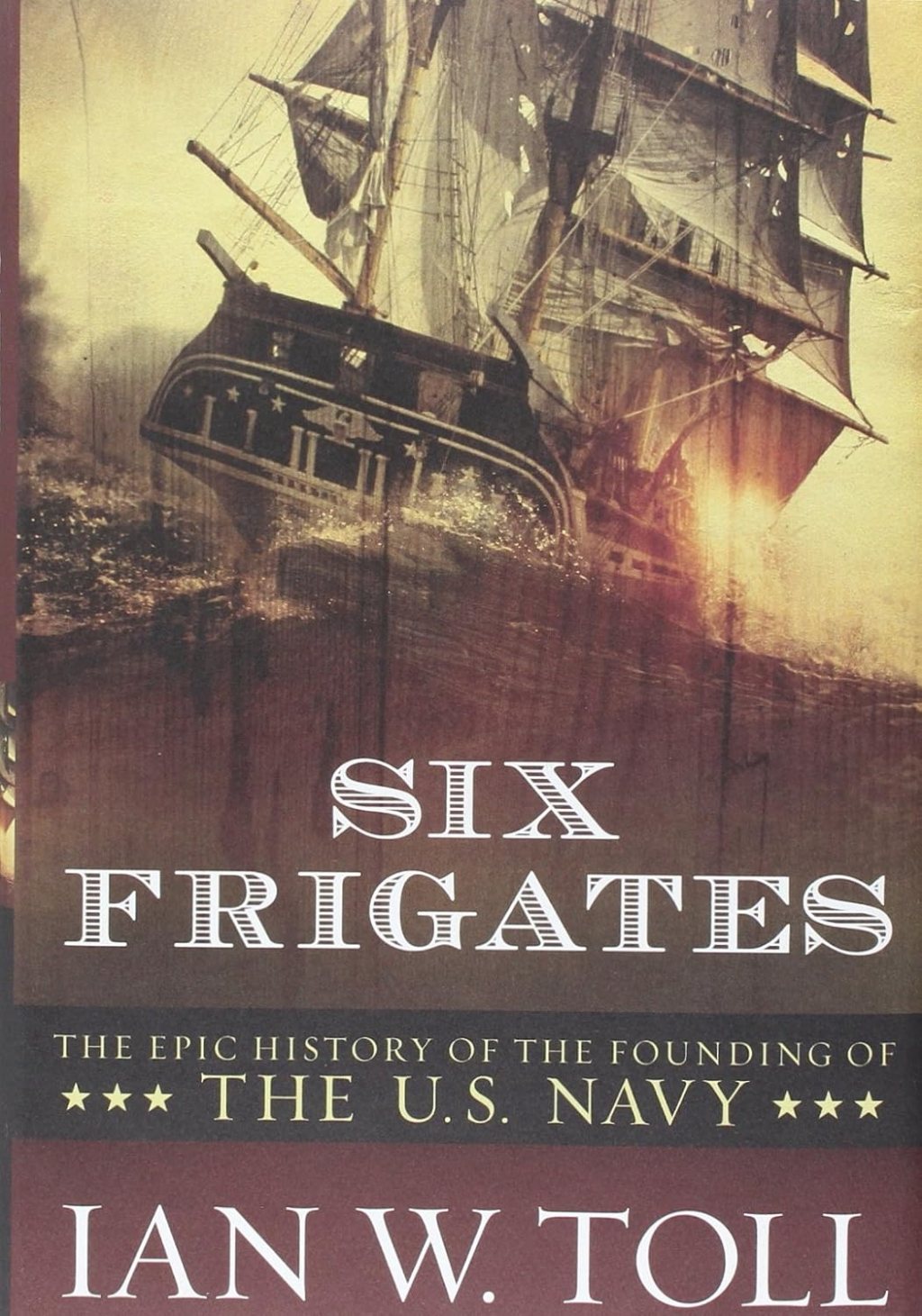
In the late eighteenth century, the English seemed almost born to the sea. They were better suited to naval warfare than their French, Spanish, and Dutch rivals, writes historian Ian W. Toll, “in the same way that a seal or a shark is inherently a better swimmer than a horse or a bear.” The central question of Six Frigates: The Epic History of the Founding of the U.S. Navy (2006) is whether the Americans – the political, ethnic, and cultural offspring of Britain and heirs to its maritime tradition – could prove equally adept at designing, building, and commanding warships capable of defeating peer adversaries on the open ocean. Toll’s answer is an emphatic yes!
By the late eighteenth century, the British way of war at sea – embodied by its greatest admiral, Lord Horatio Nelson – was, in Toll’s words, “simple, effective, and brutal.” Unlike a great land commander such as Napoleon, who sought to outmaneuver an enemy by turning his flank, British admirals rarely attempted elaborate tactical maneuvers. Nor did they generally seek to disable enemy warships by shredding their sails and masts with grapeshot or improvised anti-rigging ammunition known as langrage. Instead, the Royal Navy pursued a far more direct objective: annihilate the enemy’s fighting capability by killing its officers and sailors manning the rigging, rudder and guns. British warships closed to point-blank range, fighting “yardarm to yardarm” and unleashing broadside after broadside across enemy decks at rates of fire sometimes three times faster than their opponents. The result was often horrifying carnage followed by decisive victory.
This ruthless doctrine was perfectly captured by the famous signal hoisted aboard Nelson’s flagship Victory: “Engage the enemy more closely.” Nelson’s preference for point-blank combat left opposing fleets not only battered and defeated but psychologically demoralized. Between 1793 and 1815, Toll notes, the Royal Navy lost just seventeen frigates to the French, nine of which were later recaptured. During the same period, the French lost 229 frigates to the British. At Trafalgar, perhaps the single greatest naval victory in history, the Royal Navy captured or destroyed eighteen French and Spanish ships, took some 26,000 prisoners, and suffered just 1,700 casualties without losing a single ship. By the opening years of the nineteenth century, an aura of invincibility surrounded the Royal Navy. Against this backdrop, the improbable single-ship victories of the fledgling United States Navy in the unpopular War of 1812 over first-rate British warships of comparable size stunned the world – and perhaps no one more than the Lords Commissioners of the Admiralty and the average British person on the street.
During the wars of the French Revolution and the Napoleonic Empire, the American merchant marine prospered enormously by serving as the neutral middleman in the so-called carrying trade. The profits were staggering. A 250-ton merchant vessel, with a working life of roughly twenty years, could cost less than $20,000 to build yet earn more than that on its very first voyage. As Toll observes, “Money washed into [American] ports as predictably and relentlessly as the incoming tide.” Between 1792 and 1807, the American merchant fleet tripled to more than 10,000 vessels with a combined carrying capacity exceeding one million tons, manned by approximately 70,000 seamen. During the same period, American exports and re-exports quintupled to $108 million annually, a level not surpassed until 1835, by which time the nation’s population had more than doubled.
Despite this explosion of maritime wealth, the young republic approached naval power with remarkable hesitation. The United States built its navy slowly, reluctantly, and with little consensus about its fundamental purpose. Was it primarily intended to defend the nation’s coastline and harbors, escort merchant convoys, raid enemy commerce, wage fleet actions against rival navies, or simply transport American diplomats abroad? As Toll makes clear, the answer remained unsettled for years, shaping both the size of the fleet and the character of the service that eventually emerged.
The fledgling Continental Navy performed poorly during the American Revolution. Of the thirteen frigates constructed during the war, seven were captured by the British and another four were deliberately destroyed to prevent their capture. Beyond the daring hit-and-run exploits of captains such as John Paul Jones along the British coast, the Continental Navy produced few notable successes. In Toll’s telling, the enormous financial burden borne by the impoverished Continental Congress to build, equip, provision, and crew a navy yielded remarkably little strategic return. Compared with the decisive contributions of the Continental Army and the French fleet, the American naval effort did almost nothing to alter the outcome of the war.
One of the young republic’s foremost priorities after the Revolution – and especially after Britain closed the lucrative ports of the British West Indies to American shipping – was securing new overseas markets for its exports. American diplomats, including John Adams, negotiated commercial agreements with Sweden, Russia, Prussia, and the Netherlands, but no combination of continental European markets could compensate for the loss of British trade. At the same time, the nation’s vast merchant fleet suddenly found itself without the protection of the Royal Navy, leaving American shipping vulnerable to the persistent depredations of the Barbary States. The British had little incentive to discourage this piracy against their former colonies, and every reason to let it continue.
For advocates of limited government such as Thomas Jefferson, however, paying tribute to the Barbary pashas appeared to be a simpler and less expensive solution than building a permanent navy. A standing naval force, they feared, would inevitably require higher taxes, a larger federal bureaucracy, and the creation of a professional officer corps dominated by the politically suspect Federalists. The debate over whether to purchase peace or build the means to enforce it became one of the defining strategic questions of the early republic. Before the depredations of the Algerian corsairs, there had been little serious discussion of establishing a permanent United States Navy. But once American merchant ships began falling prey to Barbary pirates – and American sailors were imprisoned and sold into slavery in Muslim North Africa – the political calculus changed dramatically.
In 1794, Congress authorized the construction of six frigates at an estimated cost of $600,000, including the expense of building the ships and paying their officers and crews for the first three months of service. In hindsight, Toll observes, that estimate proved “preposterous.” Federalists nevertheless made a compelling case for the investment. Maritime insurance rates had climbed to as much as 25 percent of a ship’s value, imposing an estimated $2 million annual burden on American commerce. The rising cost of protecting overseas trade also drove up the price of essential imported goods such as salt, ultimately costing American consumers many times more than the projected expense of building a navy capable of defending the nation’s merchant fleet. Beyond economics, however, lay a question of national honor. An infant democratic republic only beginning to establish its place among the community of nations could ill afford the prestige effects of being openly bullied by a band of semi-barbarian corsair states in North Africa. The Federalists became – and remained – the party of the Navy. The Republicans, by contrast, insisted that the legislation passed in March 1794 explicitly limit the new squadron’s mission to combating the Barbary pirates and require that it be disbanded as soon as that threat had passed.
By 1794, Philadelphia was the largest freshwater port in the world and the leading shipbuilding center in the United States, producing roughly 8,000 tons of shipping annually, twice the output of its nearest rival. Many of the nation’s foremost naval architects were Philadelphia Quakers, whose pacifist principles made them unlikely contributors to a military enterprise. Yet the American Revolution changed some minds. Among them was Joshua Humphreys, who would go on to become the foremost designer of the early republic’s warships and the architect of the legendary six original frigates of the United States Navy.
Late eighteenth-century navies relied on three principal classes of warships. At the top were the ships-of-the-line – the “battleships” of their day – which typically carried 74 guns and were massive, heavily armed, and relatively slow. Below them were frigates, which sacrificed some firepower for speed and maneuverability. Usually carrying between 28 and 38 guns, often including powerful 24-pounder long guns, frigates were fast enough to overtake merchantmen while remaining capable of outrunning the lumbering ships-of-the-line. Their role was to serve as mobile platforms for heavy naval artillery, able to prey on commerce, scout for the fleet, and engage almost any opponent except another powerful frigate or a ship-of-the-line. Finally, there were the unrated vessels: brigs, sloops, schooners, and other small warships carrying fewer than 20 guns and typically commanded by junior officers.
Joshua Humphreys proposed something altogether different. Rather than build conventional frigates, he envisioned a class of exceptionally large and heavily armed vessels that blurred the distinction between frigates and ships-of-the-line. His ships would be powerful enough to defeat any frigate afloat while remaining fast enough to escape a ship-of-the-line, an approach that foreshadowed Admiral Jackie Fisher’s battlecruiser concept more than a century later during the Anglo-German naval arms race before the First World War.
Humphreys’ unprecedented design proved highly controversial, but Secretary of War Henry Knox and President George Washington embraced the concept. The administration awarded contracts to six of the nation’s principal shipbuilding centers – Philadelphia, Boston, New York, Baltimore, Norfolk, and Portsmouth, New Hampshire – to construct one frigate each. It was the largest federal procurement program undertaken by the young republic. Six captains were appointed to supervise construction before assuming command of their respective ships.
Because these frigates were to be the first warships of the new federal government, Knox believed their names should reflect the institutions and ideals of the Constitution. Washington reportedly approved the first five suggestions almost without deliberation: United States, President, Congress, Constitution, and Constellation. The sixth frigate, Chesapeake, took its name from the region in which it was built.
Construction, however, progressed painfully slowly, embarrassing nearly everyone involved. Then, in February 1796, before a single frigate had been completed, the United States concluded a hard-fought and expensive peace with the Barbary state of Algiers. The agreement required nearly $1 million in tribute, ransom, and gifts, including the extraordinary concession of building a 32-gun frigate for the Dey of Algiers. Altogether, the settlement consumed roughly 13 percent of the federal government’s annual expenditures.
Ironically, the treaty also threatened the very existence of the fledgling Navy. At the insistence of Jeffersonian Republicans, the original Naval Act stipulated that construction would cease if peace were reached with Algiers. Rather than abandon the program entirely, Congress chose a compromise: the three frigates closest to completion – United States in Philadelphia, Constitution in Boston, and Constellation in Baltimore – would be finished, while work on President, Congress, and Chesapeake was suspended.
By the mid-1790s, following the peace with Algiers, the debate over naval expansion became entangled in the broader international and domestic turmoil unleashed by the French Revolution. American politics increasingly revolved around the nation’s precarious neutrality between the era’s two great belligerents, Great Britain and Revolutionary France. In Congress, no opponent of naval construction proved more formidable than Albert Gallatin, who entered the House of Representatives in 1795 and soon established the influential Ways and Means Committee as a counterweight to Alexander Hamilton’s Treasury Department. Gallatin was unwavering in his commitment to reducing the national debt and restraining federal spending, particularly on military affairs.
Meanwhile, the navy-boosting Federalists had grown exasperated by the Navy’s chronic delays and significant cost overruns. Their political fortunes changed dramatically, however, with the 1798 XYZ Affair, when French foreign minister Charles-Maurice de Talleyrand’s agents demanded bribes before opening diplomatic negotiations with the United States. Public outrage swept the country, crystallized in the rallying cry: “Millions for defense, but not one cent for tribute.” The controversy transformed public attitudes toward naval power. Congress appropriated $1.4 million for the Navy in 1798, which was more than the federal government had spent on the naval affairs in all previous years combined and accounted for roughly 30 percent of all non-interest federal expenditures that year. The result was a rapid naval expansion that ushered in the undeclared naval conflict with France known as the Quasi War.
Toll’s account of the founding of the United States Navy features several unlikely and often overlooked heroes. One is the visionary naval architect Joshua Humphreys, whose innovative heavy-frigate design gave the young republic a decisive qualitative advantage at sea. Another is Benjamin Stoddert, the nation’s first Secretary of the Navy. A Revolutionary War veteran wounded at the Battle of Brandywine and a prosperous Federalist merchant from Georgetown, in what would later become the District of Columbia, Stoddert emerges as one of the book’s most capable administrators. Toll portrays him as thoughtful, pragmatic, fiscally disciplined, and unwavering in his determination to build an effective navy despite constant political opposition and financial constraints. Moreover, Stoddert was the lone member of President John Adams’s cabinet who was not a committed ally of Adams’s chief intraparty rival, Alexander Hamilton.
The new frigates quickly justified Stoddert’s confidence. Within months, they had secured the sea lanes serving American commerce, dramatically reducing the threat posed by French privateers. Their success was reflected in the insurance market: maritime insurance rates on voyages to the West Indies fell from as high as 30 percent to as little as 10 percent in 1798, a tangible measure of the security the fledgling Navy had restored to American trade. By 1799, the number of American merchant vessels captured by the French had fallen by two-thirds, while a congressional study estimated that the Navy had saved the nation more than $9 million in shipping losses. What had initially seemed an extravagant investment now appeared to be one of the young republic’s best investments.
On February 9, 1799, northeast of the island of Nevis in the Leeward Islands, Constellation defeated the French frigate L’Insurgente, securing the first major victory by the newly established U.S. Navy over a European warship. The bloody engagement offered dramatic validation of Humphreys’ heavy-frigate design philosophy and provided an enormous boost to American confidence during the Quasi War, demonstrating that the young republic could successfully challenge one of Europe’s foremost naval powers. The victory also transformed Constellation’s captain, Thomas Truxtun, into the first great hero of the U.S. Navy – and a very wealthy man.
Under the prize laws of the era, if a captured vessel was deemed to be of equal or superior force to the capturing ship, the proceeds from its sale belonged entirely to the captors. Truxtun therefore had every incentive to argue that L’Insurgente had been the more powerful vessel. Toll is not at all convinced. Although both frigates mounted roughly forty guns, Constellation carried far heavier 24-pounders, while L’Insurgente’s main battery consisted of 12-pounders. “By any objective measure,” Toll writes, “[L’Insurgente] was of lesser force than the Constellation.” Nevertheless, Truxtun persuaded Navy Secretary Stoddert to recognize the French frigate as the superior vessel and initially valued the prize at $120,000. Stoddert, highly skeptical of the claim, negotiated a compromise: Truxtun would receive the full prize share, but on a more realistic valuation of $84,500. After commissions and fees, Truxtun personally cleared approximately $8,000 – equivalent to more than $2 million today.
Later that year, Constellation fought another celebrated engagement against the French frigate La Vengeance, a ship that outgunned her by roughly fifty percent in broadside weight. After a fierce night battle, Constellation inflicted devastating damage, forcing the French frigate to flee under cover of darkness. La Vengeance suffered approximately four casualties for every one sustained by Constellation. The decisive American advantage lay not in firepower but in superior seamanship and gunnery: Constellation’s crew fired 1,229 rounds during the engagement, compared with just 742 fired by La Vengeance, despite the French ship carrying the heavier battery. In recognition of the victory, Congress awarded Captain Thomas Truxtun a gold medal.
News of the diplomatic settlement ending the Quasi War reached the United States too late to save John Adams’s bid for reelection. Yet, as Toll argues, Adams had successfully overseen the Navy’s second founding, avoiding many of the missteps that had plagued its uncertain beginnings during the Revolution and Washington administration. During the conflict, the United States demonstrated that it could not only design and build a small but formidable fleet of novel design, but also develop the shore-based infrastructure needed to sustain operations and project naval power far beyond North American waters. At the center of that achievement were the 44-gun frigates United States, Constitution, and President, widely regarded as the most powerful frigates of their day.
Thomas Jefferson became the nation’s third president in 1801 following what Toll describes as “almost certainly the most bitterly fought election in American history” – a truly remarkable claim coming from a well-informed source. Filling the post of Secretary of the Navy proved especially difficult for the new administration for two reasons. First, few senior Republicans hailed from the nation’s seaports and therefore possessed any meaningful experience with maritime affairs. Second, even fewer were eager to oversee a department that Jefferson and many of his allies intended to shrink dramatically, if not abolish altogether. Four candidates declined the appointment before Robert Smith of Maryland reluctantly agreed to serve.
The incoming Jefferson administration was determined to retire the federal debt, which stood at $83 million in 1800, while simultaneously eliminating nearly all federal excise and property taxes. These ambitious objectives were in basic conflict, leaving one obvious solution: dramatically reduce federal spending. At the time, the nation’s combined Army and Navy – roughly 6,500 officers and enlisted men – accounted for nearly seventy percent of all federal employees. Jefferson moved swiftly to shrink the military establishment. At the height of the Quasi War, the Navy had grown to nearly 700 officers and 49 vessels; under Jefferson, it was reduced to just thirteen frigates manned by 195 officers. He also consolidated the Navy’s scattered shore facilities into the new Washington Navy Yard.
Jefferson’s strategic outlook differed fundamentally from that of the once dominant Federalists. Where the Federalists looked eastward to Europe and envisioned a commercial republic whose prosperity depended on maritime trade and naval power, Jefferson imagined an agrarian nation whose future lay in westward expansion. According to Toll, he regarded overseas commerce as a necessary evil rather than a national calling and instinctively distrusted the coastal merchant class in general, once remarking that “merchants have no country.” Yet Jefferson was not the doctrinaire opponent of naval power that many of his fellow Republicans were. Instead, he sought to reshape the Navy into a force that was primarily defensive, insulated from the corrupting influence of patronage, and, above all, affordable. In Jefferson’s view, the cost of maintaining the fleet should never exceed the value of the commerce it existed to protect.
The Treaty of Algiers in 1795 – which had prompted the suspension of the original frigate-building program – was intended to become the cornerstone of peace and maritime security in the Mediterranean. American policymakers believed that Algiers, the most powerful of the Barbary states, wielded sufficient influence over its neighbors – Morocco, Tunis, and Tripoli – to restrain piracy throughout the region. The agreement came at a steep price. The United States paid nearly $1 million in cash, ransom, and gifts, while also committing to an annual tribute of naval stores worth nearly $100,000, a fantastic sum that the American government pleaded to keep secret. It eventually became clear, however, that the other states wanted their cut of the payments and that the Dey of Algiers exercised far less authority over the other Barbary rulers than American diplomats had been led to believe. “Long term war against a nation so obviously rich and defenseless was preferable to peace at any price,” Toll writes.
From the outset, one of the U.S. Navy’s greatest challenges was finding, recruiting, and retaining skilled seamen. Because the Navy relied entirely on volunteers, it had to compete in the open labor market against the highly profitable American merchant marine, where wages were often higher and conditions generally better. An even greater source of tension was the Royal Navy’s seemingly insatiable demand for manpower. In 1801, Britain maintained nearly 800 warships in commission, compared with roughly ten in the U.S. Navy. To fill their ranks, British authorities claimed the right to impress any sailor born within the British Empire, refusing to recognize the legitimacy of naturalized American citizenship. In the eyes of the Admiralty, once a British subject, always a British subject, and therefore perpetually liable for service in the Royal Navy.
If Humphreys, Stoddert and Truxton are early but forgotten heroes of the American navy, then William Bainbridge is one of the all-time goats. The intrepid and evidently competent young officer seemed to be operating under a very unlucky star, which is something that late eighteenth century sailors believed to be a very real thing. Indeed,no early American naval officer endured more public humiliation than Bainbridge. In 1798, while commanding the schooner Retaliation, he became the first officer in U.S. Navy history to surrender an American warship after being overpowered by two larger French frigates during the Quasi War. Although later exchanged and eventually vindicated, the episode cast an early shadow over his reputation. An even greater indignity followed during the First Barbary War. In 1803, commanding the new frigate Philadelphia, Bainbridge ran aground on an uncharted reef while pursuing a Tripolitan corsair outside Tripoli harbor. Surrounded by enemy gunboats and unable to free or defend his ship, he ordered her surrendered to prevent a futile loss of life. The capture of one of the Navy’s finest frigates – and Bainbridge’s subsequent nineteen months as a prisoner of the Bashaw of Tripoli – was one of the darkest episodes in early American naval history, prompting Stephen Decatur’s legendary raid to burn Philadelphia before she could be put into enemy service. Although Bainbridge would ultimately redeem himself with his brilliant victory over HMS Java during the War of 1812, his early career was marked by an extraordinary series of setbacks that would have ended the careers of many lesser officers.
If Bainbridge embodied the frustrations and humiliations of the early U.S. Navy, Stephen Decatur represented its audacity and rising confidence. Another of Toll’s central heroes, Decatur “better personified the eighteenth-century ideal of the romantic hero” than any other American naval officer. In the tiny navy of the Jefferson-era, promotions were infrequent and seniority alone offered little opportunity for advancement. The surest path to distinction was extraordinary courage in battle. Decatur found that opportunity in 1804 when he led the daring nighttime raid into Tripoli harbor to destroy Bainbridge’s captured frigate Philadelphia. The exploit, celebrated across Europe and America, instantly established Decatur as the Navy’s foremost rising star and one of the most celebrated naval officers of his generation. In recognition of his bravery and leadership in taking the Philadelphia, which Horatio Nelson was said to have called “the most bold and daring act of the age,” Decatur received a two-rung promotion, skipping the rank of master commandant. In less than six months he had gone from an anonymous lieutenant to a national celebrity and the youngest captain in the U.S. Navy at age 25
Edward Preble also performed admirably against the Barbary pirates. Toll argues that Preble was the bridge between the Navy’s uncertain infancy and its emergence as a first-rate fighting force. Humphreys designed the ships, Stoddert built the institution, Truxtun proved the heavy frigates could win, but Preble created the generation of officers like Dectaur who would make the U.S. Navy famous during the War of 1812.
Preble, a stern and demanding New England officer from Maine, took command of the Mediterranean Squadron during the First Barbary War in 1803. Unlike many of his predecessors, he believed that American prestige depended on demonstrating overwhelming force rather than paying tribute to the Barbary states. Arriving off Tripoli aboard Constitution, he transformed what had been a hesitant blockade into an aggressive offensive campaign. He orchestrated repeated bombardments of Tripoli, personally directed amphibious assaults and gunboat attacks, and relentlessly pressured the Bashaw into negotiations. Although the war ultimately ended through diplomacy before Tripoli was decisively defeated, Preble restored American credibility after the humiliating loss of Philadelphia.
His greatest legacy, however, was not tactical but institutional. Preble was an uncompromising disciplinarian who demanded professionalism, technical competence, and aggressive leadership from his junior officers. The remarkable group who served under him – including Decatur, Bainbridge, Isaac Hull, Charles Stewart, John Rodgers, and David Porter – became known as “Preble’s Boys.” Nearly all would rise to senior command and become the heroes of the War of 1812. Their victories over the Royal Navy – including Constitution’s eventual triumphs over Guerriere and Java, Decatur’s capture of Macedonian, and Stewart’s victories in Constitution – owed much to the standards of leadership and seamanship they absorbed under Preble’s command.
A peace treaty was signed with Tripoli in June 1805. Although the agreement technically required neither tribute nor payment in exchange for peace, it did include a $60,000 ransom ($1.2 million in current dollars) to secure the release of the captured crew of the Philadelphia, an outcome that many, including Navy Secretary Smith, found unseemly. Nevertheless, the war had ended on relatively inexpensive terms. As Ian W. Toll observes, “The Tripolitan War had been, in the Jeffersonian view of the world, a perfectly acceptable military adventure,” one “conducted on a scale compatible with Albert Gallatin’s severe fiscal limitations.” Moreover, the U.S. Treasury was awash in cash as customs revenues surged, fueled by the carrying trade during the Napoleonic Wars. As Toll observes, “America prospered by European misery.” The war-driven boom enabled Treasury Secretary Gallatin to eliminate unpopular internal taxes, make substantial progress toward his ambitious debt-reduction goals, and pay $11.2 million in cash for the Louisiana Purchase. Against this backdrop of fiscal abundance, the additional costs of the Tripolitan War were easily absorbed.
The final third of the book returns to the conflict with England and the Royal Nav, a struggle that revolved above all around the issue of impressment. The practice rested on the British doctrine of “indefeasible allegiance” and the Crown’s asserted prerogative to compel the service of all seamen born in Britain, even those who had later become naturalized American citizens, for the defense of the realm. The scale of the problem was staggering: between 1796 and 1812, historians conservatively estimate that roughly 10,000 American seamen were forcibly pressed into the Royal Navy.
As Toll explains, impressment was driven by three interrelated developments. First was the extraordinary expansion of the wartime Royal Navy. In 1792, about 10,000 men served in the British fleets; by 1812, that number had surged to roughly 140,000. Second was the equally dramatic growth of the American merchant marine. During the first years of the nineteenth century, the merchant fleet expanded by roughly 70,000 tons annually, requiring some 4,200 new seamen each year. As a result, the American merchant marine grew over the same period from approximately 10,000 seamen to about 70,000, with British sailors accounting for as much as half of the increase in some years. Service aboard American merchant vessels offered higher wages, less severe discipline, and shorter terms of service, making it far more attractive than life in the austere Royal Navy. It is entirely likely that the number of British deserters serving on American ships exceeded the number of American seamen impressed into Royal Navy service. Third, and closely related to the first two developments, desertion from the Royal Navy reached epidemic proportions, with rates reportedly approaching fifty percent on some ships. The result was a chronic shortage of experienced seamen. Demand was enormous, supply was limited, and British authorities looked increasingly to American vessels to fill the gap. If sailors could not be recruited, they would be impressed. “Desperate times, it seemed, called for desperate measures,” Toll writes. “If Americans were complicit in draining away manpower from the Royal Navy, and if there was no practical way to staunch the flow, why not dragoon a few Yankee seamen into joining the great campaign [against Napoleon]?”
Layered atop this fierce competition for seafaring labor was an equally contentious dispute over neutral trading rights. The Jefferson and Madison administrations embraced the principle that “free ships make free goods,” a doctrine fundamentally at odds with Britain’s controversial “Rule of 1756,” first articulated during the Seven Years’ War. Under that rule, Britain denied neutral nations the right to engage in wartime commerce on routes from which they had been excluded in peacetime. Thus, if French mercantile regulations prohibited foreign vessels from carrying goods between the French West Indies and metropolitan France during peacetime (as they generally did) Britain claimed that neutral ships could not lawfully enter that trade once war broke out. The objective was to sever the commercial lifeline between France’s lucrative Caribbean plantations and the mother country.
American merchants devised an ingenious workaround. Rather than sailing directly from the French West Indies to France, they “re-exported” colonial goods by first bringing them into American ports, where the cargoes were landed, import duties paid and later refunded, and new bills of lading issued before the goods were reloaded onto the same vessels for the final voyage to France. The legal fiction transformed what Britain regarded as a single prohibited voyage into two separate and lawful ones. The re-export trade became a major engine of American prosperity, expanding from $26 million in 1796 to $53 million by 1805.
In July 1805, a British Vice Admiralty Court in the Bahamas issued its decision in the Essex case, effectively outlawing the American re-export trade at a stroke. Overnight, American merchant vessels engaged in that commerce became legitimate targets for capture and condemnation by British cruisers and privateers. Maritime insurance rates soared by 400 percent, and between 1805 and 1807 nearly five hundred American ships were seized and brought into British ports for adjudication. Congress responded with the Non-Importation Act of 1806, imposing trade sanctions on Great Britain in a strategy that harked back to the commercial resistance measures employed during the American Revolution.
At the time, five of the Navy’s six original frigates lay at the Washington Navy Yard in various stages of dismantlement. Only the Constitution remained in active service, patrolling the Mediterranean against the Barbary pirates. By the spring of 1806, Navy Secretary Robert Smith was calling for a major naval expansion, but despite the Treasury’s robust revenues, Secretary Gallatin resisted the additional expense.
Events in Europe soon complicated matters further. Between October 16 and December 2, 1805, each belligerent won a decisive victory in its dominant sphere: Napoleon crushed the Austrian and Russian armies at Ulm and Austerlitz, while Britain secured command of the seas against the French and Spanish at Trafalgar. After 1806, as Toll observes, France and Britain were “like two hostile dogs chained to opposite posts, nose to nose but not close enough to fight.” Unable to strike directly at one another, they turned instead to full-scale economic warfare.
In November 1806, Napoleon issued the “Berlin Decree,” declaring the British Isles under blockade. With little of the French navy left to enforce it, however, the decree served primarily as a pretext for seizing neutral shipping in European ports. Britain responded in early 1807 with a new Order in Council prohibiting neutral vessels from trading between ports under French control. Taken together, the competing French and British measures left virtually every major category of American commerce with Europe vulnerable to seizure by one side or the other.
The Jefferson administration’s answer was the gunboat program, perhaps the most misguided strategic defense initiative in early American history, although, as Toll notes, the theory behind it was “not ridiculous on the face of it.” Gunboats were small vessels, typically fifty to seventy-five feet long, armed with a single 24- or 32-pound cannon and crewed by twenty to thirty men. They could be sailed or rowed but were generally too unseaworthy for operations far from the coast. Indeed, they required remarkably calm conditions to fight effectively. In essence, they were floating artillery batteries.
The concept appealed to Jeffersonians because it seemed to offer an alternative to a permanent blue-water navy with its high fixed costs and its perceived tendency to invite foreign military adventures. Instead, a large flotilla of inexpensive gunboats promised a kind of naval militia that could be mobilized quickly to defend threatened stretches of the American coastline. Between 1805 and 1807, Congress authorized the construction of 278 gunboats, although only about two-thirds (176) were ultimately completed. Their average cost reached approximately $10,000 apiece – double the original estimate of $5,000 – bringing the total investment to roughly $1.5 million. In practice, however, the gunboats proved virtually useless, and the program was quietly abandoned after James Madison assumed the presidency in 1809.
An early turning point in the history of the United States Navy came on June 22, 1807, when the 52-gun British frigate Leopard attacked and boarded the Chesapeake in an incident that shocked and humiliated the nation. Toll notes that Chesapeake had long been regarded by officers and sailors as an unlucky ship. She alone among the Navy’s original six frigates was not named for an ideal or principle associated with the Constitution, and she was the only one designed by the rival Quaker shipwright Josiah Fox rather than chief naval architect Joshua Humphreys, who openly disowned her design. From the beginning, Chesapeake seemed destined to sail under an ill star.
The encounter took place just off Norfolk, Virginia. Leopard demanded permission to search Chesapeake for alleged Royal Navy deserters, an audacious demand to make of a sovereign nation’s warship. Commodore James Barron refused but was wholly unprepared to resist, having failed to clear his ship for action before sailing. That lapse led to his court-martial and effectively ended his active naval career. Leopard then opened fire, killing three Americans and wounding eighteen. After Chesapeake, having managed only a single return shot, struck her colors, British sailors boarded the frigate and removed four alleged deserters.
Unlike Captain William Bainbridge, whose officers rallied to his defense after the loss of Philadelphia outside Tripoli Harbor in 1803, Barron found little sympathy from his junior officers on Chesapeake. None of them testified on his behalf, and the controversy over his conduct proved so bitter that it sparked no fewer than seven duels over the following two months.
Toll argues that the public outrage provoked by the Chesapeake–Leopard affair was greater than any since the early years of the American Revolution. For a brief moment, the incident united rival Federalists and Republicans in a rare display of national solidarity. Even Treasury Secretary Albert Gallatin, long a skeptic of naval expansion, found himself aligned with the growing chorus demanding a firmer response to Britain.
Americans may have been outraged by the Chesapeake–Leopard affair, but they were quickly sobered by events in Europe. In September 1807, scarcely two months after the incident and without a declaration of war, the Royal Navy bombarded Copenhagen and seized the entire Danish fleet to prevent it from falling into Napoleon’s hands. Copenhagen’s harbor defenses were considerably stronger than those of New York, Philadelphia, or Boston, yet they proved no obstacle to British sea power. The lesson was unmistakable: if Britain was willing and able to strike a well-defended neutral capital, America’s principal port cities were dangerously vulnerable. Americans, especially those living along the coast, had much to fear and little on which to rely.
With few attractive alternatives, the Jefferson administration turned to what it called “peaceable coercion” – a euphemism for economic sanctions. The strategy was, as Toll writes, “deeply woven into the fabric of American revolutionary folklore.” Its intellectual roots stretched back to the non-importation agreements of the 1760s, when American colonists sought to pressure Britain through commercial resistance rather than military force. By Jefferson’s presidency, economic coercion had become a cornerstone of Republican foreign policy.
In 1807, however, Jefferson carried the concept further than ever before, asking Congress to enact an embargo that prohibited not merely the importation of foreign goods but also the exportation of American goods. The man who had entered office in 1801 promising “a wise and frugal Government, which shall restrain men from injuring one another [and] shall leave them otherwise free to regulate their own pursuits of industry and improvement,” had, by 1808, embraced a policy of unprecedented federal intrusion into the livelihoods of nearly every American engaged in the nation’s maritime economy.
The Embargo Act quickly inflicted severe damage on the American economy. Exports collapsed by nearly 80 percent in a single year, falling from $108 million in 1807 to just $22 million in 1808. Deprived of customs duties – the federal government’s principal source of revenue – the Treasury’s fiscal surplus evaporated just as the nation needed resources to strengthen its military defenses. Federalist critics seized on the opportunity, portraying Jefferson as an impractical dreamer whose grand theories were punishing the very people he claimed to serve.
The embargo’s effects in Europe were equally dramatic, though far more uneven. Prices for staple commodities exported from America – such as timber, cotton, and rice – doubled or even tripled as supplies tightened, while goods that had previously found a ready American market – notably West Indian sugar and coffee – flooded European markets, driving prices sharply downward. British farmers, merchants, and shipowners, meanwhile, welcomed the disappearance of one of their most dynamic commercial rivals. As Toll concludes, “The embargo had been an abject failure.” Jefferson repealed the measure in one of his last acts as president, marking what was arguably the greatest and most consequential failure of his otherwise successful administration.
James Madison entered office with a nation that Toll describes as “rudderless, unsettled, and unhappy,” and argues that Madison lacked the force of personality and political leadership needed to restore confidence. A growing pro-navy faction within the Republican Party joined with the Federalists to demand a change in course. As part of the transition, Navy Secretary Robert Smith became secretary of state, while the little-known former governor of South Carolina, Paul Hamilton, assumed leadership of the Navy Department. Meanwhile, Congress enacted Macon’s Bill No. 2, restoring trade with both Great Britain and France while authorizing the president to reimpose non-intercourse against either belligerent if the other agreed to respect American neutral rights. The measure sought to exploit Anglo-French rivalry by rewarding whichever power first accommodated the United States’ demands.
The new “War Hawk” faction of the Republican Party, led by Kentucky’s Henry Clay, pushed for a dramatic expansion of American military spending, including a major increase in naval construction and, for the first time, the building of 74-gun ships of the line. The Old Guard Republicans, however, continued to view naval expenditures as an extravagant and unnecessary burden. Worse, they argued, these powerful new vessels would likely be captured by the larger and more experienced Royal Navy, absorbed into the British fleet, and turned against the very Americans who had financed their construction.
As politicians continued to debate the merits of war preparation, the Madison administration moved steadily toward a declaration of war against Britain, which Congress approved on June 18, 1812. The vote revealed deep national divisions: nearly 40 percent of both chambers opposed the declaration, including every Federalist member of Congress. No other American declaration of war would ever pass by such a narrow and partisan margin.
At the outbreak of the War of 1812, the Royal Navy enjoyed an overwhelming superiority at sea. It possessed roughly six hundred warships in active service, including 175 ships of the line mounting at least sixty-four guns on two covered gun decks, with another 250 vessels either under construction or in reserve. By comparison, the United States Navy fielded just sixteen commissioned warships, only seven of them ocean-going frigates. However, the tiny American navy possessed one decisive advantage that would ultimately prove critical: the ability to man every warship with highly motivated, well-trained crews composed entirely of volunteers.The disparity was so great that the Navy Department, led by the inexperienced former farmer Paul Hamilton, had no clear strategy for employing the limited force at its disposal. Should the frigates defend America’s principal harbors? Operate independently or in squadrons? Escort American merchant shipping or raid British commerce? Civilian naval leadership seemed to have no coherent answer. Captains Stephen Decatur and John Rodgers, by contrast, argued that the frigates should be sent far from American shores to wage commerce warfare against British shipping. President James Madison and his cabinet ultimately rejected that advice, opting instead to concentrate the Navy’s principal force at New York.
Taken as a whole, the War of 1812 may represent the low point of American national security policymaking, defense planning, and military operations. Yet, unexpectedly – and against nearly every prediction on either side of the Atlantic – the conflict also produced a handful of dramatic American naval victories over the mighty British Royal Navy. The first came on August 19, 1812, when the Constitution under Captain Isaac Hull defeated the HMS Guerriere in the North Atlantic, roughly 400 miles southeast of Halifax, Nova Scotia. The engagement marked the first major American naval victory of the war and had an outsized psychological impact. American losses totaled just seven killed and seven wounded, while the British suffered twenty-three killed and fifty-six wounded before Guerriere struck her colors. Although the victory did little to challenge Britain’s command of the sea, it demonstrated that the American heavy frigates could decisively defeat the Royal Navy’s standard 38-gun frigates in single-ship combat, boosting American morale and puncturing the aura of British naval invincibility. The boost to American morale could not have come at a better time. Just three days earlier, Captain Hull’s uncle, Brigadier General William Hull, had surrendered Fort Detroit without offering meaningful resistance to a smaller force of British regulars and their Indian allies. The stark contrast between the two commanders quickly became the subject of popular wit: “We have a Hull-up and a Hull-down,” ran the joke of the day.
The victory of Constitution over Guerriere proved to be no fluke. Just two months later, on October 25, 1812, the frigate United States, known affectionately to her crew as “Old Wagon” and commanded by the legendary Stephen Decatur, encountered HMS Macedonian about 500 miles west of the Canary Islands. Decatur skillfully exploited the superior range and hitting power of United States‘ 24-pounder long guns, maintaining a distance at which the British frigate’s lighter 18-pounders were far less effective. After nearly two hours of combat, Macedonian was reduced to a shattered hulk, having lost her mizzenmast and suffered extensive damage to her hull and rigging. British casualties totaled 36 killed and 68 wounded, while the Americans lost only 5 killed and 7 wounded. Unlike Guerriere, Macedonian remained seaworthy enough to be taken as a prize. She was sailed triumphantly into New York, where thousands of spectators crowded the waterfront to celebrate the captured British warship. The victory reinforced the lessons of Constitution’s earlier success: America’s heavy frigates designed by Joshua Humphreys, when skillfully handled, possessed a decisive advantage over the Royal Navy’s standard 38-gun frigates.
It had been nearly a decade since a British warship had been defeated in a single-ship action, and even longer since a Royal Navy frigate had struck her colors to an opponent of roughly equal force. Although these isolated American victories did nothing to challenge Britain’s command of the sea, they delivered a powerful boost to American morale while deeply embarrassing the Admiralty. “The sacred spell of the invincibility of the British navy was broken by these unfortunate captures,” lamented British Foreign Secretary George Canning, drawing an implicit parallel to Napoleon’s disastrous retreat from Russia later that year, which similarly shattered the aura of French invincibility on land. The unexpected success of the American heavy frigates, combined with the capture of five hundred British merchant vessels by American privateers in the first seven months of the war, provided a jolt of encouragement to the remnants of Napoleon’s shattered Grand Armee and forced the Royal Navy to revise its tactics and respect for the American navy.
Toll argues that the British Admiralty responded by asking its commander in North America, Admiral John Warren, to accomplish the impossible. Operating from the distant bases of Halifax and Bermuda with a force of ten ships of the line, thirty frigates, and fifty sloops of war, Warren was expected to hunt down the American heavy frigates while simultaneously patrolling the sea lanes for privateers, escorting merchant convoys from the West Indies, and enforcing a commercial blockade along the entire American Atlantic seaboard. Despite these sweeping responsibilities, the Admiralty believed Warren’s overwhelming numerical superiority – 97 warships to the Americans’ 14 – should have made the destruction of the fledgling U.S. Navy a foregone conclusion. Yet while the Americans succeeded in preserving a fleet-in-being, the Royal Navy retained the ability to strike virtually any point along the American coast at will, looting and destroying coastal communities with impunity. The American gunboat strategy, devised by the Jefferson administration specifically to counter this threat, proved completely ineffective.
The war at sea, Toll writes, “had developed into a monstrous affair of honor between the two navies,” as the British sought to restore their reputation by inviting American frigates to emerge from port and engage in single combat against equally matched Royal Navy opponents. The ill-fated Chesapeake suffered the most devastating American naval defeat of the war on June 1, 1813, in what Toll described as a “medieval jousting match,” when she was captured by HMS Shannon just outside Boston Harbor in one of the shortest and bloodiest frigate actions of the age, with 228 men wounded, including 71 dead. Although the two ships were closely matched in size and armament, Shannon’s disciplined and accurate gunnery quickly shattered Chesapeake’s command structure. Captain James Lawrence was mortally wounded early in the engagement – uttering the famous words, “Don’t give up the ship!” as he was carried below – and much of the American officer corps was killed or incapacitated within minutes.
The victory represented a dramatic reversal of the humiliating defeats the Royal Navy had suffered during the opening months of the war. Shannon’s triumph restored British confidence, demonstrated the decisive advantage of a highly trained and disciplined crew even against an opponent of comparable strength, and reinforced the Admiralty’s growing determination to avoid unnecessary single-ship engagements with the larger American heavy frigates. For the United States, the loss of Chesapeake served as a sobering reminder that superior ship design and heavier armament could not compensate for deficiencies in training, discipline, and experienced leadership.
The United States also attempted to exploit what would become one of its most effective and enduring advantages over the coming centuries: American entrepreneurial ingenuity. In March 1813, Congress passed the Torpedo Act, offering a federal bounty to any American – civilian or military – who succeeded in destroying an enemy warship by novel means of attack. The reward amounted to half the value of the vessel destroyed. For a frigate or ship of the line, the bounty could exceed $100,000, the equivalent of nearly $2 million today. “All up and down the Atlantic seaboard,” Toll writes, “entrepreneurs and inventors turned their minds to the challenge.”
One of the most promising methods involved converting merchant vessels into floating bombs, rigging them with explosives designed to detonate once they had been brought alongside a British warship. In June 1813, one such decoy vessel, Eagle, exploded off New London, Connecticut, killing a British officer and ten seamen. The attack outraged the British, who denounced it as a cowardly and dishonorable form of warfare. They quickly adapted, however, becoming deeply suspicious of abandoned merchantmen and refusing to bring unfamiliar vessels alongside their ships. As Toll observes, the “Torpedo War” never fulfilled the lofty expectations of its sponsors, although it did succeed in further embittering the increasingly bitter conflict between the two navies.
By late 1813, the British blockade had succeeded in bottling up the principal American frigates in their home ports: United States at New London, Constellation at Norfolk, Constitution at Boston, and President at Newport. Yet American privateers continued to inflict significant damage on British commerce, capturing as many as forty-five merchant vessels each month by stalking East India Company convoys and preying on isolated stragglers. Given that the central issue of the war was impressment, the conflict made little financial sense for Britain. The war was costing the government roughly £10 million annually, while the Royal Navy’s entire enlisted payroll amounted to only £3 million. Even tripling sailors’ wages would have cost far less than waging a war to preserve the practice of impressment.
Britain’s difficulties were compounded in November 1813, when a devastating hurricane struck Halifax, severely damaging much of the Royal Navy’s North American squadron. After only eighteen months in command, Admiral Warren was relieved of his post, undone by an impossible mission, unrealistic expectations from the Admiralty, and the unexpected audacity, skill, and striking power of the diminutive American navy.
Warren was replaced by Vice Admiral Sir Alexander Cochrane, who quickly adopted a harsher and more aggressive and punitive strategy. His campaign combined relentless amphibious raids in the South – including the burning of Washington, D.C. – with naval bombardments in the North, such as the shelling of Stonington, Connecticut, using rockets and incendiary shells. Yet even as British forces escalated the war, public support at home was steadily eroding. The conflict was financed through property taxes while imposing mounting economic burdens, from rising commodity prices to soaring maritime insurance premiums.
By September 1814, Lloyd’s of London estimated that American privateers had captured or destroyed some 800 British merchant vessels since the war began, including 108 in the previous month alone. Despite Britain’s overwhelming naval superiority, it had proved unable to protect its commercial shipping from persistent American attacks. Insurance rates reflected the growing danger. Coverage for merchantmen sailing between Liverpool and Halifax had climbed to 30 percent, while even the short, less than 150-mile passage between Liverpool and Dublin carried premiums of 13 percent, more than 300 times higher than before the war. Mounting losses prompted the opposition Whigs to launch a parliamentary investigation into the Admiralty’s failure to suppress the American privateers.
The Treaty of Ghent, which ended the war, was signed on Christmas Eve 1814. As Toll observes, it was “nothing more than an agreement to stop fighting.” Neither side had achieved its principal war aims; both had simply had enough. Yet the war’s final and most memorable battle was still to come. Unaware that peace had already been concluded, British forces launched an assault on New Orleans two weeks later and suffered one of the most lopsided defeats in the history of the British Army. British casualties totaled 291 killed, 1,262 wounded, and 484 captured – including three generals and seven colonels – while the Americans lost just six killed and seven wounded. The stunning victory transformed Major General Andrew Jackson into a national hero and forever shaped the popular American memory of the War of 1812.
The War of 1812 may have been, as the Federalists charged, a “ludicrous and costly war,” but, as Toll observes, the American public had no appetite for being told that the conflict had been futile or unnecessary – even though, he argues, “no other foreign war has ever divided the American people so bitterly.” Americans instead embraced the Republican narrative that the struggle had been a great patriotic crusade, sometimes called the Second American War for Independence. The war had secured, as War Hawk Henry Clay declared in 1816, “respectability and character abroad – security and confidence at home.” Indeed, America’s tiny and unassuming navy had, in Toll’s words, “shocked and humbled the mightiest fleet the world had ever known.” Victorious commanders such as Decatur, Hull, Bainbridge, Lawrence, Perry, and Macdonough became national celebrities, enjoying a level of fame comparable to that of today’s biggest Hollywood stars and elite professional athletes. As a result, the last vestiges of the Republicans’ long-standing hostility to naval power disappeared.
For nearly a century, the definitive account of the naval war of 1812 was Naval Occurrences of the War of 1812: A Full and Correct Account of the Naval War Between Great Britain and the United States of America, 1812–1815, published in 1817 by Admiralty lawyer William James. Toll describes it as a “bitterly sarcastic and deeply malevolent work,” filled with gratuitous insults directed at American culture and ad hominem attacks on the American people. Naval Occurrences remained the standard history until 1882, when a young Harvard graduate named Theodore Roosevelt published The Naval War of 1812. Roosevelt’s revisionist study systematically dismantled James’s account, offering a point-by-point rebuttal and presenting compelling evidence of the author’s distortions and fabrications. A quarter century later, during his first term as president, Roosevelt – by then an ardent advocate of American sea power – persuaded Congress to increase the naval budget by 40 percent, pushing annual expenditures above $100 million for the first time and funding the largest peacetime naval expansion in the nation’s history.
In closing, Six Frigates is not merely the story of six warships or even of the War of 1812. It is the story of a young republic discovering that military power, when guided by political purpose and exercised with restraint, could shape both its destiny and its identity. Toll reminds us that the United States did not become a maritime nation by accident but through hard-won experience, bold leadership, and a willingness to challenge seemingly insurmountable odds. More than two centuries later, his account remains a timely meditation on the enduring relationship between sea power, national ambition, and the making of American history.


Leave a Reply