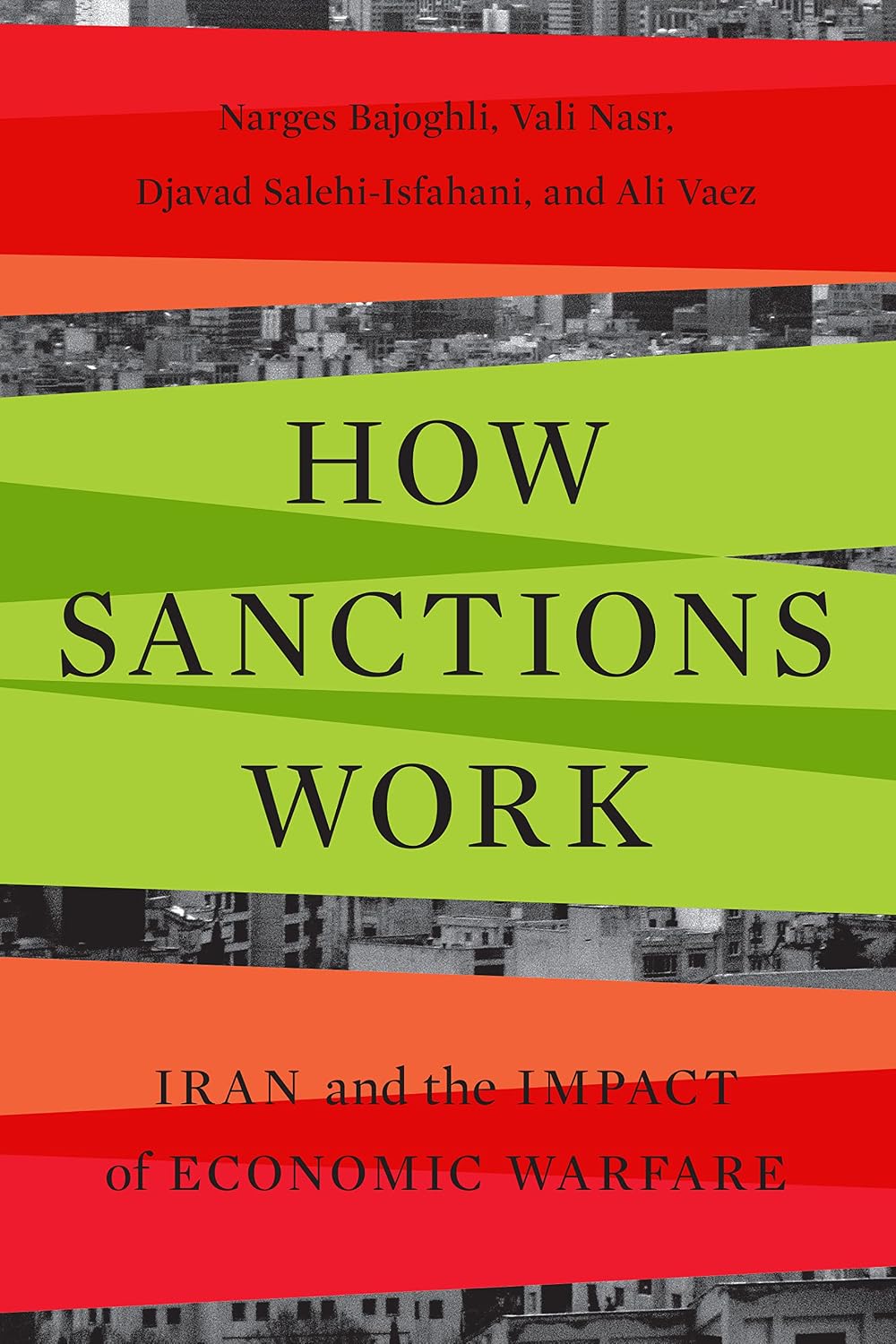
As a graduate of the Johns Hopkins School of Advanced International Studies (SAIS), I happened to be on campus when How Sanctions Work: Iran and the Impact of Economic Warfare (2024), by Narges Bajoghli and her co-authors, was released. I attended the authors’ roundtable discussion but reserved judgment until I had read the book itself. Unfortunately, after reading this slim volume cover to cover, I found it every bit as unpersuasive as the discussion had led me to expect: an earnest, carefully researched, but fundamentally one-sided account of one of the most consequential instruments of modern statecraft.
Throughout the book, the authors return to three central arguments. First, sanctions inflict their greatest damage on Iran’s middle class – the social group most capable of challenging the regime. Second, sanctions enrich the Islamic Republic’s most hardline factions, leaving them wealthier, more entrenched, and more intransigent while fostering a “battlefield mentality” (meydaan) throughout the state. Third, once imposed, sanctions acquire a bureaucratic and political momentum of their own, becoming exceedingly difficult to remove. As the authors put it, “Economic sanctions are rapidly imposed and lifted only slowly, and often not at all.” Unlike many other foreign-policy tools, sanctions become embedded in legislation and congressional politics, limiting any president’s ability to unwind them unilaterally.
These observations are often insightful, but the book rests on an assumption it never seriously examines: that the Islamic Republic is a government that can ultimately be persuaded to moderate its behavior through economic incentives. The possibility that Iran’s revolutionary leadership may be fundamentally and ideologically committed to opposing liberal democracy, supporting proxy organizations throughout the Middle East, and resisting American influence regardless of economic cost, receives remarkably little attention. If that premise is wrong, then the failure of sanctions to produce political moderation says less about sanctions than about the nature of the regime they are intended to influence.
That assumption shapes the book’s definition of success. The authors measure the effectiveness of sanctions almost entirely by the concessions they produce when lifted, rather than by the constraints they impose while in force. By that logic, the purpose of prison would be judged solely by post-release recidivism rates, with little regard for punishment, deterrence, or the simple fact that incarceration incapacitates dangerous offenders while they remain behind bars. Likewise, sanctions may fail to transform a regime yet still succeed in restricting its financial resources, military capabilities, and ability to project power abroad.
Ironically, the authors themselves present overwhelming evidence that sanctions have imposed extraordinary costs on Iran. They divide the sanctions regime into four successive waves – from the 1979 hostage crisis through the Trump administration’s “maximum pressure” campaign – and document the cumulative economic damage in meticulous detail. By their own account, President Obama’s sanctions beginning in 2011 were “devastatingly effective” at inflicting economic pain. Since 2010, poverty has doubled in rural Iran and increased by roughly 60 percent in urban areas. Oil exports fell by roughly half – from two million barrels per day to less than one million – GDP contracted by nearly 20 percent between 2011 and 2015, public investment fell 23 percent in a single year, and inflation climbed above 65 percent.
Conditions deteriorated even further during Donald Trump’s first term. Between 2018 and 2021, Iran’s economy contracted by another 12 percent while per capita income fell by 14 percent. Poverty increased by 11 percent, average living standards declined by 13 percent, food prices surged by 186 percent, and healthcare costs rose by 125 percent. By 2022, three out of every four Iranians required some form of government assistance, increasing dependence on the very regime the sanctions sought to weaken.
The authors also compellingly document the sanctions’ psychological consequences. They describe widespread “Migration Fever,” growing despair among younger Iranians, and a pervasive sense that the promises of the 1979 Revolution have been betrayed. Many Iranians, they note, openly concluded that “the Revolution was a mistake.” In this respect, the book succeeds as a vivid account of the profound social and humanitarian costs sanctions have imposed.
What it never demonstrates, however, is that these policies have imposed meaningful costs on the United States. Fourteen charts document collapsing GDP, declining oil exports, accelerating inflation, and rising poverty inside Iran, yet the authors provide almost no evidence that sanctions have materially damaged the American economy. If the overwhelming burden of “maximum pressure” falls on Iran while imposing relatively little cost on the United States, policymakers may reasonably evaluate sanctions quite differently from the authors.
The book also largely ignores one of the most striking features of American sanctions policy: its extraordinary bipartisan durability. In an era defined by intense political polarization, sanctions against Iran remain one of the few foreign-policy instruments that have consistently commanded support from both Democratic and Republican administrations, as well as successive Congresses. Rather than treating this continuity largely as institutional inertia, the book would have benefited from asking why policymakers across four decades and both political parties have repeatedly concluded that sustained economic pressure serves American interests. That enduring consensus suggests that sanctions are viewed not as an ideal policy, but as the least costly and most sustainable option among a set of deeply imperfect alternatives.
These omissions do not diminish the book’s principal contribution. The authors convincingly demonstrate that sanctions have imposed enormous humanitarian and economic costs on ordinary Iranians while strengthening many of the regime’s coercive institutions. Yet by largely neglecting the possibility that the Islamic Republic is fundamentally resistant to behavioral change, minimizing discussion of the comparatively small costs sanctions impose on the United States, and overlooking the remarkable bipartisan consensus that has sustained sanctions for decades, they present an incomplete framework for judging sanctions’ strategic value. The result is a compelling explanation of what sanctions have done to Iran, but a far less convincing account of why successive American administrations – despite disagreeing on almost everything else – have repeatedly concluded that sanctions remain the least undesirable policy available.
In closing, the authors leave little doubt about their view of both the efficacy and the legitimacy of the sanctions regime against Iran. “Sanctions, as we have shown in this book,” they write, “are a tool for creating an enemy that only grows more dangerous and aggressive the longer sanctions stay in place.” They argue that sanctions have weakened Iran’s middle class – the country’s most potent source of domestic opposition – while enriching the Islamic Revolutionary Guard Corps, deepening the securitization of civil society, and militarizing Iran’s political culture. “Iran has become a more bellicose state as a result of increased American sanctions,” they conclude. For the authors, the story of sanctions is ultimately one of “the attempted economic suffocation of a nation,” raising profound moral questions about the use of comprehensive economic warfare. An equally plausible reading, however, is that sanctions have achieved precisely what many American policymakers intended: severely degrading Iran’s economic capacity, limiting the resources available to sustain its regional ambitions, and constraining its ability to project malign influence abroad. Whether one views sanctions as a failure or a success therefore depends less on the undeniable suffering they have inflicted than on what one believes they were ultimately designed to accomplish.
 What's Tim Reading Now?
Leave a comment