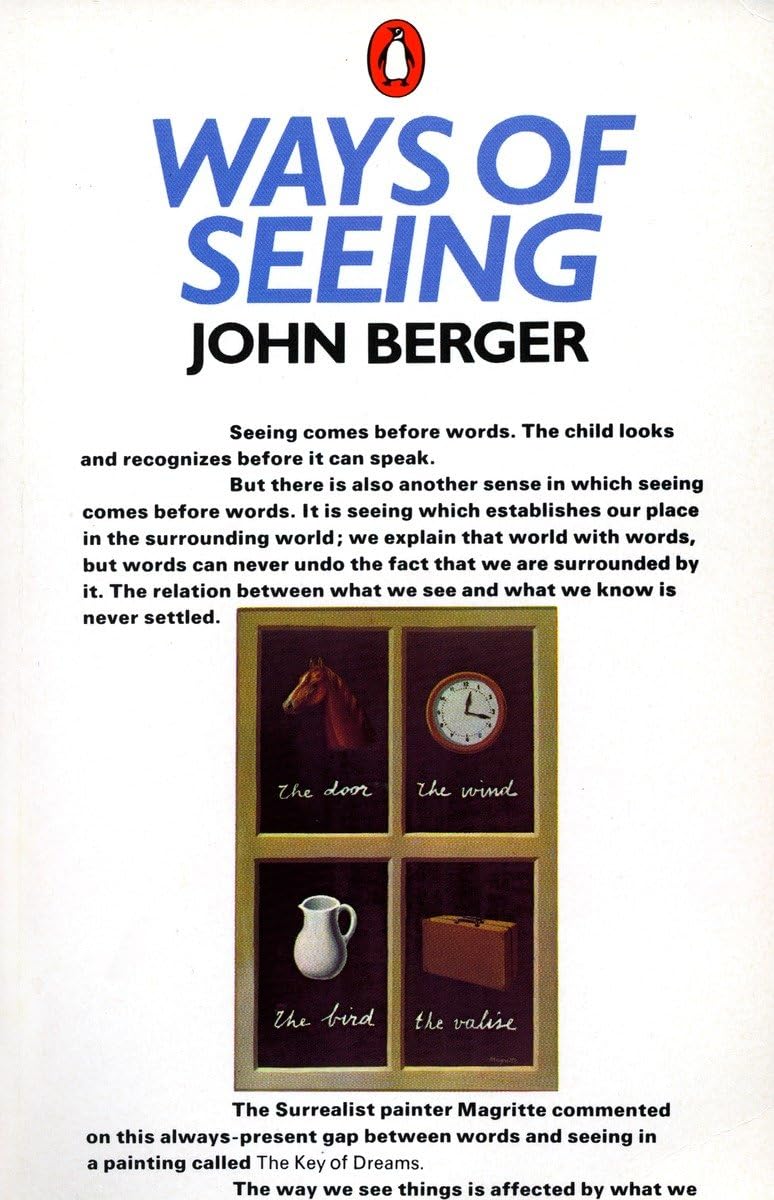
John Berger’s Ways of Seeing (1972) remains one of the most influential – and controversial – books ever written about art. More than offering definitive answers, Berger poses a series of provocative questions that have shaped the interpretation of art well into the twenty-first century. Personally, I found Ways of Seeing neither especially well written nor particularly insightful. Even so, its influence has been extraordinary, and its enduring legacy is remarkable for a book that is so brief and unadorned.
Adapted from the landmark 1972 BBC television series of the same name, the book was evidently the first to make the claim that centuries of conventional art history possess no fixed meaning. Instead, they are continually reshaped by technology, economics, ideology, and the assumptions of the viewer. It could be argued that few books have done more to democratize the study of art or to encourage ordinary readers to question accepted interpretations. More than fifty years after its publication, Berger’s arguments continue to shape museum practice, university curricula, visual culture studies, feminist art history, and media criticism, even as many of his conclusions have been refined, qualified, or challenged by subsequent scholarship.
The opening essay introduces Berger’s central thesis: every act of looking is conditioned by prior beliefs and cultural assumptions. “Seeing comes before words,” he famously declares, arguing that vision is primary and language merely interprets what has already been perceived. Modern technologies – especially photography and film – have fundamentally transformed our relationship with works of art. Before mechanical reproduction, a painting existed in one place and possessed an “aura” tied to its physical setting. Photography liberated images from museums, churches, and palaces, allowing them to appear in books, advertisements, classrooms, and television programs. As a result, masterpieces no longer possess a single authoritative meaning. They become fragments continually reinterpreted within new contexts. Berger’s debt to Walter Benjamin’s famous essay “The Work of Art in the Age of Mechanical Reproduction” is unmistakable, which he openly acknowledges, but Berger applies Benjamin’s insights with remarkable clarity and accessibility.
The second essay, presented entirely through images, invites readers to discover visual arguments without explanatory text. By juxtaposing paintings, advertisements, film stills, and photographs, Berger demonstrates that images communicate through comparison as much as through individual content. The chapter serves as an experiment in visual literacy, encouraging readers to become active interpreters rather than passive consumers. Although unconventional, it remains one of the book’s most innovative features, foreshadowing later developments in visual culture studies.
The third essay examines the European tradition of the female nude. Berger distinguishes between being naked and being nude. To be naked is simply to exist without clothing; to be nude is to become an object constructed for the gaze of another. Throughout the Western artistic tradition, he argues, women are depicted less as autonomous individuals than as spectacles designed for male viewers. Men act while women appear. Women internalize the gaze and learn to evaluate themselves as they imagine others see them. Berger supports this argument through close readings of works by Titian, Rubens, and other Old Masters, suggesting that many celebrated masterpieces reinforce unequal power relationships between men and women.
The fourth essay again relies primarily on visual comparisons, extending the previous chapter’s arguments through carefully sequenced images. Readers are encouraged to identify recurring conventions governing representations of femininity, beauty, sexuality, and power. Berger deliberately withholds explanatory commentary, trusting the visual evidence to persuade.
The fifth essay shifts from gender to economics, arguing that oil painting became the preferred artistic language of a society increasingly organized around private property and material wealth. Berger contends that from roughly the sixteenth through the nineteenth centuries, oil painting excelled at depicting surfaces – silk, velvet, silver, jewels, polished wood, ripe fruit, and expansive landscapes – not merely because artists enjoyed technical virtuosity, but because patrons wished to celebrate ownership itself. The wealthy commissioned paintings that displayed their possessions with extraordinary tactile realism. In Berger’s memorable formulation, oil painting became uniquely suited to depicting things that could be bought, sold, collected, inherited, and possessed.
The sixth essay again presents visual evidence rather than textual analysis. Paintings, photographs, advertisements, and contemporary images are arranged to reinforce the economic themes introduced previously.
The final essay explores the relationship between classical painting and modern advertising. Berger argues that advertising has inherited many of the visual conventions developed by European oil painting while fundamentally transforming their purpose. Traditional paintings celebrated possessions already owned; advertisements celebrate possessions not yet acquired. Instead of affirming status, advertising manufactures dissatisfaction. It persuades viewers that purchasing a product will produce happiness, beauty, prestige, romance, or social acceptance. Berger describes publicity as a system built upon envy, aspiration, and perpetual desire rather than fulfillment. Although written before the internet, social media, and digital marketing, this analysis has proved remarkably prescient.
The book’s greatest achievement lies in its accessibility. Berger wrote not for specialists but for ordinary viewers entering museums or encountering reproductions in everyday life. He challenged the intimidating language that often surrounded art history and insisted that every viewer possesses the capacity to think critically about images. This democratization of art criticism permanently altered public conversations about museums and visual culture.
The book also helped establish what would later become visual culture studies. Berger treated advertisements, magazine photographs, television, and fine art as parts of a single visual ecosystem rather than as separate disciplines. Today this interdisciplinary approach feels almost self-evident, but in the early 1970s it represented a profound departure from traditional art historical scholarship, which largely confined itself to canonical paintings, sculpture, and architecture.
Perhaps Berger’s most lasting influence has been on feminist art history. Although his discussion of women in European painting has since been expanded and complicated by scholars such as Griselda Pollock, Linda Nochlin, and others, his distinction between being “naked” and being “nude” fundamentally changed how generations of students approached representations of gender. His insistence that viewers consider who is looking, who is being looked at, and whose interests are served remains central to contemporary art historical inquiry.
At the same time, many of Berger’s arguments have aged unevenly. His Marxist framework sometimes encourages broad generalizations that flatten historical complexity. Oil painting undoubtedly served wealthy patrons, but it also produced profound works of religious devotion, scientific observation, psychological insight, and formal experimentation that resist reduction to economic ideology alone. Similarly, not every female nude merely reflects patriarchal domination, nor does every collector simply celebrate material ownership. Contemporary scholarship generally favors more nuanced interpretations that acknowledge multiple meanings operating simultaneously within individual works.
Likewise, Berger often privileges social and political interpretation over artistic process. Questions of composition, color, brushwork, technique, patronage, workshop practice, and historical context receive comparatively little attention. Readers seeking a comprehensive introduction to Renaissance, Baroque, or nineteenth-century painting will therefore need to supplement Berger with more traditional art historical surveys.
Nevertheless, Ways of Seeing succeeds precisely because it asks different questions from conventional art history. Rather than asking what a painting depicts, Berger asks why it depicts the world that way, who benefits from that representation, and how viewers themselves participate in constructing meaning. Those questions have become indispensable tools for historians, museum curators, cultural critics, and educators.
The influence of the accompanying BBC television series is difficult to overstate. By presenting works of art through television editing, camera movement, juxtaposition, and reproduction, Berger deliberately demonstrated the very arguments he was making about mechanical reproduction. The series reached audiences far beyond universities and museums, helping transform art history from an elite academic discipline into a subject of popular cultural discussion. Many later documentary filmmakers, museum educators, and public intellectuals adopted Berger’s conversational style and willingness to challenge traditional authority.
Ultimately, Ways of Seeing remains one of the essential books for anyone interested in art, not because every argument is correct, but because it permanently changed the questions we ask when we stand before a work of art. Berger taught generations of viewers that paintings are not passive objects to be admired from a respectful distance. They are active participants in broader conversations about power, politics, gender, economics, memory, and perception. Whether one agrees with his conclusions or not, it is now almost impossible to study Western art without engaging, directly or indirectly, with the questions he first brought into public view.
 What's Tim Reading Now?
Leave a comment