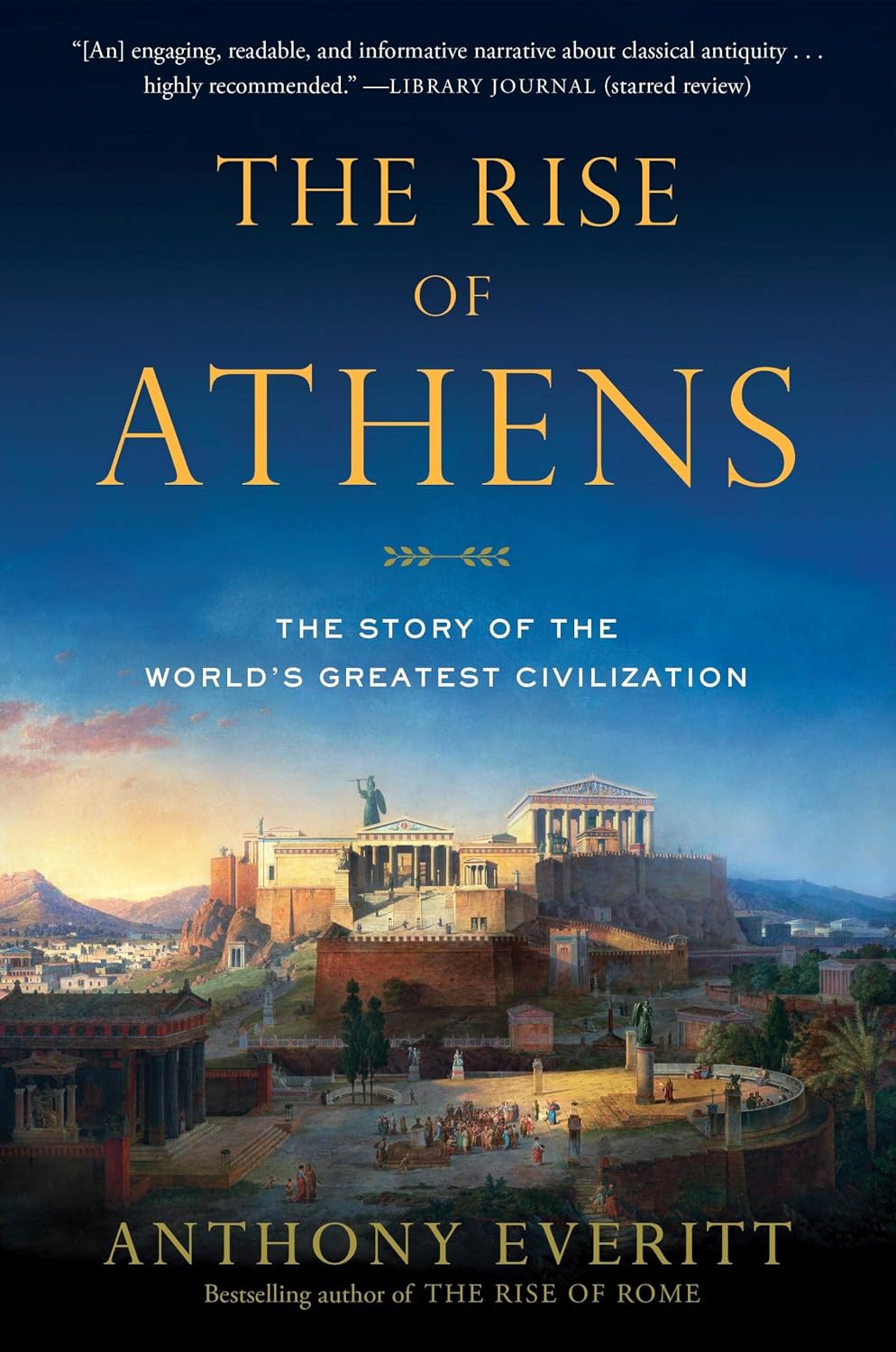
Anthony Everitt’s The Rise of Athens: The Story of the World’s Greatest Civilization (2016) is an engaging narrative history of how a relatively obscure Greek city-state rose to become the dominant political, military, and cultural power of the ancient Mediterranean during the fifth century BC. Despite its title, however, the book chronicles not only Athens’ remarkable ascent but also its relatively quick and dramatic decline, tracing the city’s story from the semi-legendary age of the Trojan War (1194–1184 BC) through the Roman period, when it had faded into little more than a quiet provincial university town. Everitt argues that Athens’ extraordinary success emerged from the convergence of favorable geography, political innovation, military necessity, and an exceptional concentration of gifted individuals. As in his earlier works, he writes for a general audience, blending lively narrative with insightful portraits of influential personalities and accessible explanations of complex political and constitutional developments.
What truly set the Greeks apart – and ultimately made them objects of admiration and emulation for later Mediterranean civilizations – was their culture. They placed immense value on honor and personal reputation, a concept they called timē. They celebrated courage, fairness, virtue, and respect for the rule of law, while viewing the relentless pursuit of excellence as the defining characteristic of a worthy individual. These ideals found their fullest expression in Homer’s Iliad, which served not merely as a work of literature but as a moral and cultural guide for generations of Greeks, including Alexander the Great.
The book is divided into six sections, the first of which, “Three’s Company,” introduces the three civilizations that dominate the narrative: Athens, Sparta, and Persia. For Athens, the author shows how geography and religion uniquely shaped early Greek – and especially Ionian – civilization. According to Everitt, Attica’s rocky soil and deeply indented coastline fostered three defining characteristics: rugged individualism, a seafaring outlook, and an eagerness to establish distant colonies. By 580 BC practically every suitable spare spot for colonization on the Mediterranean coastline had been taken up. Or, as Plato had Socrates say about his fellow Greeks: “We live around the sea like frogs around a pond.” Over time, the scattered communities of Attica were united under the leadership of Athens through a process known as synoecism – from the Greek for “dwelling together” – in which independent villages and settlements merged into a single political community, or polis. The legendary hero Theseus symbolized this unification and was remembered as the city’s first ruler to champion the common people, establishing the ideal that Athenian citizens stood on equal political footing. “Careless, sexist, and a little sociopathic, intelligent and attractive, willing to thumb his nose at the gods and capable of taking punishment for his impertinence,” Everitt writes, “Theseus was the kind of man Athenians liked to be like.” It was an archetype that would reappear again and again throughout the city’s history.
Separated by less than 100 miles as the crow flies, Sparta was nevertheless the cultural opposite of Athens. Unlike their Ionian Greek neighbors, the Dorian Spartans built a rigidly disciplined military society sustained by a vast population of enslaved helots. Spartan citizens were forbidden to engage in commerce or accumulate wealth in gold or silver. From early childhood, both boys and girls were raised to obey authority, endure hardship, and, above all, excel in battle. Cowardice invited lifelong disgrace, while adult men lived and dined in communal military messes known as syssitia. The society embraced an austere ethos in which, as Everitt writes, “criminal guile, aggression, and tolerance of pain cohabited with obedience, deference, and modesty.” Spartan women enjoyed greater social freedom than their counterparts elsewhere in Greece, and marriage customs – including the sanctioned sharing of wives under certain circumstances – reflected the state’s overriding concern with producing strong offspring. Their reputation for plain speech and severe simplicity gave rise to the modern words “laconic” and “spartan.” Where Athens looked to the semi-legendary Theseus as its founding hero, Sparta revered its equally legendary lawgiver Lycurgus. Government rested with a council of elders, the gerousia, two hereditary kings from the Agiad and Eurypontid dynasties, and five annually elected ephors, who wielded extraordinary executive authority – including the power to depose or prosecute a king. Even on campaign, two ephors accompanied the king to monitor his conduct. Yet, for all its formidable military institutions, Sparta was not expansionary nor even particularly bellicose. Everitt concludes that “Sparta would have liked nothing better than to be left alone.”
Finally, Everitt turns to the rise of Persia, the vast empire that would pose the greatest external threat to Greek liberty and independence. In 550 BC, Cyrus the Great united the previously scattered Persian tribes and, within a generation, forged one of history’s largest empires. After conquering the fabulously wealthy kingdom of Lydia and its legendary king Croesus, Cyrus extended Persian rule across a vast expanse stretching from Central Asia to Egypt. “It was an extraordinary rise,” Everitt observes. Yet this immense empire remained highly centralized under the Great King, who governed through regional governors, or satraps, responsible for administering distant provinces from the imperial capitals. Under Cyrus’s successor, Darius I, Persian expansion continued into Thrace and Macedonia while tightening control over the Greek cities of Ionia on the western coast of Asia Minor. When these Ionian cities revolted against Persian rule and appealed to Athens for assistance, the stage was set for the epic struggle between East and West that would define the next generation of Greek history. Everitt says the Greeks quickly learned a valuable lesson: “Until they learned to cooperate with one another, they would never beat the mighty Persians with their vast reserves of wealth and human capital.”
Section Two, “The Invention of Democracy,” traces the reforms introduced by Draco (c. 650–600 BC), Solon (c. 638–558 BC), and Cleisthenes (c. 570–508 BC), which transformed Athens into one of the most politically innovative states of the ancient world. For centuries, Athens had been governed by kings before power gradually passed into the hands of an aristocratic elite. By the seventh century BC, however, the city was riven by persistent conflict between powerful noble families and an increasingly impoverished citizenry, tensions only intensified by rapid population growth.
Renowned as a conciliator, Solon was elected Eponymous Archon for 594/593 BC and entrusted with extraordinary authority to reform the state. His most significant achievement was the seisachtheia, or “shaking off of burdens,” which abolished debt bondage and canceled outstanding personal debts. At the same time, he resisted calls to confiscate and redistribute large estates, instead imposing limits on future land accumulation. As Everitt observes, Solon’s sympathies lay with the poor, but although he began as a radical, he ultimately governed as a moderate and succeeded chiefly in displeasing every faction. His enduring contribution was to weaken the grip of hereditary privilege by creating a political system based increasingly on wealth, merit, and public service rather than noble birth. To that end, he divided Athenian society into four property classes. At the top were the pentakosiomedimnoi (“500-bushel men”), the wealthiest citizens, who alone were eligible to serve as archons or state treasurers. Next came the hippeis, prosperous enough to maintain a warhorse and serve in the cavalry, followed by the zeugitai, whose property qualified them to fight as hoplites. At the bottom were the thetes, laborers and small farmers who owned little property, often served as rowers in the Athenian navy, and were generally barred from holding public office. Although far from democratic by modern standards, Solon’s reforms dramatically broadened political participation and laid the constitutional foundations upon which Athenian democracy would later be built.
Equally significant, Solon granted the thetes full participation in the Assembly and established a new governing council, the boule, composed of four hundred members drawn from Athens’ four traditional tribes. He also introduced one of the most distinctive features of Athenian democracy: sortition, the selection of many public officials by lot rather than election. The practice reflected the belief that chance offered ordinary citizens an equal opportunity to serve while reducing the influence of aristocratic patronage and political intrigue. Yet Solon’s reforms ultimately failed to bring lasting stability. As wealth from trade and the growing use of coined money reshaped Athenian society, old rivalries quickly resurfaced. Within five years of Solon’s archonship, Everitt notes, law and order had begun to unravel. Three competing political factions emerged – the men of the Coast, the Plain, and the Hills – each pursuing its own interests and setting the stage for the next phase of Athens’ turbulent political evolution.
Everitt tells us that the stately Solon eventually fell in with the much younger, more handsome, leader of the Athenian peasant faction named Pisistratus, who the author suggests became Solon’s lover and explains that these pederastic relationships were core to Greek culture and functioned like marriages that cemented bonds between extended kin groups. Pisistratus was the ruler who bridged the gap between the reforms of Solon and the eventual birth of broadsale Athenian democracy under Cleisthenes. A charismatic aristocrat and celebrated military hero, Pisistratus exploited the political divisions that followed Solon’s reforms to seize power in 546 BC, establishing himself as tyrant of Athens. Although he ruled as an autocrat and was twice driven into exile, Pisistratus governed with remarkable moderation and left an enduring mark on the city. He laid out the famous Agora, expanded and elevated the great civic festivals of Dionysus and the Panathenaea, encouraged the earliest development of Greek drama, transformed Athens into a thriving center of commerce, religion, and culture, and promoted the city as both the ancestral homeland and moral leader of the Ionian Greeks. As Everitt aptly observes, Pisistratus was “the matchless celebrant of Greekness.” He preserved most of Solon’s laws, encouraged agriculture and trade, sponsored major public works, promoted religious festivals, and transformed Athens into a flourishing cultural center. Under his rule, the city also began collecting and preserving the Homeric epics, helping to shape a common Greek cultural identity.
Pisistratus strengthened the Athenian state without dismantling its emerging political institutions. He died in 527 BC at approximately seventy-five years of age, leaving behind a more prosperous, stable, and cohesive city. His long reign weakened the old aristocratic factions, centralized governmental authority, and created the political conditions that enabled Cleisthenes to introduce his democratic reforms of 508/507 BC following the overthrow of Pisistratus’s sons. In this sense, the tyrant inadvertently helped pave the way for the world’s first democracy. Everitt contends that Pisistratus’s contributions to the development of Athens have been consistently undervalued. In his view, Pisistratus governed wisely, enhanced Athens’ reputation throughout the Greek world, and fostered both domestic stability and social harmony. As the author concludes, “If one had to be ruled by a tyrant, Pisistratus was clearly the man to choose.”
Hippias and Hipparchus were the two principal sons of Pisistratus and jointly succeeded him after his death around 527. In 514, Hipparchus was assassinated by Harmodius and Aristogeiton, later celebrated by Athenians as the “Tyrannicides.” Although the murder did not immediately end the tyranny, it profoundly changed Hippias. He became increasingly suspicious and repressive, executing opponents and tightening his grip on power. Finally, in 510, Hippias was expelled from Athens with the assistance of Sparta. His overthrow cleared the way for Cleisthenes to implement his democratic reforms in 508/507, laying the institutional foundations of Athenian democracy.
Perhaps most importantly and impressively, Cleisthenes overcame the so-called curse of the Alcmaeonids. A political and religious stigma that haunted one of Athens’ most powerful noble families for nearly two centuries, it originated around 632, when the Athenian nobleman Cylon attempted to seize power and make himself tyrant. After his coup failed, Cylon and his followers sought sanctuary at the altar of Athena on the Acropolis. They were promised safe passage if they surrendered, but members of the powerful Alcmaeonid family, led by the archon Megacles, violated that promise and ordered many of the supplicants killed, even some who were clinging to sacred altars.
In Greek religion, murdering people under the protection of the gods was a terrible act of sacrilege (miasma). As a result, the Alcmaeonids were declared accursed and periodically banished from Athens. Although the events were generations in the past, political opponents repeatedly revived the curse whenever it proved useful.
The curse played a central role in the career of Cleisthenes, who belonged to the Alcmaeonid family. During his struggle for power against Isagoras in 508, Isagoras persuaded the Spartan king Cleomenes to expel Cleisthenes on the grounds that the ancient curse still tainted his family. The attempt backfired. The Athenian people rose in support of Cleisthenes, drove out Isagoras and the Spartans, and recalled him from exile. Once restored to power, Cleisthenes introduced the democratic reforms that transformed Athenian government.
Thus, the curse was more than an ancient family legend. It became a political weapon that nearly ended Cleisthenes’ career. Ironically, the effort to discredit and exile him ultimately strengthened his alliance with the Athenian people and helped set the stage for the birth of Athenian democracy.
Cleisthenes was, according to Everitt, “the most remarkable of all the statesmen who populate this history.” Yet, he also argues that his creation of Athenian democracy was also propelled by “the most-interested of motives.” After the expulsion of Hippias in 510, Cleisthenes found himself locked in a struggle for power with his aristocratic rival, Isagoras. When Isagoras gained the support of the Spartan king Cleomenes and temporarily drove Cleisthenes from Athens, Cleisthenes turned directly to the Athenian people for support. To secure their loyalty – and to undercut the power of the old noble families – he proposed sweeping constitutional reforms that dramatically expanded citizen participation in government. By reorganizing Attica into demes and new tribes, creating the Council of 500, and weakening traditional clan loyalties, he built a new political order whose success depended on popular backing. Thus, Cleisthenes’ democratic revolution was born not simply from abstract devotion to liberty but from a practical desire to defeat his political rivals and secure his own position.
In an effort to break the power of Athens’ rival political factions – the Men of the Coast, the Plain, and the Hills – Cleisthenes reorganized the citizen body into ten new tribes, each deliberately composed of members from all three regions. In a single stroke, he weakened traditional regional loyalties and redirected citizens’ allegiance toward the Athenian state. He further divided Attica into 139 demes, or local wards, each assigned to one of thirty trittyes, which in turn were grouped into the ten tribes. Every deme functioned as a miniature polis, responsible for its own local administration, festivals, and religious observances. At the center of this new political order stood the ecclesia, or Assembly, the sovereign governing body of Athens, from whose decisions there was no appeal. Meeting on average every nine days, the Assembly required a quorum of six thousand citizens to conduct official business.
Cleisthenes retained Solon’s use of sortition, or the selection of public officials by lot, for several important reasons. First, it promoted equality by giving every qualified citizen an equal opportunity to hold office. Second, because positions were not won through elections, it reduced opportunities for corruption, bribery, and political intimidation. Third, many Athenians believed that the element of chance allowed the gods to express their will in the selection process. Finally, sortition encouraged active civic engagement by reminding citizens that they could be called upon to serve the state at virtually any moment, reinforcing the idea that self-government was both a right and a shared responsibility.
Another of Cleisthenes’ most important innovations was the boule, or Council of 500, which became the chief administrative body of the Athenian state. The boule prepared the agenda for the ecclesia, which could debate only those measures that had first been considered and approved by the council. Fifty representatives from each of Athens’ ten tribes served on the boule for one-tenth of the year, rotating through the office in succession. During their term, they lived and dined in the Tholos, the circular council house in the agora, ensuring that the government remained in continuous session. To provide uninterrupted administration, the council operated around the clock in rotating shifts, and each day one of its members was selected by lot to serve as presiding officer, or chairman, for a single day. This remarkable system ensured that hundreds of ordinary citizens gained firsthand experience in the daily workings of government.
One of Cleisthenes’ more controversial innovations was ostracism, a uniquely Athenian mechanism designed to protect the state from the emergence of another tyrant. According to Plutarch, its purpose was “to humble and cut back oppressive prestige and power,” and it was almost certainly intended to prevent the rise of another popular strongman in the mold of Pisistratus. Once each year, typically in January or February, the ecclesia could vote on whether to hold an ostracism. If approved, citizens cast their ballots by inscribing a name on a potsherd (ostrakon), and a quorum of six thousand votes was required for the result to be valid. Curiously, however, the procedure was not invoked until more than two decades after Cleisthenes introduced it. As Everitt observes, “it is hard to explain this delay.”
What is so astonishing about the reforms of Cleisthenes, Everitt says, is their “purity of logic, their blithe radicalism, and their artificiality. They made no concessions and in that sense they were unpolitical. There seem to have been no negotiations.” As remarkable as Cleisthenes’ achievement was, it was matched by the Athenians’ extraordinary enthusiasm for their new political order. The system depended upon the active participation and commitment of ordinary citizens, and for decades, Everitt argues, it was sustained by an “injection of constitutional adrenaline.” Even more remarkable, the constitutional framework established by Cleisthenes endured for nearly two centuries with surprisingly few fundamental changes. Over time, Athens introduced stipends for citizens serving on juries and the boule, making public service more accessible to those of modest means, but the essential structure remained intact. Curiously, Cleisthenes himself almost immediately disappeared from the story of Athenian democracy. Instead, the Athenians embraced the far more dramatic—if greatly exaggerated, and perhaps largely mythical—origin story of Harmodius and Aristogeiton, celebrating the two “Tyrannicides” as the founders of Athenian liberty while largely overlooking the statesman who had actually designed its democratic institutions.
Section Three, “The Persian Threat,” chronicles the first great confrontation between a newly united Greek resistance and the vast Persian Empire, whose rulers the Greeks often referred to simply as the Medes. Two prominent Greek exiles played pivotal roles in the invasion. The former Athenian tyrant Hippias and the deposed Spartan king Demaratus had both sought refuge at the court of King Darius, where they advised the Persian monarch on how best to “Medize” the Greek poleis – that is, bring them under Persian rule. It was Hippias who reportedly recommended Marathon as the ideal landing site for an invasion of Attica. Confident that his former supporters would restore him to power, he even accompanied the Persian expedition, which consisted of roughly 25,000 fighting men supported by perhaps 80,000 sailors, servants, laborers, and other logistical personnel. Waiting for them on the Plain of Marathon in September 490 were just 9,000 Athenian hoplites, unsupported by cavalry or archers, preparing to confront the greatest military power the ancient world had yet seen.
The Athenian army was commanded by a board of ten generals, each holding equal authority under the constitutional reforms of Cleisthenes. The most experienced and influential among them, however, was Miltiades, a veteran commander and member of the aristocratic Philaid family. Despite facing an enemy that outnumbered the Athenians by more than two to one – and with the Spartans delaying their promised assistance – Miltiades argued for an immediate offensive rather than a defensive stand. His innovative battle plan called for thinning the center of the phalanx to just three or four ranks instead of the customary eight, while strengthening both wings. The strategy worked almost exactly as intended. Although the Persian center initially drove back the weakened Athenian line, the reinforced wings enveloped the invaders and turned the engagement into a rout. Ancient sources – almost certainly exaggerating the disparity – claim that 6,400 Persians were killed compared with only 192 Athenians.
The equally enduring legend of the messenger who ran the roughly twenty-six miles from Marathon to Athens was motivated by more than the simple desire to announce victory. According to tradition, the urgent dispatch was intended to reach the city before false reports could arrive claiming that the Persians had prevailed. With Hippias accompanying the invasion in the hope of reclaiming his tyranny, the Athenians feared that sympathizers within the city might seize power if they believed the invasion had succeeded. The runner’s message therefore announced not only a military triumph but also the failure of Hippias’s long-awaited return.
For Athens, Marathon was far more than a remarkable military victory; it became a defining affirmation of the strength of democracy and the resolve of a united citizenry. Everitt argues that Marathon demonstrated that “free men [could] overcome the hordes of an oriental despot,” a lesson that would resonate and inspire throughout Greek history. For King Darius I, however, the setback carried far less significance. As Everitt observes, “It was a pinprick to his prestige, his pride, and his empire, not a wound.” Rather than ending the conflict, Marathon merely marked the opening engagement in the long struggle between the Greek city-states and the Persian Empire, a contest that would continue for generations.
Among the Athenian hoplites who fought at Marathon was Themistocles, a wealthy politician of mixed Greek and Thracian heritage through his mother. Everitt describes him as “the first radical democrat in Athenian history.” Having served as eponymous archon in 493, Themistocles had already emerged as a formidable figure in the Assembly, where he enjoyed broad popular support. Yet he also recognized the political dangers posed by military glory. He feared that Miltiades’s spectacular victory at Marathon and the immense prestige that followed might enable a single celebrated commander to overshadow Athens’s fragile democracy.
After his triumph at Marathon, Miltiades did indeed enjoy immense prestige, but his fortunes soon collapsed without any assistance from Themistocles or other defenders of democracy. In 489 he persuaded the Athenians to fund an expedition against the island of Paros, ostensibly to punish it for supporting Persia. The campaign ended in failure, and Miltiades returned home wounded and disgraced. He was prosecuted for deceiving the people, fined the enormous sum of 50 talents, and died shortly afterward from complications of a leg wound sustained during the expedition. Unable to pay the fine himself, the debt was later paid by his son, Cimon, who would go on to become one of Athens’s leading statesmen and generals.
Themistocles understood that Marathon had inflicted only a temporary setback on the Persian Empire. The defeat was a humiliation, but hardly a decisive blow, and he correctly anticipated that the Persians would eventually return in force. Fortunately for Athens, several developments bought the city precious time. First, Egypt, then a Persian province, erupted in revolt in 486 after a sharp increase in imperial taxation, diverting Persian attention and resources. Second, that same year Darius I died suddenly and was succeeded by his son and chosen heir, the thirty-two-year-old Xerxes I, whose immediate priority was suppressing the Egyptian rebellion and securing his newly inherited empire. Finally, in 483 the Athenians discovered a rich new vein of silver at their mine in Laurium, increasing the city’s annual revenues by over 100 talents per year. Themistocles seized the opportunity, persuading his fellow citizens that the windfall should not be distributed among individuals, nor used to bolder their hoplite army, long the pride of the city, but rather invested instead in building a first-class navy, a very force that would ultimately serve as the vanguard of Greek independence.
At the time, Athenian shipyards could construct as many as eight triremes each month. In 483 BC, the Assembly approved Themistocles’ ambitious proposal to build a fleet of 200 triremes, transforming Athens into the preeminent naval power in Greece. First developed centuries earlier and appearing in the Mediterranean by around 600 BC, triremes were fast and highly maneuverable but cramped, unstable in rough seas, labor-intensive, and enormously expensive to operate, with crew wages alone costing roughly one talent per month per ship. Realizing Themistocles’ grand strategy required far more than ships. Athens also invested heavily in expanding the harbor and naval facilities at Piraeus and, in the years that followed, fortified the city’s vital connection to its port by constructing massive defensive walls along the five-mile corridor linking the Acropolis to Piraeus. These projects laid the foundations for the maritime empire that would soon make Athens the dominant power in the Greek world.
To secure support for his costly and aggressively expansionist naval strategy, Themistocles made ruthless use of ostracism to sideline his political opponents. Many of those exiled came from Athens’s old aristocratic families, including members of the long-dominant Alcmaeonid clan. Among the most famous episodes was the ostracism of Aristides, remembered through Plutarch’s story of an illiterate voter asking Aristides himself to inscribe his name on an ostrakon because he was tired of hearing him called “the Just.” At roughly the same time, alarming intelligence reached Athens that Xerxes had ordered the excavation of a mile-and-a-half-long canal across the Athos peninsula, an extraordinary engineering project that left little doubt the Persian king was preparing a massive new invasion of Greece.
In March 480, Xerxes marched out of Asia Minor at the head of a vast expeditionary force to complete what his father had begun and bring Greece under Persian rule. Among the army’s elite were the famed Immortals, the king’s personal guard of 10,000 heavily armed infantry. Everitt describes the invasion as “an overwhelming spectacle.” Determined to avenge the humiliation his father had suffered at Marathon a decade earlier, Xerxes spared no effort in assembling one of the largest military expeditions of the ancient world.
Herodotus famously claimed that the Persian army numbered 1.7 million soldiers supported by 80,000 cavalry, figures that most modern historians regard as impossibly high. Everitt suggests that Herodotus may have confused the Persian terms for a commander of one thousand (chiliarch) and a commander of ten thousand (myriarch), inflating the total by a factor of ten. On this interpretation, the invading army would have consisted of roughly 170,000 troops and 8,000 cavalry; nevertheless, an immense force by the standards of the ancient world. It was accompanied by an equally formidable fleet. Although ancient sources speak of more than 1,200 warships, perhaps only 600 ultimately reached Greece, a naval armada that remained extraordinary in its own right. Xerxes even employed some 360 triremes to construct twin pontoon bridges stretching more than two miles across the Hellespont, allowing his army to cross from Asia into Europe. Whatever the precise numbers, the invasion was an extraordinary demonstration of imperial wealth, organization, and military power — the largest force Greece had ever confronted.
Unlike the Persian expedition a decade earlier, Xerxes’s invasion would be met by an unprecedented alliance of Greek city-states, including the formidable professional warriors of Sparta. In the autumn of 481, representatives from thirty-one poleis gathered at Corinth for a Panhellenic Congress, where, under Spartan leadership, they agreed to set aside their longstanding rivalries in the face of the common Persian threat. The Spartans were entrusted with supreme command of the allied forces, both on land and at sea, despite their limited naval tradition. A Spartan, Eurybiades, was appointed commander of the combined fleet, but, as Everitt observes, the alliance’s naval strategy and orders were driven largely by Themistocles. Although Eurybiades held the title, it was Themistocles who provided the vision, persuasion, and operational leadership that would prove decisive in the campaign ahead. The Athenians made the extraordinary decision to abandon their city to the advancing Persians and stake their survival on the sea. Everitt describes the strategic debate that preceded this momentous choice as “one of the most important in the history of democracy,” for it was through open deliberation and popular consent that Athens chose a course that would ultimately determine not only its own fate but that of Greece itself.
By abandoning their city, the Athenians handed Xerxes the opportunity to fulfill one of his principal war aims: the destruction of Athens’s sacred temples in retaliation for the burning of the Persian sanctuary at Sardis during the Ionian Revolt decades earlier. In Everitt’s view, Xerxes already regarded himself as victorious, even though he had yet to win a decisive engagement on either land or sea. Yet time was not on his side. His enormous army depended on fragile supply lines, and the longer it remained in Greece, the greater the danger of shortages and starvation. As Everitt observes, “In sum, Xerxes felt that he could not afford to wait.”
The Greeks exploited this urgency with one of history’s most successful military deceptions. They spread a rumor that the allied fleet was bitterly divided and on the verge of dispersing, a story the Persian king readily accepted because it confirmed his preconceptions about Greek disunity. Lured into the narrow waters off Salamis, the Persian fleet lost the advantage of its superior numbers and was decisively defeated, surrendering some 200 ships while the Greeks lost only about 40. Although Xerxes retained a substantial navy after the battle, Everitt writes that “the spirit had been knocked out of the armada.” With his strategic objectives largely accomplished – he had occupied mainland Greece, killed a Spartan king at Thermopylae, and torched the holy temples of Athens – the prudent course was simply to return home and proclaim victory. That is precisely what Xerxes did. Leaving part of his army behind under Mardonius, he withdrew to Susa, where he celebrated what he presented to his empire as a great Persian victory.
After Xerxes returned to Persia, he left behind an elite army under the command of Mardonius to complete the conquest of Greece. Hoping to divide the allies, Mardonius repeatedly offered Athens generous peace terms, promising autonomy and the reconstruction of its temples if it would abandon Sparta. The Athenians refused every offer, choosing freedom over accommodation. In response, Mardonius reoccupied and again devastated the abandoned city before withdrawing into Boeotia to seek favorable ground for his cavalry. In 479, a united Greek army led by the Spartan regent Pausanias marched north to confront the Persians near the town of Plataea. After days of maneuvering and a confused nighttime redeployment, the Persians mistakenly believed the Greeks were retreating and launched an attack. The Greeks rallied, broke the Persian assault, killed Mardonius, and destroyed ninety percent of his army according to ancient sources, ending Persia’s attempt to conquer mainland Greece. On the very same day, according to ancient tradition, a Greek fleet won another decisive victory over the Persians at the Battle of Mycale in Asia Minor, bringing the second Persian invasion to a decisive close.
“This was Greece’s finest hour,” Everitt declares. To ensure that future generations never forgot the cost of their survival, the Athenians deliberately left the Acropolis in ruins for decades. The charred temples stood as a solemn memorial to the devastation wrought by the Persian invasion and as a powerful reminder that the threat from the East had not disappeared, but merely been postponed. At the same time, they acted decisively to prepare for the next conflict, fortifying Athens by constructing the Long Walls that permanently linked the city to its harbor at Piraeus, ensuring that even if Attica were overrun again, Athens could be supplied and defended from the sea.
Section Four, “The Empire Builders,” was perhaps my favorite. It traces the shocking denouement of the main Greek heroes of the Persian war, and then Athens’s remarkable transformation from a vulnerable city-state into the leading thalassocracy of the Greek world, presiding over a vast maritime alliance. It is a fascinating case study not only in international diplomacy and grand strategy, but also in coalition building, network effects, and the dynamics of alliance leadership. The architect of this transformation was Themistocles, whose vision had made Athenian naval supremacy possible. Yet by the 470s, Everitt observes, he had become “yesterday’s man.” Ostracized in 472, Themistocles eventually committed the unthinkable: the hero of Salamis defected to Persia, where he spent his final years as the prosperous governor of Persian-controlled Magnesia on the Ionian coast before dying in 459. The other great Greek hero of the Persian Wars, Pausanias, the victor of Plataea, suffered an equally dramatic fall. Increasingly captivated by Persian customs, he adopted Persian dress, dined in Persian fashion, and aroused suspicions that he harbored ambitions of collaborating with the enemy. Recalled to Sparta, he was eventually walled up inside a temple by the ephors and left to die. As Everitt remarks, “These perfectly rational politicians appear to have lost their senses, made grave errors, and followed suicidal or at least eccentric courses of action.”
Although both Themistocles and Pausanias ended their careers in disgrace, Everitt argues that their central strategic insight ultimately prevailed: the Greeks had survived less through invincibility than through extraordinary good fortune, and their future security depended upon sustained unity. Accordingly, in 478 the victorious city-states established a new military alliance known as the Delian League, named for its administrative headquarters and treasury on the sacred island of Delos in the Cyclades. Conceived as both a defensive and offensive coalition against Persia, the League eventually grew to perhaps two hundred member states, each formally granted a single vote regardless of size. Some members fulfilled their obligations by contributing warships, while others paid an annual financial assessment. The task of determining each state’s contribution fell to Aristides, whose reputation for fairness made him the natural choice. The League’s combined financial contributions were calculated to support a fleet of approximately one hundred triremes at an annual cost of about 460 talents. In practice, besides Athens, only three wealthy island states – Lesbos, Chios, and Samos – continued to provide substantial naval contingents of their own; most members found it easier to contribute money and leave the fighting to Athens. “From these small beginnings,” Everitt writes, “an alliance of independent states gradually grew into an empire.”
One of the more remarkable features of Athenian democracy was the resilience of its traditional aristocratic families. Despite the ancient curse said to hang over the Alcmaeonidae, the clan remained wealthy, politically ambitious, and enormously influential. Indeed, one of its most distinguished members, Cleisthenes, was largely responsible for creating the institutional framework of Athenian democracy itself. Another prominent aristocratic family, the Philaids, also retained its political prominence. Best known for producing Miltiades, the hero of Marathon, the clan reemerged as a dominant force in mid-fifth-century Athens under his son, Cimon. Like Themistocles, Cimon was of mixed heritage, born to a Thracian mother, and he combined aristocratic pedigree with broad popular appeal to become one of the city’s most influential political and military leaders.
The Delian League was ostensibly a voluntary alliance, but membership could become compulsory when Athenian strategic interests were at stake. That was the fate of Carystus, a small polis in southern Euboea, which refused to join the League in 472. Situated only a few miles from the coast of Attica, its neutrality was viewed in Athens as an unacceptable affont, and the city was compelled to enter the alliance by force. A few years later, when the Persians assembled a large army and fleet near the mouth of the Eurymedon River in Asia Minor, Cimon sailed to confront them with a fleet of 250 League triremes. His crushing victory at the Battle of the Eurymedon destroyed both the Persian fleet and army, effectively ending Persia’s ability to threaten Greek independence. Everitt presents the triumph as the moment when the long shadow cast by the Persian Wars finally lifted, securing Greece’s freedom from its traditional eastern adversary.
In 465, Sparta was struck by a catastrophic earthquake that may have claimed as many as 20,000 lives. The disaster triggered a major uprising by the helots, Sparta’s subjugated Greek serf population, who fortified themselves on Mount Ithome in the heart of Messenia. Desperate for assistance, the Spartans appealed to Athens, whose forces had earned a reputation for excellence in siege warfare. Yet after the Athenians arrived, Sparta abruptly dismissed them before the campaign was complete, apparently fearing that the democratic Athenians might sympathize with the rebellious helots. The humiliating rebuff exposed the profound ideological divide between the two powers. As Everitt observes, Athenian policy – and the mission of its maritime alliance – had been to liberate Greeks from foreign domination, not to help suppress fellow Greeks at home. Sparta’s sudden reversal shattered confidence in the pro-Spartan policy championed by Cimon, who was soon ostracized, bringing one of Athens’s most distinguished and popular political careers to an abrupt end.
At almost the same moment, Cimon’s chief political rival, Ephialtes, persuaded the ecclesia to enact a sweeping constitutional reform that dramatically curtailed the authority of the Areopagus. Powers long exercised by the aristocratic council – including oversight of public officials, supervision of the administration, and guardianship of the laws – were transferred to the democratic institutions of the ecclesia and the boule. The reforms marked a decisive shift in the balance of power toward the popular assembly and completed the democratic transformation begun by Cleisthenes decades earlier. A year later, however, Ephialtes was assassinated under mysterious circumstances, leaving his young protégé, Pericles, to assume leadership of Athens’s democratic faction. Rumors circulated that Pericles himself had orchestrated the murder of his mentor, though Everitt notes that no credible evidence has ever substantiated the charge.
Pericles cemented his position as the leading statesman of Athens at just thirty-three years of age. He was, Everitt says, “an aristocrat by temperament, but a democrat by conviction.” Pericles soon adopted a new austere lifestyle and quickly enacted a series of significant democratic reforms. First, he restricted Athenian citizenship to those born to two Athenian parents; under this rule, even celebrated figures such as Cleisthenes, Themistocles, and Cimon would have been ineligible for citizenship. Second, he expanded the use of sortition, with nearly all public officials chosen by lot rather than election. Third, to ensure that even the poorest citizens could participate in public service, he introduced a daily stipend of two obols. By 440 BC, an estimated one-third of Athenian citizens were receiving some form of government pay, making the state both increasingly expensive and immensely popular.
“The energy released by this broad participation in public life expressed itself not only through an increasingly aggressive imperialism,” Everitt writes, “but also in the life of the city.” Literature, architecture, sculpture, theater, and the visual arts flourished as never before. “It is no accident that the invention of drama occurred at about the same time as the invention of democracy,” Everitt observes. “It was the ecclesia at leisure.” The annual Great Dionysia evolved into one of Athens’ most important civic and political festivals, providing the demos with an opportunity to reflect on the great moral, social, and political questions of the day through drama, without the immediate burden of making public policy decisions.
Under Pericles’s leadership, and with Athens at the head of the increasingly powerful Delian League, Everitt writes that “the Athenians became extraordinarily self-confident and aggressive.” Athens moved to dominate the Corinthian Gulf and secure access to Attica from the Peloponnese by controlling the strategically located polis of Megara on the narrow Isthmus of Corinth. It then defeated its longtime island rival, Aegina, confiscated its fleet, and compelled it to join the Delian League as a tribute-paying member. In 457, the Long Walls linking Athens to the ports of Piraeus and Phaleron were completed, ensuring the city could maintain access to the sea even under siege. “Sparta watched these developments with growing fury,” Everitt observes. In 449, the Peace of Callias finally brought to an end the conflict with Persia that had begun some fifty years earlier with the Athenian raid on Sardis. With the Persian threat largely removed, many members of the Delian League began to question why they should continue financing such a vast fleet. The situation bore a striking resemblance to that of the American colonies after the French and Indian War, when the French had been largely expelled from North America and colonists increasingly challenged the need for continued British control and taxation.
In 448, Athens passed a decree regulating the tribute payments of the Delian League to the Athenian treasury, further tightening its control over the alliance. The empire was held together by a combination of implicit coercion and the lingering fear that, without a united naval front, Persia might one day return. To extend Athenian influence even further, as many as ten thousand Athenian citizens were settled in roughly two dozen overseas colonies known as cleruchies. Pericles responded forcefully to a series of attempted defections from the Delian League, most notably the revolt of the powerful Ionian island polis of Samos. At home, he was dogged by controversy surrounding his independent-minded and politically outspoken companion, Aspasia. By 443, Athens had reached the height of its power and prosperity. Pericles directed the city’s unprecedented wealth toward an ambitious building program, crowned by the construction of the Parthenon. Costing an estimated 500 talents, the temple was designed to rival the great sanctuaries of Artemis at Ephesus and Hera on Samos. More than a monument to Athenian glory, it also served as the treasury of the empire. As Everitt concludes, “The city became a masterpiece.”
The fifth section, “The Great War,” is a comprehensive, hundred-page account of the Peloponnesian War. In the interest of brevity, I will not summarize it here, as the conflict has been recounted equally well in many other works. Even so, this section serves as an excellent refresher on the war’s full arc, from the naval confrontation at Corcyra in 433 to the decisive destruction of the Athenian fleet at Aegospotami in 405, and is well worth revisiting from time to time.
The final section, “A Long Farewell,” chronicles the slow but seemingly inexorable decline of Athens from the dominant power of the Greek world to a city-state of international insignificance. Both Athens and Sparta emerged from the Peloponnesian War physically and financially exhausted, but Athens bore the heavier burden. The number of adult male citizens is estimated to have fallen from roughly 40,000 at the outset of the war to perhaps 15,000 by its conclusion, the result of successive catastrophes: the devastating plague, the calamitous defeat of the Sicilian Expedition at Syracuse, a series of costly naval battles, and, finally, the brief but bloody reign of terror that followed Athens’s defeat, when the city was ruled by the ruthless oligarchic regime known as the Thirty. As a result, the ranks of Athenian hoplites shrank from approximately 22,000 in 431 to fewer than 10,000 by 394, while the thetes – the lower-class oarsmen who had formed the backbone of the Athenian navy – declined even more dramatically, from about 15,000 in 415 to perhaps no more than 5,000 by 394.
The city’s finances were in equally dire condition. The imperial tribute collected from Athens’s network of allies, which had generated between 900 and 1,300 talents annually during the empire’s height, disappeared entirely after 403. With no fleet to construct and no large army to maintain, the wartime economy collapsed into a prolonged depression. Everitt estimates that the total annual value of seaborne trade within the Athenian empire exceeded 18,000 talents, with roughly a quarter – almost 5,000 talents – flowing each year through the port of Piraeus. By 402, however, the port’s annual revenues had likely fallen to just 1,800 talents. The combined collapse in population, commerce, and public revenue ensured that Athens’s recovery would be slow and uneven, while the gulf between rich and poor widened with each passing year.
Perhaps the greatest consequence of Athens’s defeat in the Peloponnesian War was not military or economic, but moral. “The fierce, self-sacrificial energy that the invention of democracy seems to have released had run its course,” Everitt writes. “Loyalty to the state gave way to a new individualism.” Never again would a statesman of the stature of Pericles or Cimon inspire Athenians to devote their wealth and, when necessary, their lives to an ambitious vision of Athenian greatness and regional hegemony.
Sparta briefly filled the power vacuum in the Aegean created by Athens’s retreat, but its victory came at a profound cost. To defeat Athens, the Spartans had accepted Persian money and support, undermining the very ideals they claimed to defend. Although they portrayed themselves as the “liberators of the Greeks,” they had become dependent upon their longtime enemy. As Everitt observes, “The fact remains that Marathon, Salamis, and Plataea had been for nothing.”
The irony deepened only a few years later when Sparta dispatched a force of 10,000 Greek mercenaries under the Persian satrap Tissaphernes to support Cyrus the Younger in his rebellion against his brother, King Artaxerxes II. After Cyrus was killed at the Battle of Cunaxa, Xenophon assumed a leadership role in the Greeks’ remarkable retreat from the heart of the Persian Empire to the Black Sea in 400 BC, a journey immortalized in his classic account, Anabasis.
Sparta and Athens were back at war less than a decade after Ageospotami. The Corinthian War (395–387 BC) erupted when a coalition of Athens, Thebes, Corinth, and Argos, backed financially by Persia, sought to curb Sparta’s increasingly arrogant and domineering leadership after its victory in the Peloponnesian War. Although Sparta won important land battles, it failed to restore its former supremacy, while the Persian navy helped destroy Spartan control of the Aegean and enabled Athens to rebuild its Long Walls and much of its naval power. The war ended with the King’s Peace of 387, imposed by Persia, which recognized Persian control over the Greek cities of Asia Minor while guaranteeing the autonomy of the Greek city-states. In the long run, the conflict exposed Sparta’s inability to maintain a stable hegemony, marked the quick return of Persia as the decisive power broker in Greek affairs, and ushered in decades of shifting alliances and continual warfare that exhausted the major city-states, paving the way for the rise of Macedon under Philip II in the mid-fourth century BC.
In 378 BC, the Athenian ecclesia established the Second Athenian League, a new panhellenic alliance intended to restore stability to the Greek world after decades of conflict. Unlike the Delian League, this coalition sought to unite Athens’s naval strength with the military power of other Greek city-states in defense of their common interests. Its sphere of operations encompassed mainland Greece and the Aegean islands, with the primary objectives of securing the vital grain route from the Black Sea and limiting Persian influence in Greek affairs. At its height, the league included roughly seventy member states. Unlike the old Athenian empire, however, Athens no longer exercised unquestioned authority. Member states participated on more equal terms, and their financial payments were officially described as “contributions” rather than the “tribute” (phoros) that had symbolized Athenian dominance under the Delian League.
Beginning in the 370s, Thebes emerged as the first Greek land power capable of defeating Sparta in open battle. Central to its success was the Sacred Band, an elite corps of 600 soldiers organized into 300 pairs of male lovers and commanded by the brilliant general Epaminondas. At the Battle of Leuctra in 371, Epaminondas employed innovative tactics to shatter the Spartan army, annihilating much of the vaunted corps of Spartan Equals in a defeat so decisive that Sparta never regained its former military supremacy. Thebes suddenly became the dominant land power in mainland Greece, ending centuries of Spartan preeminence. Beginning in 370, Epaminondas launched a series of invasions of the Peloponnese designed to break Spartan power permanently by liberating the helot population of Messenia, whose forced labor had long sustained the Spartan state. Two years later, in 368, the fortified city of Megalopolis was founded as the capital of the newly established Arcadian League, creating a powerful new political and military counterweight to Sparta in the heart of the Peloponnese.
For roughly a decade after Leuctra, Thebes was the leading power in Greece, but its ascendancy proved short-lived. The final shift in the Greek balance of power came with the rise of Macedon under King Philip II and, later, his son, Alexander the Great. Although Philip and the Macedonians considered themselves Greeks, the more sophisticated city-states of southern Greece often dismissed them as “barbarous and uncouth,” Everitt says. Drawing inspiration from Epaminondas’s military innovations, Philip transformed the Macedonian army into a permanent, professional fighting force, supported by regular pay, standardized equipment, rigorous training, and promotion based on merit rather than birth. He armed his infantry with the eighteen-foot sarissa, giving the Macedonian phalanx a decisive reach advantage over the traditional Greek hoplite formation, and complemented it with an elite corps of heavy cavalry capable of delivering decisive battlefield blows. Philip also established specialized engineering units that employed advanced siege engines, including battering rams and catapults, allowing him to reduce even heavily fortified cities.
Following the death of Epaminondas at the Battle of Mantinea in 362 and the rapid decline of Theban power, the path was cleared for Macedonian dominance of mainland Greece. Athens, meanwhile, increasingly turned inward, becoming less a great imperial power than the sleepy university town of the Greek world. Plato had founded the Academy there in 387, and it remained one of the city’s defining institutions long after its political influence had waned. Although Athens eventually declared war on Philip, it was financially exhausted and lacked the military strength to mount a serious challenge to the rising Macedonian kingdom.
The Sacred War (356–346) was fought over control of the sanctuary and oracle of Delphi. The site was under the care of the Amphictyonic League, a religious federation of Greek states responsible for protecting the sanctuary of Apollo at Delphi, administering its oracle, and resolving disputes involving the sacred sites under its care. The Amphictyonic League fined the Phocians for allegedly cultivating sacred land belonging to Apollo. Rather than submit, the Phocians seized Delphi, used the temple’s immense treasury to hire mercenaries, and fought a decade-long war against a coalition led primarily by Thebes and Thessaly. The conflict devastated central Greece, exhausted the major city-states, and provided Philip II of Macedon with the opportunity to intervene as the champion of Apollo. When the war ended in 346 BC, Philip was awarded Phocis’s seat on the Amphictyonic League and became the recognized arbiter of Greek affairs. More than any previous conflict, the Sacred War accelerated the decline of the independent Greek city-states and paved the way for Macedonian hegemony, culminating in Philip’s decisive victory over Athens and Thebes at the Battle of Chaeronea eight years later.
Everitt argues that Philip enjoyed far more support among the Greeks than the famous speeches of Demosthenes would suggest. Although Demosthenes’s Philippics have come to symbolize Greek resistance to Macedonian expansion, many contemporaries viewed Philip not as a conqueror but as the long-awaited statesman capable of ending the destructive cycle of warfare among the Greek poleis. As Everitt observes, Philip’s invasion of mainland Greece presented a “curious phenomenon”: an invader who deeply admired the civilization he sought to dominate, confronting a people who, for the most part, had little desire to resist him.
The Battle of Chaeronea, fought in 338, marked the end of the era of the independent Greek city-state. After years of expanding Macedonian influence under King Philip II, a coalition led by Athens and Thebes assembled to halt his advance in central Greece. Philip commanded the Macedonian right wing, while his eighteen-year-old son, Alexander, led the left. During the battle, Philip deliberately drew the Athenian line out of position with a feigned retreat, while Alexander and the elite Companion Cavalry smashed through the Theban left, destroying the famed Sacred Band almost to the last man. The Macedonian victory was decisive. Rather than raze the Greek cities, Philip pursued a policy of reconciliation, organizing the League of Corinth, which united nearly all of Greece under Macedonian leadership while preserving the formal autonomy of the city-states. The league’s common purpose was to launch a panhellenic campaign against Persia, a project Philip had long envisioned but which fell to Alexander to carry out after Philip’s assassination in 336. In the long run, Chaeronea ended centuries of political fragmentation and incessant warfare among the Greek poleis, replacing them with Macedonian hegemony. Although Athens continued to flourish as a center of philosophy, literature, and learning, and Sparta retained its local independence, neither would again determine the course of Greek history. Instead, Alexander’s conquests carried Greek language, culture, political ideas, and scientific inquiry across the eastern Mediterranean and Near East, inaugurating the Hellenistic Age and profoundly shaping the civilizations of Rome and, ultimately, the Western world.
In closing, Everett argues in The Rise of Athens that the great Greek city became the greatest city of ancient Hellas not because its rise was inevitable, but because democratic reform, maritime power, visionary leadership, and favorable historical circumstances combined to create an extraordinarily dynamic state. Its remarkable success, however, generated the imperial ambitions and political hubris that ultimately undermined the very system that had made it great.
 What's Tim Reading Now?
Leave a comment