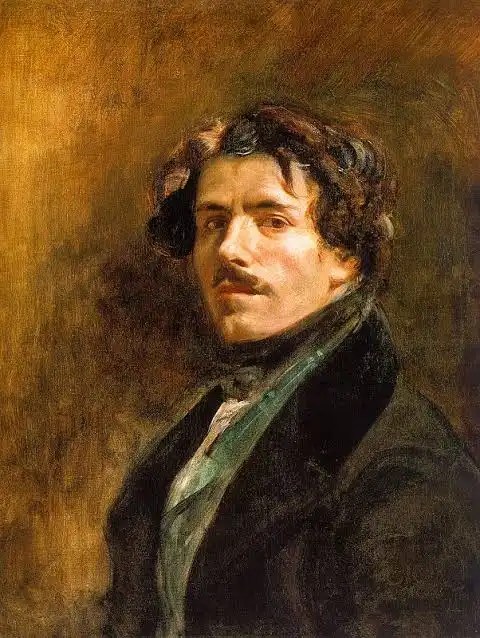
Eugène Delacroix stood at a pivotal turning point in the history of Western art. He was arguably the last great painter of the tradition shaped by Renaissance humanism; the final master to approach myth, religion, allegory, literature, and history with complete confidence that these subjects remained worthy of the grandest artistic treatment. While the generations that followed increasingly turned their attention to modern life, landscapes, and the fleeting effects of light, Delacroix remained devoted to the timeless dramas of the human condition. Yet he was no mere traditionalist. As the leading figure of the Romantic movement, he infused painting with unprecedented emotional intensity, bold color, dynamic composition, and expressive brushwork, revolutionizing the medium from within. In doing so, he laid the foundations for Impressionism, Symbolism, and many other currents of modern art. Few artists have so completely embodied both the culmination of one artistic age and the birth of another. Tom Prideaux, senior editor at Life magazine and a distinguished theater critic, tells this remarkable story with insight and clarity in The World of Delacroix: 1798–1863 (1969), one of roughly two dozen outstanding artist profiles published in Time-Life’s superb World of Art series.
Delacroix was born in 1798 at Charenton-Saint-Maurice, near Paris, while his father, Charles Delacroix, was serving as a senior diplomat after an eventful political career. An upper-bourgeois lawyer who had embraced the French Revolution, Charles had served in the National Convention and voted for the execution of Louis XVI before holding a succession of high-ranking governmental posts. By the time Eugène was born, however, Charles was fifty-seven years old and suffering from a debilitating tumor in his testicles widely believed to have left him infertile. His wife, Victoire Oeben, was forty and had already borne three children. As a result, rumors quickly arose that Delacroix’s biological father was not Charles at all, but the brilliant diplomat Charles Maurice de Talleyrand-Périgord, with whom the young artist was said to bear a striking physical resemblance. Although the claim has never been conclusively proven, it has remained one of the most enduring mysteries surrounding Delacroix’s early life.
At the age of ten, after his father had died and the family had settled in Paris, Delacroix made his first visit to the Louvre, an experience that awakened a lifelong passion for art and set him firmly on the path to becoming a painter. Following the Bourbon Restoration in 1815, his family’s revolutionary associations left him politically out of favor, but he was nonetheless determined to succeed on artistic merit alone. French painting at the time was dominated by the austere Neoclassicism of Jacques-Louis David, with its polished surfaces, idealized figures, and devotion to classical restraint. Yet a powerful new artistic sensibility was beginning to emerge. On one side stood the disciplined, rational ideals of Neoclassicism; on the other, a more spontaneous style that prized vivid color, expressive brushwork, and emotional intensity. Delacroix would ultimately choose the latter, becoming the foremost champion of the new Romantic movement in French painting.
According to Prideaux, Delacroix was “demonically industrious,” producing more than 850 paintings over the course of his career while mastering virtually every medium of artistic expression. He admired both the classical grandeur of Nicolas Poussin and the lyrical elegance of Antoine Watteau, yet forged a style uniquely his own. “The first merit of a picture,” he wrote, “is to be a feast for the eyes. That is not to say that reason is not needed in it… In many people, the eye is false and inert.” Delacroix was one of those rare artists who arrived on the scene with extraordinary force. He enrolled in the studio of Pierre-Narcisse Guérin at the age of seventeen, and within a few years had become both a celebrated talent and the center of fierce artistic controversy. Although he absorbed Guérin’s technical instruction and later continued his training at the Académie des Beaux-Arts, he never surrendered his artistic independence. As Delacroix himself explained, he was driven by “my remoteness from the standard types of painting prescribed in schools, and my dislike of academic formulae.” Prideaux aptly characterizes him as “a responsive pupil with private reservations”; an artist who respected tradition while refusing to be confined by it.
Prideaux suggests that “one of the most fruitful and fateful encounters of [Delacroix’s] life” was his friendship with the painter Théodore Géricault. In July 1816, the French frigate Méduse ran aground off the coast of West Africa after being entrusted to an incompetent captain appointed by the recently restored Bourbon monarchy. Forced to abandon ship, more than a hundred sailors and passengers were left adrift on a makeshift raft, where starvation, madness, mutiny, and cannibalism claimed most of their lives before rescue arrived nearly two weeks later. Delacroix posed as the model for one of the dying sailors in Géricault’s monumental masterpiece, The Raft of the Medusa, and the experience left a profound impression on the young artist. Géricault’s influence is readily apparent in Delacroix’s first major Salon success, The Barque of Dante (1822), a work that established a pattern that would define much of his career: critics either hailed his genius or condemned him outright. The polarized reaction mattered deeply because, as Prideaux observes, the ambitious young painter “hungered for attention.” His next great canvas, The Massacre at Chios (1824), inspired by the Greek struggle for independence, marked an even greater artistic breakthrough. It depicts not merely a scene of massacre, Prideaux argues, but the moment “where Delacroix began to be liberated.”
Prideaux argues that Delacroix forged a style from an extraordinary range of influences. He admired the compositional grandeur of the Renaissance masters, absorbed the blazing color of Peter Paul Rubens – whose depiction of water droplets on a nymph, Delacroix later remarked, profoundly shaped his understanding of color – embraced the emotional intensity of his friend Théodore Géricault, and was captivated by the revolutionary landscape painting of the English artist John Constable. Curiously, Delacroix never made the traditional artistic pilgrimage to Italy, the mecca of European painters since the Renaissance. Instead, while still in his early twenties, he spent a pivotal three months in England, a destination that Prideaux presents as, in many respects, the artistic antithesis of Italy. There Delacroix encountered Constable’s paintings firsthand and was enthralled by their freshness, spontaneity, and luminous handling of color. Prideaux says little, however, about the possible influence of J. M. W. Turner, whose bold experiments with light and atmosphere seem equally relevant to Delacroix’s artistic evolution. Even so, the author concludes that the benefits of Delacroix’s brief English sojourn “lasted a lifetime.”
Unlike Claude Monet with his haystacks or Paul Cézanne with Mont Sainte-Victoire, Delacroix rarely returned to the same motif or composition. During the fertile years of the mid-1820s, he devoted himself to an intense and disciplined exploration of his craft, constantly experimenting with color, technique, and composition. Yet even as the art world began shifting its attention toward landscapes and scenes of everyday life, Delacroix remained deeply committed to grand historical, literary, religious, and allegorical subjects. He believed that painting should tell compelling stories and engage the imagination as well as the eye. As Prideaux observes, “Throughout most of the world’s art history, a bad picture of a saint or a king was vastly more important than a good picture of an apple or a pear.” Delacroix would become one of the last great masters to embrace that centuries-old tradition before modern art turned decisively toward more ordinary subjects.
Delacroix was especially drawn to Lord Byron, admiring both the emotional power of his poetry and the romantic heroism of his life. Among Byron’s works, The Giaour proved particularly inspiring, prompting Delacroix to paint no fewer than fifteen variations on its themes over the course of his career. Byron’s own death at the age of thirty-six, while fighting alongside Greek forces in their struggle for independence from the Ottoman Empire, only deepened the artist’s admiration. The Greek War of Independence became one of the nineteenth century’s first great international humanitarian causes, rallying writers, artists, and intellectuals across Europe. For Delacroix, it provided both a powerful political subject and an ideal expression of Romanticism’s fascination with liberty, sacrifice, and human suffering.
Delacroix was also a devoted admirer of Johann Wolfgang von Goethe and his masterpiece, Faust. In 1828, he produced a celebrated series of lithographic illustrations for a French edition of the work, images that are still regarded as among the greatest visual interpretations of Goethe’s drama. Although the project cemented Delacroix’s reputation as one of Europe’s most imaginative artists, it brought him little financial reward. By this time, he had fallen out of favor with the conservative establishment of the French Academy, whose control over prestigious public commissions left the increasingly impoverished painter struggling to support himself.
Romanticism emerged in the 1820s as an artistic and intellectual revolt against the order, restraint, and rationalism that had dominated French culture since the Enlightenment and the Napoleonic era. The Romantics believed that emotion held greater truth than reason, imagination was more powerful than rigid convention, and individual freedom was preferable to inherited tradition. Delacroix stood at the center of this vibrant circle, regularly attending the Parisian salons of the 1820s and 1830s alongside literary giants such as Victor Hugo, Alexandre Dumas, Honoré de Balzac, Prosper Mérimée, and Stendhal, as well as the Polish composer Frédéric Chopin and his companion, the novelist George Sand. They shared a passion for the theater, particularly the plays of William Shakespeare, whose reputation was only beginning to flourish in post-Napoleonic France. A defining moment for the movement came with the premiere of Hugo’s Hernani in February 1830, an event Prideaux describes as “one of the most uproarious and sensational openings in theater history.” The play’s triumph marked a decisive victory for Romanticism over the entrenched classical tradition. Delacroix made his own contribution with The Murder of the Bishop of Liège (1829), a quintessentially Romantic history painting that deliberately rejected literal historical reconstruction in favor of conveying the timeless emotional reality of violence, fanaticism, and mass cruelty.
Delacroix maintained a deep and lifelong passion for literature, a devotion reflected both in his celebrated book illustrations and in the countless paintings he drew from the works of Homer, Dante, Shakespeare, Goethe, Byron, and other literary giants. Politics, by contrast, occupied a far less prominent place in his art. For much of his early career, he remained largely detached from the turbulent world of French domestic affairs, preferring subjects drawn from history, myth, and literature. That changed dramatically in 1830, when the July Revolution erupted in response to the increasingly reactionary policies of Charles X, the younger brother of Louis XVI, who had been guillotined during the French Revolution. Delacroix’s response was Liberty Leading the People (1830), the iconic canvas that transformed a contemporary political uprising into one of the most enduring allegories of freedom in the history of Western art and perhaps his single most famous image.
Delacroix was, above all, a creature of Paris’s Left Bank, venturing little beyond the capital for most of his life. Apart from a brief but transformative visit to England in his twenties, he remained thoroughly immersed in the artistic and intellectual world of Paris until 1832, when he accompanied Charles-Edgar de Mornay on a diplomatic mission to Morocco. The journey proved to be the defining travel experience of his career. Delacroix was captivated by the country’s brilliant light, vibrant colors, magnificent horsemanship, and dramatic spectacles, filling notebooks with sketches and observations that would inspire his paintings for decades. He was particularly struck by the dignity and nobility of the local people, whom he believed resembled the ancient Greeks and Romans more closely than their modern European descendants. “It’s like the times of Homer!” he reportedly exclaimed. The expedition also furnished the inspiration for some of his most celebrated Orientalist paintings, including Women of Algiers in Their Apartment, which received a mixed reception at the Salon of 1834.
Much as Édouard Manet’s brief visit to Venice in 1874 and Henri Matisse’s stay in Collioure in 1905 permanently transformed their understanding of color, Delacroix’s four-month journey through North Africa revolutionized his own artistic vision. Immersed in what he called “the devil’s sunshine,” he discovered a luminosity and intensity of color unlike anything he had experienced in Europe. As Prideaux observes, “In Morocco [Delacroix] had seen how a passionate Romanticism could unite harmoniously with the natural dignity and control that constituted pure classicism.” The synthesis would become one of the defining characteristics of his mature style.
Prideaux writes that Delacroix returned from Morocco a permanently transformed artist, possessing a “new aplomb and certainty of his gifts.” His newfound confidence was soon on display. On March 15, 1833, he completed a striking depiction of the Visigothic King Rodrigo for a pre-Lenten masquerade ball in less than three hours; a remarkable feat that testified to both his technical mastery and creative assurance. That same year, he received a prestigious government commission worth 35,000 francs to decorate the Salon du Roi (King’s Chamber), one of the most coveted artistic assignments in France. The appointment provoked considerable resentment among many members of the Parisian artistic establishment, who viewed Delacroix as an unconventional outsider. His fortunes had been transformed in large measure through the patronage of Adolphe Thiers, then Minister of Commerce and Public Works, whose support proved instrumental in elevating Delacroix from controversial Romantic to one of France’s foremost public artists.
Beginning with the Salon of 1824, Delacroix’s life and career were profoundly shaped by his enduring rivalry with Jean-Auguste-Dominique Ingres (1780–1867). Nearly twenty years Delacroix’s senior, Ingres and Delacroix both received rigorous Neoclassical training – Ingres under Jacques-Louis David and Delacroix under Pierre-Narcisse Guérin. Both revered the great traditions of Western art, yet they fundamentally disagreed about what gave painting its power. For Ingres, drawing and line were paramount; color existed primarily to serve form. Delacroix, by contrast, believed that color possessed an expressive force equal to, if not greater than, line itself. Ingres’s conservative temperament and commitment to polished, idealized realism won him the enthusiastic support of the artistic establishment, earning him election to the Académie des Beaux-Arts decades before Delacroix. Although the two painters met only occasionally, their encounters were famously tense. Their rivalry came to embody one of the defining artistic debates of the nineteenth century: line versus color, classicism versus Romanticism.
Late in his career, Delacroix crowned his artistic achievements by helping to revive one of the grand traditions of Western art: monumental mural painting. Through vast decorative commissions for churches, palaces, and public buildings, he breathed new life into a medium that had languished for generations. Prideaux argues that these works revealed Delacroix’s “unique ability to straddle the centuries” and his “genius for orchestrating the old and the new.” More than any other aspect of his career, the murals established Delacroix as the vital bridge between the artistic traditions of the past and the innovations of the future, preserving the grandeur of the Renaissance while anticipating the expressive freedom that would define modern art.
The commissions also brought him long-overdue financial security. His monumental decorative cycle for the Chamber of Deputies, featuring figures ranging from Dante and Homer to Virgil and Alexander the Great, earned him 60,000 francs and occupied him for nearly a decade. The income proved especially important because Delacroix deliberately avoided portrait painting, the lucrative genre that sustained most artists of comparable ability. Instead of producing fashionable likenesses for wealthy patrons, he devoted himself to history, literature, religion, and monumental decoration, sacrificing commercial success for artistic independence until the French state finally rewarded his genius with commissions worthy of his ambition.
Prideaux argues that Delacroix’s overriding objective was to create murals that blended seamlessly with the architecture and decorative programs they adorned. “Instead of working like a virtuoso soloist,” he writes, “Delacroix painted as a member of the orchestra of other artistic craftsmen and the designers of the building.” The heroic allegorical figures of Justice, Agriculture, Industry, and War in the friezes of the Salon du Roi recall the monumental, muscular forms of Michelangelo’s Sistine Chapel, while the great cupola of the Palais du Luxembourg library – with scenes such as Virgil introducing Dante to Homer – echoes the intellectual grandeur of Raphael’s School of Athens. Yet despite these unmistakable debts to the masters of the Renaissance, Delacroix’s murals remain distinctly his own. As throughout his career, his figures are defined by moments of encounter and confrontation, their emotional intensity transforming historical, literary, and allegorical subjects into timeless dramas of the human condition.
In his later years, Delacroix became something of a conservative curmudgeon. He viewed the upheaval and mob violence of the Revolution of 1848 with deep disdain and looked skeptically upon the new technologies – railroads, telegraphs, and steam-powered factories and ships – that were rapidly transforming French society. Ironically, the one modern invention he genuinely admired was photography, never fully recognizing the profound challenge it would eventually pose to painters. Yet even as he entered his mid-sixties, Delacroix’s creative energy remained astonishing. He continued to work at a prodigious pace, undertaking physically demanding decorative commissions, including the magnificent central ceiling of the Galerie d’Apollon at the Louvre, a testament to both his enduring ambition and his remarkable artistic vitality.
Delacroix was finally elected to the Académie des Beaux-Arts in 1857 after being passed over six times during the previous two decades. By then he had grown increasingly withdrawn socially, yet this long-delayed recognition from France’s artistic establishment meant a great deal to him. Throughout his final years, he remained deeply concerned with his reputation and the judgment of posterity. He once remarked that he wished he could return a hundred years after his death to see how he was remembered. Writing more than a century later, Prideaux suggests that Delacroix’s reputation remains somewhat complex, although few painters have been more admired by other artists. Indeed, he has become, the author claims, the quintessential “artist’s artist.”
Ultimately, Delacroix’s enduring importance lies not merely in the extraordinary paintings he left behind, but in his vision of what art itself should accomplish. He believed that a great work of art must do more than faithfully record appearances. It should first appeal to the senses, then stir the emotions, and finally speak directly to the soul. In Delacroix’s view, painting reached its highest purpose not by reproducing reality, but by illuminating the deeper truths of the human experience.
 What's Tim Reading Now?
Leave a comment