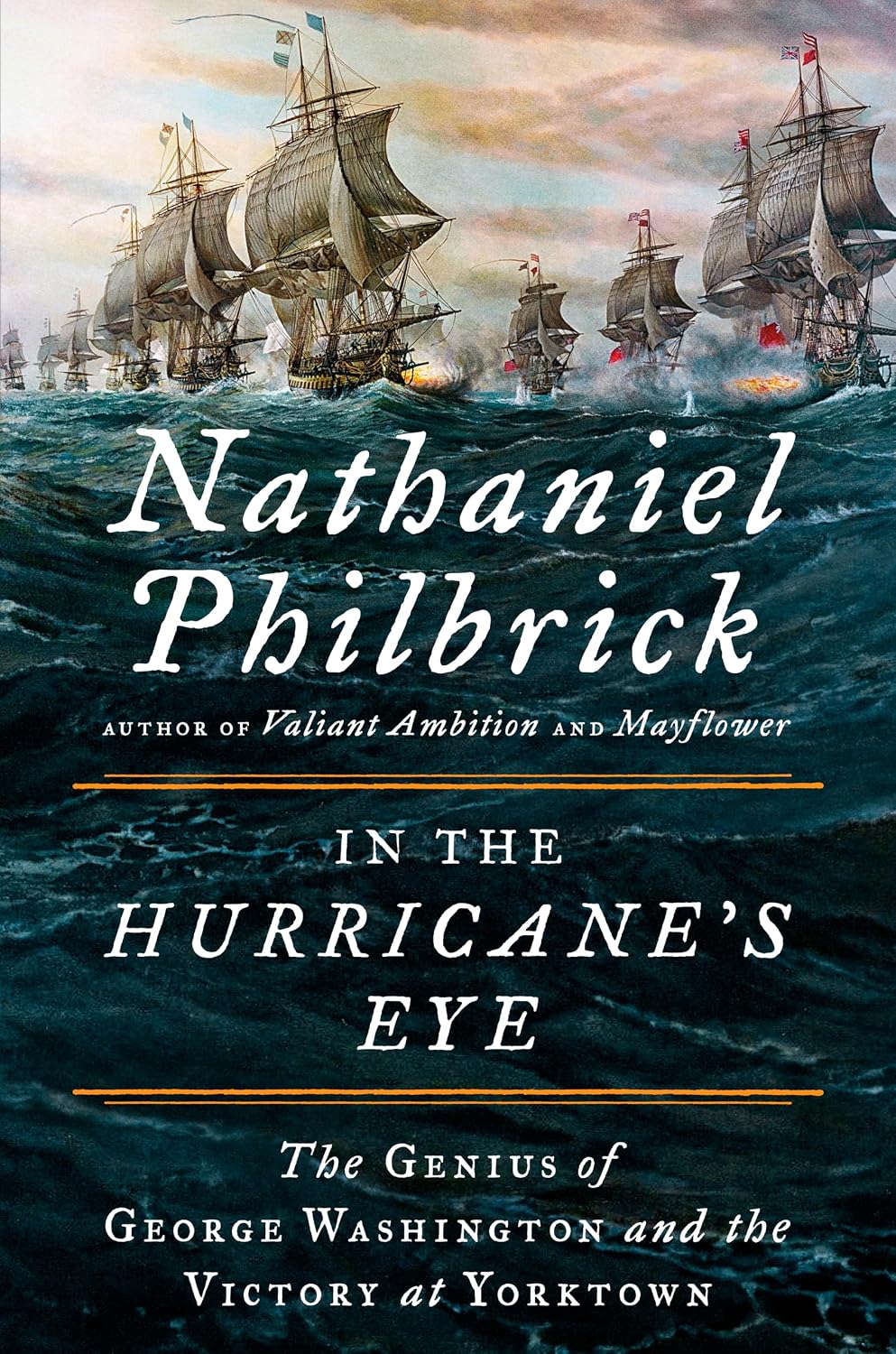
The American Revolution technically continued for nearly two years after the capitulation of Lord Cornwallis at the Siege of Yorktown in October 1781, but the war was effectively decided during that dramatic campaign, which brought together some 20,000 American and French soldiers and a powerful French battle fleet that converged from hundreds of miles of way and from different directions. Popular historian Nathaniel Philbrick recounts the events in In the Hurricane’s Eye: The Genius of George Washington and the Victory at Yorktown (2018), a crisp and engaging narrative. Yet despite the book’s subtitle, much of the strategic genius behind the victory belonged not to George Washington alone or even primarily, but also to the French commander Jean-Baptiste Donatien de Vimeur, comte de Rochambeau and the French admiral François Joseph Paul de Grasse.
The principal warship of the age was the formidable 74-gun ship of the line. Carrying seventy-four cannon arranged on two gun decks – 24-pounders on the lower deck and 18-pounders above – it struck the ideal balance between firepower, durability, and maneuverability. Manned by a crew of roughly 500 to 750 officers and sailors, the “74” was the battle tank of the Age of Sail. Constructing a single vessel required the timber from some 2,000 mature oak trees, covering an estimated fifty-seven acres of forest. By the time of the American Revolution, the Royal Navy had well over 100 ships of the line of all rates, over half of which were 74s, by far the most numerous and versatile type, making them the backbone of the British battle fleet. The fledgling United States navy had none.
Washington long understood that British naval superiority was one of the greatest obstacles to American independence. The Royal Navy controlled access to supplies from Europe, transported large armies rapidly along the Atlantic seaboard, and blockaded American ports and inland waterways with relative ease. So long as Britain maintained undisputed command of the sea, the Continental Army seemed destined to endure a slow war of attrition, gradually exhausted by shortages of men, money, food, and supplies.
The American Revolution remained a near-run thing for far longer than many Americans realize. Most know that the Patriot cause nearly collapsed before the landmark year of 1776 had even ended. Had Washington and his newly formed Continental army failed to escape from New York and then strike the Hessians at Trenton and the British at Princeton before enlistments expired at year’s end, the United States might well have remained within the British Commonwealth on terms similar to those of Canada or Australia. Less widely appreciated is how close the Revolution came to collapse four years later, in the fateful year of 1780, arguably the annus horribilis of the American cause. In that light, the decisive victory at Yorktown just a year later appears even more improbable than it does at first glance.
In May 1780, American Major General Benjamin Lincoln surrendered Charleston to the British army under Sir Henry Clinton. More than 5,500 American soldiers and sailors were taken prisoner, roughly one-third of the Continental military establishment. The surrender also cost the Americans hundreds of artillery pieces, thousands of muskets, and most of the military supplies in the Southern Department. It was the greatest single American military defeat of the Revolutionary War and remained the largest surrender of U.S. forces until the Battle of Harpers Ferry more than eighty years later.
The disaster deepened just three months later. At the Battle of Camden, Horatio Gates’s 4,000-man Southern Army was decisively defeated. Nearly 2,000 Americans were killed, wounded, captured, or missing; another thirteen percent of the Continental Army lost in a single engagement and arguably the second-worst defeat of the war after Charleston. In three months, the effective fighting force of the American cause was cut roughly in half. Then came the final blow. With Britain’s southern campaign at its height, the discovery in September 1780 that one of Washington’s most celebrated generals, Benedict Arnold, had conspired to surrender West Point to the British made the autumn of 1780 the darkest period of the Revolution. Had Arnold succeeded, British control of the Hudson River corridor might have severed New England from the rest of the states and fundamentally altered the course of the war. In the wake of these defeats, the Continental dollar collapsed in value, giving rise to the famous phrase, “not worth a Continental.” To make matters even worse, On the night of January 1, 1781, about 1,500 soldiers of the Pennsylvania Line barracked in Morristown, New Jersey mutinied. Three weeks later the New Jersey Line mutinied. Two of the ringleaders were executed.
Without the intervention of a powerful French fleet, the prospects for American independence would likely have continued to deteriorate. The Continental Army was approaching the limits of the new nation’s political and economic endurance. Britain, however, faced mounting challenges of its own. In the summer of 1779, a massive Franco-Spanish invasion force – 66 warships, some 400 transports, and 40,000 troops – assembled along the English Channel in preparation for an invasion of the British Isles. For the first time in decades, the Royal Navy could no longer take its command of the sea for granted. At the same time, large portions of both the British and French fleets remained deployed in the West Indies, today’s Caribbean, protecting the immensely profitable sugar islands that were among the most valuable possessions of their respective empires. Against that backdrop, the prospect of a large French fleet establishing naval superiority off the American coast seemed highly improbable.
Then nature intervened. In October 1780, three powerful hurricanes swept through the West Indies, wrecking ships and devastating fleets. The lesson was unmistakable: during hurricane season, the safest place for a navy was anywhere but the Caribbean. Before these storms, Philbrick argues, the prospect of a major French naval expedition to North America had seemed remote. Suddenly, however, the French fleet’s very survival depended on remaining away from the Caribbean from August through the end of October. It was precisely the strategic opening Washington had long sought. After years of lobbying for meaningful French naval support against British strongholds along the American coast, the hurricanes transformed what had once seemed an unlikely request into a practical necessity.
Meanwhile, British General Cornwallis ignored the advice of his superior, Sir Henry Clinton, and pushed deep into the Carolinas in an effort to trap and destroy the last remnants of the Continental Army in the South under Nathanael Greene. At the same time, in late September 1780, George Washington met with the French commander Rochambeau in Hartford, Connecticut, to discuss strategy for the 1781 campaign. Two issues dominated their deliberations: money and naval support.
In January 1781, the newly commissioned British Brigadier General Benedict Arnold arrived in the Chesapeake with a force of roughly 1,200 soldiers transported by a fleet of 46 vessels. Advancing up the James River to Richmond, he launched a scorched-earth campaign across the Virginia countryside. Arnold’s commander, Sir Henry Clinton, regarded control of the Chesapeake as essential to defeating the American forces in the Carolinas by severing the flow of men and supplies to Nathanael Greene’s army. After his swift raid through Virginia Tidewater, including the largely defenseless capital at Richmond, Arnold withdrew to Portsmouth in the Hampton Roads region. Once there, he immediately recognized the danger of becoming isolated and cut off. As Philbrick observes, exactly nine months before the siege of Yorktown, Arnold found himself in almost precisely the same strategic predicament that would ultimately lead to Cornwallis’s downfall.
By mid-February 1781, Washington was pressing for the French fleet at Newport, Rhode Island, to sail south, cut off the British, and capture the traitor Arnold. The French commanders, Rochambeau and Chevalier Destouches – who nominally served under Washington but showed little inclination to include him in their strategic deliberations – hesitated until they learned that the young Marquis de Lafayette was already marching south with a force assigned to capture Arnold. The prospect that the ambitious upstart marquis might win the glory while the French fleet remained idle in Newport finally spurred them to action. Even so, the fleet did not sail until nearly a month after Washington first proposed the expedition. The following day, a British squadron of eight ships of the line under Mariot Arbuthnot departed from Gardiners Bay at the eastern end of Long Island. Thanks to their copper-sheathed hulls, the British ships enjoyed a decisive speed advantage that would prove critical in closing the French squadron’s seventy mile head start.
Arbuthnot’s copper-sheathed ships overtook and then passed Destouches’s squadron, effectively blocking the entrance to the Chesapeake at Cape Henry. The British fleet held a modest advantage of twenty-two guns, but its greater edge lay in speed. Of the two commanders, Philbrick notes, Destouches was the more reluctant to seek battle. Arbuthnot had already thwarted his mission to trap Arnold, and the French admiral was inclined to abandon the expedition and return to Newport.
Then fortune intervened. A sudden shift in the wind gave the French the weather gauge, conferring a crucial tactical advantage on Destouches’s more vulnerable squadron. Moreover, French naval tactics and signaling had improved markedly since the Battle of Quiberon Bay, where the Royal Navy had annihilated a French fleet in 1759. “For the first time in centuries,” Philbrick writes, “a whisper of doubt had entered the collective psyche of the British navy.”
Destouches seized the initiative, and Philbrick argues that he thoroughly outmaneuvered and outfought Arbuthnot. Although the French suffered more casualties than the British – 164 to 97 – the British ships sustained far greater damage, while the French squadron emerged largely intact. Philbrick laments that all Destouches needed to do after the engagement was sail into the Chesapeake and capture Arnold, but Destouches later claimed he was unaware of how badly he had mauled the British squadron. Instead, he returned to Newport, while the battered Arbuthnot limped into the Chesapeake, technically the victor of what became known as the Battle of Cape Henry.
Washington vented his frustration over the French delay in private letters that Philbrick suggests he may have expected to be intercepted and exposed, thereby embarrassing the French and perhaps goading them into swifter action in the future. Had the French acted when he first urged them to, Washington wrote to Lund Washington, his cousin and the caretaker of Mount Vernon, “the destruction of Arnold’s corps would have been inevitable before the British fleet could have been in condition to put to sea.” He was probably right. It also did not help that, in April 1781, Lund provided British soldiers with food and drink to dissuade them from ransacking Mount Vernon, a pragmatic decision that Washington nevertheless found deeply mortifying.
Meanwhile, the British high command in America was consumed by its own internal discord. North American Commander-in-Chief Sir Henry Clinton envisioned a new strategy for the Carolinas and Virginia. Rather than pursuing further territorial conquest and local intimidation, he hoped to consolidate British gains through a policy of conciliation, demonstrating to the other colonies the peace, stability, and prosperity enjoyed by states such as South Carolina after returning to the British fold. Philbrick argues that Clinton could hardly have chosen a less suitable subordinate to implement such a politically delicate strategy. Commanding in the field was the “dedicated and energetic” Charles Cornwallis, who was personally estranged from Clinton and whose instinct was always to press the offensive with little regard for the political consequences. The southern strategy envisioned by the North Ministry demanded patience and restraint. Cornwallis instead favored relentless action – demonstrating energy, initiative, and visible progress in contrast to the increasingly inactive Clinton, who seemed content to direct the war from the relative comfort of New York City. Controversially dumping much of his baggage train, Cornwallis drove ever deeper into the interior with a highly mobile force that lived off the land and pursued the Continental Army with remarkable speed and determination.
Cornwallis pursued Nathanael Greene across North Carolina toward the Dan River in early February in a campaign of maneuver known today as “The Race to the Dan.” Greene skillfully delayed the British while sending all available boats to the north bank of the river. On February 14, 1781, the Americans crossed safely into Virginia just hours before Cornwallis arrived, denying the British the decisive battle they desperately wanted. Instead of destroying Greene’s army, Cornwallis exhausted his own forces and set in motion the campaign that ultimately ended at Yorktown.
Greene’s original plan had been to remain north of the Dan River until his expected reinforcements arrived. Instead, determined to prevent Cornwallis from roaming freely across the Carolinas to recruit Loyalist militia and confiscate Patriot property, he recrossed the river and resumed a skillful campaign of maneuver against the British. In the meantime, the Continental Army swelled to more than 4,200 soldiers as reinforcements arrived, roughly twice the size of Cornwallis’s increasingly depleted force. The two armies finally met on March 15, 1781, at the Battle of Guilford Court House in present-day Greensboro. Greene employed the same three-line defensive formation that Daniel Morgan had used so effectively at the Battle of Cowpens. Although Cornwallis technically won the battle by holding the field, Greene’s army inflicted devastating losses on the British. Philbrick argues that this costly “victory” persuaded the ministry in London that the southern campaign was succeeding when, in reality, the opposite was true, “a misapprehension that would lead to the concentration of British troops in Virginia in the months ahead,” he writes. Washington would learn about the Battle of Guilford Courthouse the day after he learned about the Battle of Cape Henry.
Cornwallis retreated as far south as Wilmington, North Carolina. While he lingered on the coast, Greene pressed on into South Carolina, where he famously declared, “We fight, get beat, rise, and fight again.” Cornwallis could have embarked his exhausted army on transports and returned safely to Charleston, but, like Burgoyne before him, he could not bring himself to retreat – or even to do anything that resembled retreat. Instead, his instinct was to seize the initiative once more by carrying the war into Virginia, where he was convinced the British Army could force the climactic battle that would finally end the conflict. Philbrick argues that this was precisely the kind of bold, offensive spirit Cornwallis’s civilian superiors in London wanted to hear. At the same time, however, it was also reminiscent of “the wild and exaggerated claims of a punch-drunk brawler looking for one last fight.”
The author argues that Clinton’s cautious, wait-and-see strategy was ultimately the wiser course. A prolonged war, he contends, held out the real possibility of bringing both the French and the Americans to the breaking point. Philbrick notes that the French believed the imminent collapse of the American cause remained a distinct possibility. “In truth,” he writes, “[Rochambeau] had grave doubts about the Americans’ ability to finish what they had started,” and relations between the French commander and General Washington were marked by “wariness and distrust.” Time favored the British, as the Continental Army continued to struggle with chronic shortages of food, supplies, and pay. Yet Clinton deferred to the more bellicose ambitions of his subordinate, sacrificing long-term strategic prudence for short-term political accommodation. As Philbrick observes, “Cornwallis had become the increasingly desperate embodiment of Germain’s and the King’s determination to win the war at all costs.”
Perhaps the most contentious question surrounding the Yorktown campaign is a deceptively simple one: Whose idea was it to march a combined Franco-American army 575 miles overland from Newport to Yorktown, where it would converge with Lafayette’s army while a French fleet seized control of the Chesapeake? In his later memoirs, Rochambeau claimed that the strategy originated with him. Washington offered a different account after the war, insisting that his plans to attack New York had been a deliberate ruse designed to deceive Clinton. Even so, he freely acknowledged that he had long been fixated on besieging New York City in hopes of dislodging the roughly 10,000 British troops that had occupied it for the previous five years. Philbrick argues that the central issue occupying Washington’s mind in the spring of 1781 was not the ultimate destination but how he and Rochambeau would move their armies. Washington believed naval mobility was indispensable, having seen firsthand how British command of the sea had enabled the capture of New York in 1776, Charleston in 1780, and the subsequent devastation of Virginia.
Philbrick argues that the first three years of French involvement in the American Revolution were marked by confusion and disorganization at nearly every turn, making the extraordinary precision of the Yorktown campaign all the more remarkable. He credits an unlikely figure with helping to engineer this dramatic turnaround: the thirty-four-year-old Spanish envoy Francisco Saavedra. Now largely forgotten in American history, the energetic diplomat played a pivotal role in securing the funds that financed the French naval expedition to the Chesapeake in 1781. In just six hours on August 16, 1781, Saavedra persuaded the merchants of Havana to contribute six tons of gold and silver coins – worth the equivalent of 1.2 million French livres (500,000 Spanish pesos) – to finance the French expedition. The funds were advanced as a loan, to be repaid with two percent interest upon the arrival of the next treasure fleet from Mexico. In a very real sense, American independence may have depended on the cupidity of Havana’s Spanish merchants.
Philbrick contends that Saavedra’s contributions to the successful Franco-Spanish capture of British-held Pensacola, and later to the expedition that trapped Cornwallis at Yorktown, were “indispensable.” Indeed, he concludes that “no one short of Washington and de Grasse … would do more to make the Yorktown campaign a success than Francisco Saavedra.” Saavedra not only secured the expedition’s funding but also arranged for Spanish warships to defend Haiti, freeing de Grasse to send his entire thirty-ship fleet northward, along with 3,400 French troops stationed on the island. This concentration of force enabled the French to establish naval superiority in the Chesapeake. In all likelihood, those additional six ships and thousands of troops tipped the balance in favor of the combined Franco-American operation.
The Franco-American alliance also benefited from an unexpected change in leadership within the British fleet in the Caribbean. The fleet was commanded by Admiral George Rodney, one of the most aggressive and successful naval commanders of the age. Rodney was also notorious for his relentless pursuit of prize money from captured ships and ports. By 1781, however, the sixty-two-year-old admiral was suffering from a host of physical ailments, including a painfully enlarged prostate. His second-in-command, Rear Admiral Samuel Hood, was a capable officer but lacked Rodney’s aggressiveness and tenacity. In early August, Rodney sailed for England with two ships of the line and a frigate to seek medical treatment, leaving Hood in command. Before departing, however, Rodney failed to pass along intelligence he had received from the Dutch indicating that de Grasse’s fleet was sailing for the Chesapeake. Philbrick describes this omission as “the most extraordinary of all in this ever-lengthening list of failed British opportunities.” Not until September 8 – fully a month after Rodney first received the report – did British commanders in New York learn that de Grasse was bound for the Chesapeake, by which time it was too late to provide meaningful support to Admiral Graves. “Whether it was the feuding between Clinton and Cornwallis or the dubious and sometimes unfathomable behavior of Rodney,” Philbrick writes, “the British were plagued by discord and miscommunication.”
Secrecy was paramount as the Yorktown campaign took shape in mid-1781. Washington needed Clinton to believe for as long as possible that the combined Franco-American army intended to besiege the main British force in New York City via a landing on Staten Island, even as he attempted to move an exhausted, unpaid, underprovisioned, and increasingly surly Continental Army away from the Atlantic seaboard and into the mid-Atlantic. As late as August, much could still have gone wrong. The British fleet might have reached the Chesapeake first, forcing de Grasse to return to the Caribbean. Cornwallis might have recognized the danger and withdrawn to North Carolina before Lafayette and Rochambeau could trap him. Clinton might also have unraveled the entire campaign by launching an offensive against the French and American forces as they maneuvered around New York and crossed the Hudson River. Arguably, British indecision and timidity proved every bit as decisive as Washington’s audacity and the long-awaited, full-scale commitment of French naval and land forces.
“The bitter truth was that by the summer of 1781 the American Revolution had failed,” Philbrick writes. “…the very existence of the United States rested with the soldiers and sailors of another country.” The Continental Army was held together largely by the extraordinary force of Washington’s personal leadership, while Robert Morris – one of the wealthiest men in America, who would ultimately be ruined financially by the cause – was almost single-handedly keeping the war effort afloat by issuing his own promissory notes, known as “Bobs,” as an emergency substitute for hard currency following the collapse of the Continental dollar. Even that proved insufficient. Rochambeau ultimately lent Morris $25,000 hard dollars from the funds raised in Havana so the remaining soldiers of the Continental Army could finally be paid. As Philbrick concludes with exasperation, “Not only were the French providing the United States with a navy, they were paying its army.”
Moreover, Washington could muster only about 2,500 fit Continental soldiers for the march to the Chesapeake. By contrast, the French contributed more than 5,000 troops from Rochambeau’s army in New England and another 3,100 soldiers who arrived with de Grasse’s fleet from the Caribbean. Together, these forces joined Washington’s army to trap and besiege Cornwallis’s Virginia command of roughly 7,000 men – nearly two-thirds the size of Clinton’s main army in New York – along with 4,500 runaway slaves crowded into an area just 500 yards wide and 1,200 yards long (roughly 124 acres). The French also brought critical capabilities the Americans lacked. Regarded as “the greatest artillerists in the world,” Philbrick notes, they possessed extensive expertise in modern siege warfare; Yorktown was Rochambeau’s fifteenth siege operation.
At sea, de Grasse brought nearly thirty ships of the line to seal off Cornwallis’s only avenue of escape, while Admiral de Barras arrived from Newport with eight additional ships of the line. Although de Barras technically outranked de Grasse and initially bristled at serving in a supporting role, he subordinated his personal pride to the success of the allied operation. Philbrick offers a stinging assessment of the resulting imbalance: “The American army was, in essence, a fly on the back of an elephant, and [Washington], as that fly’s commander, was in no position to claim credit for a plan that had been essentially forced on him by the French.” That said, Philbrick does credit Washington’s insistence on secrecy and deception with allowing the combined Franco-American army to march around New York and through New Jersey largely unmolested.
It wasn’t until August 31 – a day after de Grasse’s fleet of twenty-eight ships of the line and five frigates sailed into the Chesapeake Bay – that the British finally realized the nature and scope of the Franco-American campaign. “Clinton had been completely bamboozled,” Philbrick writes, “and his officers knew it.” Nineteen ships of the line and eight frigates under the cautious and indecisive Admiral Graves and more aggressive Admiral Hood departed the British base at Sandy Hook bound for the Chesapeake to relieve General Cornwallis.
De Grasse could have remained at anchor and forced the smaller British fleet to attack on his terms. Instead, he chose to put to sea immediately, deploying the rare ligne de vitesse (“line of speed”) formation, in which ships formed the battle line according to their relative speed rather than their prescribed positions. It was only the second time in the history of the French navy that the tactic had been employed. The result was almost immediate: enormous gaps opened between the French ships, some stretching as much as three miles, compared with the customary battle spacing of just 600 to 1,200 feet. Although numerically superior, the French fleet appeared dangerously exposed, with its scattered van vulnerable to isolation and destruction. Yet rather than exploiting the opportunity, the recently combined British fleets – hampered by the astonishing fact that they still operated under different signaling systems – adhered to a more conventional and cautious approach. Admiral Graves elected to form a uniform line of battle parallel to the disjointed French fleet, squandering what may have been his best chance to seize the initiative and exploit the disunity of the French battle line.
Graves neglected to strike the signal for the line ahead, leaving in place an order that directly contradicted his signal to engage the enemy, a potentially fatal mistake. Incredibly, this was the very same error Admiral Arbuthnot had made at the Battle of Cape Henry. As a result, the British rear squadron under Admiral Hood continued to follow in Graves’s wake instead of peeling away to engage the French. Consequently, the Battle of the Chesapeake on September 5, 1781 was fought almost entirely by the leading squadrons of the two fleets, while Hood’s ships in the rear were never fully brought into action. Graves later made it clear that he thought Hood had willingly failed to engage the French rearguard, which ultimately cost the British victory.
The French navy benefited from a more uniform signaling system than its British counterpart, but it was hampered by divisions within its own officer corps. French naval leadership was deeply fractured along class lines. Officers of aristocratic birth who had been trained at the royal naval academy, such as de Grasse, were known as the “Reds” because of the color of their uniforms. They often looked down on officers of more modest origins – many recruited from the merchant marine or the army to serve as auxiliary naval officers – who wore blue uniforms and were known as the “Blues.” The Battle of the Chesapeake proved to be a rare example of effective cooperation between the two factions. While the Red de Grasse exercised overall command of the French fleet, the Blue Bougainville won distinction by leading the French vanguard, which bore the brunt of the fighting.
The leading squadrons of both fleets suffered extensive damage during the battle, although the British came off decidedly worse. For the next four days, the opposing fleets shadowed one another without renewing the engagement. The French fleet, now reinforced by de Barras’s squadron from Newport, returned to the Chesapeake, having accomplished its principal objective: trapping Cornwallis at Yorktown. Graves, concluding that no further action was feasible, withdrew to New York to regroup.
Meanwhile, Washington and Rochambeau rode into Yorktown on September 14. The trap had closed. More than 19,000 French, American, and militia troops now surrounded Cornwallis’s army, while some 20,000 French sailors and thirty-six ships of the line dominated the Chesapeake. For several weeks in the autumn of 1781, Yorktown became the largest concentration of people in North America. The allies now had roughly six weeks to force Cornwallis’s surrender before de Grasse and the French fleet would be compelled to return to the Caribbean.
For a time, Cornwallis maintained control of the York River, preserving a vital line of communication between his main force at Yorktown and the smaller British fortification across the river at Gloucester. Washington repeatedly urged Rochambeau to seize control of the river, but the French commander declined for several weeks. Meanwhile, the British high command in New York remained paralyzed by indecision. On September 25, Admiral Digby arrived from London with three additional ships of the line, increasing the Royal Navy’s strength to twenty-five. Yet, as Philbrick observes, “[Clinton, Graves, Hood, and Digby] were caught in a collective nightmare of dread and indecision, powerless to act just when events seemed to demand that something – anything – be done.” Cornwallis later maintained that he had remained on the defensive at Yorktown because of repeated assurances from General Clinton that relief was imminent.
Cornwallis made his final serious attempt to break out of Yorktown on the night of October 16, 1781, just three days before his surrender. His plan was bold but born of desperation. He intended to ferry roughly 1,000 troops across the York River to Gloucester Point, where a smaller British force under Lieutenant Colonel Banastre Tarleton was stationed. Once united, the combined force would overwhelm the French troops guarding Gloucester, escape into Virginia’s interior, and potentially march north toward New York. The operation began promisingly, with the first wave crossing the river without incident. Before the remaining troops could follow, however, a violent squall swept across the York River, scattering the boats and making additional crossings impossible. Cornwallis had no choice but to recall the troops already on the opposite shore, and by dawn they had returned to Yorktown. His last opportunity to escape had vanished.
With his final escape attempt thwarted, Cornwallis recognized that his position was hopeless. Allied artillery continued to batter the British defenses, the lines were steadily collapsing, and no relief force from New York was forthcoming. The next day, October 17 – exactly four years after Burgoyne’s surrender at Saratoga – Cornwallis requested a ceasefire and opened negotiations. By then, approximately 300 British and German soldiers had been killed in the bombardment and another 600 seriously wounded. Two days later, on October 19, 1781, roughly 7,000 British and German troops formally surrendered, effectively bringing major combat operations in the American Revolutionary War to an end. Ironically, on the very day Cornwallis laid down his arms, the long-awaited British relief expedition finally sailed from Sandy Hook.
For the first time, as Philbrick observes, “a British general had been defeated, not by the land or even another army, but by the sea.” The terms of surrender were also considerably harsher than those Horatio Gates had granted Burgoyne at Saratoga. Instead, they mirrored the conditions the British had imposed on American General Benjamin Lincoln following the surrender of Charleston the previous year: the defeated troops would remain prisoners of war in America rather than be paroled. In a fitting act of poetic justice, Washington selected Lincoln – the officer who had endured the humiliation of surrendering Charleston – to accept the British capitulation at Yorktown. At a stroke, the Crown lost roughly one-third of its military force in North America. Yet, as Philbrick argues, the decisive blow was not simply the loss of manpower but the defeat’s immense “symbolic value,” which shattered British confidence and undermined the political will to continue the war. When news of Cornwallis’s surrender reached London on November 25, Prime Minister Lord North is said to have exclaimed, “Oh God! It’s all over!” For the first time in a long while, he was right.
Roughly six months later, on April 12, 1782, Admiral Rodney decisively defeated de Grasse’s French fleet at the Battle of the Saintes, securing Britain’s lucrative possessions and strategic naval dominance in the Caribbean. With the empire’s most valuable sugar islands no longer under immediate threat, the British government could negotiate peace with its former American colonies from a position of greater confidence.
In closing, In the Hurricane’s Eye makes a compelling case that the Franco-American victory at Yorktown was anything but inevitable, let alone probable. Rather, it emerged from an extraordinary chain of contingent events, each of which had to unfold in precisely the right way for the allied strategy to succeed. As he writes, the outcome depended on “everything from Admiral Rodney’s decision to return to England for medical attention, to de Grasse’s decision to sail to the Chesapeake with the entire French fleet, to Clinton’s refusal to interfere in any way with the allied armies’ departure from White Plains, to Cornwallis’s determination to remain at Yorktown even after the arrival of a large French fleet.” Had any one of these decisions been different, the American Revolution might have ended very differently.
The timing could scarcely have been more fortunate. Although Yorktown effectively ended major combat operations, the young republic remained politically fragile and financially exhausted. In the months that followed, the Continental Army itself teetered on the brink of collapse as frustrated officers, weary of years without pay, drifted toward what became known as the Newburgh Conspiracy. Once again, Washington’s extraordinary leadership preserved the Revolution. By appealing to the honor, sacrifice, and shared purpose of his officers, he held the army together just long enough for peace to be secured and for the civilian government to survive its own profound weaknesses.
Washington himself never viewed American independence as an inevitable triumph. Upon resigning his commission, he described the colonies’ victory as “little short of a standing miracle.” Philbrick’s account demonstrates just how justified that assessment was. In the Hurricane’s Eye is not merely a history of Yorktown but a reminder that history often turns on decisions made under uncertainty, fleeting opportunities, and extraordinary individuals willing to seize them. If the American Revolution was, in Washington’s words, a miracle, then the events that unfolded in the Chesapeake in the autumn of 1781 were the miracle’s defining moment.
 What's Tim Reading Now?
Leave a comment