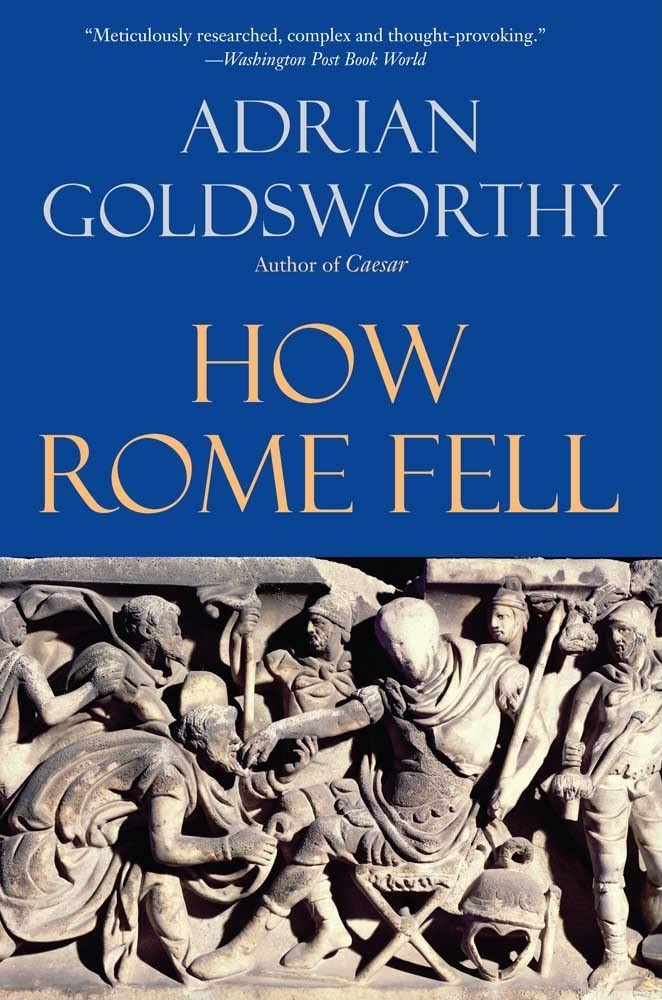
Eighteenth-century British historian Edward Gibbon famously wrote, “The decline of Rome was the natural and inevitable effect of immoderate greatness.” More than two centuries and countless scholarly debates later, British historian Alexander Demandt wryly observed, “The only thing historians agree on about the fall of the Roman Empire is that it happened.” Indeed, yet another British historian, Adrian Goldsworthy, notes in How Rome Fell: Death of a Superpower (2009), “The fall of the Roman Empire remains one of the great mysteries of history.” Yet rather than asking why the Roman Empire gradually declined and the Western Empire ultimately collapsed, Goldsworthy sets out to explain how that process unfolded. It is a subtle distinction, but an important one. He emphasizes that the empire was ultimately defeated by its own political dysfunction long before external enemies delivered the final blows.
The decline and fall of Rome was a long process, and no single event or military defeat can be said to have caused it. For centuries, Rome endured setbacks – many of them catastrophic – yet somehow managed to recover. That cycle of resilience and renewal broke down in the third century. Why? Goldsworthy notes that historians have generally offered two explanations: either Rome’s enemies had become more formidable, exemplified by the rise of the Sassanid Persian “superpower,” or the empire faced too many simultaneous threats, particularly the barbarian incursions across its European frontiers, to respond effectively. He rejects both arguments. “There is no good case for claiming that the enemies of the Late Roman Empire were simply more formidable than those of earlier periods,” he writes, while noting that barbarian raids along the northern frontier “were not new.” The puzzle is why, after the third century, it stopped recovering.
The real difficulty, he argues, is that historians lack the basic demographic and economic data – such as reliable population and trade figures – needed to measure the extent of any long-term decline with confidence. As a result, scholars have often emphasized the evidence that survives, including law, government, intellectual life, culture, and religion, reinforcing broad narratives of continuity rather than change. Goldsworthy instead advocates a return to narrative history, arguing that a careful reconstruction of events over the centuries offers the best means of understanding how Rome’s decline actually unfolded. He argues that following events chronologically reveals patterns that thematic studies often obscure.
The central thesis of How Rome Fell is that the Roman Empire’s greatest enemy was not foreign invasion but civil war. Goldsworthy acknowledges that external foes, particularly the Persians, repeatedly exploited the empire’s chronic internal divisions and recurring civil wars. Yet he argues that these enemies were opportunists rather than the primary cause of Rome’s decline. Indeed, from A.D. 217 until the deposition of the last Western Roman emperor in 476, there were only a handful of periods lasting as long as a decade during which the empire was not convulsed by civil war. Every adult emperor from Septimius Severus (r. 193–211) onward experienced at least one such conflict during his lifetime, a profound departure from both the Roman Republic and the early Empire. These wars were not fought over ideology or competing visions of government; they were naked struggles for political power between rival networks of patrons and clients. Personal survival became each emperor’s overriding priority, shaping both his decisions and the structure of the imperial state. Administrative and military reforms increasingly served to preserve emperors rather than strengthen the empire. Every successive civil war exacted a price. Over time, these internal conflicts eroded the army’s administrative and logistical systems, disrupted recruitment and training, and, perhaps most damaging of all, undermined its discipline.
One of Goldsworthy’s more original institutional arguments is that the marginalization of the Senate removed an important stabilizing political elite and transformed the city of Rome itself into the spiritual heart of the empire while being stripped of nearly all political power. By the end of the third century, senators had virtually ceased to hold military commands of any significance and no longer supplied the empire’s future emperors, who increasingly emerged from across the imperial population. In earlier centuries, an emperor needed to fear only a relatively small circle of powerful senators; by the Late Empire, a rival could emerge from almost anywhere. Family pedigree and political connections no longer determined who might seize the purple. The only true coin of the realm was command of a loyal and effective army.
Over time, military and civil authority became increasingly separated, while the trend toward smaller provinces continued. Goldsworthy argues that later reforms – including those of Diocletian – were designed less to govern effectively than to protect emperors from rivals. The bureaucracy expanded, provinces multiplied, and command structures became more complex. These reforms addressed symptoms without curing the underlying political instability. As a result, emperors from the third century onward spent much of their reign performing duties that had once been delegated to imperial legates. Yet no emperor could be everywhere at once. Goldsworthy argues that the fundamental change after the third century was not the scale of the challenges confronting Rome, but the empire’s diminishing ability to deploy its resources and leadership effectively in response. Ironically, the imperial bureaucracy of the Later Roman Empire was far larger than that of the first two centuries, even though its army may have been smaller.
One solution was to multiply the emperors themselves. In 293, Diocletian established the Tetrarchy, one of the most innovative constitutional experiments in Roman history. Rather than entrusting the empire to a single ruler, the new system divided authority among two senior emperors (Augusti) and two junior emperors (Caesars), each responsible for a different region while governing as part of a single imperial state. Although the Tetrarchy itself collapsed within a generation, many of Diocletian’s administrative and military reforms endured, profoundly shaping the character of the Later Roman Empire.
The foremost responsibility of a Roman field army in the Later Empire was not to defend the frontiers but to protect the emperor from rival Romans. “The state developed in ways to protect emperors from internal rivals,” Goldsworthy observes, “but singularly failed to do so.” Lacking any clear or widely accepted system of succession, the empire remained perpetually vulnerable to civil war. Yet the Augustan settlement had functioned with remarkable stability for nearly two centuries, a record of success that Goldsworthy insists was no “mere fluke.”
He attributes that stability largely to the political prestige and influence of the Senate. “In the third century the empire largely lost the Republican façade so carefully constructed by Augustus,” he writes. Augustus and his successors, through the reign of the Five Good Emperors, governed through the Senate. Although the Senate possessed little genuine political independence, its dignity and authority were carefully preserved. More importantly, emperors of the first and second centuries entrusted senators with virtually every major military and civil office, effectively governing the empire through an established ruling elite rather than through personal military patronage. Emperors were able to delegate without fear and without the need to direct campaigns in person. Politically, the small senatorial class were much easier for emperors to control.
The Roman Empire endured for centuries despite the corrosive effects of civil war and economic stagnation because, as Goldsworthy argues, “Rome was massive, heavily populated, and rich.” The Sasanian Empire was its strongest regional rival, yet there was never any realistic prospect of a Persian army marching on the Tiber. For centuries, Rome simply had no true peer competitor – militarily, politically, or economically. That remained true even as its population, army, and economy gradually declined. The empire was unlike anything else in the known world: vast enough that it did not need to operate at peak efficiency to survive and, at times, still prevail.
The Later Roman Empire, Goldsworthy argues, was not designed to govern efficiently but to preserve the emperor’s position and serve the interests of the imperial administration. “Sheer size prevented rapid collapse or catastrophe,” he writes. Its institutions slowly decayed, becoming progressively less capable of responding to crises, yet the empire continued to endure because no external rival was strong enough to exploit its weakness fully. Goldsworthy likens the Later Roman Empire to a retired world-class athlete “whose body has declined from neglect and an unhealthy lifestyle. At times the muscles will still function well and with the memory of former skill and training. Yet, as neglect continues, the body becomes less and less capable of resisting disease or recovering from injury. Over the years the person would grow weaker and weaker, and in the end could easily succumb to disease.”
Finally, Goldsworthy considers an enduring question: Is the United States a modern Rome? He emphasizes that the differences between the two are at least as significant as the similarities. Above all, Rome was a superpower that endured for centuries without a true peer competitor. The United States, by contrast, faces geopolitical rivals unlike anything encountered by ancient Rome. Nor is there any precise modern equivalent to the tribal peoples beyond Rome’s frontiers, although large-scale illegal immigration presents its own political and economic challenges.
If there is one lesson from Rome’s decline that does resonate, Goldsworthy argues, it is the extraordinary slowness of the process. The empire spent centuries under increasingly overstretched emperors whose foremost concern was often their own political survival, yet it continued to function long after its institutions had begun to decay. Goldsworthy stresses that contemporaries rarely recognized they were living through irreversible decline. Institutions slowly weakened while daily life often continued much as before. Only in hindsight can historians identify events that marked decisive turning points. “Bureaucracies are stubborn,” he observes. “They tend to expand on their own and develop their own agendas.” Rome endured for generations before its final collapse came with surprising speed. The decline of the United States is not inevitable, Goldsworthy concludes, but neither is it impossible. Looking back, historians can see that Rome never truly recovered from the civil war that followed the murders of Commodus and Pertinax less than ninety days apart in A.D. 193 – a turning point that almost certainly went unrecognized by those living through it. The equivalent tipping point for the United States, if one exists, may likewise be apparent only in retrospect.
In closing, the book’s most enduring insight is that Rome did not fall because it encountered problems it had never faced before. It fell because, after centuries of political instability and civil war, it could no longer respond to familiar problems with its former resilience. That subtle shift – from identifying causes to explaining the erosion of institutional capacity – is what distinguishes How Rome Fell from many earlier works on the subject.


Leave a Reply