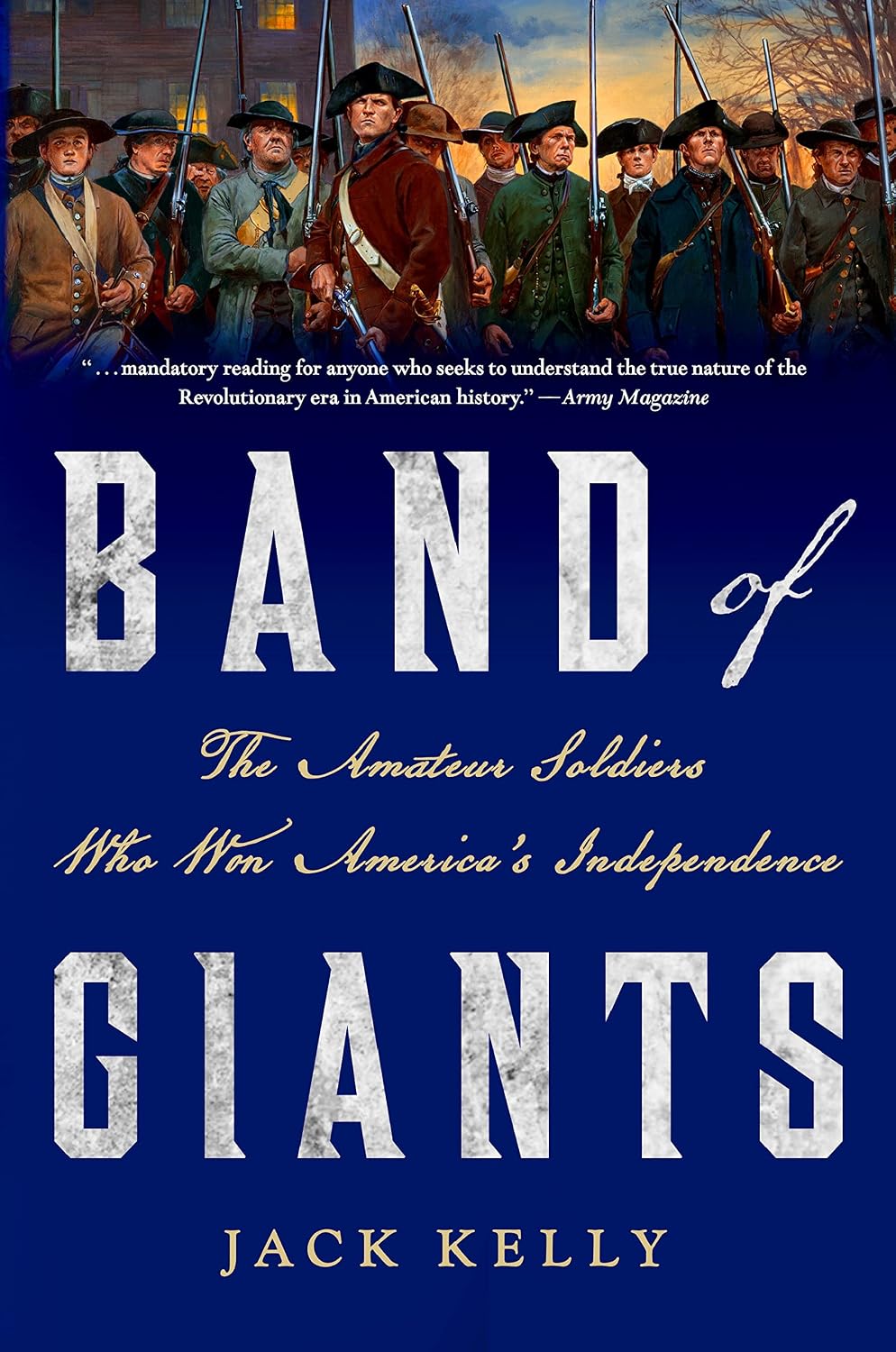
Band of Giants: The Amateur Soldiers Who Won America’s Independence (2014) by Jack Kelly quite literally fell into my lap. While having dinner with old friends from graduate school, my hostess mentioned that she had an extra copy and insisted I take it home. I read almost the entire thing on my flight back to San Francisco.
The first thing to consider before reading this book is its author. Jack Kelly occupies an unusual niche in American history. He is neither an academic historian in the traditional sense nor simply a bestselling popular historian in the mold of Barbara Tuchman, David McCullough, Robert Massie, or, more recently, Stacy Schiff, Candice Millard, and Erik Larson. Kelly began his career as a journalist and novelist before turning almost exclusively to narrative nonfiction on early American history. Over the years he has earned a reputation as a meticulous and engaging storyteller, although I found his prose to shade toward the purple. Consider this doozy of a sentence from the opening chapter of Band of Giants: “The milky gunpowder smoke smeared the air with a sulfurous haze and the taste of burnt metal.” Perhaps such writing helps you connect better with the story; I found it mostly a distraction. Kelly’s books seem to be respected by both general readers and many professional historians, although they are not regarded as groundbreaking works of original scholarship. The chief criticism of his work – and Band of Giants is a good example – is that it is synthetic rather than revisionist. Kelly excels at distilling the best existing scholarship into a compelling narrative, relying on established historical research instead of uncovering new archival evidence or advancing major reinterpretations of the past.
I would describe Band of Giants as a concise, credible, and highly readable chronological account of the American Revolution told almost exclusively through the lens of military history. It is a story of bloody battles, intrepid heroes, incompetent generals, and an extraordinary, nearly decade-long succession of crushing Patriot defeats, improbable victories, and countless brushes with catastrophe. Kelly traces the conflict from General Braddock’s disastrous defeat on the Monongahela during the French and Indian War in 1755 – a formative experience for future Revolutionary war leaders such as George Washington, Horatio Gates, and Daniel Morgan – to the final surrender of Lord Cornwallis at Yorktown in 1781. Along the way, he demonstrates just how precarious the American cause remained for much of the war and how remarkable its eventual triumph truly was.
Despite its subtitle – The Amateur Soldiers Who Won America’s Independence – Band of Giants adds little that is new to our understanding of the Continental soldiers, their motivations, or their place in the society of the early republic. Earlier and more scholarly works have explored these questions in far greater depth. John Shy’s A People Numerous & Armed (1976), for example, is a thoughtful collection of essays that reframes the American Revolution as a political and social struggle no less than a military one. Rejecting both triumphalist American mythology and simplistic narratives of British incompetence, Shy argues that Britain gradually adapted its strategy from imperial policing to conventional warfare and ultimately to a sophisticated counterinsurgency campaign, only to be thwarted by the resilience of the Continental Army and, above all, the decentralized militia system that made pacification impossible. Richly researched and especially valuable for its analysis of British strategy and revolutionary warfare, Shy’s work remains one of the most insightful contributions to the Revolution’s politico-military history.
Charles Royster’s A Revolutionary People at War (1980) goes even further, arguing that the Continental Army was sustained by a profound belief that its soldiers were fighting for God, posterity, and the moral destiny of the new nation. Over the course of the war, however, this idealism gave way to growing estrangement between the professional army and the civilian society it defended. As many officers came to see themselves as the true guardians of the Revolution, ordinary Americans recoiled from their demands for pensions and special status, fearing they embodied the very hierarchy and privilege the Revolution had been fighting to overthrow. Royster contends that George Washington’s restraint during the Newburgh Crisis preserved the principle of civilian supremacy and that the early republic subsequently cultivated a comforting myth of a united, virtuous revolutionary generation, obscuring the deep tensions that had nearly divided army and people. It is a provocative, persuasive reinterpretation that challenges one of the central founding myths of the United States.
If it is this kind of deep historical and social analysis that you’re seeking, Band of Giants is not the book for you. Kelly makes no attempt to advance new interpretations or challenge the existing historiography. Instead, he offers a straightforward, engaging retelling of the Revolution, emphasizing the remarkable achievements of the citizen-soldiers who, against extraordinary odds, defeated what was widely regarded as the most professional army in the world. His strength lies not in reinterpreting the Revolution, but in telling its military story with clarity, pace, and respect for the historical record.
Many of the future general officers of the Continental Army received their first taste of war while serving under British command during the French and Indian War (1754–1763), including George Washington, Horatio Gates, Charles Lee, John Stark, Israel Putnam, Artemas Ward, John Sullivan, Daniel Morgan, Philip Schuyler, Richard Montgomery, and Hugh Mercer. According to Kelly, their service as junior officers and enlisted men exposed them not only to the hardships and horrors of eighteenth-century warfare, but also to the fundamental shortcomings of European military doctrine when applied to the dense wilderness of North America. General Edward Braddock’s disastrous defeat on the Monongahela in 1755 shattered the aura of British invincibility and demonstrated the perils of moving cumbersome baggage trains through virgin forests with troops trained to fight in rigid linear formations.
Kelly argues that Washington deeply admired Braddock as a mentor while possessing an uncommon willingness to learn from experience. He quickly recognized the need for flexibility and adaptation on the battlefield, yet he never abandoned Braddock’s conviction that “discipline is the soul of an army” and that it was indispensable for holding an army together through prolonged campaigns, defeats, and logistical hardships. From Braddock, Washington also absorbed an instinct for offensive action, a distrust of Native American allies, the value of a close-knit military staff, and the importance of troop hygiene, dependable pay, and professional administration.
Washington grappled throughout the Revolution with a fundamental paradox. On the one hand, he had learned from Braddock that a successful army depended upon discipline, hierarchy, and unwavering obedience to command. On the other, the very spirit that inspired American farmers, merchants, and mechanics to take up arms in defense of liberty often made them reluctant and often ineffective professional soldiers. As Kelly observes, “militias might elect unit commanders and allow officers to fraternize with their men – real armies did not.” Likewise, professional armies consisted of officers and enlisted men committed to serve for the duration of the war, whereas militia units frequently dissolved when short-term enlistments expired or when their members were asked to campaign beyond their home states. Reconciling these two fundamentally different military cultures became one of Washington’s greatest challenges, testing his administrative skill, political judgment, and leadership over nearly eight years of war.
The American Revolution, with its emphasis on merit over birth and social standing, also elevated a remarkable group of young men with little or no formal military experience who would become some of the Patriot cause’s most effective commanders. Among them were Boston bookseller Henry Knox, Rhode Island blacksmith and farmer Nathanael Greene, Connecticut merchant Benedict Arnold, and Caribbean-born New York student Alexander Hamilton. All were in their twenties when fighting erupted at Lexington and Concord. They began by immersing themselves in military history and theory, then forged their reputations through years of grueling campaigns, exhausting marches, humiliating retreats, and hard-won battlefield experience.
Perhaps the most effective American battlefield commanders of the Revolution bridged two worlds: they had gained firsthand combat experience serving under the British during the French and Indian War, yet they also possessed an instinctive appreciation for the realities of the North American wilderness and the strengths of the American citizen-soldier. No two officers better embodied this combination than John Stark of New Hampshire and Daniel Morgan of Virginia, whom Kelly describes as “the patriots’ most skilled natural fighters.” Both were already in their forties when the first shots were fired at Lexington and Concord in 1775. Neither was a professionally trained officer in the European tradition, yet both emerged from the French and Indian War convinced that success in North America required a fundamentally different style of warfare than that practiced on the battlefields of Europe. Their frontier experience taught them to prize mobility, initiative, and the intelligent use of terrain over rigid adherence to linear tactics. Above all, they understood the strengths and limitations of the American citizen-soldier better than almost any of their contemporaries, enabling them to transform ordinary farmers and frontiersmen into remarkably effective fighting forces.
Stark first distinguished himself at Bunker Hill, where his New Hampshire regiment, positioned behind a simple rail fence, repeatedly repulsed British assaults with disciplined, close-range volleys. His finest hour came two years later at Bennington, where he skillfully coordinated New England militia in a series of converging attacks that overwhelmed a German and Loyalist force sent to gather supplies for Burgoyne’s invasion. The victory destroyed nearly an entire British detachment, deprived Burgoyne of desperately needed reinforcements and provisions, and contributed directly to the Saratoga campaign, the turning point of the war. Stark instinctively recognized that militia should not be asked to fight like British regulars. Rather than imposing rigid discipline, he capitalized on their confidence, local knowledge, and willingness to fight aggressively from cover, turning ordinary farmers into an extraordinarily effective fighting force.
Morgan began his military career as a teamster, hauling supplies for the British Army during the French and Indian War. After striking a British officer in response to an insult, he was sentenced to receive 500 lashes for insubordination, a punishment that reportedly ended after 499 blows when the count was mistakenly lost. The ordeal earned him the enduring nickname “the Old Wagoner.” Morgan’s military genius reached its fullest expression in the southern campaign. Kelly describes him as “a bare-knuckle fighter” who approached war “with a remarkably clear vision, uncluttered by social furniture and learned biases.” After earning distinction during the failed assault on Quebec and commanding his celebrated rifle corps at Saratoga, where his backwoods rifle marksmen harassed British officers and disrupted enemy formations, he achieved immortality at Cowpens in January 1781. Anticipating Banastre Tarleton’s impetuous style, Morgan deliberately drew the British into attacking what Kelly calls a “brilliant, unconventional” three-line defensive formation. He instructed his militia to fire only a pair of volleys before withdrawing in an orderly fashion, convincing Tarleton that the Americans were collapsing. As the British surged forward in disorder, Morgan’s Continental regulars counterattacked while the militia returned to strike the enemy’s flanks, producing one of the most complete tactical victories of the Revolution. Cowpens remains a classic example of battlefield deception, disciplined planning, and the masterful employment of mixed forces. Kelly goes so far as to call Cowpens “the most decisive Patriot victory of the war.” Weakened by age and the cumulative burdens of a lifetime of hard campaigning, it would prove to be the Old Wagoner’s final battle.
Although their temperaments differed, Stark and Morgan shared several defining characteristics. Both exploited forests, hills, fences, and broken ground to negate British advantages in discipline and drill. Both relied on aggressive maneuver and surprise rather than attrition. Most importantly, they understood that American militia could become formidable soldiers when employed according to their strengths rather than forced into European methods of warfare. Their success demonstrated that flexibility, local initiative, and practical battlefield experience could overcome even the world’s finest professional army. Together, Stark and Morgan embodied a distinctly American style of command: adaptive, resourceful, and rooted in the realities of fighting a revolutionary war on the North American frontier.
Other officers possessed a gift for administration: the rare ability to solve seemingly insurmountable logistical problems and simply find a way. Their contributions lacked the drama of the battlefield exploits of a John Stark or Daniel Morgan, yet they were arguably even more essential to the survival and ultimate success of the Continental Army. Henry Knox and Nathanael Greene were the archetypes of this type of leader, although both also demonstrated exceptional courage and competence in combat. If Stark and Morgan proved that battlefield leadership could overcome British tactical superiority, Knox and Greene demonstrated that wars are won as much through organization and logistics as through valor under fire. Knox accomplished one of the Revolution’s greatest logistical feats by transporting nearly sixty tons of captured artillery from Fort Ticonderoga more than three hundred miles across frozen wilderness to Boston during the winter of 1775–76. Those guns allowed Washington to fortify Dorchester Heights, compelling the British to evacuate Boston without a major battle and giving the Patriot cause what Kelly aptly describes as “their first real thrill of the war.” Greene, meanwhile, became Washington’s indispensable quartermaster general, transforming the Continental Army’s chronically dysfunctional supply system and helping sustain and re-equip the army during and after the desperate winter at Valley Forge. By ensuring that soldiers received food, clothing, ammunition, transportation, and other essential supplies, he made it possible for Washington’s army to remain in the field as an effective fighting force. Their accomplishments are a powerful reminder that the Revolution was won not only through tactical brilliance on the battlefield, but also through extraordinary feats of administration and logistics, without which those victories could never have been achieved.
A third archetype of Revolutionary commander was the highly mobile cavalry and partisan leader. These officers – all operating in the Southern theater – conducted semi-independent campaigns across the Carolinas and Virginia and became legendary under colorful sobriquets: Francis “Swamp Fox” Marion, Henry “Light Horse Harry” Lee, and Thomas “Carolina Gamecock” Sumter. Through relentless raids, reconnaissance, ambushes, and swift hit-and-run attacks, they harassed Cornwallis’s army, disrupted British communications and supply lines, and helped channel his forces toward the Yorktown peninsula during the final major campaign of the war. They also waged a brutal civil war against Loyalist militias throughout the South, discouraging recruitment and undermining British efforts to consolidate control from their bases at Charleston, Savannah, and elsewhere. Operating with remarkable speed, daring, and cunning, they often matched British brutality with violence of their own. These mounted partisan forces proved more than a worthy match for the feared British cavalry commander Banastre Tarleton.
A fourth type of Patriot commander was the complete amateur at arms who nevertheless revealed himself to be a military genius. Arguably only three American generals fit this description: Benedict Arnold, Nathanael Greene and Anthony Wayne. Arnold possessed extraordinary energy, courage, tactical brilliance, and an instinctive gift for leadership. His improvised naval campaign on Lake Champlain in 1776 delayed the British advance from Canada long enough to prevent a potentially decisive thrust down the Hudson River that year. As the nineteenth-century naval historian Alfred Thayer Mahan famously observed, “Save for Arnold’s flotilla, the British would have settled the business.” A year later, Arnold’s audacious leadership at Bemis Heights was instrumental in securing the American victory at Saratoga, the turning point of the war, even if Horatio Gates received most of the public acclaim.
Greene’s genius expressed itself differently. While not without flaws – his support for defending Fort Washington in 1776 contributed to one of the Continental Army’s worst defeats – he consistently demonstrated exceptional judgment, initiative, and strategic vision. After distinguishing himself in nearly every major campaign of the war, from Boston and the New York retreat to Trenton, Princeton, Brandywine, Germantown, and Monmouth, Greene assumed command of the shattered Southern Department in late 1780, following the catastrophic fall of Charleston and Horatio Gates’s disastrous defeat at Camden. There he conducted one of the most remarkable campaigns in American military history. Rather than seeking a decisive battle, Greene skillfully combined maneuver, logistics, and carefully chosen engagements to exhaust Cornwallis’s army. His stubborn stand and orderly withdrawal at Guilford Court House inflicted losses the British could ill afford, forcing Cornwallis to abandon the Carolinas for Virginia and setting in motion the chain of events that culminated at Yorktown. For many military historians, Greene ranks second only to George Washington among American commanders of the Revolution. If Washington’s indispensable achievement was preserving the Continental Army, Greene’s was demonstrating that superior strategy, operational mobility, and logistical endurance could reclaim the South and ultimately secure American independence.
Anthony Wayne represents the third naturally gifted battlefield leader who, despite having no prior military experience, possessed an extraordinary instinct for war. Before 1775, Wayne was a Pennsylvania farmer, surveyor, businessman, and legislator with no formal military training or combat experience. Yet he quickly emerged as one of Washington’s most trusted and aggressive field commanders. Unlike Henry Knox, whose genius lay in logistics, or Nathanael Greene, whose strength was strategy and operational maneuver, Wayne excelled in leading disciplined troops under fire. He combined meticulous preparation with fearless execution, earning a reputation for audacity that inspired both his soldiers and his enemies. Although remembered by posterity as “Mad Anthony,” the nickname obscures the fact that his boldest operations were carefully planned and rigorously rehearsed rather than reckless.
Wayne distinguished himself in nearly every major campaign of the middle years of the war, including Brandywine, Germantown, Monmouth, and Yorktown. His finest achievement came at Stony Point in July 1779, when he led a daring nighttime bayonet assault against a heavily fortified British position on the Hudson River. After carefully reconnoitering the defenses and drilling his men to rely on the bayonet rather than musket fire, Wayne personally led the attack despite suffering a head wound during the assault. The fort fell within minutes in one of the most brilliantly executed operations of the Revolution, earning Wayne a rare gold medal from Congress. Although Washington abandoned Stony Point shortly afterward because it could not be held, the victory demonstrated that the Continental Army had matured into a disciplined force capable of matching British regulars in a complex offensive operation.
Wayne’s greatest contribution was proving that the Continental Army could successfully undertake bold, professional offensive actions rather than merely survive on the defensive. His leadership embodied the confidence and competence the army acquired as the war progressed. If Washington was the indispensable commander who preserved the army and Greene the strategist who reclaimed the South, Wayne was the Revolution’s consummate assault commander: a fearless tactician whose disciplined aggression repeatedly translated careful planning into decisive battlefield success.
Ironically, some of the Continental Army’s most experienced – and ostensibly best-prepared – general officers at the outset of the Revolution proved to be among its least effective, ultimately ending their military careers in disappointment and disgrace. On paper, Charles Lee appeared to be the Patriot cause’s most promising senior commander in 1776. A veteran of the British Army with extensive European combat experience, many contemporaries believed he should replace Washington, whose early campaigns were marked by troubling indecision. Yet Lee’s reputation steadily unraveled. Captured by the British in late 1776, he was exchanged two years later only to perform disastrously at the Battle of Monmouth, where his confused conduct led to a court-martial and dismissal from the army.
Horatio Gates followed a similar trajectory. “Gates’s primary talent was for organization, for staff work,” Kelly writes, “rather than battlefield command.” Celebrated as the hero of Saratoga in 1777, his reputation rested in large measure on the battlefield brilliance of John Stark at Bennington and Benedict Arnold at Bemis Heights. Three years later, Gates suffered a crushing defeat at Camden, where Cornwallis routed his army and shattered his military reputation, prompting Congress to remove him from command. Kelly notes, however, that Gates’s decision to flee the battlefield was defensible from the standpoint of “cold military logic” and insists that the general was “no coward,” even while acknowledging that his conduct “would indelibly stain his reputation.” The combined disasters of Charleston, Camden, and Benedict Arnold’s betrayal at West Point reduced the Patriot cause to its lowest ebb since the dark days following the fall of New York in late 1776.
Kelly largely endorses the conventional scholarly view that both Lee and Gates were competent but ultimately mediocre officers whose reputations owed more to their previous service in the British Army than to exceptional military talent. The Revolution repeatedly demonstrated that European experience alone was of limited value on the vastly different battlefields and counter-insurgency operations in North America. Somewhat surprisingly, given their conventional backgrounds as British Army officers, both Lee and Gates held the American militia in relatively high regard and were more inclined than Washington to employ them aggressively on the battlefield.
The Continental Army also benefited enormously from a small but exceptionally talented and devoted cadre of foreign volunteers, most notably the French Marquis de Lafayette, Prussian Baron von Steuben, Bavarian Johann de Kalb, and Polish Tadeusz Kościuszko, whose leadership, technical expertise, and unwavering commitment to the Patriot cause proved invaluable to the American war effort. Collectively, these men supplied expertise that the fledgling republic largely lacked. Lafayette strengthened the alliance with France, von Steuben professionalized the army, Kościuszko provided indispensable engineering skill, and de Kalb contributed experienced battlefield leadership. None of them alone won the Revolution, but each filled a critical gap in American capabilities. Together they demonstrate that the Patriot victory depended not only on the courage of citizen-soldiers but also on the willingness of talented foreigners to commit their lives and professional expertise to an improbable cause.
Finally, one must consider those American generals of exceptional promise whose careers were cut tragically short before they had the opportunity to realize their full military potential. Three men stand out above all others: Richard Montgomery, Hugh Mercer and Adam Stephen.
Montgomery was one of the Continental Army’s most experienced and accomplished professional soldiers. An Irish-born veteran of the British Army who had distinguished himself during the French and Indian War, he resigned his commission, settled in New York, and enthusiastically embraced the Patriot cause. Within months of receiving his Continental commission, he led the brilliantly executed invasion of Canada, capturing Montreal almost without bloodshed and displaying the combination of caution, decisiveness, and administrative competence that Washington so admired. His death while leading the assault on Quebec on New Year’s Eve 1775 deprived the Continental Army of one of its ablest senior commanders at a moment when experienced leadership was desperately scarce. Many contemporaries believed Montgomery possessed the judgment, discipline, and steadiness to rank alongside Washington’s finest generals.
Hugh Mercer inspired a similar confidence. A Scottish physician and veteran of the Battle of Culloden, Mercer later served with distinction in the French and Indian War before settling in Virginia, where he became a close friend and trusted confidant of George Washington. Commissioned a brigadier general in 1776, Mercer quickly earned a reputation as an aggressive yet thoughtful battlefield commander. At the Battle of Princeton in January 1777, he gallantly rallied his outnumbered troops against overwhelming British forces before being mortally wounded after refusing to surrender. His sacrifice bought the precious minutes Washington needed to bring up reinforcements and turn near defeat into one of the Revolution’s most important victories. Although neither Montgomery nor Mercer lived long enough to establish the battlefield reputations of Greene, Morgan, or Stark, both combined professional military experience with personal courage, sound judgment, and the confidence of Washington himself. Their early deaths deprived the Continental Army of two commanders who seemed destined for its highest ranks.
Stephen was a highly experienced officer. A Scottish-born physician, he had served alongside Washington during the French and Indian War and had risen to major general by 1777. Washington respected his courage and fighting ability enough to entrust him with a division during the Philadelphia campaign. Historically, Stephen occupies an interesting middle ground. Before Germantown he was regarded as a capable, aggressive combat commander and one of Washington’s more reliable division commanders. His downfall came not because he lacked courage or experience, but because repeated intoxication undermined his judgment at precisely the moment Washington could least afford it. He remains the only Continental Army major general to be immediately cashiered following a court-martial during the Revolutionary War. His dismissal also allowed Washington to elevate the Marquis de Lafayette to command of Stephen’s former division, accelerating Lafayette’s rise as one of the Continental Army’s most important generals.
Beyond exploring the diverse personalities and talents of Washington’s motley cast of lieutenants, Kelly subtly underscores the fundamentally irregular nature of the American Revolution. Twenty-first-century Americans, shaped by the nation’s long and often frustrating experiences with counterinsurgency in Vietnam, Iraq, and Afghanistan, may recognize many familiar patterns, only with the Americans cast in the role of the insurgents. Military engagements were only one front in the conflict. Equally important was the battle for public opinion, in which both sides sought to mobilize popular support while undermining the legitimacy of their opponent.
Kelly illustrates this dynamic through episodes of propaganda and psychological warfare. The murder of the young Loyalist Jane McCrea near Fort Edward in 1777 by Iroquois warriors allied with the British became one of the Revolution’s most potent propaganda victories for the Patriot cause. As Kelly notes, “The heartbreaking news of Jenny McCrea’s killing had been reported in graphic detail by almost every colonial newspaper.” Whether or not the details were embellished, the story inflamed anti-British sentiment by convincing many Americans that British commanders were willing to unleash what they regarded as uncontrollable “savages” against innocent civilians. Reports of the merciless bayoneting of American soldiers attempting to surrender during the so-called “Paoli Massacre” outside Philadelphia in 1777 spread rapidly throughout the colonies, further eroding support for the British Army among neutrals and even some Loyalists.
Next, the Waxhaws Massacre in May 1780 was one of the most infamous episodes of the American Revolution and became a powerful rallying cry for the Patriot cause. Fought near the North Carolina/South Carolina border, the engagement occurred just weeks after the British capture of Charleston, when a force of Virginia Continentals under Colonel Abraham Buford was overtaken by the British Legion commanded by Lieutenant Colonel Banastre Tarleton. After Buford attempted to surrender, Tarleton’s cavalry charged into the American ranks. Many Patriots later claimed that British troops continued to cut down soldiers who had thrown down their weapons or were attempting to surrender, while British accounts maintained that the fighting continued because confusion erupted after Tarleton’s horse was shot and his men believed he had been killed. Whatever the precise sequence of events, the result was devastating: more than one hundred American soldiers were killed and many others were wounded, often by saber rather than musket. News of the incident spread rapidly throughout the colonies, giving rise to the battle cry “Tarleton’s Quarter” – meaning no quarter would be expected or given – and reinforcing the image of the British southern campaign as one of exceptional brutality. The episode inflamed Patriot resistance, stiffened militia recruitment throughout the Carolinas, and contributed to the fierce, often ruthless character of the southern war that followed.
The situation was further inflamed by a similar chain of events that unfolded in the southern backcountry later that year. Major Patrick Ferguson’s threats to ravage the frontier settlements galvanized the Overmountain Men, whose victory at the Battle of Kings Mountain in October 1780 destroyed one of Cornwallis’s most capable Loyalist forces and marked a turning point in the southern campaign. It was, Kelly writes, like Concord five years before, “a people’s victory, an amateurs’ victory.” In British General Henry Clinton’s later estimation, Kings Mountain “unhappily proved the first Link of a Chain of Evils that followed each other in regular Succession until they at last ended in the total loss of America.”
The atrocity stories of McCrea, Paoli, Waxhaws and Ferguson all boosted recruitment to the American cause from New England to Georgia. Driven by vengeance after their decisive victory at Kings Mountain, the Overmountain Men condemned thirty-six Loyalists to death and hanged nine from the branches of nearby oak trees, a grim reminder of the brutal, often fratricidal nature of the Revolution in the southern backcountry. Kelly’s larger point is that, like many insurgencies before and since, the American Revolution was fought as much through narrative, intimidation, and the contest for popular allegiance as through conventional military operations.
Another leitmotif of Band of Giants is that the Revolution’s so-called giants were often consumed by petty rivalries, personal ambition, and fierce competition for rank, recognition, and promotion. Washington himself was deeply wounded by the criticism leveled against him by supposed subordinates such as Charles Lee and by influential members of Congress. He even found his authority threatened during the so-called Conway Cabal, when Inspector General Thomas Conway and the Congressional Board of War sought to curtail his independence and elevate Horatio Gates in his place. Gates and Benedict Arnold feuded bitterly during the Saratoga campaign, while Arnold’s growing resentment over perceived slights, unpaid expenses, and Congress’s failure to recognize his achievements ultimately contributed to his decision to betray the Patriot cause. Daniel Morgan and John Stark likewise felt insulted by Congress’s reluctance to reward their extraordinary battlefield accomplishments with timely promotions. Meanwhile, many ordinary Americans increasingly viewed the officers of the Continental Army with suspicion, believing they had begun to resemble the privileged military establishment they had rebelled against. That is, members of a standing army who considered themselves set apart from, and superior to, the common citizen. Kelly thus suggests that the celebrated “Spirit of ’76” either proved remarkably short-lived or, more likely, never existed in the harmonious form later generations imagined.
Moreover, these giants of the Revolution often expressed a melancholy, world-weariness, and sense of ingratitude that stands in sharp contrast to the traditional mythology surrounding the Founding Fathers and the citizen-soldiers of 1776. Late in the war, Nathanael Greene confided to his wife, Caty, “There is so much wickedness and villainy in the World and so little regard to truth, honor and justice that I am almost sick of life.” A few months later, on the eve of his brilliant campaign culminating at Guilford Court House, an improbable triumph every bit as critical as Trenton four years earlier, he wrote to General Washington, “How I shall be able to support myself under all these embarrassments God only knows. Censure and reproach follows the unfortunate.” Kelly uses passages such as these to remind the reader that the architects of American independence were not unshakable heroes, but exhausted, often disillusioned men who bore immense personal burdens while struggling to sustain a revolution whose success was anything but assured.
Band of Giants also contains several episodes that surprised even me. According to my own book review archive, I’ve read at least twenty-six books on the American Revolution over the past few decades, yet I had never encountered the remarkable 1779 expedition of George Rogers Clark, the older brother of William Clark of the famed 1804 Lewis and Clark Expedition. Leading a small force of Virginia frontiersmen, Clark undertook an extraordinary campaign from Pittsburgh into the Illinois Country, capturing the British posts at Kaskaskia and, after a grueling winter march, Vincennes, before returning east. His audacious expedition secured American control of the Old Northwest and strengthened the young nation’s claim to the territory that would eventually become much of the Midwest. It was one of the American Revolution’s most daring and strategically significant operations, despite involving fewer than 200 men and today largely forgotten to history.
Next, Kelly chronicles the Sullivan Expedition, the largest offensive operation undertaken by the Continental Army outside the main theater of the Revolution and one of George Washington’s most controversial campaigns. It too is an event I don’t recall reading about before.
Ordered in response to repeated raids by Loyalists and members of the Iroquois Confederacy against frontier settlements in New York and Pennsylvania – including the massacres at Wyoming Massacre and Cherry Valley massacre – the expedition was intended to eliminate the Iroquois as an effective British ally and secure the vulnerable American frontier. Washington instructed Major General John Sullivan – “luckless John Sullivan,” according to the author – to carry the war into the heart of Iroquois territory and destroy the resources that sustained further resistance.
In the summer of 1779, Sullivan led roughly 4,000 Continental soldiers (a third of the effective Continental Army at the time) north from Pennsylvania, joining forces with Brigadier General James Clinton in central New York before advancing deep into the Finger Lakes region. After defeating a combined force of Loyalists and Iroquois warriors at the Battle of Newtown – the expedition’s only major engagement – the Americans systematically burned dozens of villages, destroyed orchards, and ruined vast quantities of corn and other food stores. By the campaign’s end, more than forty Iroquois settlements had been destroyed, leaving thousands of Native Americans to face the coming winter with little shelter or sustenance.
Militarily, the expedition achieved its immediate objective. It crippled the agricultural base of the Iroquois nations allied with Britain, reduced the scale of coordinated frontier raids for a time, and demonstrated the Continental Army’s ability to project force far beyond the main theaters of the war. Strategically, however, it did not end violence along the frontier, as many displaced Iroquois refugees regrouped around British-held Fort Niagara and continued to participate in raids. The campaign remains one of the Revolution’s most contentious episodes, remembered both as an effective military operation and as a devastating act of destruction that permanently altered the balance of power in the Northeast and accelerated the dispossession of Native American peoples from their ancestral lands. But for Sullivan, Kelly writes, “the campaign of 1779 was the end. He carped and complained and criticized too often. Congress dismissed him from the service.”
In the end, Kelly argues that the American victory rested on one quality above all others: perseverance. In the immortal words of Nathanael Greene, “We fight, get beat, rise, and fight again.” What had been true at Bunker Hill remained true throughout eight long years of hardship, deprivation, defeat, and uncertainty. “Determination and perseverance,” Kelly concludes, “were the Americans’ most important resources.” Many of the Revolution’s greatest leaders have faded from popular memory, even as their names endure in places most Americans scarcely realize were named in their honor: Knoxville, Tennessee; Montgomery, Alabama; Fayetteville, North Carolina; Lafayette, Louisiana; Waynesboro, Pennsylvania; Fort Wayne, Indiana; Greensboro, North Carolina; and DeKalb County, Georgia. As the United States commemorates the 250th anniversary of its independence in 2026, it is fitting to remember not only Washington and the other familiar icons of the Revolution, but also the remarkable men whose courage, ingenuity, and perseverance secured American independence and whose legacy continues to shape the nation they helped create.


Leave a Reply