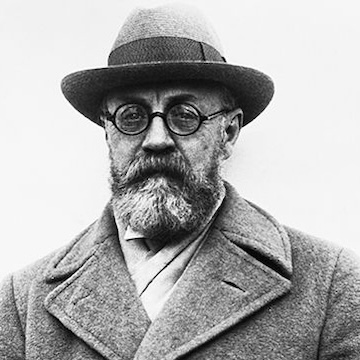
The World of Matisse: 1869–1954 (1969) by longtime New York Times art critic John Russell was one of the final volumes published in the landmark Time-Life World of Art series. Appearing just fifteen years after Matisse’s death, it was written at a time when both the artist’s reputation and his place in the history of modern art were still being actively debated. Russell offers a sympathetic yet balanced portrait of a man who came to painting relatively late in life but ultimately devoted himself to a singular artistic pursuit: the exploration of color and design reduced to their purest and most essential forms.
Henri Matisse was born in a middle class family and showed no signs of promise nor interest in art. He studied law in Paris, at his father’s insistence, and received high marks. He returned home to take an entry level legal jobs and seemingly settled down to the life his father imagined for him.
In 1890 he suffered appendicitis and during his recovery his mother gifted him a painting set. The effect, the author says, was “prodigious.” Later in life, Matisse would recall that he had “been called.” He began taking early morning drawing classes and was quickly hooked. By 1892 he informed his father that he, the formerly “listless and docile” son, had committed himself to the career of painter. Somewhat surprisingly, his father let him try his luck with the support of a modest stipend.
He went to Paris and was eventually admitted to the Ecole des Beaux-Arts, France’s official, government-supported art school. He quickly fell under the spell and tutelage of Gustave Moreau, who fundamentally shaped the future artist. Even at this point, the author says, there was no hint of Matisse’s greatness nor his revolutionary ideas around color. By 1896, Matisse had emerged as Moreau’s prize student. He encouraged his protege to paint large and bold pictures to compete for the prestigious Prux de Rome, which offered the winner to study in Rome for several years at the expense of the French government.
Matisse was then, and to remain, an apolitical artist. He painted, the author says, “pictures of family life, of tables laden with good things to eat and drink, of beautiful women taking their ease in beautiful surroundings.”
It took Matisse years of disciplined effort and self-reflection to develop his distinctive artistic style. Success did not come easily, and on several occasions he came close to abandoning his artistic ambitions altogether. He approached his training with the methodical logic and determination of the lawyer he had once intended to become. Among the many influences that shaped his development, two stood above all others: his teacher, Moreau, and Paul Cézanne (1839–1906). So profound was Cézanne’s mastery of color and form that Matisse famously declared, “Cézanne is the master of us all.”
Matisse’s artistic career began relatively late but initially advanced with remarkable speed. He quickly attracted the support of influential mentors and patrons, including the art professor Gustave Moreau, Salon president Pierre Puvis de Chavannes, and the critic Roger Marx. Yet this promising ascent came to an abrupt halt as he entered his early thirties. The deaths of these key supporters left him without powerful advocates just as his personal responsibilities were rapidly increasing. Around 1898, Matisse married and soon found himself supporting a growing family of three children. At the same time, his father, having lost faith in his son’s prospects as an artist, cut off the modest stipend on which he had relied.
The setbacks continued. Following Moreau’s death, Matisse was effectively pushed out of the École des Beaux-Arts by Fernand Cormon, Moreau’s successor, who saw little promise in him and insisted that the thirty-one-year-old make room for younger, more promising students. The author describes the years 1902–1903 as Matisse’s “time of dread and dudgeon,” a period marked by financial strain, professional uncertainty, and self-doubt.
Yet one of the book’s most striking themes is Matisse’s relentless work ethic and unwavering commitment to forging his own artistic identity. Determined to deepen his understanding of the human form, he turned to sculpture while simultaneously immersing himself in the work of Paul Cézanne. Painting, the author notes, was an intense and often agonizing process for Matisse. “Matisse suffered when he painted,” he writes, observing that the artist was prone to violent outbursts of frustration when his work failed to meet his expectations.
During these difficult years, however, Matisse also formed friendships that would profoundly influence both his style and his career. André Derain and Maurice de Vlaminck, two younger and unconventional artists, encouraged his growing appreciation for the expressive power of color. Meanwhile, the older and financially secure Paul Signac introduced him to the Pointillist techniques of Georges Seurat. Although the author ultimately describes Pointillism as a “false trail” for Matisse, the movement nevertheless played a crucial role in his artistic evolution, helping to place him on the path toward becoming one of the defining figures of modern European painting.
Matisse burst onto the art scene in 1905 at the age of thirty-five. By 1908, he had achieved an international reputation and attracted a devoted circle of followers. The dramatic turning point came after a fateful trip to the French seaside town of Collioure with Derain and Vlaminck. There, under the extraordinary Mediterranean light, Matisse discovered how to feel color rather than merely see it. Color became aggressively irrational, used not to mirror reality, but to convey emotion and meaning. Returning to Paris, Matisse exhibited his portrait of his wife, Woman with a Hat, at the Salon d’Automne, where it helped ignite an artistic revolution that critics mockingly dubbed Fauvism, or “the Wild Beasts.”
The Fauves’ liberation of color from the constraints of natural representation quickly influenced other avant-garde movements across Europe, including the Expressionism of Edvard Munch in Norway, the Die Brücke movement led by Ernst Ludwig Kirchner in Germany, and the emerging abstraction of Wassily Kandinsky in Russia. Although somewhat inadvertently, Matisse became the leading figure of this pivotal moment in modern art, a transformation that unfolded over only a few remarkable years. As the author memorably observes, “Matisse in effect had brought electricity to a civilization based on candles.” His monumental Joy of Life, exhibited at the 1906 Salon des Indépendants, was the supreme expression of his new lyrical use of color and remains one of his most celebrated works. The poet Guillaume Apollinaire was among Matisse’s earliest champions, and his enthusiastic writings did much to elevate the artist’s growing reputation.
Matisse’s career entered a decisive new phase between March 1906 and February 1907, when he produced some of his most celebrated works, including The Joy of Life and Blue Nude, and attracted a small group of influential patrons who would prove essential to his financial security and eventual commercial success.
Foremost among them were the Stein family — Leo, Gertrude, and Michael Stein — but especially Michael’s wife, Sarah Stein, who later helped Matisse establish a short-lived art school in Paris that operated from 1908 to 1911. The Steins purchased many of Matisse’s earliest masterpieces, including Woman with a Hat in 1905 for just $100 (roughly $3,500 in 2026 dollars). It was in the Steins’ famed Paris salon that Matisse first met Pablo Picasso in 1906. Twelve years younger than Matisse, Picasso would become his most significant contemporary. Yet, as the author notes, the two men were neither close friends nor true rivals and were, in many respects, artistic opposites. Gertrude Stein regarded Picasso as the greater genius. If Matisse’s Fauvism represented a revolution of feeling and color, Picasso’s Cubism constituted a more profound revolution in form and construction.
Other important American patrons included the Cone sisters of Baltimore, while the Russian industrialist and collector Sergei “The Mad Russian” Shchukin became one of Matisse’s most important patrons and commissioners. Shchukin assembled a remarkable collection of Matisse’s work, much of which was seized after the Russian Revolution and today resides in the collections of the State Hermitage Museum in Saint Petersburg.
By 1910, Matisse was among the most celebrated artists in the world, though he remained surprisingly underappreciated in his native France. His most important patron was the Russian collector Shchukin, whom the author describes as “the ideal patron for Matisse”: fabulously wealthy, fiercely independent in his tastes, and unencumbered by conventional Western notions of what great art should be.
Shchukin purchased his first Matisse in 1904 and continued acquiring his work for the rest of the artist’s career. Unlike many Western critics, he did not judge Matisse against established European artistic traditions. Instead, he immediately grasped the power of Matisse’s bold color, flattened forms, and two-dimensional compositions, which resonated with both Russian Orthodox iconography and medieval Islamic art.
In many ways, Matisse’s artistic project was to liberate color and free painting from the constraints of traditional perspective. Rather than constructing compositions through illusionistic depth, he often organized his canvases through visual analogies and rhythmic relationships held together by harmonies of pure color.
Shchukin played a pivotal role in Matisse’s career when he commissioned a series of monumental decorative panels for his Moscow mansion based on the themes of dance, music, and repose. The commission, worth roughly $5,000 at the time (about $175,000 today), resulted in some of Matisse’s most ambitious works. Yet the completed panels were so daring in their treatment of the nude that Shchukin initially feared displaying them publicly in his home, worried they would provoke social ostracism.
Matisse spent much of 1911 in Moscow overseeing the installation of the panels in Shchukin’s mansion. It would be his last trip abroad until his journey to Tahiti in the 1930s. As a result of Shchukin’s patronage, Russia became home to one of the largest collections of Matisse’s work in the world, a collection that remained largely hidden from public view after the Bolshevik Revolution and was not widely accessible until the 1950s.
By 1913, Matisse had also gained two important American patrons: John Quinn and Albert C. Barnes. Together, they assembled some of the finest collections of Matisse’s work in the United States and helped cement his reputation on both sides of the Atlantic.
Matisse was forty-five years old when the First World War began. For the first several years of the conflict, his art career effectively went underground as salons closed and exhibitions disappeared. Yet the interruption brought an unexpected benefit. With no critics, dealers, or art-world fashions demanding his attention, Matisse was free to work largely in isolation. He devoted himself to a series of ambitious, experimental canvases, including The Piano Lesson and The Music Lesson, pushing his art in increasingly austere and intellectual directions.
In 1917, Matisse made the fateful decision to spend the winter in Nice. What began as a temporary escape from wartime Paris ultimately transformed the course of his career. From that point onward, he spent increasing amounts of time on the French Riviera, settling there permanently in the early 1920s and remaining closely associated with the city until his death in 1954. Many of the works that define his mature style, including his celebrated odalisques and luminous interior scenes – emerged from this period.
The paintings of Nice marked a striking departure from the more abstract and experimental works that had established Matisse’s reputation as a revolutionary. Earlier, he had sought to remake the language of painting itself; in Nice, he seemed content to paint for the sheer pleasure of seeing. The French public responded enthusiastically. Within a decade, works from his early Nice period were selling for the equivalent of roughly $150,000 in today’s dollars.
The author argues that this new artistic direction helped express Europe’s collective convalescence after the horrors and exhaustion of four years of total war. The pursuit of pleasure, beauty, and sensuality was reborn, and Matisse captured it perfectly. His paintings celebrated the richness of ordinary life: decorative patterns, sunlit rooms, flowers, fabrics, everyday objects, and the graceful sensuality of the female form. In an age desperate for relief, Matisse offered not escape from reality but a renewed appreciation for its simple pleasures.
Matisse was captivated by the scale and color of New York City when he visited in 1930. By contrast, his long-awaited trip to Tahiti left him largely disappointed. Yet the author argues that the influence of Tahiti on Matisse’s final great creative phase is unmistakable. The lush colors, organic forms, and sense of visual freedom he encountered there would reemerge powerfully in the cut-outs of the 1940s and 1950s.
In 1933, Matisse undertook three monumental murals for Albert Barnes, his most important American patron. The commission was among the first major mural projects awarded by an American collector to a living European artist. The preparatory studies reveal an artist increasingly committed to simplification. The muscular, straining dancers of earlier versions gradually gave way to flatter, more elemental forms rendered in sweeping contours and pure outlines. The completed murals satisfied both Matisse’s artistic ideal and Barnes’s desire for a work of monumental decorative power.
It was also during this period that the political climate in Europe darkened. The Nazis began removing Matisse’s works from German museums, while Matisse himself sold his prized Cézanne, Three Bathers. The author sees this sale as symbolically significant. By 1936, Matisse had moved beyond his long homage to the great master of the previous generation. He no longer needed Cézanne’s example to teach him solidity of form; he had fully absorbed the lesson and made it his own.
By the late 1930s, Matisse was also moving in a new artistic direction. What had begun as an experimental technique – using cut paper shapes to aid the composition of paintings – was gradually evolving into an art form in its own right. The cut-out was no longer merely a preparatory tool; it was becoming the finished work itself.
Matisse remained in France during the Second World War and largely steered clear of politics, even as several figures from his past were swept up in the conflict. His former companions André Derain and Maurice de Vlaminck were later ostracized for their perceived collaboration with the German occupation, while Matisse’s ex-wife and daughter were arrested and tortured for their support of the French Resistance.
During these years, Matisse undertook what was perhaps the most unexpected commission of his career: the design and decoration of the Dominican Chapel of the Rosary (Chapelle du Rosaire) in Vence, near Nice. Conceived largely as an expression of gratitude to the Dominican nuns who had helped nurse him back to health, the chapel became a masterpiece of simplicity. Matisse sought to create a work of art stripped to its essentials while preserving its function as a living place of worship. He later regarded the chapel as one of his greatest achievements.
His final major contribution to art was the development of his celebrated cut-outs. Confined by illness and diminishing mobility, Matisse began cutting brightly colored sheets of paper into organic forms and arranging them into vibrant compositions. What began as a practical adaptation evolved into a radically new artistic language.
As Matisse entered the final years of his life in the early 1950s, there were concerns among some critics that his reputation might fade. He risked being remembered as the Fragonard or Boucher of his age, a painter of pleasure and elegance whose languorous Nice-period works seemed detached from the great political and social upheavals of the twentieth century. Yet, as the author argues, history reached a very different verdict. Matisse emerged not as an apologist for a fading elite but as the timeless master of color, form, and simplicity. His influence has extended far beyond painting, inspiring generations of artists and designers, from Keith Haring to Banksy, and securing his place among the most important artists of the modern era.
In 1941, Matisse suffered a serious intestinal illness that left him largely bedridden and physically frail for the remaining thirteen years of his life. During his convalescence, he discovered the artistic possibilities of colored paper cutouts, a medium born of necessity when he could no longer stand comfortably at an easel. Characteristically, Matisse transformed this limitation into an opportunity, embracing cutouts as a new means of expressing his lifelong pursuit of pure color, clarity, and design. The innovation was recognized almost immediately; by 1949, the Paris Museum of Modern Art devoted an entire exhibition to his cutout works. The medium enabled Matisse to remain creatively productive from his bed and wheelchair, allowing him to create art virtually until the day he died.
What emerges from Spurling’s biography is not simply the story of a great painter, but of a man who spent more than six decades relentlessly pursuing a single artistic question: how to express the greatest possible emotion with the greatest possible simplicity. Matisse’s achievement was not the product of sudden inspiration or effortless genius. It was built through years of struggle, self-doubt, experimentation, and disciplined work. Time and again, he reinvented himself without abandoning the fundamental principles that guided his art. By the end of his life, he had transformed color, liberated form, and expanded the possibilities of modern painting. More than seventy years after his death, Matisse remains what he always aspired to be: an artist whose work brings order, clarity, and joy to the world.
 What's Tim Reading Now?
Leave a comment