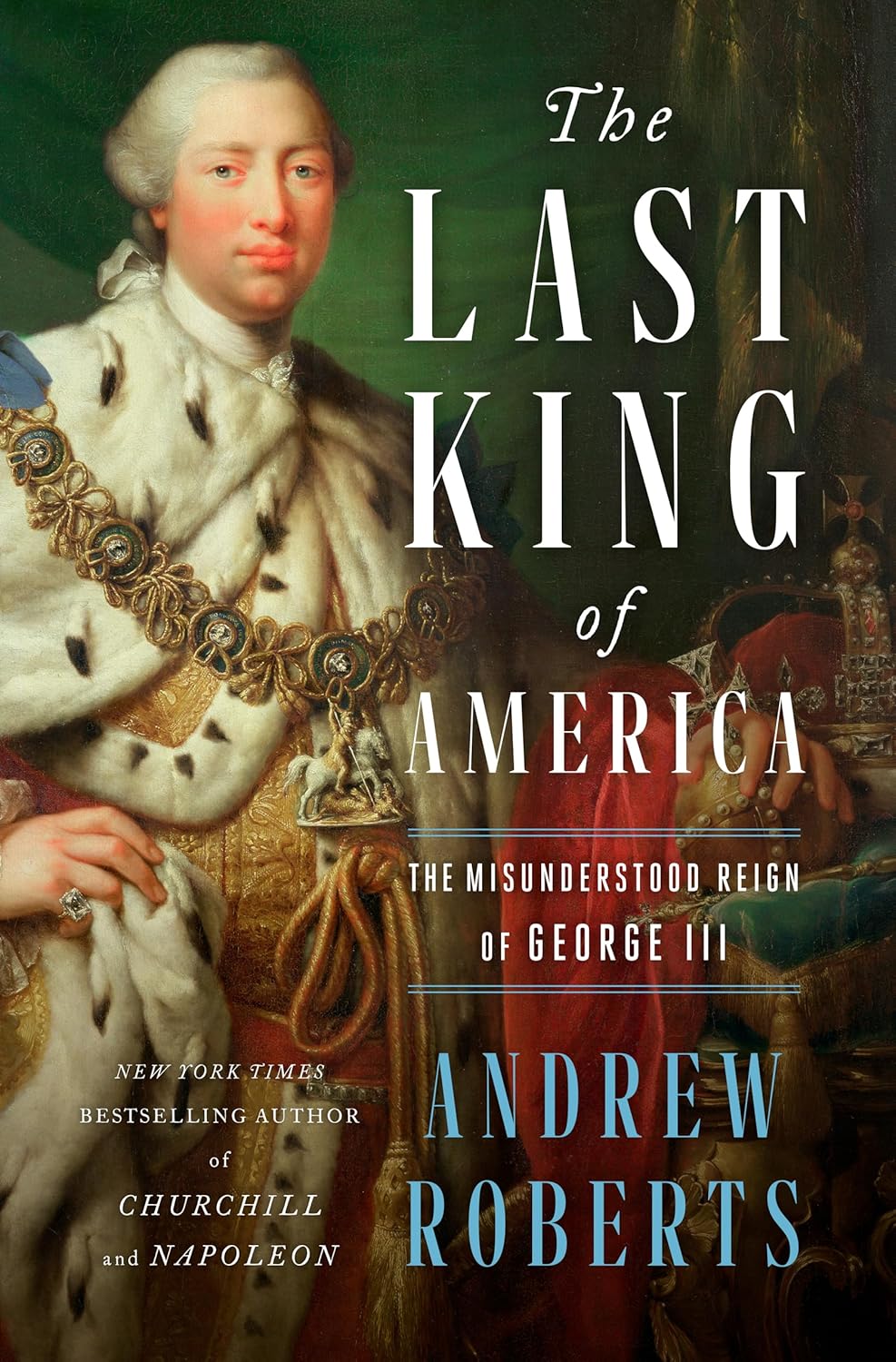
“George III is one of the most tragic monarchs in British history, as well as one of the most underestimated and misunderstood.” So concludes Andrew Roberts in his sweeping, revisionist biography of the Hanoverian king who reigned for nearly sixty years, guiding Britain through the American Revolution, the French Revolution, and the Napoleonic Wars while helping to lay the foundations of the nineteenth-century British Empire. In The Last King of America: The Misunderstood Reign of George III (2021), Roberts offers a deeply researched and highly sympathetic portrait of a monarch whose reputation has long been overshadowed by the loss of the American colonies and by his struggles with mental illness.
Roberts seeks to set the record straight on a wide range of issues, from the personal and mundane to the grandly historical. In nearly every case, George III (1738-1820) emerges in a far more favorable light than traditional accounts have allowed. At the most fundamental level, Roberts argues that George was, quite simply, a decent man. “The people who knew George III best loved him the most,” the author observes, “which is not always the way with public figures.” Roberts portrays the king as a devoted husband and father, a loyal friend, a man of personal integrity, fiscal prudence, and intellectual curiosity, as well as a conscientious defender of his people, his nation, and the British constitution. Indeed, the only significant flaw Roberts identifies is the king’s lifelong – and somewhat puzzling – aversion to travel.
Another popular misconception about George III concerns his supposed lack of intelligence. Roberts argues that nothing could be further from the truth. Far from being dim-witted or intellectually incurious, the king actively sought out the company of many of the most brilliant minds of his age, including the celebrated writer Samuel Johnson. He was also a passionate patron of the arts, founding the Royal Academy in 1768 and enthusiastically promoting classical music, helping to attract and support composers such as Handel, Haydn, and Mozart in Britain. An avid reader, George amassed a library of more than 65,000 volumes and devoted much of his leisure time to study. Taken together, Roberts argues, these pursuits reveal a monarch of considerable intellect, curiosity, and cultural sophistication.
That said, Roberts acknowledges that, despite his wide-ranging intellectual interests, George III was not a typical product of the Enlightenment. He was profoundly religious, deeply traditional in both his personal morality and social outlook, and unwaveringly committed to preserving his own honor as well as that of his nation and people. Roberts portrays him as instinctively skeptical of innovation and unconvinced by the Enlightenment’s faith in inevitable human progress. In George’s view, reform often created greater problems than those it sought to solve. He was also personally courageous, facing multiple assassination attempts with remarkable composure and preternatural aplomb. In many respects, Roberts suggests, the Hanoverian king embodied the idealized Englishman of his age, the sturdy, brave, patriotic, common-sense figure known as John Bull.
Above all, George III valued stability. Roberts argues that this preference can be traced to the turbulence of his youth and his early years as heir to the throne. The future king was a shy, modest boy who lost his father at the age of twelve, leaving a void that was largely filled by his tutor and mentor, Lord Bute. His adolescence was further marked by persistent anxieties that his ambitious uncle, the Duke of Cumberland, might attempt to displace him from the line of succession. These experiences instilled in George a deep appreciation for order, continuity, and constitutional government. Yet when he ascended the throne in 1760 at the age of twenty-two, Roberts contends that he quickly rose to the demands of kingship, ruling “conscientiously and well” for more than half a century.
Roberts’s central argument is that the most damaging, enduring, and fundamentally untrue charge leveled against George III was that he harbored tyrannical ambitions. From Thomas Jefferson and Edmund Burke to Winston Churchill and Lin-Manuel Miranda, critics across the centuries have portrayed the king as a would-be despot. As a representative example, Roberts cites the now-famous line from the Broadway phenomenon Hamilton, in which George III warns the American colonists: “When push comes to shove, I will send a fully armed battalion to remind you of my love.” The recurring theme in such portrayals is that George sought to “restore royal power” and roll back the constitutional settlement that emerged from the Glorious Revolution.
“One of the aims of this book,” Roberts writes, “has been to show how false such accusations are.” Far from attempting to expand the powers of the Crown, Roberts argues, George III sought primarily to preserve the constitutional order he had inherited from his grandfather, George II, and pass it intact to his successor. In this interpretation, the king was not a reactionary absolutist but rather a cautious guardian of the status quo. Roberts ultimately characterizes George III’s political outlook as “archetypally conservative” – committed above all to continuity, stability, and the preservation of established institutions.
Perhaps the only reform that George III consistently supported was an effort to make government more “broad-bottomed” and less dependent on the great Whig aristocratic families that had dominated British politics since their support helped place William and Mary on the throne in 1688. George sought to draw from a wider pool of talent when forming his ministries, rather than relying on a relatively small circle of powerful political dynasties. In the process, Roberts argues, he helped restore the respectability of the Tory Party for the first time since its association with the Jacobite Rebellion of 1715.
In an age marked by intense factionalism and personal rivalries, George III aspired to build governments that transcended party labels, drawing ministers from a broad range of backgrounds, interests, and political perspectives. Unsurprisingly, Roberts notes, these efforts provoked fierce resistance from Whig grandees who stood to lose influence under such an arrangement. Critics such as Horace Walpole portrayed the king’s actions as an assault on constitutional government, helping to create the enduring image of George III as a monarch bent on expanding royal power. Roberts contends, however, that the king’s objective was not to undermine the constitution but to broaden participation within it.
Perhaps most important of all, Roberts argues that George III saw himself as standing above party politics and serving as the ultimate custodian of the national interest. He fully understood that the British constitution vested significant discretionary powers in the Crown, but he also recognized that those powers had limits—and he was scrupulous in respecting them. Although the monarch retained the constitutional right to veto legislation passed by Parliament, George III never exercised that power during his more than fifty years on the throne, despite disagreeing with numerous measures over the course of his reign. Roberts observes that such restraint is difficult to reconcile with the image of a monarch harboring dictatorial ambitions.
To be sure, George fiercely defended the prerogatives of the Crown against what he viewed as encroachments by the Whig oligarchy. Yet, Roberts emphasizes, he never sought to expand those powers or add new ones to the royal arsenal. His objective was preservation, not aggrandizement. Once again, Roberts portrays George III as a thoroughgoing conservative, committed above all to maintaining the constitutional settlement he had inherited and passing it intact to future generations.
Roberts further strengthens his case by comparing George III’s reign with the genuine European despotisms of the late eighteenth century. In 1768, the Spanish Crown suppressed an uprising in Louisiana through mass executions. In 1772, the liberties of Poland were extinguished when Austria, Prussia, and Russia partitioned and dismembered the Polish-Lithuanian Commonwealth. Even the relatively enlightened Empress Catherine the Great responded to the Pugachev Rebellion of 1773–1774 with brutal reprisals, including public executions, beheadings, and dismemberments.
Against this backdrop, Roberts argues, George III appears far removed from the stereotype of a tyrant. Whatever his faults, the king consistently sought a negotiated and peaceful resolution to the crisis with the American colonies; perhaps, the author suggests, to an excessive degree. Rather than exhibiting the instincts of an autocrat, George’s actions reflected a monarch operating within constitutional constraints and displaying a level of restraint that compared favorably with many of his contemporaries on the European continent.
When political unrest erupted in the American colonies following the Stamp Act of 1765, Roberts contends that George III’s position was both reasonable and defensible. Britain had expended enormous sums and accumulated staggering debts in defending its North American colonies during the Seven Years’ War. It therefore seemed only fair to most Britons that the colonists, who had benefited from that protection, should bear a portion of the financial burden by helping to pay down the debt and contribute to their own defense going forward.
According to Roberts, this view was not confined to the king or his ministers but was shared across virtually every segment of British society. Indeed, he argues that public support for the policy was reflected in the general elections of 1774 and 1780, both of which endorsed governments committed to maintaining parliamentary authority in the colonies. From this perspective, George III was not imposing a personal agenda but rather supporting a policy advanced by his ministers and broadly backed by the British public. Roberts suggests that had the king attempted to override that consensus and substitute his own judgment for that of Parliament and the electorate, it would have provided far stronger evidence of authoritarian tendencies than anything he actually did during the imperial crisis.
If George III and his ministers can be faulted for anything, Roberts argues, it was their failure to grasp the true nature of the American Revolution and the depth of popular support for the colonial cause. The debate over taxation and representation, he contends, was ultimately a pretext that led inexorably to the more important and larger question of political independence. To many British observers in 1775 – including the king himself – the unrest in America appeared to be the work of a small faction of troublemakers with little genuine support among the broader population. It was widely assumed that this ungrateful and misguided resistance would collapse at the first serious display of British resolve and firepower.
“Not until the policy of appeasement in the 1930s,” Roberts writes, “did virtually the entire British establishment get something so important so completely wrong.” Yet, he argues, it is unfair to place the primary blame for this misjudgment on George III alone. The king’s views reflected a broad consensus shared by much of Britain’s political, military, and intellectual elite.
Moreover, British policymakers viewed the conflict through a strategic lens that bears comparison to later Cold War thinking. Much as American foreign policy elites would embrace the domino theory in the twentieth century, many eighteenth-century British statesmen feared that conceding independence to the American colonies would trigger a cascading unraveling of the empire itself. If one group of colonies could successfully break away, they reasoned, it might only be a matter of time before the rest of Britain’s far-flung possessions followed suit. From this perspective, the struggle in America was not merely a dispute over taxes or representation but a test of whether a global empire could remain politically coherent and territorially intact.
In Roberts’s view, the genius of the American Founding Fathers lay in their ability to persuade their countrymen to abandon one legitimate source of authority – the sovereignty of Crown and Parliament – in favor of another. As he writes, they succeeded in “excit[ing] their countrymen to replace a perfectly valid political legitimacy deriving from the sovereignty of the Crown and Parliament with their own form of legitimacy, which was equally valid but incompatible with the first.” To accomplish this, Roberts argues, the revolutionary leadership had to construct a compelling (even if phony) narrative that justified a complete break with Britain.
The author contends that the twenty-eight grievances leveled against the Crown in the Declaration of Independence were, in many cases, exaggerated and designed more for political effect than as a balanced accounting of British rule. In the struggle for independence, the revolutionaries needed both a unifying cause and a villain against whom to rally public opinion. Portraying George III as a tyrant served that purpose, regardless of how poorly the accusation aligned with the king’s actual conduct and philosophy of government. Roberts suggests that the image of George as a despotic monarch was less a reflection of reality than a political necessity. Much as Voltaire famously remarked in 1768 that “if God did not exist, it would be necessary to invent Him,” Roberts argues that Jefferson and his fellow revolutionaries effectively “invented” George III the tyrant in order to provide the Revolution with a powerful and emotionally resonant antagonist. “The American Revolution is a testament not to George III’s tyranny, which was fictitious,” Roberts writes, “but to Americans’ yearning for autonomy.”
In the end, George III found himself blamed by the American colonists for waging the war and by many of his British subjects for losing it. Roberts argues that once France and Spain entered the conflict in 1778, the strategic situation changed dramatically, transforming what had been a colonial rebellion into a global war. Under those circumstances, he contends, the only strategy that offered Britain a realistic chance of victory would have required complete national mobilization, sharply increased taxation, and the ruthless prosecution of total war in the colonies. Such a strategy might have included scorched-earth tactics against patriot strongholds, the large-scale arming of southern slaves and Indian allies, and even the destruction of major American cities – measures not unlike the burning of Washington DC during the War of 1812.
Roberts argues that George III behaved with particular constitutional restraint during the American crisis, loyally supporting his ministers while refraining from directing policy in a manner that would have exceeded the proper role of the Crown. Yet this very deference also exposed one of the king’s weaknesses: a tendency to remain loyal to key ministers long after it had become apparent that they were unequal to the task before them.
By the time he appointed Lord North as prime minister in 1770, George had already worked with five different prime ministers in just over nine years. Against that backdrop, Roberts finds the king’s decision to retain North for twelve years – including five years after the catastrophe at Saratoga – somewhat puzzling. North himself readily acknowledged his lack of military expertise and repeatedly sought permission to resign, only to be persuaded to remain. Roberts suggests that George’s loyalty stemmed from a combination of North’s personal affability, his effectiveness in managing Parliament, and his broad acceptability to the political establishment. Yet, in retrospect, he argues, the king needed a statesman of far greater vision and energy. The later success of William Pitt the Younger during the second great crisis of George’s reign – the struggle against Revolutionary and Napoleonic France – demonstrated the transformative impact that exceptional political leadership could have on Britain’s fortunes.
Roberts is similarly critical of George III’s decision to back the scandal-plagued Lord George Germain and to retain him as Secretary of State for the American Department from 1775 to 1782, even after the collapse in 1777 of the strategy that bears his name, a plan designed to isolate New England by linking British forces advancing south from Canada with those moving north from New York. Although Germain’s plan ultimately collapsed, Roberts notes that it represented the only comprehensive British strategy of the war and perhaps the best opportunity Britain ever had to achieve victory. Even so, he argues that the ultimate failure of the British war effort owed less to decisions made in London than to a series of disastrous judgments by commanders in the field. General Burgoyne’s decision to press forward toward Saratoga despite mounting difficulties, General Howe’s failure to destroy Washington’s army around New York and his subsequent decision to capture Philadelphia rather than link up with Burgoyne, and Lord Cornwallis’s fateful decision to establish his army at Yorktown all proved decisive. These were operational and strategic errors that lay largely beyond the king’s ability to direct or control. In Roberts’s assessment, while George III may be faulted for some of his ministerial appointments, the military failures that ultimately cost Britain the war were principally the result of decisions made by his generals rather than by the king himself.
Roberts points to George III’s unwillingness to embrace such extreme measures and tactics as further evidence that he was nothing like the tyrant portrayed in Revolutionary propaganda. Despite the enormous stakes involved, the king never seriously contemplated the kind of uncompromising campaign that might have maximized Britain’s chances of retaining the colonies. This restraint is all the more striking given the magnitude of what was ultimately lost. Roberts describes American independence as “the greatest geostrategic catastrophe to befall Britain between the loss of the Angevin lands in France in the fifteenth century and the fall of France in 1940.” Even so, George remained unwilling to sacrifice his principles – or the constitutional character of his monarchy – in a desperate attempt to preserve the empire at any cost.
In the final analysis, Roberts contends that George III’s greatest failure was his inability to recognize and accept the inevitability of American independence sooner. Yet it was a misjudgment shared by the overwhelming majority of informed British opinion at the time. Indeed, Roberts argues that the colonies were growing so rapidly in population, wealth, and self-confidence that some form of independence was probably only a matter of time. Had it not occurred in 1783, he suggests, it might well have happened by the end of the Napoleonic Wars a generation later. From that perspective, the immense suffering and loss of life endured by both sides during the American Revolution appear not only tragic but, in hindsight, largely unnecessary.
Roberts further argues that the framers of the United States Constitution paid an “unintended homage” to the political system they claimed to reject. Thomas Paine’s Common Sense promised that the American Revolution would provide “the power to begin the world over again,” yet the Constitution’s architects ultimately created a chief executive who possessed many of the same powers and prerogatives as the British monarch. One of history’s great ironies, Roberts observes, is that while the powers of the British Crown were steadily curtailed over the next two centuries, those of the American presidency expanded dramatically. In this sense, the American Revolution may have replaced one source of executive authority with another, far more powerful version, rather than eliminating it altogether.
Lastly, Roberts seeks to set the record straight regarding the nature and impact of George III’s mental illness. Since the 1960s, many historians have believed that the “King’s Malady” was caused by porphyria, a rare inherited disorder that impairs the body’s ability to produce heme, a vital component of hemoglobin. More recent scholarship, however, has advanced a different diagnosis – one that Roberts fully endorses – that George III suffered from bipolar disorder marked by recurrent manic episodes.
Over the course of his reign, the king experienced five major bouts of mania, ranging in duration from several weeks to nearly a decade in the final years of his life. The first occurred in 1765 during the Stamp Act crisis, followed by a more serious episode in 1788–89 on the eve of the French Revolution. Additional relapses followed in 1801 and 1804 amid the turmoil of the Napoleonic Wars. His final breakdown began in 1810 and lasted until his death in 1820. During this period he lost both his eyesight and much of his hearing, and at times reportedly spoke almost continuously for more than twenty-four hours. In 1811, Parliament effectively removed him from active rule by passing the Regency Act and appointing his eldest son – the profligate rake who would become George IV – as Prince Regent. The king remained sovereign in name, but never again exercised meaningful political authority.
Whether readers ultimately accept Roberts’s rehabilitation of George III or not, The Last King of America succeeds admirably in its primary objective: forcing a reconsideration of one of history’s most familiar villains. Roberts does not claim that George III was a flawless monarch. He acknowledges the king’s misjudgments during the American crisis, his occasional stubbornness, and his inability to recognize the inevitability of colonial independence. Yet he convincingly demonstrates that the traditional image of George as a tyrant, simpleton, and would-be despot bears little resemblance to the historical figure who emerges from the documentary record. The result is not merely a biography of a king but a broader meditation on how historical reputations are formed, distorted, and perpetuated. Deeply researched, elegantly written, and consistently thought-provoking, The Last King of America stands as both a compelling portrait of George III and a powerful reminder that history’s losers are often remembered less for who they were than for the myths their victors found useful to create.
 What's Tim Reading Now?
Leave a comment