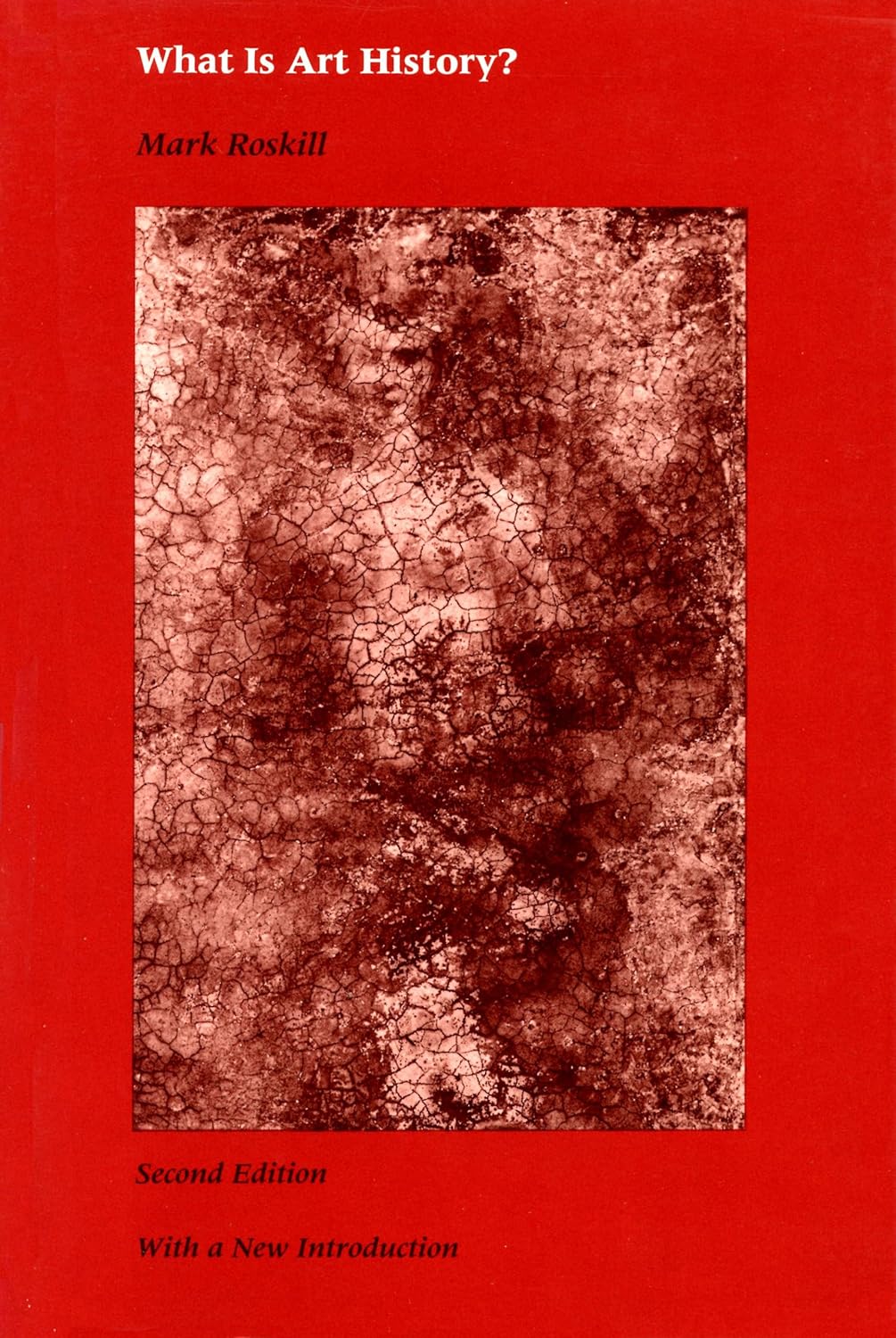
The title of this book says it all. Originally published in 1975, What Is Art History? by art historian Mark Roskill provides a lively and engaging introduction to the discipline. Organized into a series of short, richly illustrated chapters, the book explores the central questions, methods, and responsibilities that define the work of the art historian. Accessible without being simplistic, it serves as both an informative primer for newcomers and a thoughtful reflection on the practice of art history itself.
Roskill begins by arguing that art history is, in many respects, a science, complete with its own methods, principles, and techniques of inquiry. A central theme of What Is Art History? is his contention that works of art are inseparable from the societies and cultures that produced them. In this sense, art history overlaps with disciplines such as anthropology, archaeology, and sociology, all of which seek to understand human beings through the artifacts and institutions they create. Factors such as intellectual and social context, religious beliefs, systems of patronage, subject matter, and composition all shape our interpretation of a work and are essential to the art historian’s task. Throughout the book, Roskill emphasizes that art history is fundamentally comparative in nature: nearly every aspect of an art historian’s work involves examining, grouping, and contrasting large numbers of works in order to identify patterns, influences, and relationships.
In Chapter One, Roskill examines one of the art historian’s most important responsibilities: establishing the attribution of significant works of art. He notes that it was during the Renaissance that art first came to be viewed as an expression of individual personality and creativity. As a result, distinctions between masters began to attract greater attention, and scholars increasingly sought ways to identify the hands behind particular works. Although some artists had signed their works earlier, the widespread practice of signing paintings did not become common until the seventeenth century.
The effort to develop a more scientific approach to attribution emerged much later, in the late nineteenth century, through the work of the former physician Giovanni Morelli. Morelli’s methods were subsequently refined by the influential art historian Bernard Berenson, whom Roskill describes as “the greatest connoisseur of Italian painting of our time.” Among Berenson’s most enduring contributions was The Drawings of the Florentine Painters (1903). Berenson classified artworks according to regional schools and traditions – such as the Umbrian, Venetian, and Tuscan – arguing that each possessed distinctive characteristics shaped by geography, culture, and historical circumstance. As Roskill observes, “no artist can break away completely in every respect from the artistic conventions of his day,” making attribution as much a matter of understanding artistic context as identifying individual genius.
Chapter Two explores a topic closely related to attribution: identifying collaboration between artists. Roskill illustrates this challenge through the example of Masaccio (“Loutish Tom”) and Masolino (“Little Tom”), two Florentine painters of the same generation who worked closely together during the 1420s, most notably on the frescoes of the Brancacci Chapel. Although the two artists shared certain stylistic similarities, Roskill demonstrates that their approaches to depicting the human face and figure were markedly different. Using Madonna and Child with St. Anne as an example, he shows how even two seemingly similar angelic figures can reveal the distinct hands of their creators.
According to Roskill, Masolino remained rooted in the so-called International Style of the late Middle Ages, characterized by graceful poses, softer faces, and a decorative elegance. Masaccio, by contrast, embodied the dramatic realism and emotional intensity of the early Renaissance. Nowhere are these differences more apparent than in their depictions of Adam and Eve and the life of St. Peter in the Brancacci Chapel. Masolino’s figures tend to be stylized and restrained, while Masaccio’s are strikingly naturalistic and capable of conveying profound human emotion.
The two artists also differed in their compositional methods. Masolino frequently employed the technique of “continuous narration,” depicting multiple episodes involving the same characters within a single fresco. Masaccio, on the other hand, favored more unified and centralized compositions in which separate scenes functioned as complementary parts of a coherent whole. Roskill concludes that Masolino was significantly influenced by Masaccio’s presence and artistic innovations during their collaboration in the Brancacci Chapel, making their partnership an illuminating case study in how art historians distinguish individual contributions within a shared work.
Chapter Three takes the question of attribution a step further by examining which portions of major works by celebrated artists were actually executed by assistants rather than by the master himself. Roskill uses the term “school” broadly to encompass the assistants, pupils, and followers who worked under and were influenced by a recognized master. He argues that an artist’s style is much like handwriting: no matter how closely another person imitates it, certain distinctive qualities of the original artist remain discernible to the trained eye.
To illustrate this challenge, Roskill turns to Piero della Francesca (c. 1412–1492), one of the great painters of the early Renaissance, whose workshop produced a number of collaborative works. He contrasts Piero with artists associated with his broader artistic tradition, such as Perugino (c. 1446–1523), whose style reflected both personal innovation and the influence of earlier masters. Roskill notes that some works attributed to Piero contain striking variations in quality and execution. In a polyptych from around 1445, for example, the gestures and facial expressions of the figures differ noticeably between the principal panels and the predella. During the fifteenth century, predellas often served as spaces where artists and workshop assistants could experiment with composition, technique, and narrative. Such variations raise a fundamental question for the art historian: do all parts of a work truly belong together, or do they reveal the hands of multiple artists working within the same workshop?
Chapter Four explores the art historian’s role in separating fact from fiction and legend from reality in the lives of artists about whom little reliable information survives. Roskill illustrates this challenge through the example of the great but short-lived Venetian Renaissance painter Giorgione (c. 1478–1510). He examines how modern scholars have sought to unravel the “mystery of Giorgione,” including the question of which paintings can be confidently attributed to him and what characteristics define his distinctive style.
Because Giorgione died suddenly of the plague while still a young man, stories and legends about his life quickly emerged, many of them of dubious authenticity. These accounts were further popularized by Giorgio Vasari in Lives of the Artists, first published in 1550. Vasari portrayed Giorgione as largely self-taught, though he also noted his association with the workshop of the Bellini family, the leading painters of Venice at the time. The scarcity of reliable documentation and the mythology that accumulated around his life have made attribution especially difficult, a problem that continues to occupy art historians today.
Roskill argues that identifying Giorgione’s work requires careful attention to several recurring features, including his distinctive use of landscape and his treatment of “costume”: the historically, socially, and culturally appropriate appearance of figures within a work of art. Art historians also examine elements such as composition, the handling of light, the organization of space, and the posture and interaction of figures. In Giorgione’s case, Roskill notes a pronounced interest in geometry and formal structure, qualities that gave his work a remarkably modern character by the standards of the early sixteenth century. His innovative style would profoundly influence the next great master of the Venetian Renaissance, Titian (c. 1490–1576), whose career carried many of Giorgione’s artistic innovations to new heights.
One of the few paintings that can be definitively attributed to Giorgione is The Tempest, which Roskill describes as “the most poetic of Giorgione’s creations.” The painting would go on to influence an entire generation of Venetian pastoral art. Giorgione’s brief career overlapped with that of Raphael, and although the two artists worked hundreds of miles apart, Roskill argues that their styles share important similarities, particularly in the harmonious relationship they establish between figures and space and in their treatment of the human form. At the same time, he suggests that Giorgione moved beyond the High Classical ideals of the period, creating figures that are more imposing, enigmatic, and psychologically charged.
More broadly, the chapter explores the themes of artistic influence and historical continuity. Giorgione’s significance lies not only in the paintings he produced but also in the profound impact he had on subsequent artists, most notably Titian. Roskill demonstrates that understanding an artist requires looking beyond individual masterpieces to examine the wider network of influences, relationships, and artistic developments that connect one generation to the next.
Chapter Five turns to a more specialized aspect of the art historian’s craft: understanding not only the stories that works of art were intended to tell, but also how those works originally appeared and the broader context in which they were experienced. Roskill illustrates this challenge through Raphael’s tapestries for the Sistine Chapel, the last major artistic project that Raphael personally oversaw and one that exerted a profound influence on European art throughout the sixteenth century.
Roskill recounts how two relatively young art historians in the 1950s sought to reconstruct the original arrangement and meaning of the tapestry cycle. Within the larger decorative program of the Sistine Chapel, Michelangelo’s ceiling depicted humanity’s fall from grace, while the wall frescoes narrated the stories of Moses and Christ. Raphael’s tapestries complemented these themes by portraying how Saints Peter and Paul received their divine commissions from Christ and subsequently carried Christianity to Jews and Gentiles, respectively.
Following the Sack of Rome in 1527, the tapestry cycle was broken up and dispersed. Although all ten tapestries were eventually returned to the Vatican in 1557, their original sequence and placement remained uncertain. To reconstruct the cycle, the two art historians examined a wide range of evidence, including the theological narrative of the series, the lighting conditions within the chapel, the visual and thematic relationships between individual tapestries, and the compositional structure of each design. Their work demonstrated that art historians must often think beyond individual objects and consider how a group of works functioned together to create a unified visual and intellectual experience.
Roskill’s larger point is that great works of art are rarely isolated creations. The Sistine tapestries were designed to operate as part of a coherent narrative and decorative program, one that had to harmonize with Michelangelo’s ceiling, the chapel frescoes, and the architectural setting itself. Understanding such works therefore requires reconstructing not only the objects themselves but also the environment, sequence, and meaning that originally connected them.
Chapter Six pursues a theme similar to that of Chapter Four, though in some ways an even more challenging one: reconstructing the life and career of an artist who was largely unrecognized during his lifetime and then forgotten for centuries afterward. To explore this problem, Roskill turns to the rural French painter Georges de La Tour (1593–1652), whom he describes as “one of the truly outstanding artists of the seventeenth century.” According to Roskill, de La Tour was long overlooked for two reasons. First, he was provincial, working primarily in Lorraine and lacking the connections enjoyed by artists in Paris. Second, his work was unfashionable. Its stark simplicity and strong Dutch influences stood in sharp contrast to the more elegant and decorative styles favored by many of his contemporaries.
It was not until the early twentieth century that art historians began to recognize the significance of de La Tour and the broader Caravaggist tradition to which his work belonged and shaped by the Utrecht School. Remarkably, the first major exhibition devoted exclusively to de La Tour was not held in Paris until 1972. His paintings are characterized by their austere compositions, spiritual intensity, and dramatic contrasts of light and shadow, qualities inspired by Caravaggio yet transformed into something uniquely contemplative and mystical.
The rediscovery of de La Tour’s oeuvre brought art historians back to many of the same challenges discussed earlier in the book. As in Chapter One, questions of attribution were paramount. Over time, scholars identified between twenty-five and fifty paintings that could plausibly be assigned to de La Tour. As in Chapter Four, historians also faced the task of reconstructing the artist’s life, influences, and development from fragmentary evidence. Unlike Giorgione, however, de La Tour enjoyed a career that spanned roughly three decades, allowing scholars to trace the evolution of his style over time.
To do so, art historians first grouped his paintings into broad categories, such as genre scenes and religious subjects, and then attempted to determine whether certain themes or stylistic characteristics predominated during particular periods of his career. They also sought to identify the artists and traditions that may have influenced him. From this work emerged a three-part chronology. The first phase, from roughly 1620 to 1630, was dominated by genre painting. The second, from 1630 to 1640, saw a turn toward more solemn and overtly religious subjects. Finally, in the last phase of his career, from 1640 until his death in 1652, his paintings became increasingly simplified, geometric, and contemplative, combining formal rigor with a heightened sense of naturalism.
Roskill concludes by noting that de La Tour’s movement toward greater solemnity and simplicity closely parallels the artistic development of the French painter Nicolas Poussin (1594–1665), despite the fact that the two men almost certainly never met. This observation leads him to a broader discussion of the concept of Zeitgeist, or the “spirit of the age,” an idea associated with the German art historian Heinrich Wölfflin and the Viennese scholar Max Dvořák. According to this view, artists working within the same civilization often move in similar directions over time, even when they are not in direct contact with one another.
Roskill is careful, however, to note the dangers of this approach. The theory can easily become circular: scholars identify a period style from the work of individual artists and then use that same style to explain the artists themselves. Nevertheless, he concludes that the recurring parallels between artists of the same era suggest that something more than mere coincidence is at work. The challenge for the art historian is to recognize these broader cultural currents without losing sight of the individuality of the artists who helped create them.
Chapter Seven is perhaps the most entertaining chapter in the book, as it explores the hidden meanings and symbolic language embedded in works of art – messages that modern art historians must painstakingly decipher and recover. Roskill notes that many paintings, particularly still lifes, contain symbolic or allegorical content that would have been readily understood by contemporary viewers. Fresh-cut roses and peonies, for example, often symbolize the fleeting nature of youth and beauty, while a fly may represent sin and cherries may allude to the heavenly fruit of salvation.
To examine this topic, Roskill turns to the work of Johannes Vermeer (1632–1675) and Diego Velázquez (1599–1660). He argues that Vermeer, in particular, was influenced by Cesare Ripa’s Iconologia, a highly influential late sixteenth-century handbook that provided artists with detailed instructions for representing abstract ideas through symbolic imagery. Ripa, for example, recommended depicting Faith as a seated woman holding a chalice in one hand and resting the other upon a book, with a globe beneath her feet. Roskill points out that this description closely parallels the composition of Vermeer’s Allegory of the Catholic Faith, suggesting that the artist consciously drew upon an established visual vocabulary understood by educated viewers of his day.
The chapter demonstrates how a failure to recognize the symbolic conventions of a particular period can lead modern observers to misunderstand the subject of a work entirely. Roskill cites Velázquez’s The Tapestry Weavers (Las Hilanderas) as a striking example. Long regarded as a simple genre scene depicting women at work, the painting is now understood to represent Ovid’s myth of Arachne, transformed into a sophisticated meditation on art, competition, and creativity.
At the same time, Roskill cautions against seeing hidden meanings everywhere. Symbolic content is often only one aspect of a painting and may be secondary to other artistic concerns. While “pictures within pictures” and layers of allegorical meaning are especially common in seventeenth-century Dutch art, not every object or figure carries a secret significance. Sometimes, as Roskill dryly observes, a woman knitting is simply a woman knitting. The challenge for the art historian is to distinguish genuine symbolism from overinterpretation. Because these meanings were often intended to be subtle or disguised, recovering them requires a combination of historical knowledge, visual sensitivity, and scholarly restraint.
Chapter Eight explores another fascinating aspect of the art historian’s craft that is closely related to the problem of attribution discussed in Chapter Three: the authentication of artworks and the detection of forgeries. Roskill notes that roughly ninety-five percent of attribution disputes turn out to involve something other than deliberate fraud. A painting may have been executed by a pupil in a master’s workshop rather than by the master himself, substantially altered by later restorers, or created by a lesser-known contemporary artist whose work was subsequently misidentified. Genuine forgery, he argues, is comparatively rare.
The exception that proves the rule is the extraordinary case of the Dutch artist and master forger Han van Meegeren (1889–1947), whose fake Vermeers deceived not only leading art historians and critics but also prominent figures within the Third Reich, including Luftwaffe commander Hermann Göring. Van Meegeren was a failed painter who harbored a deep resentment toward the art establishment, which had dismissed his work as little more than empty virtuoso pieces. Initially, he set out to create fake Vermeers as a way of humiliating his critics while simultaneously demonstrating his own technical brilliance. Over time, however, forgery became a lucrative profession that financed an increasingly lavish lifestyle following an expensive divorce and the collapse of his legitimate artistic career.
Van Meegeren succeeded because he was not merely a gifted painter but also an accomplished student of art history. He possessed an intimate knowledge of seventeenth-century Dutch painting techniques, Vermeer’s artistic development, and the kinds of “lost” works that experts might plausibly accept as new discoveries. He also understood the scientific methods used to authenticate paintings. To evade detection, he carefully employed period-appropriate materials, ensured that pigments appeared hand-ground rather than industrially manufactured, and even baked his canvases to harden the paint and simulate centuries of aging. Equally important, he fabricated convincing stories about the provenance of his works, often claiming that they came from anonymous aristocratic families forced to sell treasured masterpieces because of financial hardship. The chaos of the Second World War made such stories especially difficult to verify.
In total, van Meegeren produced approximately half a dozen forged Vermeers and perhaps twenty additional forgeries attributed to other Dutch masters. Ironically, he was ultimately exposed not through art historical investigation but because he was accused of selling Dutch cultural treasures to the Nazis. To avoid charges of treason, which could have carried the death penalty, he confessed that the paintings were his own creations and then demonstrated his methods by producing another forgery under close observation.
Although Roskill’s book predates the event, a similarly remarkable forgery scandal emerged in the United States decades later. Brooklyn-based Chinese artist Pei-Shen Qian created convincing imitations of works by artists such as Mark Rothko and Jackson Pollock that fooled leading galleries, collectors, and experts. In 2020, two excellent films explored these famous cases: Made You Look: A True Story About Fake Art, a documentary about the Qian scandal, and The Last Vermeer, a feature film dramatizing the story of van Meegeren. Both provide entertaining and illuminating examples of the challenges art historians face in distinguishing authenticity from deception.
Finally, in Chapter Nine, Roskill examines the role of the art historian in interpreting and evaluating modern art. As his principal example, he turns to Pablo Picasso’s (1881–1973) monumental anti-fascist mural Guernica, created for the Spanish Pavilion at the 1937 World’s Fair in Paris. Unlike many artists of earlier periods, modern artists are often highly articulate about the ideas, beliefs, and intentions underlying their work. As a result, there is frequently less uncertainty when interpreting modern art, particularly when it comes to identifying the symbolic meanings embedded within an image. In Guernica, for example, figures such as the horse (the people) and the bull (brutality of fascism) are interpretations reinforced by Picasso’s own comments and by the recurrence of these motifs throughout his earlier work.
Roskill notes that Guernica draws upon a family of images that Picasso had been developing for years. Each figure and symbol possesses its own significance, yet all function together within a larger composition that conveys a powerful sense of mourning, anguish, confusion, and social collapse. The mural’s monochromatic palette also contributes to its emotional impact. Roskill connects Picasso’s use of black, white, and gray to a longstanding tradition within Spanish art, particularly the work of Francisco Goya (1746–1828), whose paintings often possess what he describes as a “somber, ascetic, and penitential” quality. At the same time, the absence of color carries a more universal symbolism, evoking death, grief, and despair.
The chapter also highlights the importance of biography in the interpretation of modern art. Because so much more is known about the personal lives of modern artists than those of earlier centuries, art historians are often able to draw meaningful connections between an artist’s experiences and the themes of a work. In Picasso’s case, Roskill argues that the emotional turbulence reflected in Guernica may be understood not only as a response to the horrors of war but also as an expression of upheaval within the artist’s own private life. As Roskill writes, the mural’s imagery “suggests a confusion and dislocation of values, an ambiguity between good and evil,” reflecting both the instability of Picasso’s domestic circumstances and the broader collapse of moral certainty brought about by war and the looming threat of violence. In this way, Guernica serves as a fitting conclusion to Roskill’s exploration of art history, demonstrating how symbolism, biography, historical context, and visual analysis converge in the interpretation of a single masterpiece.
More than fifty years after its original publication, What Is Art History? remains an engaging and persuasive introduction to the field. A recurring theme throughout the book is that works of art cannot be understood in isolation. Whether identifying the hand of a particular artist, disentangling the contributions of assistants and collaborators, reconstructing the original arrangement of Raphael’s Sistine Chapel tapestries, or deciphering the symbolic language embedded in Dutch and Spanish paintings, the art historian must constantly place individual works within broader artistic, social, religious, and cultural frameworks. Roskill repeatedly reminds the reader that every work of art belongs to a larger conversation, one that extends across generations of artists, patrons, viewers, and scholars.
Equally important is Roskill’s insistence that art history is grounded in evidence. The attribution methods of Morelli and Berenson, the painstaking reconstruction of Giorgione’s life and oeuvre, the rediscovery of Georges de La Tour, and the exposure of master forger Han van Meegeren all reveal a discipline built upon careful observation, comparison, and critical analysis. Art historians must weigh documentary evidence, stylistic characteristics, historical circumstances, and material facts while remaining aware of the dangers of speculation, legend, and wishful thinking.
Yet Roskill also shows that art history is not merely a technical exercise. The discipline ultimately seeks to recover meaning. Whether interpreting the allegorical imagery of Vermeer, uncovering the mythological subject of Velázquez’s The Tapestry Weavers, or analyzing the emotional and symbolic power of Picasso’s Guernica, art historians strive to understand how works of art communicate ideas and values to their audiences. This task requires both scholarly rigor and imaginative empathy, for the historian must learn to see a work of art as its original viewers might have seen it.
Perhaps the book’s greatest achievement is its demonstration that art history is fundamentally an act of reconstruction. The historian attempts to restore what time has obscured: lost contexts, forgotten meanings, broken artistic relationships, missing evidence, and even neglected artists. Whether studying a Renaissance fresco, a Baroque masterpiece, or a modern mural, the ultimate goal remains the same: to understand not only what a work of art is, but why it came into being and what it meant to the world that produced it.
 What's Tim Reading Now?
Leave a comment