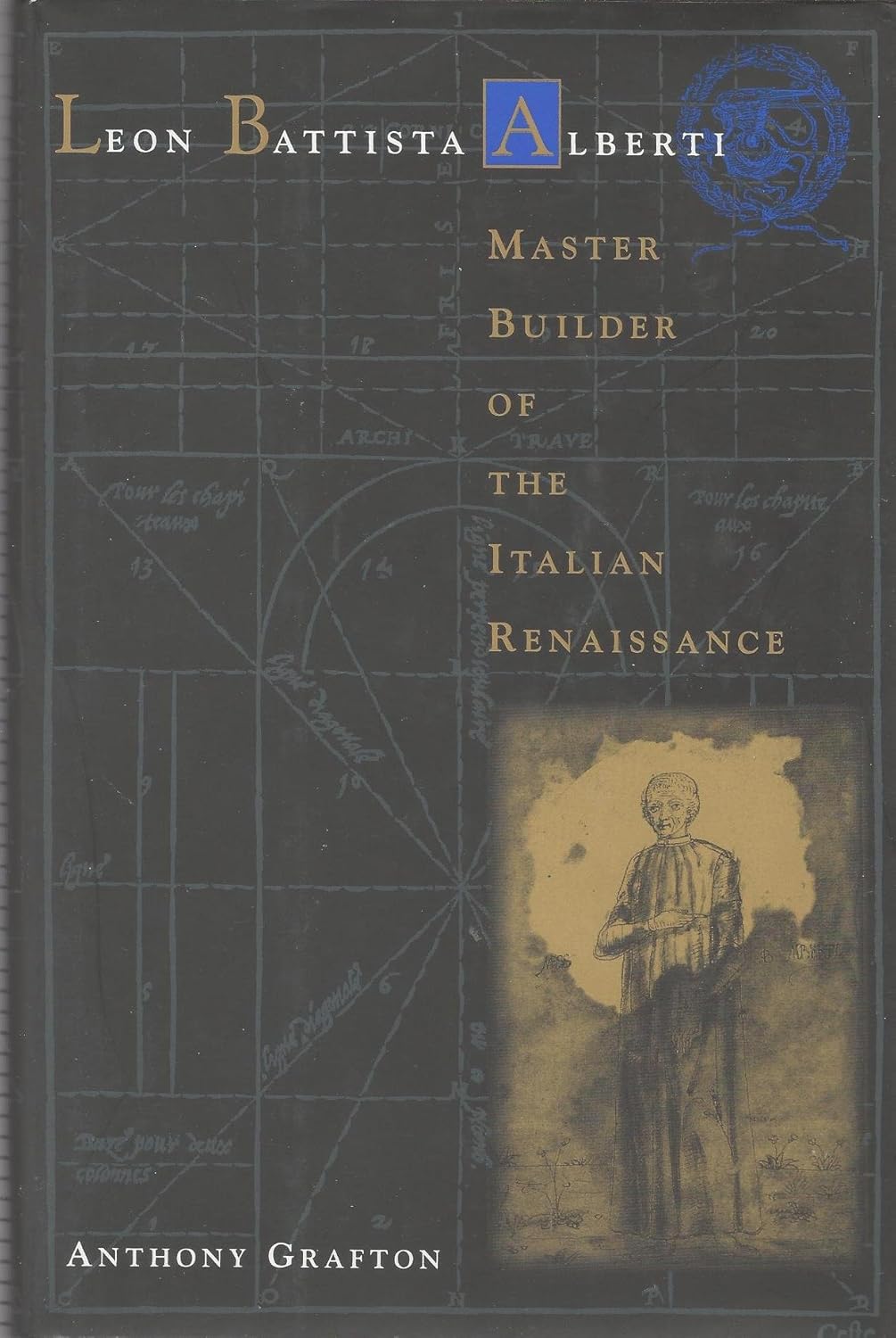
Leon Battista Alberti (1404–1472) was the quintessential Renaissance man, famously described by the nineteenth-century historian Jacob Burckhardt as the “universal man.” In Leon Battista Alberti: Master Builder of the Italian Renaissance (2000), historian Anthony Grafton places the great Florentine humanist into historical perspective while attempting to uncover the complex individual behind the carefully constructed public persona.
Alberti emerges as “a fascinating, labile, passionate man,” according to Grafton; a handsome, athletic, intellectually restless, and possessed of impeccable taste and astonishingly broad interests. A celibate scholar of extraordinary range – artist, playwright, architect, rhetorician, cryptographer, and antiquarian – Alberti became a sought-after advisor to the wealthiest courts of quattrocento Italy on matters of aesthetics, architecture, and culture. He was a man of immense talent and nearly boundless ambition, the courtier par excellence and an early master of what modern scholars call “self-fashioning,” cultivating expertise not only in scholarship and design, but even in the proper way to walk, ride, and converse – “an avatar of grace in every word and movement,” as Grafton writes.
Alberti helped formulate the first coherent principles of linear perspective, creating the illusion of three-dimensional space on a flat surface, and developed a visual language for classical Renaissance architecture that would shape Europe for centuries. Deeply optimistic about human potential, he believed that men could accomplish almost anything “if they only have the will to do so.” Yet beneath the brilliance and self-confidence lay profound insecurity and a depressive streak: deprived of wealth and status after his father’s death, Alberti spent decades struggling unsuccessfully for acceptance within his own extended family.
Alberti was born into privilege as the son of one of Florence’s leading men, but after his father’s death in 1421, when Alberti was just seventeen, he found himself an indigent and illegitimate orphan. Inheriting neither wealth nor status, he quickly developed a resentment toward the deeply hierarchical society of Renaissance Italy. Leon Battista would have to make his own way in the world, and much of his life thereafter was devoted to escaping poverty and obscurity in pursuit of rank, dignity, and recognition.
He earned a doctorate in canon and civil law from the University of Bologna, yet soon concluded that the legal profession could not provide the cultural and social standing he believed was his due. Following in the footsteps of Petrarch, whose life preceded Alberti’s by almost exactly a century (1304-1374), Alberti immersed himself in the Latin classics and pursued the systematic imitation of the great Roman authors, above all Cicero and Virgil. He quickly distinguished himself in the highly valued humanist skill of applying ancient texts to contemporary situations and problems. This effectively gave Alberti a kind of passport into the emerging “Republic of Letters,” the transnational community of Renaissance scholars and intellectuals. The central method of these early humanist works was deliberate imitation: Alberti sought to assemble fragments of ancient texts into new literary mosaics that addressed contemporary concerns while appearing authentically classical in style and spirit.
Immersion in the classics gave Alberti intellectual purpose and creative direction, but it did not produce the rapid social advancement he had hoped for. Grafton wryly observes that Alberti quickly learned that “scholar” does not rhyme with “dollar.” By the late 1420s, as he approached the age of thirty, Alberti had established himself as an exceptionally skilled classicist, yet he still faced profound uncertainty about the ultimate direction and purpose of his life.
The papal curia and the Florentine chancery offered Alberti the clearest avenues for advancement. Both institutions provided formal positions in which crisp, classically inspired Latin was essential for drafting papal bulls, diplomatic correspondence, and civic propaganda celebrating the triumphs of the city. Young scholars from widely different backgrounds – including Leonardo Bruni, Niccolò Niccoli, Poggio Bracciolini, Leonardo Dati, and Coluccio Salutati – moved easily between these overlapping intellectual communities and frequently collaborated with one another. Like the writings of Cicero himself, their works often centered on examples of virtuous and flawed behavior that readers were encouraged either to emulate or avoid, all expressed in impeccably polished Latin. These humanists understood that their work would immediately face intense scrutiny from learned peers. Grafton notes that being a Quattrocento humanist was “not hospitable to faint-hearted writers,” and Alberti – though deeply sensitive and often burdened by self-doubt – repeatedly exposed his work to the criticism of those he most admired. “Alberti’s bold, sometimes radical Latin writings aroused the attention of many readers,” Grafton observes. Yet it was ultimately through his powerful writings on art and architecture that Alberti would secure his enduring reputation.
In 1436, Alberti published On Painting in two versions: Italian, intended for artists and craftsmen, and Latin, aimed at scholars and patrons. It was a deliberate turning point in his career. He dedicated the work to Filippo Brunelleschi and provided the earliest precise description of how to construct a systematic and coherent perspective for representing three-dimensional space on a flat surface. In Alberti’s view, Brunelleschi had surpassed the achievements of the ancients, and much of that success stemmed from the application of new techniques and technologies. More remarkably, he had done so without a master to imitate. No Renaissance poet could hope to equal Virgil, nor could a modern historian rival Livy, but in art and architecture Alberti believed that Quattrocento Italians had begun to exceed even the greatest painters, sculptors, and architects of classical antiquity. Grafton suggests that, though already middle-aged, Alberti used On Painting and its prefatory tribute to Brunelleschi to stake out new intellectual territory for himself in the worlds of art and architecture. It was engineers and mathematicians such as Brunelleschi, he argued, who served as the pioneers of the artistic revolution that would reach its full maturity in the early sixteenth century. These innovators valued tradition and understood the importance of light, proportion, and visual harmony, themes that would come to define the masterpieces of the High Renaissance. Yet they also earned prestige through innovation, constantly seeking new and better ways to solve old problems – a quality captured by the Latin concept of ingegno, which combined intellectual brilliance with practical inventiveness.
Grafton places considerable emphasis on Alberti’s creation around 1435 of the commemorative plaquette, a small, low-relief sculpture cast in bronze and traditionally used to celebrate important individuals or events from the classical past. “Alberti’s medal gave physical embodiment, crisp and novel artistic form,” Grafton writes, “to his and other engineers’ and artists’ new claims to elevated social and intellectual status.” In effect, it suggested that modern artists, engineers, and intellectuals deserved the same immortality in bronze that had once been reserved for the emperors and great men of ancient Rome. Alberti thus transformed an ancient and familiar artistic form, giving it a radically new purpose. His medals celebrated the artist and intellectual as heroic figures while remaining simultaneously classical and modern, traditional and innovative. In doing so, Alberti united past and present in visual art much as he had previously done in literature, adapting the forms of antiquity to express distinctly Renaissance ideals. The fashion for medals spread rapidly through Italian courts in the 1440s.
When the antiquarian Cyriac of Ancona visited Florence in 1433 – the same year that Cosimo de’ Medici returned from exile – he immediately recognized that the city was undergoing a profound artistic revolution. Grafton notes that, within a generation of Cyriac’s visit, Florence boasted eighty-four specialist woodcarvers but only seventy butchers, a striking indicator of the city’s growing devotion to artistic production. Artists such as Donatello, Filippo Brunelleschi, and Lorenzo Ghiberti were producing what Grafton calls a “double shock”: works that were at once startlingly innovative and deeply rooted in classical antiquity. Though their individual styles differed, they belonged to a common avant-garde movement that fused modern creativity with ancient models. Their achievements suggested that contemporary artists were not merely the heirs of the classical world but its equals – and perhaps its superiors. Indeed, Grafton argues that they were creating works “greater than anything the world had experienced before.”
Simply put, Alberti believed that painting was not a mere craft but a liberal art that was grounded in geometry and guided by the principles of rhetoric. Alberti employed the tools and language of humanism to both describe and shape this artistic revolution. Unlike the ancient author Pliny, whose Natural History chronicled the historical development of painting and sculpture, Alberti’s On Painting was, in Grafton’s view, the first artistic manifesto of the modern age. It offered a systematic, coherent, and detailed set of principles for painting unlike anything that had previously existed. In doing so, Alberti deliberately elevated painting from a traditional craft to a learned art. The painter’s intellect and creative judgment became more important than the physical materials used to produce the work. Alberti’s central concern was the creation of convincing visual illusion: three-dimensional space rendered on a flat surface, hair and garments that appeared to move naturally, postures that captured the realities of human movement, and faces that conveyed authentic emotion. He envisioned a new ideal artist who combined the technical ingenuity of an engineer with the intellectual sophistication of a humanist scholar. The ultimate purpose of painting, Alberti argued, was to move its audience emotionally and psychologically, much as a great orator stirred the minds and hearts of his listeners.
The ancient rhetorical principle of decorum occupied a central place in Alberti’s theory of painting. It held that every element of a work of art should be appropriate to its subject, setting, and purpose. The concept derived directly from the writings of Cicero and Quintilian, who taught that a speaker’s style, tone, gestures, and language should always suit the occasion and audience. Alberti applied this rhetorical framework to visual art. Just as an orator should not employ grand, emotional language when discussing a trivial matter, a painter should ensure that every figure, gesture, expression, costume, and action accords with the story being told. Kings should appear dignified, warriors courageous, saints pious, children playful, and mourners overcome with grief. Facial expressions, body language, and even the movement of drapery should reinforce the emotional and moral content of the scene. To achieve these effects, Alberti strongly encouraged artists to study and sketch the nude human form, believing that a deep understanding of anatomy and movement was essential to convincing representation. At the same time, the language of rhetoric provided him with a powerful vocabulary for describing the artistic revolution unfolding around him. In the process, Alberti produced not only a practical manual for painters but also a comprehensive theory of painting itself. According to Grafton, On Painting “wove together the literary and the technical strands of Alberti’s culture in a text that seemed cogent and accessible to his fellow scholars,” and, one assumes, to artists as well. In return for offering such a sweeping treatment of the theory and practice of painting, Alberti asked the painters of his day to reward him by including his likeness in their works – a request that, judging by the surviving evidence, few contemporary artists chose to grant.
Another key term in Alberti’s artistic vocabulary was the Latin word historia, which broadly denoted narrative or inquiry and encompassed subjects drawn from both history and classical mythology, especially those carrying an explicit moral purpose. Once again underscoring the close analogy between painting and rhetoric, Alberti argued that “the greatest work of the painter” was the depiction of important stories through images. Grafton notes that Alberti adopted and expanded the concept of historia, transforming it into a foundational element of his rhetorical theory of painting. His ideal historia called for a new style of art that combined the technical innovations of Brunelleschi and Masaccio – particularly their mastery of three-dimensional representation – with the elevated themes and moral seriousness of classical antiquity. As an example, Alberti pointed to Giotto’s Navicella in the Vatican, which depicted the biblical story of Christ and his disciples in a fishing boat, although he viewed antiquity as the chief source from which a painter should draw. In technical terms, Alberti believed that selecting the right subject matter – a process he equated with the rhetorical principle of invention – was far more important than the specific visual devices used to tell the story. Just as a great orator succeeds first through the power of his argument, a great painter succeeds first through the significance and emotional force of the narrative he chooses to depict.
Alberti also argued that the artist’s work was analogous to humanist scholarship in another important respect: it should be open to informed criticism and revision. Just as humanist scholars circulated manuscripts among trusted readers and incorporated their feedback or emendations, Alberti believed that artists should welcome the judgments of knowledgeable observers. Public art, in his view, was not purely an individual achievement but, in many respects, a collaborative enterprise that required openness, humility, and a willingness to learn from others. Grafton observes that Alberti never lost faith in the idea that a social and collaborative system of intellectual production would produce better results than one based solely on individual inspiration. The creation of great works, whether literary or artistic, depended not only on talent but also on engagement with a community of informed critics and fellow practitioners. Grafton suggests that this collaborative ethos may help explain why Ghiberti, who actively solicited feedback from virtually every goldsmith and sculptor in Florence while preparing his trial panel for the Baptistery doors, ultimately defeated the more secretive and individualistic Brunelleschi in the final competition.If true, Grafton suggests, Alberti’s preferred model of a collaborative community of artists and critics may have operated less as an engine of collective genius than as a self-reinforcing circle of insiders.
Next, Alberti stressed the importance of proper composition, which was a form of decorum – the perfect correspondence between all the individual pieces of the artwork and the subject matter. This included the arrangement of the figures in the painting as a whole, in which each body must conform in size and role to the subject of the action. This meant that, for Alberti, the incorporation of precious materials often violated the decorum of the painting.
In the final analysis, Grafton writes, On Painting fulfilled Alberti’s central aim: “it made a powerful case for a new art and a new kind of artist, one so powerful that it would become an orthodoxy in its own right.”
Alberti also wrote On the Family, a deeply personal treatise on marriage, childrearing, education, household management, wealth, and the preservation of a family dynasty in an age when death often came early and unexpectedly. Historians have long debated how the work should be interpreted: was it a reflection of the realities of fifteenth-century family life, or an attempt to reconstruct an idealized world based on classical models? Grafton argues it was the latter and that the work was heavily influenced by Xenophon’s Oeconomicus, a dialogue on household management, and thus followed a familiar humanist pattern of adapting ancient texts to address contemporary concerns. As Grafton puts it, “the [Quattrocento] writer quarries his materials from the palace of antiquity.” As with historia in rhetoric and painting, Grafton argues that Alberti’s model family, drawn from Xenophon’s historical example, was intended as an “ideal pattern, a model for emulation,” rather than a realistic portrait of fifteenth-century Florentine society. Yet Alberti was not simply reproducing classical ideas; he was selectively reshaping them for his own purposes. Indeed, Grafton notes that Alberti entirely ignored one of the most important developments in Florentine society during the period in which he wrote the book: the introduction of the catasto, a new tax system that assessed property taxes through a detailed examination of each household’s assets and liabilities. The catasto replaced the older system of forced loans based on generalized assumptions of family wealth and represented a major transformation in Florentine economic life. Alberti’s silence on the subject suggests that his goal was not to provide a realistic account of contemporary society, but rather to construct a normative vision of how family life ought to be organized and governed.
Alberti is probably best known today as an architect and the designer of such iconic Florentine landmarks as the Rucellai Palace and the façade of Santa Maria Novella. Yet he did not begin his architectural career until the 1450s, when he was already well into middle age. As he had with painting, Alberti argued that architecture should communicate with its audience and adhere to the same fundamental principles he had articulated in On Painting, especially the principle of decorum. A building’s exterior should speak clearly and appropriately to the passerby, expressing its purpose, dignity, and place within the social order. This shift in Alberti’s interests – from the management of the household in On the Family to the design of buildings and the cultivation of a public identity – coincided with a decisive turning point in his career and marked the beginning of the work for which he would become most famous.
By 1450, Alberti had effectively drafted a blueprint for his own transformation from an independent man of letters into a courtier who earned his living by providing wealthy patrons with cultural authority, intellectual prestige, and expert advice. Since the mid-1430s, he had served in the papal curia of Pope Eugene IV, traveling with the court from Florence to Bologna and Ferrara. Grafton describes Eugenius’s curia as “brilliant, even spectacular … an earthly equivalent to the celestial hierarchy of angels.” During this period, Alberti composed Pontifex (1437), a treatise that outlined his vision of ideal religious leadership. He argued that a bishop should govern through wisdom, moral example, self-discipline, and service to the common good rather than through the mere exercise of authority. Prudence, moderation, learning, and the ability to inspire others through personal conduct were, for Alberti, the defining virtues of effective leadership. In many respects, the ideal bishop of Pontifex closely resembles the ideal civic leader celebrated throughout Renaissance humanism, suggesting that Alberti was developing a broader theory of authority that extended well beyond the Church itself.
Life as a courtier in Quattrocento Italy offered extraordinary rewards, but it also carried significant risks. “Courtiership, like falconry,” Grafton writes, “required dexterity and suppleness.” The successful courtier was expected to walk, ride, converse, and conduct himself with effortless dignity, projecting refinement while concealing the labor required to achieve it. A century later, Baldassare Castiglione would give this quality a name: sprezzatura, the art of making the difficult appear easy; a kind of secular grace marked by charm, poise, and studied nonchalance. Between 1438 and 1450, Alberti honed these skills in the service of the Este court in Ferrara, one of the earliest Renaissance dynasties to provide substantial patronage to innovative artists, architects, and scholars. Over the course of the fifteenth century, the Este family would become both some of the greatest palace builders in Italy and among the most sophisticated patrons of the visual arts. “Ferrara, in short,” Grafton writes, “offered cultural opportunities that could have been custom tailored to fit Alberti’s special skills and central interests.”
By the time of Leonello d’Este’s death in 1450, Grafton argues, Alberti had emerged as one of Europe’s foremost antiquarians, rivaled only by figures such as Poggio Bracciolini, who had helped establish rigorous new standards and methods for the direct study of ancient texts, monuments, and archaeological sites. Alberti’s knowledge of classical art and architecture – including his understanding of how ancient rulers had employed painters, sculptors, and public works to achieve both aesthetic and civic ends – exerted a powerful influence on tastes and practices in Ferrara. His expertise extended from the grand scale of urban planning and the relationship of buildings to the surrounding cityscape to the smallest details of inscriptions and decorative programs. By this point, Grafton writes, Alberti had firmly established himself as a “dominant figure, the expert critic … the ideal counselor in antiquity.”
Throughout his life, Alberti pursued the material remains of the ancient world with extraordinary energy and curiosity. His investigations even included a failed attempt to raise first-century Roman ships from the bottom of Lake Nemi, an undertaking Grafton memorably describes as “a catastrophic experiment in underwater archaeology.” This lifelong engagement with ancient ruins formed the foundation of the architectural theory into which Alberti poured his greatest intellectual ambitions as both scholar and writer. It also guided his broader effort to recover and reinterpret the lost grandeur of ancient Rome. Indeed, Grafton contends that “no one did more [than Alberti] to call the lost city of the ancients back to life.” Alberti viewed Rome as a palimpsest whose successive historical layers could be identified, separated, dated, and analyzed. In this sense, he embodied a new kind of Renaissance professional, one who combined, in Grafton’s words, “philological and technical expertise, the scholar’s learning and the connoisseur’s eye.”
With On the Art of Building, Alberti set out to write the first independent architectural treatise since On Architecture by Vitruvius in the first century BC. Completed around 1452 but not published until after his death, the work represented the culmination of decades spent studying the ruins, texts, and civic life of the ancient world. Grafton describes it as “by a long margin, the longest and most learned, as well as the most influential of Alberti’s works.” It drew upon interests and experiences that Alberti had cultivated since the 1430s, particularly his work as an antiquarian, archaeologist, and student of ancient Rome. Grafton argues that “no one did more … to forge a language for discussing the built world and to found it on rich theory and observation.” The treatise was also remarkably well-timed. Since the fourteenth century, Italian princes, lords, and merchant dynasts had been consolidating urban properties and transforming them into increasingly grand palaces and civic spaces. Alberti’s work provided these ambitious patrons with something they had never before possessed: a comprehensive intellectual framework for architecture and a practical guide to designing buildings that projected power, dignity, harmony, and civic purpose.
In the treatise, Alberti developed a comprehensive theory of buildings, their makers, and their purpose, emphasizing the architect’s role not merely as a designer of structures but as an organizer of society and space. Indeed, the treatise was aimed less at the craftsmen and builders who physically erected structures than at the rulers, clerics, patrons, and intellectuals who conceived, commissioned, funded, and directed building projects. He sought to establish general principles that could guide the design of public buildings, cities, and monuments, grounding architecture in both mathematics and human experience. In short, he ended up producing both highly mathematical sets of principles and an overall sensitive account of buildings and their surroundings interacting and complementing each other.
Above all, Alberti believed that large buildings had to satisfy several important – and often competing – requirements simultaneously. First, they needed to provide practical shelter, keeping out rain and moisture while admitting ample light and air. Second, they had to accommodate a variety of human activities by offering both public and private spaces, open and enclosed environments, and areas suited to different social functions. Third, the façade needed to relate organically to the structure it enclosed, much as an animal’s skin reflects the underlying arrangement of bones and muscles. Finally, every element of a building had to contribute to a coherent whole. Architecture, in Alberti’s view, was not merely the art of constructing individual structures but of creating environments that promoted civic harmony, human flourishing, and the common good.
One of the most surprising frustrations of Grafton’s biography is that he spends relatively little time explaining the geometric principles that Alberti himself presented in what the author calls “simple, legible forms.” To better understand the significance of Alberti’s ideas, I found myself turning to additional sources.
At the heart of Alberti’s architectural theory was the conviction that buildings should embody the same mathematical harmony found in music. Beauty arose from the precise and rational relationship of all parts to one another, a principle he called concinnitas, which Grafton translates as “the possession of such harmonious and mutually complementary parts that nothing could be added to or removed from it without spoiling the whole.” The author goes on to write that concinnitas, “like health and eugenics,” if often in the eye of the beholder. Drawing on classical antiquity, geometry, and musical ratios, Alberti favored simple numerical proportions such as 1:1, 1:2, 2:3, and 3:4. He believed that rooms, façades, and entire structures felt naturally beautiful when their dimensions were organized according to these balanced relationships.
Alberti recommended that important spaces be based on ideal geometric forms such as squares, circles, and harmonious rectangles. He frequently employed the sphere, arch, and dome as organizing principles because they represented mathematical perfection and visual unity. Ceiling heights, he argued, should relate proportionally to the dimensions of a room, while a building’s exterior façade should visibly express the same order and harmony that governed its interior spaces. Classical elements such as columns were expected to follow established proportional rules, and Alberti famously maintained that buildings should mirror the balanced proportions of the human body itself.
Ornament, in Alberti’s view, should enhance structure rather than conceal it. True beauty came not from decorative excess but from the underlying mathematical order of the design. These ideas helped redirect Renaissance architecture away from the irregular verticality and complexity of Gothic forms toward the calm, symmetrical, and carefully proportioned spaces that would come to define the High Renaissance.
“The visual language of Alberti’s architecture,” Grafton writes, “strikingly resembled the verbal language of his literary works.” Once again, the arts of rhetoric and oratory provided the framework for Alberti’s thinking. For Alberti, architecture was a form of text written in the languages of arithmetic, geometry and ornament. Just as Quintilian organized his teachings around invention, arrangement, and style, Alberti structured his architectural theory around construction, function, and beauty. And just as in painting and oratory, Alberti stressed the vital role of decorum in architecture: “The greatest glory in the art of building,” he explained, “is to have a good sense of what is appropriate.” Decorum determined the proper scale of a project as a whole.
Yet, as Grafton observes, “the texture of On the Art of Building as a whole is that of a quilt, not a tapestry; a compilation from multiple sources, not a seamless composition.” The work rests firmly on the standard methods of Renaissance humanism: close reading, careful excerpting, commonplace-book compilation, and the creative adaptation of ancient texts to contemporary needs. Like much of Alberti’s scholarship, it was less an act of invention from whole cloth than a masterful synthesis of inherited traditions into a new and influential intellectual framework. And, like the humanist writer, Alberti believed that the successful architect must collaborate with his critics. As in painting, Alberti had created an intellectual institution, albeit one that only really took shape after his death.
Alberti regarded himself not merely as a theorist but as a practicing architect, and the accession of Pope Nicholas V (r. 1447–1455) gave his architectural ambitions a powerful new impetus. Flush with the revenues generated by the Jubilee of 1450, Nicholas embarked on an ambitious campaign to transform Rome into a magnificent urban center worthy of both its ancient imperial heritage and its role as the capital of Christendom. His goal was nothing less than the creation of an ideal city: a restored Rome that fused the grandeur of the classical past with a hopeful Christian future. The pope envisioned a city whose buildings would strengthen the faith in both a literal and a spiritual sense. Had Nicholas’s plans been fully realized, Grafton argues, they would have constituted the first great experiment in modern urban planning.
The pope’s chief architect was Bernardo Rossellino. The precise nature and extent of Alberti’s involvement in Nicholas’s building program remain subjects of scholarly debate, but Grafton contends that strong circumstantial evidence points to Alberti playing an active advisory role in several important projects. In particular, he appears to have counseled the pope in favor of aesthetic restraint. Alberti admired the “grave, simple churches” of early Christianity and was instinctively skeptical of excessive ornament, monumental display, and lavish expense. Nicholas, by contrast, believed that magnificence itself possessed religious value and that splendid buildings would attract pilgrims to Rome while inspiring ordinary believers. Although Alberti frequently criticized overly grandiose projects, he nevertheless supported Nicholas’s larger vision of Rome as a renewed Jerusalem, a city whose restored beauty would symbolize both the revival of the Church and the rebirth of civilization itself.
In the end, Grafton presents Alberti not merely as a gifted architect or humanist scholar, but as one of the principal architects of the Renaissance itself. Again and again, Alberti appears as a synthesizer: of antiquity and innovation, theory and practice, art and rhetoric, scholarship and public life. Whether writing about painting, family, architecture, or civic leadership, he sought to adapt the wisdom of the ancient world to the needs of his own age. At the same time, he helped create a new social role for the intellectual as expert advisor, cultural authority, and public figure. If Alberti’s life sometimes seems marked by insecurity, ambition, and relentless self-fashioning, those qualities only make him more recognizable to modern readers. Grafton’s achievement is to recover not the marble statue of a Renaissance genius, but the complicated and often vulnerable man behind it. The result is a compelling portrait of an individual who did as much as anyone to define the ideals of the Renaissance and whose influence continues to shape how we think about art, architecture, expertise, and human potential.
 What's Tim Reading Now?
Leave a comment