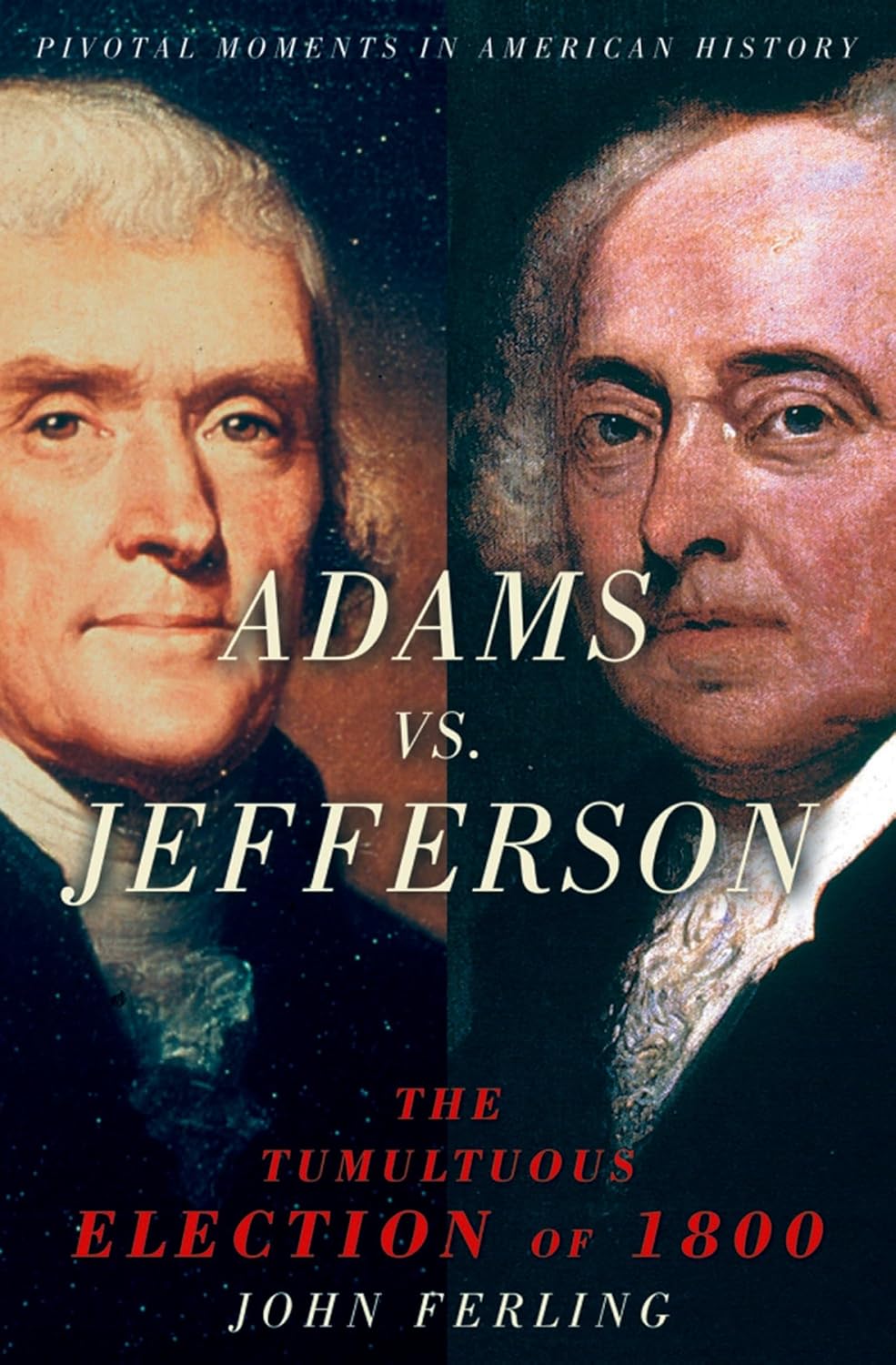
Thomas Jefferson came to call America’s fourth presidential election the “Revolution of 1800.” Indeed, the showdown between Federalist incumbent John Adams and Republican Democrat challenger Jefferson was selected as a topic in the excellent “Pivotal Moments in American History” series edited by David Hackett Fischer and James McPherson. It marked the first peaceful transfer of power between rival political parties in modern history, legitimizing democratic opposition, curbing Federalist dominance, and setting the young American republic firmly on a path toward broader popular government. Historian John Ferling tells this important story admirably in Adams vs. Jefferson: The Tumultuous Election of 1800 (2004).
At the turn of the nineteenth century, the fledgling United States remained overwhelmingly rural, agrarian, and pre-industrial. Its population had doubled since 1776 to just over five million, yet only one American in twenty-five lived in a town or city with more than one thousand inhabitants. Just four urban centers — New York City, Boston, Charleston, and Baltimore — had populations exceeding twenty thousand. Beneath this modest demographic growth, however, lay a profound moral contradiction: roughly one in six Americans lived in bondage as enslaved people.
Though dramatically different in temperament, upbringing, and personal style, Adams and Jefferson were the closest of friends until the political upheavals of the early 1790s drove them apart. Abigail Adams once observed that Jefferson was the only man with whom her husband “could associate with perfect freedom and unreserve.” Adams, born in 1735, relished public life and was energized by debate and oratory. Jefferson, born eight years later, often shrank from public display and, while a “virtuoso with words,” as Ferling notes, was never at ease as a speaker. Yet for all their differences, both men were fiercely ambitious. They worked closely together in the Second Continental Congress in 1775, and in 1784 lived near one another in Paris for ten months before Adams departed for London as American minister to Great Britain. Ferling argues that foreign service proved formative for both men, though in sharply different ways. Adams looked upon Europe – and especially the gathering storm in France, which he called a “democratical hurricane” – with sober realism, accurately foreseeing the confusion and bloodshed of the French Revolution. Jefferson remained sanguine about the revolution’s promise for far longer than events warranted. He once excused the excesses of the French Revolution by saying that one could not “expect to be translated from despotism to liberty in a feather bed.” These contrasting experiences abroad ultimately pushed the two men toward opposing political philosophies: Adams came to believe that liberty depended upon a strong central government, while Jefferson saw mankind’s best hope – especially for the impoverished and powerless rural and urban masses he encountered across Europe – in sharply limiting government’s reach.
In the wake of victory over the British, a powerful spirit of egalitarianism swept across the new United States. Men who before 1776 would scarcely have been entrusted with even the smallest village office were now being elected to state legislatures. To many members of the old elite, these political newcomers seemed shallow, uncultivated, and lacking in virtue, wholly unfit for the responsibilities they had assumed. This new “leveling spirit,” nationalists such as James Madison and Alexander Hamilton feared, was fueling excessive democracy, punitive land taxes, and fiscal irresponsibility. What the republic needed, in their view, was a stabilizing class of conservative leaders – what Madison called “individuals of weight” – whose judgment, property, and virtue would temper popular passions. A strong central government led by “the most considerate and virtuous citizens” could serve as a firewall against rapid, reckless, and destabilizing change. In this sense, Madison sought a radical restructuring of national government precisely to prevent radicalism from taking root in the increasingly plebeian state legislatures.
The bonds that had long united Jefferson and Adams ultimately broke in 1791. Ferling calls the 1790s “one of America’s most passionate decades,” in the company of the 1850s, 1930s and 1960s. One catalyst was Adams’s publication of Discourses on Davila, in which he wrote approvingly of certain stabilizing virtues associated with monarchy, alarming republicans who feared aristocratic drift. Another was Jefferson’s inadvertent endorsement of Thomas Paine’s newly published Rights of Man, whose attack on “the political heresies which have sprung up among us” was widely interpreted as a veiled denunciation of Adams, now vice president, and perhaps of the broader Federalist worldview he represented. Meanwhile, the ambitious national financial system devised by Hamilton deepened the ideological gulf between Jefferson and the Washington administration, Adams included. Convinced that most Americans instinctively distrusted concentrated national power, Jefferson resolved to organize formal opposition. By the autumn of 1791, the Jefferson-backed National Gazette, edited by Philip Freneau, had become the nation’s first opposition newspaper, challenging the Federalist narrative advanced by the Gazette of the United States, edited by John Fenno. The election of 1792 would thus become the first since ratification of the Constitution to be contested openly along partisan lines.
“Foreign policy ignited the partisan fires that blazed like a raging inferno throughout [Washington’s] second administration,” Ferling writes. The decisive turning point came in 1793, when Great Britain declared war on Revolutionary France. Americans were deeply divided in their sympathies. A large segment of the population viewed Britain, their former colonial master, as the chief enemy of liberty and the principal obstacle to the rights of man. Another substantial portion admired Britain’s social order, commercial strength, and political institutions, and hoped the new United States might develop along similar lines. These competing visions were fundamentally irreconcilable, and the Anglo-French war poured fuel on an already smoldering political divide, intensifying passions to a fever pitch. At its core, Ferling argues, the nation was wrestling with a profound question: what kind of republic – socially, politically, and morally – would America become?
President Washington was determined to preserve American neutrality, believing the fragile republic needed time – breathing room to stabilize, consolidate its institutions, and grow stronger before becoming entangled in Europe’s wars. But Great Britain made neutrality increasingly untenable through its Orders in Council, which barred neutral nations from trading with the French West Indies. By mid-1794, nearly four hundred American vessels had been seized, and large numbers of American sailors were impressed into service in the Royal Navy. In response, Washington dispatched John Jay to London as envoy to negotiate a settlement – a controversial choice, given Jay’s earlier willingness during negotiations with Spain in 1786 to consider relinquishing American navigation rights on the Mississippi River. At the same time, the administration reacted forcefully to the Whiskey Rebellion in western Pennsylvania, mobilizing federal authority to suppress the uprising. To Jefferson, Madison, and others aligned with the Democratic-Republican cause, these actions seemed to confirm their darkest suspicions: that a self-regarding elite demanded deference and stood ready to crush dissent by force when challenged.
When the terms of the Jay Treaty reached the United States in March 1795, they touched off another explosion of partisan fury. To many Americans, the agreement amounted to a humiliating capitulation. Great Britain made no meaningful concessions on the issues that most inflamed American opinion: it refused to ease its commercial restrictions, declined to grant broader trading rights with belligerent nations, and would not renounce its policy of impressing American sailors into the Royal Navy. Support for – and opposition to – the treaty fractured sharply along sectional lines. Southern and Western Republicans denounced the Eastern Federalists as little more than heirs to the loyalist Tories: “monarchists and nabobs who yearned to shore up the old deferential and hierarchical social structure of the colonial past,” in Ferling’s telling. To their critics, the Federalists seemed to be marching arm in arm with Britain, determined to extinguish the democratic promise of the two great revolutions of the eighteenth century. In Jefferon’s estimation, there were two political parties in the infant country – one which feared the people (Federalist) and the other that feared the government (Republican).
Nevertheless, Ferling regards Washington’s performance between 1794 and 1796 as his “finest hour since the daring strikes at Trenton, Princeton, and Germantown.” In that brief eighteen month span, Washington preserved peace abroad while resolving two of the republic’s most vexing western challenges. General Anthony Wayne’s decisive victory at the Battle of Fallen Timbers secured American authority in the Ohio Country, while Pinckney’s Treaty with Spain finally guaranteed free navigation of the Mississippi River, opening the Mississippi Valley to American commerce and settlement. By pairing firmness with restraint, Washington had not only kept the young nation out of war, but also secured strategic gains that had long been intractable.
A recurring theme in Ferling’s portrayal of the principal actors is Thomas Jefferson’s perpetual – and steadily worsening – financial distress. When Jefferson returned from France in 1789 to become the nation’s first Secretary of State, he was already burdened by heavy obligations, the result of assuming debts from his father-in-law’s estate as well as his own expansive tastes and acquisitive habits. Altogether, he owed roughly £6,500, an immense sum, nearly twice what a skilled craftsman might hope to earn over a lifetime. Yet Jefferson continued to live beyond his means, spending well in excess of both his income and his government salary, with his indebtedness reportedly growing by roughly ten percent annually during his service in Washington’s cabinet. By the time he resigned on the final day of 1793, his debts had climbed to approximately £7,800, a burden he admitted was robbing him of sleep. Ferling does not dwell on the extent to which Jefferson may have blamed eastern Federalist financiers for his chronic financial troubles, but given Jefferson’s deep suspicion of commercial elites, it is not difficult to imagine that he viewed at least some of the consequences of his own profligacy through the lens of a distant Anglophile mercantile establishment stacked against men like him. By 1819 Jefferson’s personal debt had ballooned to $40,000 and he required $1,200 a year just to cover the interest payments.
The first truly contested presidential election came in 1796, and it unfolded within a remarkably fluid and uneven electoral system. At the time, there were no national laws governing voting, leaving each state free to determine who was eligible to cast a ballot in presidential elections. Before 1776, only about sixty percent of white males qualified to vote, with the figure falling as low as twelve percent in Virginia. After independence, growing pressure for suffrage reform produced significant – though widely varying – expansions in voting rights from state to state. Meanwhile, as Ferling observes, “the electoral college system was a calamity waiting to happen.” There were 136 presidential electors spread across sixteen states; in nine states, electors were chosen by state legislatures, while in the remaining seven they were selected by popular vote. By 1796, six states had extended the franchise to all white male taxpayers, signaling a slow but meaningful democratization of political participation.
Democratic-Republican Party partisans cast the election as a stark moral and political struggle: on one side stood men like themselves, champions of the rights of mankind and republican liberty; on the other, they warned, was a clique of royalist Anglophiles determined to preserve a hierarchical society offering little opportunity for common people. At a Republican rally in Philadelphia, supporters chanted “Jefferson and no king,” while mocking John Adams as the monarchist “Duke of Braintree.” The Federalist Party retaliated in kind, portraying Jefferson as weak, wavering, indecisive, and dangerously irreligious – an ivory-tower philosopher wholly unsuited for the burdens of national leadership.
The weaknesses of the Electoral College system, combined with the near absence of party discipline, brought the election perilously close to chaos. Nearly forty percent of the electors cast at least one ballot for someone other than the candidate nominated by their party’s congressional caucus, underscoring how fluid and unsettled the new political order remained. The results once again exposed the young republic’s deep sectional divides. Adams swept nearly every northern electoral vote outside Pennsylvania, yet secured only two votes south of the Potomac River – one each from Virginia and North Carolina – just enough to give him a narrow victory and make him the nation’s second president. At the same time, turnout was strikingly low, dipping to perhaps twenty-five percent in Pennsylvania, a reminder that the election’s outcome may not have fully reflected popular sentiment. James Madison attributed the Federalist triumph partly to the lingering prestige of George Washington and partly to strong northern support for the Jay Treaty. Yet, as Ferling notes, the man least disturbed by the result may well have been Thomas Jefferson himself, who humbly accepted his position as vice president in an administration he vehemently opposed.
Although none of the cabinet members from George Washington’s second administration had been particularly close to John Adams, the new president chose to retain them, a decision that may have been the single greatest mistake of his presidency. Nearly to a man – but especially treasury secretary Oliver Wolcott, secretary of war James McHenry, and secretary of state Timothy Pickering – they proved more loyal to the increasingly strident ultra-Federalist vision of Alexander Hamilton than to Adams himself. Hamilton, though holding no official office, remained deeply and aggressively involved in national policy, exerting enormous influence from outside government. At the same time, many Americans openly wondered whether the fragile Union could endure without the unifying force and towering prestige of Washington at its center. Events soon brought that question into sharp relief, as the young republic came perilously close to unraveling at the seams.
Thomas Jefferson led the opposition to the Federalist Party from within Adams’s administration. Ferling notes that Jefferson has often been remembered as a “dreamy, insular utopian,” but argues that in reality he was a “meticulous, hands-on politician,” carefully cultivating and directing his own “coterie of myrmidons” in much the same fashion as his elusive and committed rival, Alexander Hamilton. Like Hamilton, Jefferson possessed a keen understanding of the intimate connection between foreign policy and domestic objectives. By the late 1790s, he had come to believe that American autonomy was once again threatened by the very force that had imperiled it two decades earlier: a deeply entrenched northeastern mercantile elite, centered in the seaport cities and, in his view, embedded throughout the machinery of all three branches of national government. The Republican mission, as Jefferson saw it, was to resist what he regarded as a creeping re-submission to Great Britain and to reclaim the independence for which the Revolution had been fought. Ferling argues that while Jefferson remained lucid, disciplined, and politically calculating, he nevertheless embraced a number of exaggerations and half-truths about Hamilton and the designs he supposedly harbored for the republic.
John Adams’s lone presidential term was among the most turbulent in American political history. Few presidents have seen their popularity soar as rapidly as Adams’s did after the exposure of the XYZ Affair, only to watch it collapse just as swiftly following his signing of the Alien and Sedition Acts – legislation Ferling calls “the greatest blot on his presidency.” Yet the Acts were, in many respects, consistent with Adams’s political philosophy: a willingness to defer broadly to Congress on domestic matters while jealously guarding executive authority in foreign affairs. His gravest mistake, however, may have been the creation of the Provisional Army in 1798, which also included highly unpopular new taxes to support the $2 million expense. A progressive federal property tax was imposed on dwelling houses valued above $100, farmland and other real property were taxed based on assessed value, while slaveholders were taxed 50 cents per enslaved person. Adams called George Washington out of retirement to command the force, but largely as a symbolic figurehead, while Washington’s favored lieutenant, Alexander Hamilton, assumed effective control. To Jefferson and his Republican allies, this seemed the final piece of an increasingly repressive Federalist design falling into place. Thomas Jefferson became convinced that Hamilton posed a genuine threat: a wildly ambitious strongman who might emerge as America’s own Napoleon Bonaparte.
Jefferson’s response was the drafting of the Virginia and Kentucky Resolutions, advancing the doctrine of state nullification, a theory that Ferling argues proposed “nothing less than the overthrow of the constitutional settlement of 1787–88” by restoring the states to the dominant position they had occupied under the Articles of Confederation. At the same time, many Americans – including now even President Adams – feared that Hamilton might use the Provisional Army to suppress political opposition, particularly in Virginia. Ferling observes that, by 1799, Adams had come to believe he had “no choice but to act as the father and protector” of the republic, shielding both republican government and the fragile young nation from what he saw as dangerous forces gathering within his own party. Acting on that conviction, Adams resolved to send a peace delegation to Paris to negotiate directly with France, a bold move he undertook without first consulting his increasingly disloyal cabinet, thereby shattering what little confidence remained between the president and his ministers. Yet Adams then made a fateful political miscalculation: bowing to cabinet demands, he delayed the mission’s departure by eight months until firmer assurances arrived from France. That delay ensured that the successful resolution of the Quasi-War would not become clear in time to strengthen his reelection prospects in 1800.
By the election of 1800, the Federalist Party was already in retreat, even in former bastions such as New York City and New England, where skilled artisans and urban laborers increasingly came to regard the party as the political home of the gentry: property owners, financiers, and speculators who, in popular eyes, prospered without truly laboring. The party that proudly imagined itself as the party of “the wise, the rich, and the good” was more and more seen as an aloof elite, clinging desperately to the summit of a rigid and hierarchical social order. Ferling credits Aaron Burr with best grasping the new realities – and political possibilities – of urban democracy emerging in New York. In 1800, Burr orchestrated what was arguably the first modern electoral campaign in American history, helping engineer a stunning Republican victory over a complacent and disorganized Federalist machine. Burr spoke at street rallies, carefully assembled a slate of legislative candidates with strong name recognition, dispatched German-speaking operatives to canvass neighborhoods populated by recent immigrants, organized aggressive get-out-the-vote efforts, and stationed party workers at polling places to guard against Federalist chicanery. When the victory was secured, Burr exulted with characteristic bluntness: “We have beat you by superior Management.”
Meanwhile, the Federalist Party was imploding on a national scale. On May 5, 1800, Adams finally dismissed Secretary of State Pickering and Secretary of War McHenry, both leading figures in the Hamiltonian wing of the party. The move stunned Federalists. Theodore Sedgwick, the Federalist Speaker of the House and a fellow Massachusetts statesman, reacted with barely concealed contempt, declaring that Adams’s actions revealed him to be “a very unfit and incapable character.” The party’s internal divisions, once papered over by shared ideology and fear of Republican ascendance, were now breaking violently into the open, with Hamilton leading the charge against the president.
Ferling reminds us that the election of 1800 was not really Adams vs Jefferson, but rather Adams and Charles Coteworth Pinkney vs Jefferson and Aaron Burr. Burr was, in many respects, an American blueblood. His maternal grandfather was the renowned theologian Jonathan Edwards, one of the towering intellectual figures of colonial America. Yet Burr’s early life was marked less by privilege than by hardship and daring. During the American Revolutionary War, he endured the brutal Canadian campaign of 1775 and later fought at the Battles of New York and New Jersey campaign and Battle of Monmouth. Despite these credentials, he showed little serious interest in politics until his thirties. By then, his taste for luxury and display had left him chronically indebted – owing roughly $80,000 by the election of 1800, an enormous sum for the era. Ferling calls Burr “the most dazzling and captivating of the four candidates” in that contest, but charisma alone did not make him presidential timber. Burr, the author argues, was committed to no deep or passionate political principles; his chief allegiance was to personal advancement, to winning laurels and wielding power. Possessed by what contemporaries saw as a “frenetic ambition” – an insatiable hunger for wealth, possessions, influence, and acclaim – Burr seemed driven by a restless appetite for more of everything, a gluttonous avidity that propelled him relentlessly forward.
Federalist candidate Charles Cotesworth Pinckney, on the other hand, was perhaps the most refined and cosmopolitan of the four candidates, yet in some ways the least compelling. Educated at Christ Church, Oxford and trained in law at London’s Inns of Court, he returned to his native South Carolina in 1769 at the age of twenty-four after sixteen years abroad. In 1773, the Crown appointed him attorney general of the province. It is striking, in retrospect, that a man so deeply shaped by English education, manners, and institutions would come to identify so strongly with the patriot cause – though notably, he was the last of the four candidates to fully embrace independence. During the American Revolutionary War, he fought under General Washington at the Battles of Brandywine and Germantown, and was eventually captured following the Siege of Charleston in 1780. Though he lost much of his property in the war, he quickly rebuilt his fortunes, earning some £4,500 a year from his legal practice at a time when a skilled craftsman in New York City might make only £100. He declined appointments in Washington’s cabinet as Secretary of War in 1794 and Secretary of State in 1796, only later accepting the post of United States minister to France in 1798 – a mission that ended in diplomatic humiliation when his papers were rejected by the French. Ferling describes Pinckney as “an elitist whose social sensibilities had been reinforced by his lengthy residence in England.” Dependable, honorable, and sincerely patriotic, he nevertheless lacked the democratic instincts – and the restless energy – that animated figures like Alexander Hamilton or Aaron Burr.
The presidential election of 1800 was the first in American history to feature a prolonged, organized national campaign. George Washington had been virtually unopposed in the first two elections, and gave only about one hundred days’ notice before the election of 1796 that he intended to retire. By contrast, the contest of 1800 stretched on for more than a year and unfolded with unprecedented bitterness. Campaign pamphlets were often viciously scurrilous. In The Prospect Before Us, the incendiary polemicist Scotsman James Callender savaged Alexander Hamilton, denounced John Adams as “the father of the Alien and Sedition Acts,” and dismissed Charles Cotesworth Pinckney as “a name synonymous with insignificance.” (Callendar would receive a nine month jail sentence for the piece.) Vice President Thomas Jefferson quietly helped finance the tract’s publication while energetically advancing his own political vision through an extensive letter-writing campaign, calling for a government that was “rigorously frugal and simple.”
Jefferson pledged to retire the national debt, disband the standing army in favor of local militias, and sharply reduce the navy to remove what he viewed as temptations toward foreign adventurism. His message was amplified by a rapidly expanding Republican press. In 1795, there had been only eighteen Republican newspapers in the United States – roughly fourteen percent of the nation’s total – but by 1800 that share had surged to nearly forty percent. These papers trained much of their fire on Adams, accusing him of betraying the revolutionary cause of liberty and becoming, in essence, a latter-day Tory, the very kind of figure he had thundered against in 1776. To Republicans, the election of 1800 was nothing less than a battle for the soul of the Revolution and the preservation of the republican ideals on which the nation had been founded.
Things only got worse for poor John Adams. In October, Alexander Hamilton published his notorious Letter from Alexander Hamilton, Concerning the Public Conduct and Character of John Adams, a blistering fifty-four-page philippic that amounted to a savage denunciation of the sitting president and the nominal leader of Hamilton’s own Federalist Party. Hamilton portrayed Adams as vain, ill-tempered, imprudent, jealous, hasty, and impetuous – in short, a man fundamentally unfit for high office. Republicans could scarcely believe their good fortune, as the Federalists’ most formidable intellect had publicly turned his guns on his own standard-bearer. But what was Hamilton’s true aim in unleashing such a shocking broadside? The author suggests Hamilton’s motives may have been twofold and truly Machiavellian. First, he hoped Adams would lose enough Federalist support to the South Carolinian Pinckney to deny any candidate a majority in the electoral college, thereby throwing the election into the Federalist-controlled United States House of Representatives, where Hamilton believed outcomes could be managed more favorably. Failing that, an Adams defeat and the election of the detested Republican Thomas Jefferson might at least clear the way for Hamilton and his allies to regroup as an unencumbered opposition force, consolidate Federalist strength, and prepare for a renewed contest in 1804. Indeed, on election eve Jefferson saw Pinkney as his most formidable rival with the fate of the election handing on South Carolina. It would turn out that neither Adams nor native son Pinkney would receive a single vote in the Palmetto State.
The Federalist Party fought back as best it could, warning that Jefferson’s diplomatic sojourn in France from August 1784 to September 1789 had dangerously radicalized him. They derided him as a “Solomon of Jacobinism” – a genius in the service of chaos. He was, they argued, an atheist, ideological zealot, and social leveler bent on undermining the federal Constitution and unsettling the established order. Federalists also argued that the 1790s had brought far greater economic prosperity and national stability than the troubled decade of the 1780s, making it folly, in their view, to turn back the clock toward state sovereignty or embrace the sweeping Republican reforms that would steer the republic into uncharted and potentially perilous waters. In the end, however, it was too little and too late: the Federalists’ hopes of retaining the presidency for a fourth consecutive term were slipping rapidly beyond their grasp.
Jefferson and Burr each finished with seventy-three electoral votes, while Adams received sixty-five and Pinckney sixty-four. Several conclusions were unmistakable. First, the rival parties remained deeply divided along sectional lines. Second, party discipline and political organization had advanced by leaps and bounds, helping drive voter turnout in some places to as high as seventy percent. Third, the Constitution’s notorious Three-fifths Compromise proved decisive: had enslaved people not been counted for purposes of apportionment in the United States Electoral College, Adams would likely have edged Jefferson by a margin of sixty-three votes to sixty-one. Fourth, the growing adoption of winner-take-all general tickets for choosing electors also worked against Adams, depriving him of scattered electoral votes he might previously have captured in states swept by Republican slates. Fifth, Republicans surged to control of both houses of Congress, securing roughly sixty-five percent of the seats in the House of Representatives and fifty-eight percent of the Senate. Sixth, despite this sweeping congressional success – and Jefferson’s conviction that Republican voters substantially outnumbered Federalists – his share of the popular vote was likely only about fifty-two percent, hardly the overwhelming mandate he believed he had won. Finally, although the Framers had not intended for the people’s voice to directly determine the presidency, those who participated in the pivotal election of 1800 understood that, for the first time in modern history, the American people had peacefully turned a sitting president out of office.
The Framers had expected that the United States Electoral College would often function chiefly as a nominating body, narrowing the field of candidates from which the United States House of Representatives would then select a president. What they had not foreseen was the rise of organized political parties – and certainly not the constitutional absurdity of the House being forced to choose between two candidates from the same party, each tied with the same number of electoral votes. Compounding the uncertainty, the Federalist Party still held a commanding sixty-four to forty-two majority in the House until the newly elected Congress was sworn in. Seven weeks after the election results were known, the presidency remained unresolved. Many Federalists, including Speaker Theodore Sedgwick, came to regard Burr as the lesser of two evils. He may have been selfish, ambitious, and morally suspect, but he seemed to lack Jefferson’s radical political philosophy and reputed irreligiosity. Alexander Hamilton, by contrast, astonishingly favored his longtime nemesis Jefferson over Burr, whom he judged “the most unfit man in the U.S. for the office of President.” Yet Hamilton’s support was hardly disinterested. He sought assurances that, if elevated by the Federalist-controlled House, Jefferson would preserve the existing fiscal system Hamilton had painstakingly constructed, maintain America’s policy of neutrality abroad, and at minimum preserve – if not strengthen – the United States Navy.
Meanwhile, Republicans worked assiduously to persuade Burr to stand aside. Ferling suggests that Burr’s youth (he was only forty-five in 1800) combined with Jefferson’s well-established habit of retiring early from public life (he had stepped away from office in 1776, 1781, and 1793) offered Burr a strong chance of becoming the Republican standard-bearer in 1804 or 1808 while still only in his early fifties. Burr, Ferling argues, understood the fickle currents of politics well enough to recognize that mounting a sustained campaign against the candidate Republican voters clearly preferred would amount to political suicide.
At the same time, many Federalist Party leaders rallied behind a bargain proposed by Hamilton: support Jefferson in exchange for assurances that he would preserve key elements of Federalist policy. Jefferson consistently and publicly rejected such terms outright, though James A. Bayard later claimed that private understandings were indeed reached to break the deadlock. On the thirty-sixth ballot – and a full fifteen months after the presidential campaign had begun – Jefferson was finally elected the third president of the United States. Despite Jefferson’s lifelong denials, Ferling believes the Virginian quietly struck a bargain with Federalist leaders, and points to Jefferson’s conduct in office as circumstantial evidence: he never moved decisively against the First Bank of the United States, tolerated continued federal borrowing, and refrained from sweeping Federalist officeholders from government. Ferling contends that Jefferson likely concluded there was no better path – if civil conflict was to be avoided and his elevation secured peacefully – especially when a majority of Federalists preferred Burr to him. In any event, the concessions may not have been as great as they appeared. Hamilton’s financial system was already deeply embedded in the fabric of the republic and would have been exceedingly difficult to dismantle, while Jefferson still managed to replace roughly half of the federal workforce by his second year in office without resorting to a forceful purge. Only a binding commitment to preserve an expansive navy, Ferling argues, would have seriously troubled Jefferson’s convictions.
On March 4, 1801, Jefferson was sworn in as the third president of the United States, marking the first peaceful transfer of power from one political party to another, an event virtually without precedent in world history. To many Americans, Jefferson’s inauguration represented nothing less than the culmination of the American Revolution: a triumph over militarism, monarchical tendencies, commercial oligarchy, corrupt stockjobbing, infringements on civil liberties, and what Republicans viewed as a creeping political reunion with Great Britain. For his part, Adams quietly departed the capital early on the morning of the inauguration, retiring in dignified but bitter disappointment to Braintree.
Ferling concludes that Jefferson’s phrase, the “Revolution of 1800,” was something of an exaggeration. Yet he concedes that Jefferson’s presidency – together with those of his two Virginian successors, James Madison and James Monroe – ushered in profound and lasting change, not least through the Louisiana Purchase, which helped secure the republic’s future as a vast nation of independent yeoman farmers for generations to come. “Republican governance came with a new tone, a new style, and a new ideology,” Ferling writes, “that enabled the nation to move piecemeal from the habits of 1800, laced as they were with restrictive customs that had persisted from colonial days, toward egalitarianism and democratization.” In that sense, Jefferson’s triumph was, in many ways, what Thomas Paine had long envisioned: “the birthday of a new world.”
In a fitting and happy epilogue, after decades of bitter political estrangement, Adams and Jefferson reconciled in 1812 and, over the next fourteen years, exchanged more than 150 remarkable letters, a correspondence rich in reflection, philosophy, and mutual admiration. Ferling notes that both men took genuine satisfaction in restoring their friendship, though the reconciliation likely meant even more to Adams, who was deeply gratified to be embraced once again as an equal by Jefferson, a statesman who, by then, stood securely in the American pantheon alongside George Washington and Benjamin Franklin.
 What's Tim Reading Now?
Leave a comment