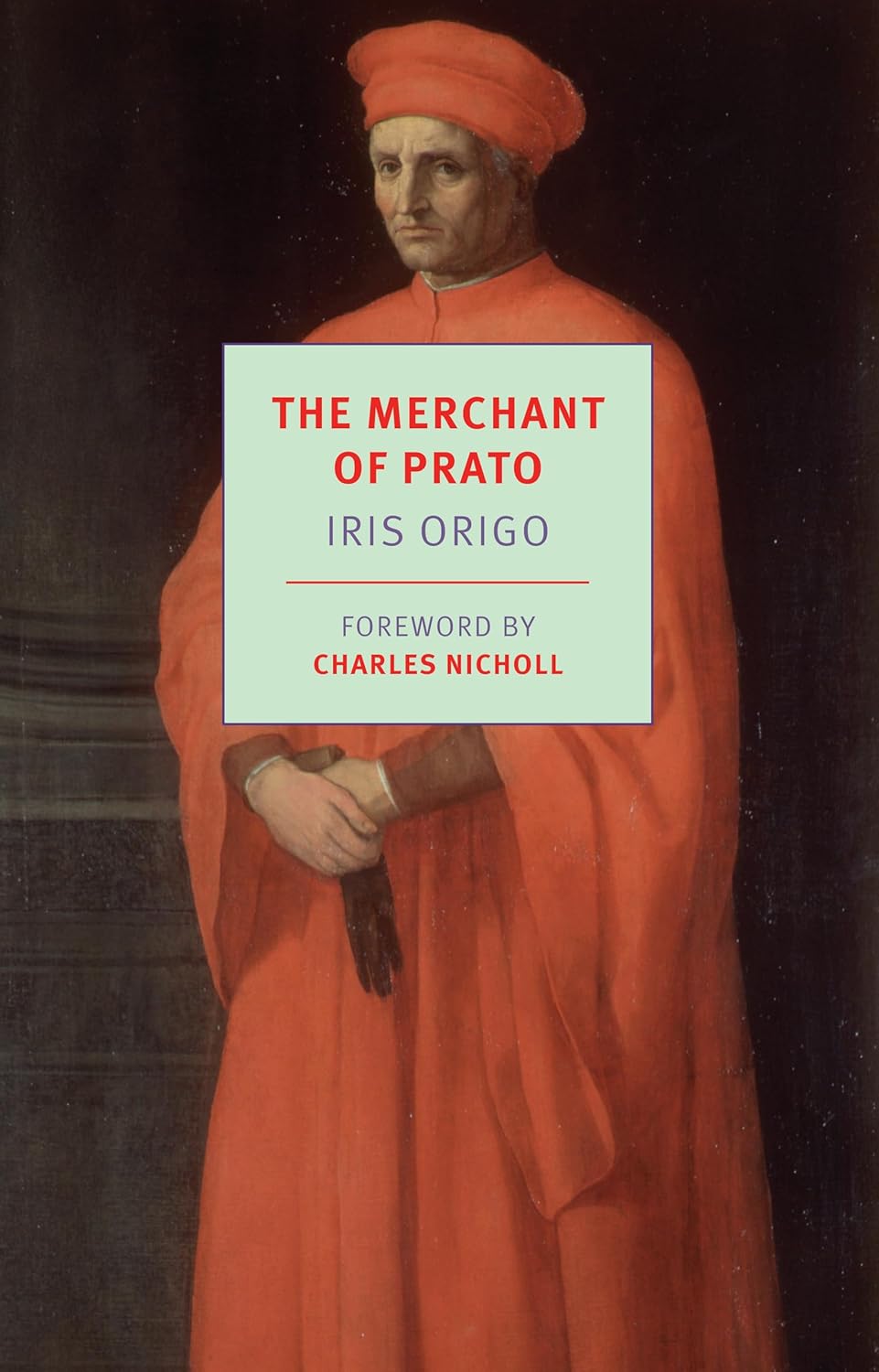
The Merchant of Prato (1957) by Iris Origo has long deserved its reputation as a modern classic of historical writing. I had the good fortune to read this remarkable book while traveling through Bologna in the spring of 2026, an ideal setting for Origo’s vivid reconstruction of late medieval Italy. At its center is the extraordinary rise of Francesco di Marco Datini, a penniless orphan from humble beginnings who left Prato for Avignon at fifteen and returned three decades later unimaginably wealthy – a story with all the contours of a medieval Horatio Alger tale. As Charles Nicholl observes in the foreword, Datini emerges in Origo’s hands as “a kind of archetype of modern capitalism.” His life survives through an astonishing archive of eleven thousand letters and five hundred account books, documents Origo herself describes as “unliterary, unpolished, unromantic, self-repetitive.” From this mountain of correspondence she reconstructs, with remarkable intimacy and precision, the world of a restless, anxious, and fiercely ambitious merchant dealing in armor, wool, metals, wheat, paintings, slaves, and countless other commodities, while enduring the strains of a deeply unhappy and childless marriage to the daughter of an executed nobleman.
Datini’s family was largely wiped out in the first wave of the plague in 1348. Two years later, in 1350, he left Tuscany alone for Avignon to seek his fortune in what Origo describes as “an almost inexhaustible luxury market.” His surviving archive of correspondence begins in 1372, and Origo notes that the dominant tone of these early letters is one of pride, arrogance, and relentless self-confidence.
In 1376 he married Donna Margherita. She brought no dowry, but she was young, beautiful, and of noble blood — quite a prize for the son of a humble butcher. When Datini returned to Prato in 1382, the small Tuscan town numbered perhaps twelve thousand inhabitants, “a society of industrious, God-fearing, law-abiding, thrifty men,” in Origo’s memorable description. Datini soon entered the cloth guild, the Arte della Lana, and rapidly established himself as one of the town’s leading merchants. In 1388 he joined the Florentine guild of silk merchants – the Arte di Por Santa Maria – and in 1399 he joined the money-changers guild (Arte del Cambio) and 1404 joined yet another guild, that of the cloth-finishers (Arte di Calimala). Yet, as Origo observes, he was respected more than he was liked by his fellow Pratesii and Florentines, where he was considered “an outsider, a yokel, and an upstart,” Origo says.
Datini carefully avoided politics and public office, steering clear of the endless factional quarrels that consumed so many Italian communes. Secretive by nature, he guarded the details of his trade closely and, at least at first, displayed few outward signs of his immense and growing wealth. Among his early ventures was the importation of English cloth and wool — the former subject to an export tax of only two percent, the latter burdened by duties approaching one-third of its value.
The journey of these commodities was extraordinarily long and complex. In the first stage alone, raw wool took as much as fourteen months to travel from the trading posts of Majorca to the workshops of Prato. Transforming the wool into finished cloth required another six months, after which the merchants still faced the lengthy process of selling the completed product, often taking a year or more. From beginning to end, a single commercial cycle could stretch across four years. Yet after accounting for the cost of raw materials, transport, packing, tolls, insurance, taxes, manufacturing, and sales, the final profit margin was only about nine percent. The combination of slow turnover and modest returns ultimately discouraged Datini from committing too much capital to the trade.
Datini’s defining trait as a merchant was the astonishing breadth of his activities. At various times he was an armourer, mercer, shopkeeper, moneychanger, and international trader, constantly shifting capital and attention wherever opportunity beckoned. Yet one of the central themes running through Origo’s narrative is Datini’s deep and abiding anxiety. “He conducted his trade,” she writes, “with the knowledge that every venture was precarious, and every achievement at the mercy of events beyond his power and control.” His fortune, Origo suggests, was built less on spectacular risks than on the patient accumulation of countless modest gains over decades of disciplined work. He was, in essence, a cautious and highly pragmatic businessman who avoided politics, lent no money to kings or prelates, and financed no wars.
The typical commercial arrangement of the period was the short-term company: a partnership, usually lasting two or three years, in which a small group of merchants pooled capital and shared profits. In theory, no member was permitted to belong to more than one company at a time. In practice, however, Datini maintained interests in several firms simultaneously, each firmly under his control. Many of his so-called “partners,” Origo notes, were in reality “little more than shareholders without a vote.”
Datini’s far-flung enterprises were managed day to day by salaried agents known as fattori, who represented his interests in trading centers across Europe. “If the brains were those of the great merchants at home,” Origo writes, “the risks and the daily toil were those of their anonymous, forgotten servants.” Yet the remarkable feature of Datini’s commercial empire was how personally he supervised it all. With almost no administrative staff, he acted simultaneously as strategist, clerk, accountant, and overseer, attempting to direct every detail through an endless stream of correspondence. Much of this obsessive control sprang from his profoundly cynical view of human nature: he regarded most men as fundamentally dishonest, self-interested, and greedy. The consequence was predictable. Despite his immense wealth and success, Datini seems rarely to have known a peaceful hour.
Datini’s marriage to Donna Margherita was frequently strained and often marked by long separations. Origo places much of the blame on Datini himself, describing him as “irascible, restless, unfaithful and cross … a difficult man, either to serve or love.” Yet Donna Margherita, for her part, “was neither Beatrice nor Griselda” — neither an ethereal muse nor a meekly submissive wife. Intelligent, strong-willed, and emotionally resilient, she proved more than capable of resisting her husband’s moods and demands. The couple’s childlessness, combined with Datini’s lack of close family ties, would cast an increasingly heavy shadow over his later years.
One of the most fascinating aspects of Origo’s narrative is the window it opens onto the economics of everyday life in late medieval Tuscany. A pig, for example, cost about three florins, while a housekeeper earned roughly ten florins a year. A wet nurse might receive twelve florins annually, and a dowry for a poor girl about fifteen. A physician earned approximately sixty florins a year. Luxury goods, however, could command staggering sums: a fine fur-lined coat might cost thirty-five florins, while an elegant gown could fetch as much as seventy-five. Although sumptuary laws theoretically restricted such displays of wealth, they were widely ignored in practice.
Transportation and status animals were similarly expensive. A good riding horse cost up to twenty florins, while a fine mule could range anywhere from fifty to one hundred florins. A female slave sold for roughly fifty-five florins. An acre of farmland outside Prato cost about twenty florins, while the dreaded prestanzone — a compulsory “loan” to the Florentine government that functioned as a form of taxation — could extract as much as two hundred and fifty florins at a time.
If there is a true hero in The Merchant of Prato, it is Datini’s trusted assistant and notary, Ser Lapo Mazzei, who was fifteen years younger than his employer. Origo portrays Ser Lapo as an ideal humanist in the mold of Leon Battista Alberti: thoughtful, learned, deeply Christian, and compassionate toward the poor — the very opposite of the “rough, restless, grasping merchant” he served. It was Ser Lapo who eventually taught Donna Margherita to read and write, an accomplishment still regarded at the time as both exceptional and, in some quarters, faintly dangerous for a woman.
Unlike the childless Datini household, Ser Lapo presided over a large and vibrant family, fathering fourteen children, five of whom survived into adulthood. Throughout the book he serves, in many respects, as Datini’s conscience, struggling patiently against his employer’s coldness, cynicism, and spiritual pride. Ser Lapo’s influence would prove decisive in Datini’s final years, playing a central role in persuading the aging merchant to leave his immense fortune – some 70,000 florins – to the poor of Prato.
In the end, The Merchant of Prato is far more than the biography of a successful medieval merchant. Through the astonishing survival of Datini’s letters and account books, Iris Origo reconstructs an entire world: its commerce, anxieties, marriages, ambitions, pieties, and daily routines. What emerges is not a romantic portrait of the Renaissance merchant class, but something far more compelling — a deeply human story of wealth pursued at enormous emotional and spiritual cost. Datini built a commercial empire through discipline, caution, and relentless labor, yet he remained restless, suspicious, and profoundly lonely. Origo’s achievement lies in transforming dusty ledgers and business correspondence into a work of remarkable intimacy and psychological depth. Nearly seventy years after its publication, the book remains not only a masterpiece of social history, but also a timeless meditation on ambition, insecurity, and the uneasy relationship between material success and human fulfillment.


Leave a Reply