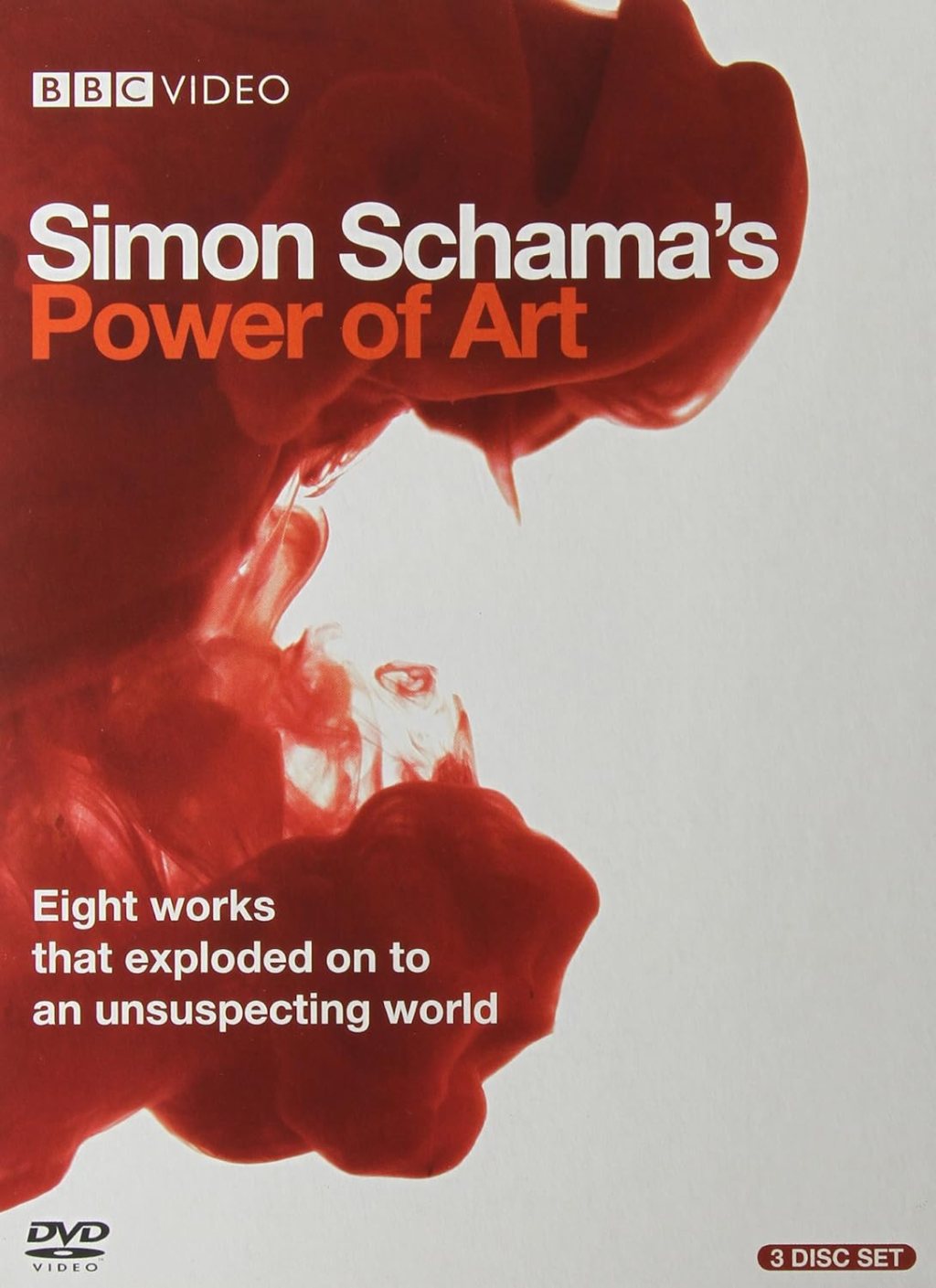
Simon Schama’s The Power of Art (2006) is less a history of art than a forceful meditation on why certain artists still command our attention centuries after they lived. Schama’s core argument is that truly great art is not decorative, polite, or merely technically accomplished – it is disruptive. It shocks, unsettles, compels, and, at its highest level, alters how humanity understands itself. To make that case, Schama centers each chapter on a single masterpiece, treating it as the distilled expression of an artist’s genius and historical significance. What emerges is not only a gallery of extraordinary works, but a sweeping argument that art’s greatest power lies in its ability to fuse personal vision with moral and emotional force.
For Schama, Caravaggio’s David with the Head of Goliath is the work of a man painting his own reckoning. Caravaggio’s genius was his ruthless realism – his insistence that sacred and heroic subjects be rendered with dirty feet, bloodshot eyes, and brutal physical truth. But in David with the Head of Goliath, Schama sees something deeper: confession. The severed head is widely believed to be Caravaggio’s own likeness, transforming the biblical story into a meditation on guilt, self-loathing, and redemption. This is why Caravaggio endures: he brought divinity down into the grime of ordinary life and made psychological honesty inseparable from artistic greatness.
Gian Lorenzo Bernini’s The Ecstasy of Saint Teresa represents, for Schama, the full theatrical flowering of the Baroque imagination. Bernini understood that religious experience needed to be felt viscerally. His marble saint is suspended between agony and bliss, caught in a moment so sensual that modern viewers are often startled by its erotic intensity. Schama argues that Bernini transformed sculpture by animating stone with flesh, emotion, and movement, creating sacred drama that overwhelms the senses. He made art immersive, emotional, and alive in a way no sculptor before him had achieved.
Schama treats Rembrandt’s The Conspiracy of Claudius Civilis as the defiant masterpiece of a proud artist in decline. Financially ruined and increasingly unfashionable, Rembrandt responded not by flattering taste but by painting with greater boldness, mystery, and moral gravity. Schama sees in this monumental canvas a statement of artistic independence – thick paint, shadowy forms, and dramatic solemnity deployed in service of liberty, resistance, and sacrifice. Rembrandt’s greatness lies in his refusal to compromise. He painted not for applause, but for truth.
With Jacques-Louis David’s The Death of Marat, Schama examines art as political weapon. David transformed the murdered revolutionary Jean-Paul Marat into a secular saint – serene, noble, purified by sacrifice. Schama’s insight is that David understood images can create political myth more powerfully than speeches or laws. Here was art not merely reflecting revolution, but helping construct its moral narrative. David deserves remembrance because he demonstrated that painting could shape ideology itself.
J. M. W. Turner’s The Slave Ship is, for Schama, moral fury rendered as atmosphere. Turner dissolves line and form into violent color, storm, and sea, making nature itself seem to rage against human cruelty. Inspired by the atrocity of enslaved people thrown overboard for insurance claims, Turner created a painting of apocalyptic beauty and horror. Schama argues that Turner’s revolution was to paint force itself – light, motion, terror, sublimity – anticipating modern abstraction while wielding art as ethical indictment.
For Schama, Vincent van Gogh’s Wheatfield with Crows is not merely the work of a troubled mind, but of a visionary who turned emotional intensity into a new language of seeing. The blazing yellow fields, violent sky, and uncertain path evoke beauty, dread, and spiritual longing all at once. Van Gogh’s transformation was to make feeling itself the architecture of painting. He taught modern art that subjective truth could be more profound than objective representation.
Schama presents Pablo Picasso’s Guernica as perhaps the twentieth century’s greatest cry of protest. Responding to the bombing of civilians during the Spanish Civil War, Picasso shattered bodies, animals, and architecture into fractured anguish. Schama argues that Cubism here became moral language – fragmentation as the only honest response to mechanized slaughter. Guernica endures because it transformed modernist experimentation into universal testimony against barbarism.
Finally, Mark Rothko’s Seagram Murals represents, in Schama’s telling, the stripped-down culmination of centuries of spiritual art. Rothko abandoned image, narrative, and symbol, reducing painting to hovering planes of color that confront viewers with silence, melancholy, awe, and dread. Schama insists Rothko’s abstraction is anything but empty – it is cathedral-like in emotional weight. Rothko proved that in a secular age, art could still create sacred space.
The enduring brilliance of The Power of Art is Schama’s insistence that these artists matter not because they were masters of craft – though they were – but because each permanently expanded what art could do: confess, overwhelm, resist, persuade, accuse, lament, and transcend. Their masterpieces changed not just painting or sculpture, but the moral and emotional vocabulary of civilization itself.
 What's Tim Reading Now?
Leave a comment