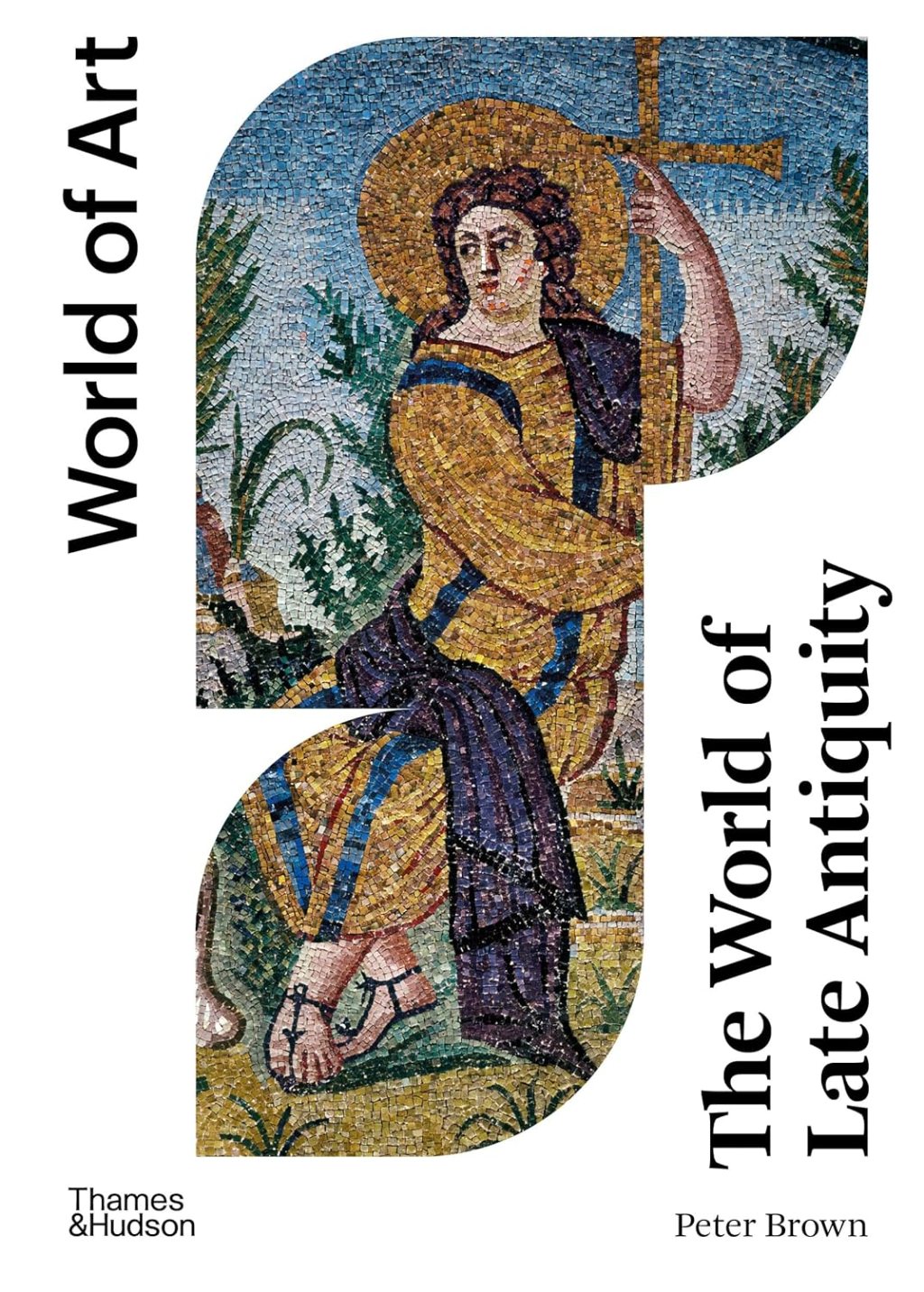
At the heart of The World of Late Antiquity by Peter Brown (1971) is a focus on continuity. Rather than seeing a sharp break between classical antiquity and the medieval world, Brown emphasizes the persistence and evolution of institutions, ideas, and social structures. The Roman state did not simply vanish; it mutated, most notably in the Byzantine East. Urban life contracted in many regions but remained vibrant in others. Classical culture was not extinguished but selectively preserved, reshaped, and repurposed within Christian and later Islamic contexts.
Brown defines Late Antiquity as the roughly five centuries between 200 and 700 AD. Rather than an era of decline and fall, he presents it as a period of profound social and cultural transformation that gave rise to “astounding new beginnings.” A central theme of his narrative is how people navigated and adapted to the sweeping changes brought about by a deep spiritual and cultural revolution. The convergence of so many simultaneous shifts produced a distinct phase of European civilization. In Brown’s view, Late Antiquity was a world “vibrant with change,” in which the ancient traditions of Greece and Rome underwent a final – often rapid – transformation that laid the foundations for the medieval era and, in many respects, the modern world.
The story of the Roman empire at its height around 200 AD is often told through the lens of the roughly ten percent of the population living in urban centers clustered along the narrow Mediterranean coastline—“like frogs around a pond,” as Socrates famously observed. This relatively small, interconnected world produced a strikingly uniform culture, shared tastes, and a common language. The Roman governing class was notably tolerant of local customs and religions, but it also expected a degree of cultural conformity. Urban society was defined by clear and rigid social boundaries.
A central theme of Brown’s work is the gradual shifting and redefinition of boundaries after about 200 AD. He highlights a period of intense and often anxious religious activity between roughly 170 and Conversion of Constantine, driven in part by a revival of oracles and the growing prominence of holy men who offered more personal forms of connection with the divine. At the same time, the devil and a host of demons came to be seen as ever-present and malevolent forces.
One of Brown’s most influential contributions is his treatment of religion as a central driver of change. He places the rise of Christianity – and later Islam – not as epilogues to Rome, but as defining features of the age. Brown explores how religious authority reconfigured social and political life, particularly through the emergence of new figures such as bishops, monks, and holy men. His famous analysis of the “holy man” as a mediator between the local community and the divine helped redefine how historians understand authority in a world where traditional civic structures were weakening. Power became less about imperial office and more about spiritual charisma and local influence.
“In few ages has one half of the world lived in such stalwart indifference to how the other half was living as in the Roman Empire in the second century,” Brown observes. Between 200 and 300 AD, Christianity spread steadily across the empire, deepening the divide between urban centers and the countryside. During this period, the traditions and local loyalties on which the upper classes relied began to erode – slowly and imperceptibly. The hinterlands of the empire were, in effect, becoming a different world.
Those uprooted or dislocated from traditional social structures proved especially receptive to the new religious movements and cults, including Christianity, that proliferated during this time. Brown is careful to stress that Christianity’s expansion was neither inevitable nor purely gradual; it must be understood within the broader context of the social and cultural upheavals of the third century. Something was missing in the life of the rural Roman town – something Christian missionaries proved adept at addressing and exploiting. According to the author, Christianity offered a sense of community, whose demands and relations were explicit, that appealed to men who felt deserted. Meanwhile, the turnstile of emperors were too preoccupied with the frontiers and a collapsing economy to care about Christians in the mid-third century. “Seldom has a small minority played so successfully on the anxieties of society as did the Christians,” Brown writes. “They remained a small group: but they succeeded in becoming a big problem.”
Brown argues that the most consequential boundary in Late Antiquity was the one drawn after death. In the third century, religious movements gained influence by promising their adherents victory and rest in the afterlife, challenging the older civic consensus centered on traditional public worship. From multiple directions, that long-standing religious order began to erode, giving way to new forms of belief and spiritual allegiance.
Brown argues that, over the course of the third century, Christianity developed into a church capable of absorbing an entire society. The conversion of Constantine the Great – and, perhaps even more important, the sustained diffusion of Christian ideas now permitted within the empire – helped enable Christianity’s rapid ascendancy between 300 and 363 AD, one of the most consequential transformations in world history.
In this new order, the Christian bishop emerged as a member of the intellectual elite, particularly in the Greek-speaking cities. These leaders argued that the finest traditions of classical philosophy and the highest standards of classical ethics could be preserved against barbarism only by being grounded in Christian revelation – and that the embattled Roman Empire itself had been spared from destruction through the protection of the Christian God.
The classical world tended to conceive of religion in terms of institutions and rituals – shrines, temples, and festivals that overshadowed the individual. By the fourth century, that balance had shifted: the individual increasingly eclipsed the community, whether in the form of the emperor dominating the Senate and the city of Rome, or the bishop or holy man assuming authority over local society. At the same time, asceticism spread across the Roman world, offering those who felt dislocated a chance to begin life anew, often within the confines of a monastery.
Brown characterizes monasticism as both an act of withdrawal and a form of protest. Moreover, it eased the transition from senator to bishop, from all powerful imperial court to “the austere gerontocracy of the Catholic Church.” These ascetics constituted a kind of Roman counterculture, fashioning themselves, in his words, as “prize-fighters against the devil.” The figure of the holy man – holding demons at bay and, through prayer, bending divine will – came to occupy a central place in late antique society. Though a small minority, such individuals embodied an ideal of piety admired by the broader population, believed capable of confronting in this life the terrors of the Last Judgment. Brown says the monks were the “midwives” that helped transform Christianity into a mass religion. In Brown’s view, the rise of the holy man at the expense of the temple marks the true end of the classical world.
Nevertheless, Rome’s geographic grip on the Mediterranean steadily weakened: Britain was abandoned by 410, Gaul by the late fifth century, and Mesopotamia fell to Islamic forces by the mid-seventh century. “As the Mediterranean receded,” Brown writes, “so a more ancient world came to light.”
Rome was a vast, slow-moving, and predominantly agricultural society. In the ancient world, food was the most precious commodity. Transporting it by sea or river was relatively cheap and easy, but over land was often prohibitively expensive. As a result, inland communities remained largely isolated from the cultural life of the cities and from one another.
Between roughly 240 and 300 AD, the empire was shaken by invasions and political instability. This “crisis of the third century” exposed the stark contrast between the Mediterranean core of Roman civilization and the more fragile, less developed regions inland and along the frontiers. Over the course of a single generation – from about 245 to 270 – nearly every frontier collapsed. The Roman world fractured, and competing armies elevated some twenty-five emperors in just forty-seven years.
Brown argues that the crumbling Roman empire of the third century was ultimately stabilized by a military revolution driven largely by professional soldiers from the provinces. The traditional legion was reorganized into smaller, more flexible units capable of defense in depth, while the size of the army expanded to well over half a million men. To sustain this force, the imperial bureaucracy – and the tax apparatus that supported it – grew significantly.
Brown notes that the conservative aristocratic elites in Rome never fully embraced this “New Model Army,” in part because it became, in his words, “an artesian well of talent,” elevating capable men of humble or provincial origins – much as Napoleon’s marshals would centuries later – and displacing the traditional aristocracy from its hold on power. By the end of the reign of Constantine the Great in 337, a new “aristocracy of service” had firmly established itself at the top of Roman society.
The author highlights two defining features of this new elite. First, it was animated by a genuine commitment to excellence, grounded in the careful cultivation of classical ideals. Second, it remained open – at least in principle – to talent from across the empire, allowing figures such as Plotinus, Augustine of Hippo, and Jerome to rise through its ranks. This hybrid order, blending old traditions with new forms of merit, helped restore a measure of stability and prosperity to the Roman world for the next century.
The newly established governing class ushered in what Brown calls an “Age of Restoration” (reparatio saeculi), as the Roman world demonstrated striking resilience and renewed economic vitality. Cities expanded even as smaller towns declined, and the fourth century, in Brown’s telling, became an era of revival marked by the rapid accumulation of wealth. Yet this prosperity was unevenly distributed: the gap between rich and poor widened dramatically – by as much as fivefold. At a time when a peasant might earn five gold pieces a year and a successful merchant perhaps 200, a prominent senator or provincial magnate could command incomes as high as 120,000. These figures became focal points of local loyalty and often funded major civic works in their regions. Despite their immense wealth, Brown emphasizes that this new class of super-elites remained, in important ways, remarkably open to new talent.
Brown argues that the most immediate legacy of Late Antiquity was the widening rupture between East and West. A key factor in this split was the contrast in political and social loyalties. The East, more populous, urbanized, and commercially oriented, was also wealthier and maintained a relatively strong allegiance to the emperor. By contrast, much of the West remained overwhelmingly rural and underdeveloped. Its more fragile economy struggled to withstand the pressures of heavy taxation and repeated invasions. Yet despite these differences, both regions underwent profound transformations in religion and culture, marking a decisive break from the classical world of around 200 AD.
Brown also broadens the geographical lens. Late Antiquity, in his telling, is not confined to Rome or even the Mediterranean but extends into Persia, Arabia, and beyond. This wider scope helps integrate the rise of Islam into a shared late antique world rather than treating it as an external rupture. The effect is to place Christianity and Islam within a common continuum of religious and cultural development.
By 350 AD, the center of gravity of the Roman world had shifted decisively to the eastern Mediterranean, while the western empire edged toward collapse. Brown concedes that the causes of this breakdown were complex, involving a combination of economic contraction and declining morale. He highlights, in particular, the generation between 380 and 410, when the two dominant power groups in the Latin West – the senatorial aristocracy and the Catholic Church – began to distance themselves from the Roman army, the very institution that sustained their security.
Brown identifies Valentinian I (r. 364–375) as the last strong western emperor, whose strict discipline and merit-based promotions alienated the civilian elite. By contrast, under Valentinian III (r. 425–455), high office had become “a virtual appanage of the Italian and Gallic nobility,” whose leadership was often amateurish and driven by narrow and vested interests. Ironically, many of the era’s most vocal defenders of the old order were unreformed pagans.
This society, Brown argues, proved neither strong enough to repel external pressures nor flexible enough to absorb them. The result resembled a kind of gold rush, as peoples from the less developed regions north of the empire moved into and exploited the wealth of the Mediterranean world. The Visigoths crossed the Danube in 376 and entered Italy in 402; the Vandals moved into Gaul and Spain in 406. Although their leaders were often willing to integrate into Roman society and partake in its prestige, they were largely excluded. These groups became, in Brown’s phrase, at once “powerful and unabsorbable,” forced to remain tight-knit warrior elites – foreign bodies perched uneasily atop populations that largely carried on with their own affairs.
Some elements of Brown’s interpretation have been refined or challenged over the past fifty years. Later historians have reintroduced a greater appreciation for material decline in the western provinces and have emphasized economic contraction more than Brown did, such as Adrian Goldsworthy’s How Rome Fell. But even these revisions tend to operate within the framework he established rather than rejecting it outright.
In sum, The World of Late Antiquity remains a landmark work not because it settled debates, but because it changed the questions historians ask. It is one of those rare works that doesn’t just reinterpret a period – it effectively creates a new one. Before Brown, the centuries between roughly the third and eighth centuries AD were commonly framed as an era of decline: the “fall” of the Roman empire and the onset of the so-called Dark Ages. Brown overturned that narrative. His central argument is that Late Antiquity should be understood not as a story of collapse, but as a period of transformation, adaptation, and cultural creativity stretching from the Roman empire into the early medieval and Islamic worlds. Thus, Brown replaced a story of endings with one of beginnings – and in doing so, permanently altered how we understand the transition from the ancient to the medieval world.
 What's Tim Reading Now?
Leave a comment