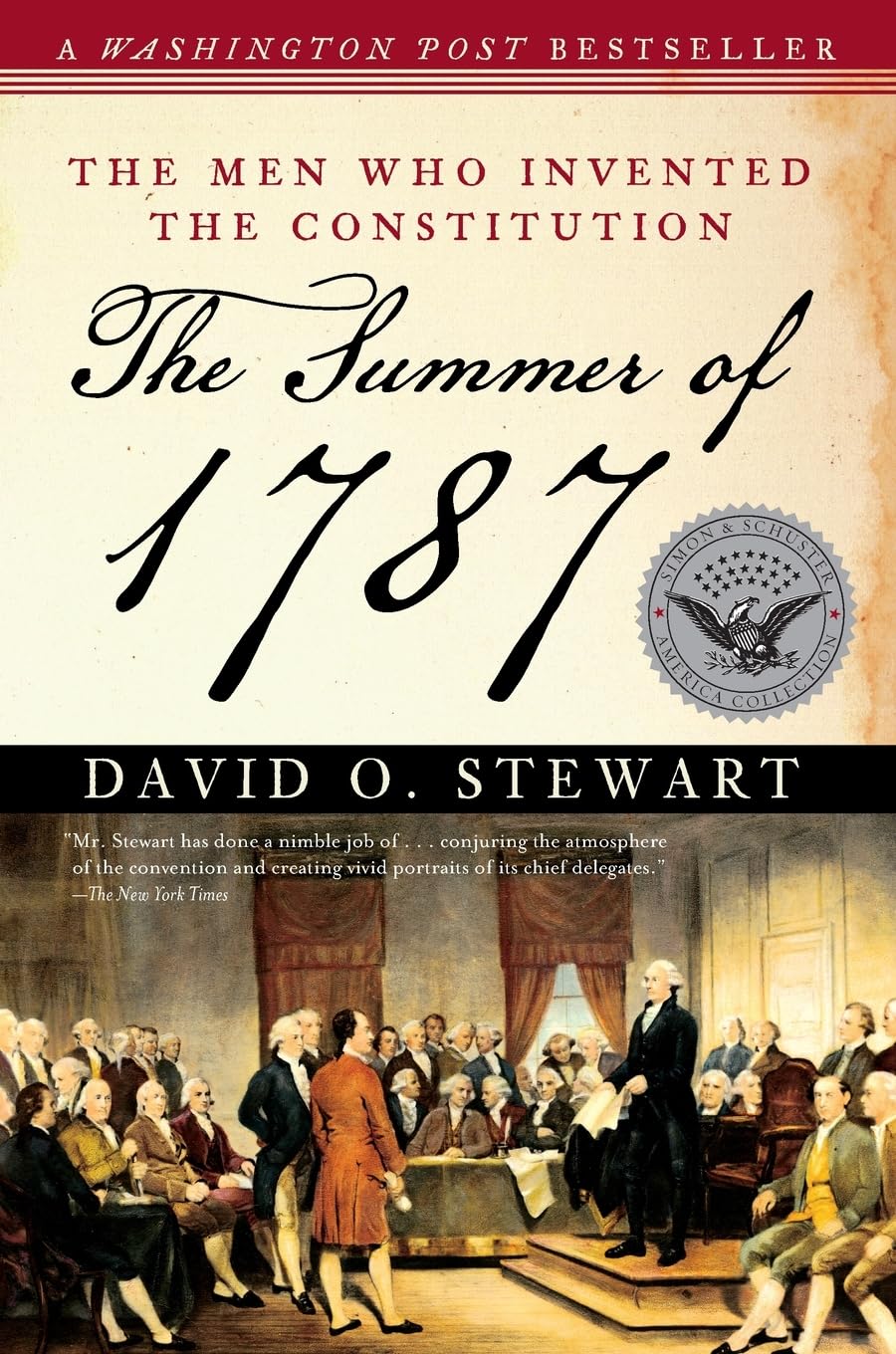
In March 1785, Virginia planter George Mason traveled to George Washington’s estate at Mount Vernon to discuss a matter of shared concern: fishing, taxation, and toll rights on the Potomac River. A royal charter issued by Charles I of England in 1632 had defined Maryland’s boundary as extending to the far bank of the river, fueling more than a century of disputes between the two states. In theory, the Articles of Confederation prohibited states from entering into agreements without congressional approval, but the Confederation was too weak and ineffective to resolve such conflicts. Washington famously described it as “a half-starved, limping Government that appears to be always moving on crutches, tottering at every step.” In response, Virginia and Maryland proposed a series of regularly scheduled interstate conferences to settle their differences, even inviting Delaware and Pennsylvania to participate. If the central government could not govern, the states would have to act themselves. As historian David O. Stewart argues in The Summer of 1787, this modest meeting between two Virginia political and economic luminaries helped plant the seeds for the Constitutional Convention – where Washington’s decision to attend and preside would prove decisive.
Stewart next points to the domestic unrest in Massachusetts known as Shays’s Rebellion as a critical catalyst in persuading George Washington to abandon the role of a permanently retired Cincinnatus and reenter public life in support of meaningful reform of the national government at the proposed Philadelphia convention in May 1787. “I am mortified beyond expression,” Washington wrote in response to the armed assault on the Springfield Armory by local farmers and the failure of the Massachusetts militia to respond effectively.
Although Stewart draws on Leonard Richards’s revisionist but expertly researched Shays’s Rebellion: The American Revolution’s Final Battle, he largely adheres to the traditional interpretation of the uprising as the product of widespread rural indebtedness, resentment over court fees that favored creditors, and an undercurrent of radical “leveling” across social classes. He gives less attention to the role played by proposals to redeem state war debt at face value, which stood to benefit a small group of Boston speculators. In any case, Stewart acknowledges that the “political impact [of Shays’s Rebellion] was immense.” Even before the uprising, the Confederation Congress had demonstrated its inability to issue stable currency, maintain an army, regulate trade, or raise revenue. As a result, the young nation stood perilously close to dissolution.
Stewart argues that the Confederation Congress functioned less as a true national government than as a diplomatic forum in which independent states pursued their own interests. This weakness left Americans to contend with what he describes as the twin scourges of “bad money and confusing money.” In 1780, for example, a sheep might cost $150 in Continental paper currency but just $2 in hard coin. By 1785, the dollar traded at different exchange rates across the states. Stewart characterizes the monetary system of the 1780s as one of “monetary anarchy,” in which “every citizen was a currency trader, and every transaction carried the risk of being cheated.” The absence of a stable, credible currency in turn crippled government finances: by 1786, ten of the thirteen states had failed to meet their requisitions, and South Carolina had contributed nothing for three years. “Vagabondage,” Stewart concludes, “is not the hallmark of a great government.”
Twelve states appointed seventy-four delegates to the Constitutional Convention, though only fifty-five ultimately arrived in Philadelphia, and just over half of those – thirty in total – remained for the full four months. Of these committed participants, more than half came from just three states – South Carolina, Pennsylvania, and Virginia – whose delegations were present for nearly the entire duration. No more than eleven states were represented at any one time. Among the fifty-five delegates, twenty-nine had served in uniform during the Revolution, thirty-five were lawyers, thirteen were engaged in trade, and about a dozen owned or managed slave plantations. Collectively, they were widely regarded as an all-star assembly; as Alexis de Tocqueville later observed, the convention brought together “the choicest talents and the noblest hearts which had ever appeared in the New World.”
Notable absentees included John Adams and Thomas Jefferson, both serving abroad, as well as prominent states’ rights advocates Samuel Adams and Patrick Henry. Those who did attend broadly agreed on the central solution to the nation’s predicament: power had to be shifted away from the states and vested in a stronger national government. The most passionate defenders of local rights – those who would become known derisively as anti-Federalists – were not present to argue their view.
The Virginia delegation loomed large from the outset of the convention. George Washington was elected to preside, and Edmund Randolph opened proceedings by introducing fifteen resolutions that became known as the Virginia Plan. As Stewart notes, the plan “started with a lie”: its opening resolution proposed that the Articles of Confederation be merely “corrected and enlarged,” when in fact it sought to replace them entirely. While the Virginians initiated the entire process of rewriting the constitution, they would not ultimately control its final form.
The Virginia Plan envisioned a powerful national government centered on a bicameral legislature. The “first branch” (the future House of Representatives) would elect the “second branch” (the Senate), and together these bodies would choose the executive and the judiciary. It did not clearly enumerate federal powers, offered no developed system of checks and balances, and made little provision for state sovereignty. It was a far cry from the final constitution that emerged four months later.
At the same time, the plan introduced two issues that would dominate the convention’s debates: representation based on population rather than the one-state, one-vote structure of the Articles, and the unresolved question of slavery: how, or whether, enslaved people would be counted for purposes of representation in a nation where, from Maryland to Georgia, they made up roughly forty percent of the population.
Stewart argues that James Wilson of Pennsylvania was the convention’s leading advocate for democratic principles in the form of proportional representation. The clash between large and small states came to dominate the proceedings, though Stewart concedes that to modern Americans the divide may seem “as quaint as a minuet or a duel at dawn.” At the time, Virginia, Pennsylvania, and Massachusetts – despite their sharply different economies, driven respectively by tobacco, flour, and fish – accounted for nearly half of the nation’s population and formed the core of the large-state coalition.
James Madison believed the small states were far from unified. In the North, New York and Connecticut favored preserving the Articles of Confederation despite their evident weaknesses, while Delaware and New Jersey were open to a new national government so long as states retained equal representation in the legislature. The small southern states – Georgia, Maryland, and the Carolinas – proved more flexible, willing to support a range of outcomes so long as their system of slavery was protected, and potentially strengthened, within the new constitutional framework. James Wilson seized on this opening to its fullest extent, much to the dismay of later generations.
Wilson played a central role in forging what later critics would call a Faustian bargain – a “covenant with death” – that produced the Three-Fifths Wilson-Rutledge Compromise, effectively securing southern support for proportional representation. In 1787, slavery was deeply entrenched in American society: roughly 681,000 enslaved people made up about sixteen percent of the population. While present in every state, its concentration varied widely; in places like South Carolina, nearly half the population was enslaved, even as overall numbers had declined in parts of the South during the Revolution.
Interestingly, the three-fifths ratio was first devised in 1783 under the Articles of Convention as a basis under which to apportion tax burdens. At that time the southern states wanted slaves to be counted at one-half their number while the northern states proposed three-quarters. Three-fifths was thus a rather random compromise that nevertheless came to dominate American politics for almost the next century. At the core of the argument was whether black slaves were human beings or property. The three-fifths clause essentially concluded they were both. The three-fifths clause would result in fourteen extra House seats for the southern states in 1793, eventually growing to twenty-seven additional seats in 1812. Stewart writes that Stewart paid a high price to win the support of the southern states to the big state view of proportional representation.
The small states responded to the emerging large state / slave state coalition with the so-called New Jersey Plan. Unlike the Virginia Plan, it genuinely sought to revise and strengthen the Articles of Confederation rather than replace them outright. It granted Congress authority to regulate trade but retained the system of state requisitions for revenue, apportioned according to the population of free citizens plus three-fifths of all others. The plan called for a unicameral legislature in which each state cast a single vote, with unanimity required for certain measures and a supermajority – nine states – for others. Stewart portrays its leading advocates, such as William Paterson of New Jersey, as cautious to a fault, writing that they “demonstrated a curious instinct for the capillary, not the jugular.” In the end, the large state / slave state alliance held firm, bolstered by the somewhat incongruous support of Connecticut.
The delegate who altered American political history was an obscure member from Georgia (but originally from Connecticut) named Abraham Baldwin. In a crucial committee vote, Baldwin sided with the large states – creating a temporary majority that kept proportional representation alive as a viable path forward. This shift helped prevent the convention from collapsing and opened the door to the eventual Connecticut Compromise. “The momentum shift was seismic,” Stewart says, “Now the stalemate was real.” Without Baldwin’s timely switch, the large-state position might have failed outright, potentially derailing negotiations—so his vote helped keep alive the compromise that ultimately defined the structure of Congress and the balance between state and national power.
By mid-July, tempers were flaring amid stifling heat – windows kept shut to preserve secrecy – and a lack of meaningful progress on the central issues, most notably the content over legislative representation. According to Stewart, the august assembly of America’s brightest minds had quickly devolved into a cockpit of power politics. After eight weeks of stalemate, the small-state delegates ultimately wore down the large states, including the Virginia delegation, through what Stewart describes as “equal parts of inspired bluff and determined advocacy.” Despite having the most to lose from the failure to establish a strong central government, they persuaded their larger counterparts – and their southern slave state allies – that they would walk out of the convention unless equal representation by state was guaranteed. Stewart characterizes their success in securing equal representation in the Senate as a “remarkable” political triumph.
Not only did the small states narrowly secure an important victory, but the interests of future states were also at stake. Elbridge Gerry of Massachusetts proposed structuring the new government so that the original thirteen states would always hold a majority in the national legislature over any combination of newly admitted states. The motion failed by a single vote. In rejecting it, the convention embraced a novel principle: that new states would enter the Union on equal footing with the original members. In short, the former colonies would not become colonizers. This decision marked a decisive turn toward fairness and equality for the expanding West and presented another unprecedented achievement of the Constitutional Convention.
Another unprecedented achievement was the inclusion of antislavery provisions in the Northwest Ordinance, which Stewart calls “the Ipswich Miracle,” after the Massachusetts hometown of its chief architects, Rev. Manasseh Cutler and Nathan Dane. Stewart argues that the southern states that supported these provisions fundamentally misread their long-term implications. From their perspective, the Northwest Territory would likely be settled primarily by New England migrants and could serve as a containment zone for abolitionist sentiment. Additionally, by excluding slavery, southern leaders believed they would avoid economic competition in staple plantation crops such as tobacco and indigo north of the Ohio River. In their view, they had struck a favorable bargain – securing a fugitive slave clause in exchange for designating the Northwest Territory as free soil.
The role of the chief executive proved one of the convention’s most vexing challenges. In the late eighteenth century, the very idea of a non-hereditary national leader was difficult to conceive; even republics such as Switzerland operated without a single executive authority. Delegates worried that any presidency would be dominated by candidates from the largest states, and most recoiled at the notion of direct popular election. Gouverneur Morris’s proposal for election by the people was decisively rejected, 9–1, amid widespread concern that the public was too easily misled and unreliable.
Various alternatives were floated. Some favored selection by Congress, while others sought more indirect mechanisms. James Wilson even proposed a lottery system in which a group of fifteen randomly chosen congressmen would select the president. As Stewart observes, “the delegates were dizzy with alternatives…the Convention had lost its rudder on the issue.”
On July 27, the Constitutional Convention adjourned for a prearranged eleven-day recess. During the break, a five-member Committee of Detail remained behind to organize and synthesize the nineteen statements of principle developed over the preceding six weeks, most of which were derivatives of the original proposals put forward in the Virginia Plan. John Rutledge of South Carolina chaired the group, which included Oliver Ellsworth of Connecticut, Nathaniel Gorham of Massachusetts, James Wilson of Pennsylvania, and Edmund Randolph of Virginia. Four of the five were lawyers (three would go on to serve on the Supreme Court) and they all knew each other from the Confederation Congress and the weaknesses of the Articles of Confederation. None of the five wrote down a description of the committee meetings. Stewart describes this brief recess as “a watershed,” noting that the committee’s work – producing the first draft of the Constitution – was “the most important single undertaking of the summer.”
The Committee of Detail transformed the 1,200 words of nineteen disparate resolutions into a coherent plan of government spanning 23 articles, 41 sections, and roughly 7,000 words. In doing so, the five-member panel introduced a number of provisions the convention had not previously debated—for example, assigning the Senate authority to negotiate treaties and appoint ambassadors, powers later refined in the final draft to an “advice and consent” role.
Under the leadership of John Rutledge, the committee made several changes that, in Stewart’s view, “fundamentally reconstituted the new government”: limiting the national government to a defined set of enumerated powers; imposing explicit constraints on state sovereignty, such as prohibiting states from issuing currency, taxing imports, making treaties, or waging war; and incorporating provisions favorable to southern interests, including protections for the slave trade, restrictions on export taxes, and supermajority requirements for certain commercial regulations. The first two, which left state and federal governments sovereign and separate, yet intertwined, with one superior, became a hallmark of the American Constitution and “a signal achievement of the Convention,” according to Stewart. The pro-southern provisions would trigger an insurrection when the delegates returned from their break. The overall result was a remarkably comprehensive draft that tilted in favor of the south and the central government. As Stewart puts it, “Rutledge and his committee hijacked the Constitution. Then they remade it.”
When the Convention reconvened on August 6, the members of the Committee of Detail effectively became, in Stewart’s words, “the Convention’s sheepdogs,” guiding the delegates through debates, clarifying provisions, proposing revisions, and pressing the body to move forward. Time was running short, and the sense of urgency was palpable. The committee’s report marked a decisive turning point, transforming a set of abstract resolutions into a structured and recognizable constitutional framework.
A final five-member Committee of Style, led by Gouverneur Morris, would soon refine this draft into its enduring form as they trimmed twenty-three articles down to seven. During this phase, several critical issues were resolved or reshaped. The new national government was denied the power to issue paper currency, while the states were explicitly prohibited from doing so. Madison’s long-held proposal to grant Congress a veto over state laws was rejected. At the same time, the House of Representatives was given the exclusive authority to originate tax and spending bills – a concession to the large states for accepting equal representation in the Senate, a provision that would be tweaked in the final draft allowing the Senate to make amendments to House spending bills. The slave trade was limited to the next twenty years, but came with a guarantee that the provision could never be amended, the only provision in the Constitution with that protection. This provision resulted in approximately 170,000 additional Africans being imported into the United States in bondage. Slavery was arguably the most intractable issue before the Convention and would ultimately prove resistant to any gradual or peaceful resolution, despite the hopes of many of the Founding Fathers.
The Committee of Postponed Parts, led by the forgotten figure of David Brearley of New Jersey, but including the brainpower of Morris, Madison, Roger Sherman, Rufus King and John Dickinson, comprehensively reworked the presidency. The committee limited the presidential term from seven years to four, but allowed for re-election. They transferred powers of appointing ambassadors and Supreme Court justices from the Senate to the president. They also created the office of the vice president and ensured that there would be a democratically elected component to his choosing given the vast powers the executive branch would wield. The Brearley Committee believed that the Senate would end up choosing the president ninety-five percent of the time because no candidate after Washington would win a majority of electoral votes outright in an election where few candidates were known nationally. Stewart says that history has not been kind to Brearley and his committee, but suggests that they were given an almost impossible task on an impossibly short timeline. When Thomas Jefferson read the Constitution he said the American president sounded like “a bad edition of a Polish king.”
As the Constitution took its final shape in late August, three notable opponents emerged: Elbridge Gerry of Massachusetts, and George Mason and Edmund Randolph of Virginia. These prominent dissenters gave voice to a broader concern that a strong central government might devolve into aristocracy or even monarchy. All three expressed deep mistrust of the Senate and of maintaining a national standing army under presidential control. Gerry warned that the draft Constitution “is as complete an aristocracy as ever was framed,” and likened a standing army to a “standing member” in a marriage – “an excellent assurance of domestic tranquility, but a dangerous temptation to foreign adventure.” He proposed limiting the army to 3,000 men, prompting George Washington to reply that such a restriction would only be sensible if foreign powers agreed to cap their invading forces at the same number. Gerry was defeated.
Gerry proved more successful in pressing for the addition of a Bill of Rights. Stewart regards its initial omission as “a political blunder of the first magnitude.” Madison had argued that such protections were unnecessary, since the federal government possessed only limited, enumerated powers and none over speech or religion. Within a few years, however, he came to appreciate their importance, particularly as he opposed the Alien and Sedition Acts.
In closing, The Summer of 1787 offers a readable and insightful account of one of the greatest acts of political innovation in human history. What stands out most is the outsized role played by figures largely forgotten today – John Rutledge, Edmund Randolph, James Wilson, Gouverneur Morris, Charles Cotesworth Pinckney, Abraham Baldwin, David Brearley, and many others. Of course, some of the most prominent names also played decisive roles. Benjamin Franklin, “with his disarming wisdom, cheerful countenance, and benign age,” Stewart writes, “contributed as much as anyone to the Convention’s success.”
James Madison is often celebrated as the “Father of the Constitution” – and in many respects rightly so – but Stewart underscores that the diminutive Virginian frequently found himself on the losing side of key debates. Drawing on another scholar’s research, Stewart notes that of the seventy-one specific issues Madison moved, seconded, or strongly supported, he lost forty – yielding a success rate of just 56 percent.
The men who framed the Constitution followed widely divergent paths after the summer of 1787. Washington and Madison became president. Five went on to serve in the U.S. Supreme Court, sixteen in the Senate, thirteen in the House, and four in the cabinet. Two – Alexander Hamilton and Richard Dobbs Spaight of North Carolina – were killed in duels, while two others met mysterious ends: George Wythe of Virginia was poisoned, and John Lansing Jr. of New York disappeared without a trace. Five declared bankruptcy. John Rutledge was nominated as Chief Justice but became the first nominee rejected by the Senate; in despair, he attempted suicide before being rescued by slaves. James Wilson, though appointed to the Supreme Court, fell deeply into debt, was briefly imprisoned, and ultimately died while fleeing creditors – the only justice to die while fleeing justice. By the late 1790s, the once-crucial bonds among the leading Virginians – George Washington, George Mason, James Madison, and Edmund Randolph – had frayed, as financial strain and deep political divisions left many of them estranged from one another.
Stewart concludes on a lofty note: “Born in secrecy, the child of lofty idealism and rough political bargains, the Constitution is a story that will continue as long as the nation does.” The chief draftsman of the final text, Gouverneur Morris, offered a more pragmatic assessment of the document he did more than anyone to refine: “I not only took it as a man does his wife, for better or worse, but—what few men do with their wives—I took it knowing all of its bad qualities.”
 What's Tim Reading Now?
Leave a comment