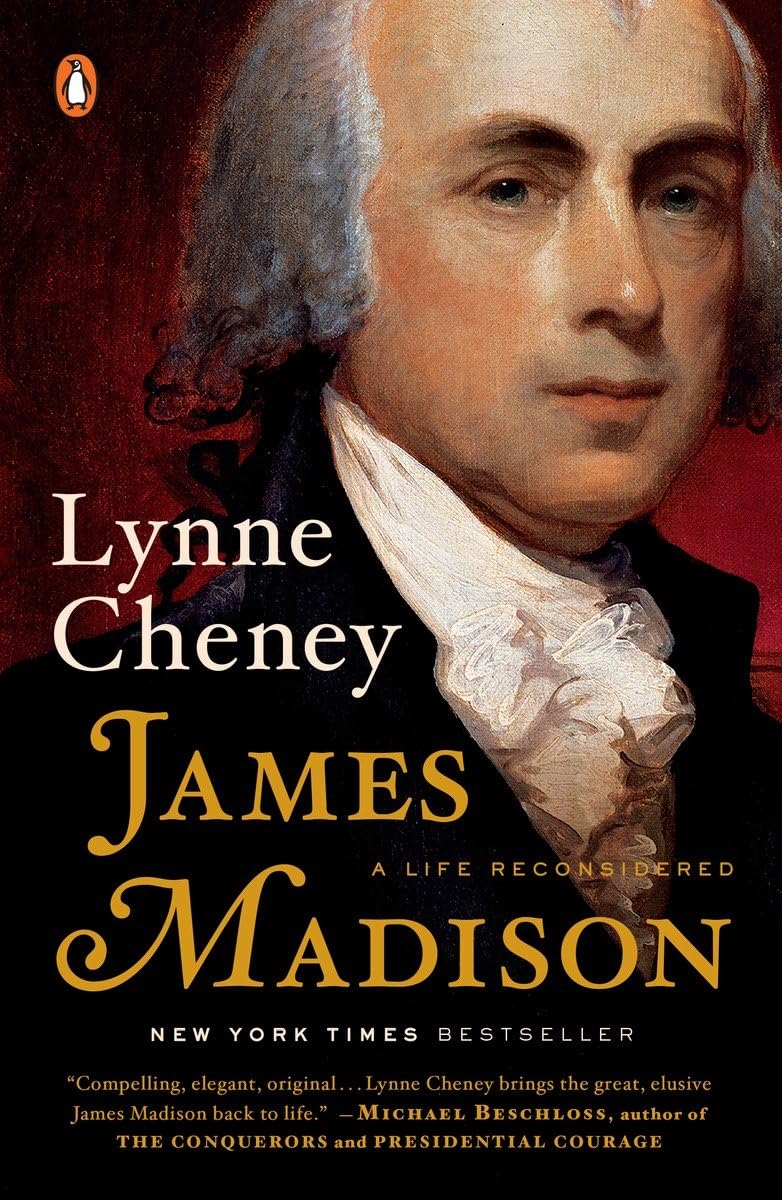
Mid-nineteenth-century Democratic U.S. senator from Illinois and presidential candidate Stephen A. Douglas was known as the “Little Giant.” It seems to me that James Madison is far more deserving of that title. The principal architect of the U.S. Constitution, a driving force behind the Federalist Papers, a former Secretary of State, and a wartime president, the five-foot-four, self-effacing Virginian – who endured a lifetime of debilitating epileptic seizures and chronic illness – nonetheless punched far above his weight among the Founding Fathers. In the assessment of legendary Supreme Court chief justice and fellow Virginian, John Marshall, “If [eloquence] includes persuasion by convincing, Mr. Madison was the most eloquent man I ever heard.” Former Second Lady Lynne Cheney calls him “the political equivalent of Mozart in the late 1770s” and “one of the great lawgivers of the world.” She tells the remarkable story of Madison’s life in James Madison: A Life Reconsidered (2014), a thorough yet highly readable biography of America’s greatest original political philosopher.
Madison’s greatest contribution to political thought is arguably his insight that no society, however small, is truly homogeneous, and that the notion of a single, unified “will of the people” is therefore misleading. Interest groups – what the Founders called “factions” – are an enduring feature of political life and must be accommodated rather than suppressed. Madison’s solution was to extend the sphere of the republic so that no single interest could dominate, while embracing the constructive role of opposition parties in contesting majority opinion within a stable framework. Unlike Thomas Jefferson – who once remarked, “If I could not go to heaven but with a party, I would not go there at all” – his junior partner in founding the Democratic-Republican Party, James Madison, believed that parties were “natural to most political societies.”
Born in 1751 to a prosperous planter in Virginia’s Piedmont, James Madison never held what we would consider a conventional job throughout his long life. His father chose Princeton over William & Mary not only for its lower cost, but also for its healthier climate and its more disciplined reputation, free from the heavy drinking and late-night card playing associated with Williamsburg. Madison’s years at Princeton proved both formative and among the happiest of his life. There he came under the influence of the university’s Scottish-born Presbyterian president, John Witherspoon, who had arrived in America in 1768. Witherspoon’s forceful defense of colonial rights and his belief in equality and society as a voluntary compact left a lasting impression on Madison, while also encouraging his deep study of the classics. Witherspoon himself would go on to become a committed Son of Liberty and the only clergyman to serve in the Continental Congress.
Not all of Madison’s experiences at Princeton were happy. During periods of intense, almost relentless study, he began to suffer from what were likely epileptic seizures—a condition that would trouble him for the rest of his life and often bring him a sense of shame and anxiety. In the eighteenth century, such afflictions were commonly attributed to supernatural causes, even possession, and the Bible’s multiple references to seizures offered little comfort. Madison took some solace, however, in the example of John Locke, the era’s most influential modern philosopher, who also endured chronic physical illness. In tribute, Madison later named his home, Montpelier, after the town in southern France where Locke had gone to recover his health.
Cheney writes that Madison’s thinking “underwent a sea change” over the winter of 1773–1774. He largely abandoned the religious doctrines of his upbringing, likely, she suggests, because he rejected the harsh, judgmental interpretations of his seizures. He soon acquired a reputation as an unbeliever. At the same time, he came to the defense of Virginia’s Baptist minority, who were being harassed by the Anglican majority. This marked the beginning of Madison’s lifelong conviction that diversity sustains freedom: the larger the republic, the more likely it is to contain clashing ideas and competing interests – and the less likely any single faction can become dominant, tyrannical, or corrupt. It was an idea Madison may have first encountered in David Hume’s Idea of a Perfect Commonwealth, first published in 1752. Suspicion of majority rule would become one of the central pillars of his political philosophy. “There is no maxim in my opinion,” Madison wrote to James Monroe, “which is more liable to be misapplied and which therefore more needs elucidation than the current one that the interest of the majority is the political standard of right and wrong.”
Madison entered political life at just 25 in 1776, when he was elected to the Virginia Convention, the colony’s provisional government since 1774. There he came into contact with many of Virginia’s leading figures, including Patrick Henry, George Mason, and the rising statesman Edmund Pendleton. A formative setback followed a year later, when Madison lost reelection to a local barkeep, Charles Porter, who freely supplied voters with liquor at the polls. The episode likely offered Madison his first firsthand lesson in the short-sighted tendencies of mass democracy.
He soon rebounded, however, with election to the Council of State, an eight-member body whose approval was required for the governor’s decisions. In this early administrative role, Madison displayed a remarkable capacity to absorb complex information and respond with clarity and precision. As Cheney observes, “Madison’s genius showed itself in the dismantling of conventional wisdom and the creation of new concepts.” It was also during this period that his lifelong friendship with Thomas Jefferson took shape. Both men were sons of Virginia’s Piedmont rather than the politically dominant Tidewater, and thus retained something of the frontier’s independent spirit. As Cheney notes, “They encouraged, defended, and had a profound effect on each other—and on the nation they helped build.”
Madison was first elected to the Continental Congress in 1780. By then, the colonial economy was in disarray and Congress was largely powerless. Since the start of the war, prices had soared—sugar increasing tenfold and bacon twentyfold. Cheney notes that Madison was dispirited both by the uneven caliber of his fellow delegates and by the financial impotence of Congress under the Articles of Confederation. He even proposed an amendment authorizing Congress to use force to compel states to meet their financial obligations.
In late 1782, Madison began working with the twenty-seven-year-old Alexander Hamilton, fresh from Yorktown, on a plan to establish federal revenue through a five percent import duty. In an ironic twist, the origins of the infamous three-fifths clause can be traced to a compromise Madison helped shape during debates over taxation: Northern delegates argued that enslaved people should be counted at three-quarters for tax purposes, while Southern delegates proposed one-half. Madison split the difference.
The childless bachelor Madison was fully devoted to his work in Philadelphia, laboring steadily through the dark years of the early 1780s. He confronted a host of crises: a starving Continental Army, French hesitation, Benedict Arnold’s betrayal and subsequent invasion of Virginia, a near mutiny of unpaid soldiers in New Jersey on New Year’s Day 1781, and the loss of free navigation on the Mississippi – an issue of particular importance to his home state.
By the end of the war, at just 32, Madison had emerged as a leader in the new nation, widely respected for his sound judgment, forged through diligence, perseverance, and carefully constructed, historically informed reasoning. When not engaged in public business, he retreated to his boardinghouse room, immersing himself in the study of confederations such as the ancient Greek Amphictyonic Council and the Achaean League – experiences that convinced him such systems were prone to weakness and short-lived stability.
None of this would have been possible, however, without the sustained and largely unconditional financial support of his slave-owning, planter father. Madison made several unsuccessful attempts to achieve financial independence, including a venture in land speculation in upstate New York with his fellow Virginian and future president, James Monroe. In the end, he never accumulated sufficient resources to live independently of his family’s slave-powered plantation.
By 1784, Madison had left Philadelphia for Richmond, where he served in the Virginia Assembly. His principal aims were to strengthen the federal government at the expense of the states and to secure religious liberty. His chief adversary was the formidable states’ rights advocate, Patrick Henry. Madison’s doubts about the capacity of either the individual states or the Confederation Congress to create an effective national government continued to deepen.
In September 1786, he took part in the Annapolis Convention, convened to address interstate commerce and regulation. Only five states sent delegates, and the effort was quietly abandoned in favor of a broader convention the following year to consider sweeping reforms to the Articles of Confederation. Madison’s most consequential contribution to launching the Philadelphia Convention was persuading George Washington to attend at the head of the Virginia delegation – a powerful signal of the seriousness of the undertaking. Henry, by contrast, refused to participate. In the end, the absence of strong states’ rights voices worked decisively to Madison’s advantage.
A key feature of the Constitutional Convention was secrecy; without it, there was little chance such a contentious group could have produced a workable result. Fortunately for posterity, Madison served as the intensely devoted – though unofficial – scribe, a role Cheney describes as “voluntary and arduous” that yielded “one of the most treasured records of American history.” He was also a principal architect of the opening proposal, the Virginia Plan, which called for an entirely new and more powerful national government, with executive and judicial branches and a bicameral legislature apportioned by population.
The small states, led by William Paterson, countered with the New Jersey Plan, which largely sought to preserve the Articles of Confederation while modestly expanding congressional powers. Madison ultimately lost on two issues he considered fundamental: proportional representation and an unambiguous federal veto over state laws. These defeats forced him to adjust his position on other elements of the emerging system. With equal representation in the Senate, he came to favor a federal government of enumerated powers to constrain Congress, while also strengthening the executive as a necessary check on what he famously warned could become a “legislative vortex.” Madison also helped synthesize competing proposals into the Electoral College system for presidential elections – one of the convention’s most difficult and history’s most maligned compromise arrangements.
After four months of nearly continuous labor, Madison left the convention exhausted and, in many respects, discouraged, with little confidence that the new constitutional framework would succeed in practice. Yet he would go on to play an even more consequential role in securing its ratification. Cheney notes that Madison was initially surprised by the widespread demand for a Bill of Rights, believing it unnecessary since the federal government possessed only limited, enumerated powers. In his view, because no authority had been granted over speech, the press, or assembly, no explicit guarantees were required. His mentor and colleague, Thomas Jefferson, disagreed emphatically: “A bill of rights is what the people are entitled to against every government on earth, general or particular, and what no just government should refuse or rest on inference.”
Cheney credits Madison with making another pivotal, and in many respects historical, insight into the nature of republican government with his argument in Federalist 10 that political parties – or “factions” as they were called in the eighteenth century – were “sown in the nature of man” and should be openly embraced and accommodated. The best approach was to construct an expansive republic with many competing interests that coalesced into parties that then defended their interests against the majority. Only that would guarantee a stable republic where citizens were free and private property respected.
Madison faced off against Patrick Henry at the Virginia ratifying convention, where Henry emerged as a powerful, populist advocate for states’ rights, deeply wary of the authority granted to the new federal government. The Constitution, he warned, “squinted toward monarchy,” adding, “I see the awful immensity of the dangers with which it is pregnant. I see it—I feel it.” Madison responded with characteristic restraint, relying on arguments that Cheney describes as “always clear, precise, and consistent.” His steady leadership ultimately helped secure Virginia’s ratification of the Constitution by a narrow margin of 89 to 79.
The influence Madison wielded early in Washington’s first term was immense and likely never duplicated. He wrote the primary draft of Washington’s first inaugural address, then wrote the House of Representatives formal response to Washington’s address, and then wrote Washington’s reply to the House. “Never again in the history of the United States,” Cheney writes, “would any politician’s voice as Madison’s did in the early days of the Republic.” Moreover, Madison emerged as the final architect of the Bill of Rights. Although long skeptical of their need, Madison’s ultimate solution was not to explicitly grant fundamental rights to the people, but rather to ensure they were expressly protected from infringement, denial, or violation by the government. Cheney writes that Madison almost single-handedly formulated the amendments, insisted on their introduction and led their passage through legislative obstacles. It was, Cheney writes, “a magnificent performance, one unmatched by any congressional leader since.”
Before Washington’s first term had ended, Madison emerged as the leading opposition figure to the very government he had done more than anyone to create – and to the administration he had helped guide in its early years. The breaking point was Hamilton’s proposal for a national bank, which he saw as a blatant attempt to turn the limited government proposed by the Constitution into an unlimited one. Madison argued that the plan assumed powers not explicitly granted under the Constitution and not justified by the “general welfare” clause of Article I, Section 8, even though he had written in Federalist 44 that “whenever the end is required, the means are authorized.” He did not see this as a contradiction, maintaining that none of the Constitution’s enumerated powers required a national bank to be carried out. Hamilton’s sweeping interpretation, Madison argued, was driving the nation toward the Leviathan state that Thomas Hobbes had described in 1651.
At its core, Madison’s concern was that the delicate balance between state and federal authority had shifted back too far toward the central government, and he set out to correct it. As Cheney observes, “There was more than one way to destroy a republic, and Madison’s strategy changed as his perception of the danger changed.” If Congress could charter a national bank, Madison feared, there would be little it could not justify.
This moment also helped prompt Madison and Thomas Jefferson to undertake a four-month journey through the Northeast, ostensibly for botanical research, but in reality to gauge support for organized political opposition to the Hamiltonian program. Jefferson professed to dislike the very idea of parties, while Madison recognized them as an inevitable feature of political life. Their first concrete step was to enlist Madison’s Princeton classmate, Philip Freneau, to edit and publish the nation’s first opposition newspaper, the National Gazette.
The central argument was that the existing federal government had effectively become a political party – one that was neither particularly enlightened nor benevolent. Madison charged that the Federalists were “more partial to the opulent than to the other classes of society” and, having convinced themselves that mankind was incapable of self-government, believed that rule could be maintained only through “the pageantry of rank, the influence of money and emoluments, and the terror of military force.” In contrast, the emerging opposition – the Republicans – claimed fidelity to the true spirit of ’76 and to the vision of a limited federal republic embodied in the Constitution. This shift brought Madison into closer alignment with Virginia’s political elite than at any point in his career and increased his popularity as he more forcefully criticized the Washington administration’s heavy-handed suppression of the Whiskey Rebellion.
For more than two decades, Madison was able to devote nearly all of his time to public affairs, freed from financial concerns by his father’s support and unencumbered by a family of his own. That changed in 1794, when the 43-year-old married the 26-year-old Philadelphia Quaker widow Dolley Payne. The marriage proved a happy one, lasting more than forty years, and gave Madison a formidable political partner as he rose within Washington society. His marriage also became a target of political slander, as opponents maligned Dolley Madison as both sexually insatiable and barren.
Foreign policy dominated domestic politics in the 1790s, and the Jay Treaty of 1795 sharply divided the nation along regional and partisan lines. The agreement did secure several concessions for the young United States: British withdrawal from forts in the Northwest Territory, the creation of commissions to adjudicate American losses to the Royal Navy, and limited trade access to the West Indies. Yet it remained conspicuously silent on some of the most contentious issues, including impressment, protection of neutral shipping rights, and guaranteed most-favored-nation trading status for the British. Madison argued that the treaty reflected a “want of real reciprocity,” while Thomas Jefferson viewed it as nothing less than a political coup.
Madison attempted to block the treaty’s implementation by opposing the appropriation of funds in the House. Its ratification and execution, Cheney writes, were “the most controversial in the nation’s history,” provoking intense public outrage and even violence. In 1796, Frederick Muhlenberg, a Pennsylvania Republican, was stabbed by his brother-in-law days after casting a pivotal vote to fund the treaty, effectively ensuring its enforcement. While some have argued that the treaty was imperfect but necessary to preserve peace, Cheney rejects this view, contending that Britain was too preoccupied with European conflicts to risk war with the United States, and that the agreement instead contributed to the undeclared naval conflict with France. For Madison, the episode marked a decisive and final break with the Washington administration; he never again visited Mount Vernon. The French broke off diplomatic relations and Madison was one of the American leaders president Adams asked to go to France to smooth things over. He refused.
The Alien and Sedition Acts placed Madison in the unusual position of advancing a view he had once firmly opposed. At the Constitutional Convention of 1787, he had argued that the federal government should have the authority to veto state legislation, a battle he lost at the time. A decade later, however, he took the opposite stance, asserting in his draft of the Virginia Resolutions against the Alien and Sedition Acts that states had the right to “interpose” when the federal government exceeded its delegated powers. This argument laid the groundwork for the doctrine of nullification – a form of states’ rights veto over federal law – that would remain deeply contentious in American politics and would later be invoked by New England Federalists in 1808 to oppose the embargo that devastated their regional economy and southern Democrats who opposed emancipation.
Jefferson, Madison, and their Republican allies ultimately benefited from Federalist overreach. While the Federalists had initially gained support through their steady handling of the Citizen Genêt affair and the XYZ Affair, by the time they enacted the Alien and Sedition Acts and raised a new army – ostensibly to counter a potential French invasion, with Alexander Hamilton as second in command – their judgment appeared deeply flawed. The combination of repressive legislation and expanded military force, funded by new direct taxes, alarmed many Americans, particularly in Republican strongholds like Virginia, where citizens feared the army was intended to suppress domestic opposition rather than confront a foreign threat. The Republicans moved quickly to capitalize on these concerns. Although Adams later sought to distance himself from the more hardline Federalists in his cabinet – especially Secretary of State Timothy Pickering and Secretary of War James McHenry – by easing tensions with France and disbanding the army, the damage to his reelection prospects had already been done. News of the peace with France established by the Peace of Mortefontaine would not arrive in Washington until after the presidential election – the so-called Revolution of 1800.
Cheney observes that the peaceful transfer of power from John Adams to Thomas Jefferson in 1800 was “a turning point not just for the United States but the entire world.” As president, Jefferson came to rely on James Madison’s judgment “to an extraordinary degree.” Chief among their concerns was securing American access to the Mississippi River—an issue of vital importance to western settlers and one Madison had wrestled with for decades, often in dealings with a declining yet stubborn Spanish empire. The problem was ultimately resolved through the Louisiana Purchase, in which the United States acquired approximately 828,000 square miles from France for $15 million. With a single transaction, the nation gained control of the Mississippi’s outlet and nearly doubled the size of what Jefferson called the “Republic of Liberty.” The Senate ratified the treaty by a vote of 24 to 7. Madison, who had spent nearly a decade denouncing Federalist executive overreach, fully supported the Louisiana Purchase.
Madison long believed that the Constitution did not grant the Supreme Court the power of judicial review as later articulated by John Marshall in Marbury v. Madison. As early as 1788, he warned that making the Court the sole arbiter of constitutional questions would render it “paramount in fact to the legislature,” an outcome he believed neither intended nor proper. By the time he became a defendant in what would become one of the most consequential decisions in American legal history, however, Madison had largely reconciled himself to the arrangement, having failed to identify a workable alternative.
As early as Jefferson’s second administration, with the once-reviled Federalists fading from power, the Republican Party began to fracture between a radical wing – known as the “Old Republicans” or “Quids” – and a more moderate faction led by Jefferson and Madison. The radicals were led by John Randolph of Roanoke, chairman of the powerful House Ways and Means Committee and one of the most eloquent orators of his generation. He would prove to be a formidable and implacable adversary of Madison’s. One of the earliest sources of this rupture was the Yazoo land scandal in Georgia. Randolph emerged as the leading congressional critic of the Yazoo claims, taking a hardline moral stance against any compromise that would compensate subsequent purchasers. He instead pressed for full repudiation of the fraudulent sales, but his uncompromising position was ultimately overridden by a more pragmatic approach championed by Madison and Treasury Secretary Albert Gallatin, who favored a settlement to stabilize property rights. Congress adopted this compromise in 1804, compensating claimants and rejecting Randolph’s stricter position. In response, Randolph branded Madison a “Yazoo Man.” During Jefferson’s second term, critics began to suggest that Madison was assuming a role akin to Alexander Hamilton’s in the Washington administration – the “evil genius” who had led a revered leader away from his core principles.
Jefferson and his administration remained broadly popular throughout both terms despite significant policy shifts, economic disruption caused by the Embargo Act – which cut exports to Britain by nearly 80 percent from 1807 to 1808 – and a steady stream of personal attacks. Cheney attributes Jefferson’s enduring popularity to his tax cuts, reduction of the national debt, the Louisiana Purchase, and his steadfast efforts to keep the nation out of European wars.
A persistent theme in Cheney’s biography is Madison’s decades-long rivalry with fellow Virginian and future president James Monroe. Tensions first surfaced in the 1790s over diplomatic strategy and deepened when Monroe, after being recalled as minister to France under George Washington, aligned more closely with Jeffersonian hardliners than with Madison’s more measured approach. The rivalry intensified in the lead-up to the 1808 election, when Monroe – encouraged by factions wary of Madison and the perceived Virginia political “dynasty” – allowed himself to be positioned as an alternative candidate. Although he never mounted a full campaign and received no electoral votes, the episode exposed divisions within the Republican Party and forced Madison to consolidate support. Madison ultimately secured the presidency with 122 electoral votes to Charles Cotesworth Pinckney’s 47 and George Clinton’s 6, though the contest left a lingering strain between the two Virginians. Madison eventually named Monroe his secretary of state, but only after the disastrous tenure of his first choice, Robert Smith.
For two decades, Jefferson and Madison had sought to defend U.S. sovereignty through economic means and coercion. They believed that, for a republican government, firm but peaceful measures – such as discriminatory tariffs, tonnage duties, embargoes, and non-importation acts – offered a viable alternative to war, which in his view fostered nothing but large standing armies, heavy taxation, mounting debt, and ultimately domination by an aristocratic elite. This outlook helped shape the broader philosophy of Thomas Jefferson and the Republican Party. By 1812, it had become clear that such measures were failing to compel Britain to change its aggressive maritime policies, particularly the Orders in Council, a series of decrees issued during the Napoleonic Wars, most notably in 1807, aimed at crippling Napoleonic France but which fell heavily on the United States. In effect, the Orders required neutral nations like the U.S. to route trade through British ports, pay duties to Britain, and risk seizure by the Royal Navy if they failed to comply. Madison grew increasingly alarmed not only by British actions at sea but also by their presence in West Florida and their influence over access to the Gulf Coast, an issue of vital importance to the southern states.
Hamilton’s national bank offers another striking example of Madison’s reversal on some of the most contentious issues of the early republic. In 1791, James Madison fiercely opposed the creation of the bank and Alexander Hamilton’s broader financial program. Two decades later, however, the national bank had become an integral part of Madison’s own financial system, particularly as the nation prepared for war with Britain, with strong support from his Treasury Secretary, Albert Gallatin. For a figure so often regarded as one of America’s foremost political theorists, Madison displayed a notable willingness to revise – even reverse – his positions in response to changing circumstances.
During Madison’s presidency, New England Federalists came to view the ascendant Republicans much as Jefferson and Madison had once viewed Washington and Hamilton – as genuine threats to the core principles of the republic and even to their personal safety. Many in New England feared a coming “Republican Reign of Terror.” As historian Samuel Eliot Morison observed, longtime Federalists began “to look on the national administration as a far more dangerous enemy than the nation [Great Britain] against which war had been declared.”
At the same time, some of Madison’s Republican allies called for decisive action against the perceived internal threat posed by Federalists, echoing measures reminiscent of the Alien and Sedition Acts and proposals for a new model army. Supreme Court justice Joseph Story even floated the idea of an internal police force to safeguard the government, while Philadelphia publisher Mathew Carey labeled opposition to the administration as treasonous. To his credit, Cheney notes, Madison held firmly to his long-standing principles in this moment, refusing to abandon them despite the pressures of power and changed circumstances. Implacably hostile “Blue Light Federalists,” such as former secretary of state turned senator Timothy Pickering, would be resisted but tolerated.
The War of 1812 is often described as a “Second American Revolution,” a conflict in which the young republic reaffirmed its independence. That may be true, but it was also, in many respects, one of the most poorly conceived and managed military efforts in American history. The imbalance was stark: the U.S. Navy fielded just 16 warships, while the Royal Navy commanded more than 300. The consequences of a decade of Republican neglect of the armed forces quickly became apparent. Senior commanders such as Isaac Hull and Henry Dearborn were past their prime, and there were few capable younger leaders ready to step forward. Meanwhile, the war effort was further undermined by the lax and ineffective leadership of Secretary of War John Armstrong Jr., who became a persistent adversary of Madison within his own cabinet – echoing the internal conflicts that plagued the Adams administration.
Madison was forced into the role of his own wartime secretary of war, at times personally present near the front as the British advanced on Washington and ultimately burned the capital. On one point, however, he was resolute: he would not be accused of abandoning his post, as Jefferson had been during his governorship of Virginia in the Revolution – a charge that shadowed Jefferson for the rest of his life. Madison’s conduct during the invasion was largely vindicated by a congressional investigation in 1814, which attributed the fall of Washington to three “unfortunate circumstances”: Maryland’s failure to fully mobilize its militia, delays in arming another militia unit, and a lag in calling up Pennsylvania forces. It seems to me a friendly Congress essentially left its president off the hook.
In time, Madison turned to his former rival James Monroe, appointing him to serve concurrently as secretary of state and secretary of war – effectively positioning him as heir apparent. In the end, Cheney concludes, “the War of 1812 accomplished nothing.” The Treaty of Ghent failed to resolve the central issues that had prompted the conflict, namely impressment and the Orders in Council. Yet with Napoleon defeated and exiled to Elba, Britain had little incentive to continue impressing American sailors or harassing American commerce. Even so, the war’s longer-term effects were significant: it accelerated American expansion, particularly in consolidating control over the Northwest Territory from British-allied Indian tribes, and it had a powerful psychological impact. As John Adams observed during the war – it convinced both Britain and France that the United States was “something,” and Americans themselves that they were not “nothing.”
Toward the end of his second term, Madison signed legislation establishing the Second Bank of the United States, creating an Army general staff, and expanding the navy. All three were actions that would have driven him and Jefferson to distraction twenty-five years earlier. His old inter-party nemesis John Randolph of Roanoke scoffed that Madison had “out-Hamiltoned Alexander Hamilton.” Cheney, more charitably, suggests that Madison had simply “learned to learn” – coming to recognize that monetary strength and military capacity were essential to national security, a conclusion Alexander Hamilton would no doubt have readily endorsed.
On his final full day in office, Madison vetoed a bill for internal improvements – not because he opposed its goals (he supported building roads and canals), but because he believed the federal government lacked the constitutional authority to undertake such measures without a formal amendment. In this respect, he remained consistent: the national government possessed only enumerated powers, and respecting those limits was essential to “the permanent success of the Constitution.” In Cheney’s view, Madison’s greatest achievement was demonstrating that “a republic could defend itself and remain a republic still.”
In retirement at Montpelier, as the Republican Party fractured into what would become the Democratic and Whig parties, James Madison expressed views increasingly aligned with Whig policies – supporting internal improvements once authorized by constitutional amendment and endorsing protective tariffs, including the so-called Tariff of Abominations so hated in the South, which he believed fell within Congress’s powers under the commerce clause. Late in life, Madison was somewhat embarrassed to see Democrats invoke his own Virginia Resolutions and Report of 1800 to defend a doctrine of nullification he no longer supported. Cheney argues that Madison clearly understood the dangers inherent in that doctrine, particularly its potential to provoke sectional conflict between North and South.
Jefferson died in 1826, Monroe in 1831, and Madison in 1836. All three left office burdened by heavy debts and died on the brink of bankruptcy, as Virginia’s plantation economy continued its long decline. Congress intervened to prevent Dolley Madison from falling into destitution, appropriating $30,000 (roughly $900,000 in today’s dollars) for the publication of the first three volumes of Madison’s papers. Even so, she slipped into genteel poverty and was ultimately forced to sell Montpelier in 1845.
 What's Tim Reading Now?
Leave a comment