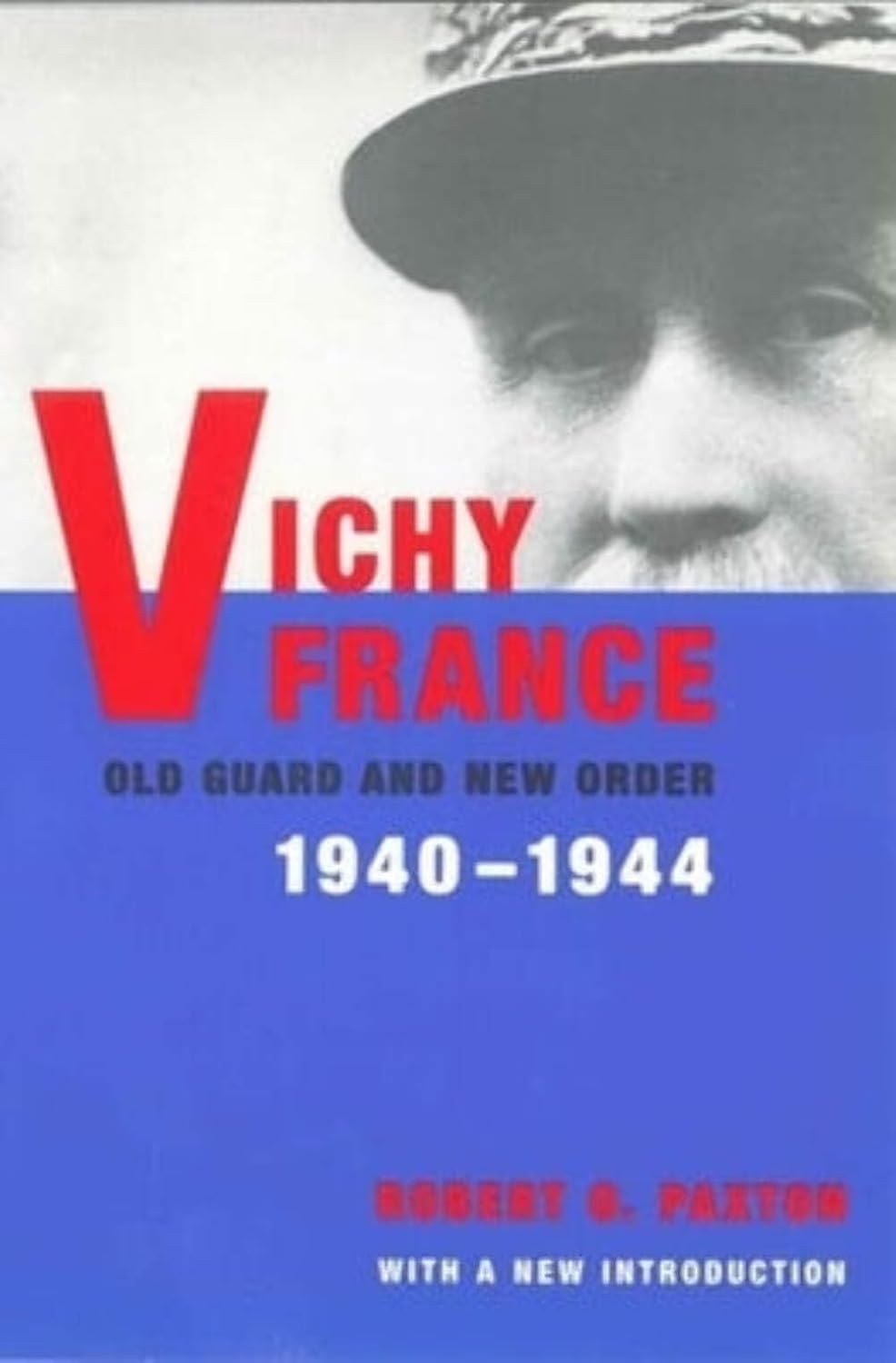
Vichy has long been a stain on French honor and national pride. As such, many in France have preferred to bury the history and legacy of the four-year collaborationist regime. Perhaps because of this, I have always felt that relatively little is taught about Marshal Pétain and the government that ruled France from the central spa town of Vichy, first under partial German occupation and then, after November 1942, under the occupation of the entire country. I picked up Columbia University historian Robert O. Paxton’s classic history of the regime, Vichy France: Old Guard and New Order, first published in 1972, looking for a scholarly, objective, and clear-eyed analysis of Vichy and its complicated legacy. I found that Paxton’s book delivered precisely that.
No matter how you slice it, France does not emerge from the Second World War looking particularly good. Not only was the French Army annihilated in just six weeks, but some forty-five million French citizens were kept in check by a German occupying force of roughly 40,000. Over the next four years, France would be the principal foreign furnisher of labor power, raw materials, and manufactured goods to the Nazi war machine.
Paxton’s book takes direct aim at what had been the standard historical interpretation in the two decades following the Second World War, most notably Robert Aron’s Vichy Regime (1954). Aron portrayed France as suffering under a brutal Nazi diktat while the Vichy regime sought to shield the French population through a careful policy of foot-dragging and passive resistance, secretly supporting the Resistance while waiting for the right moment to turn against the German occupiers. This is a story that Paxton says most people in France want to believe. Unfortunately, he argues, it is entirely and fundamentally inaccurate. The real question is not “Did Vichy save something”? But rather “Did Vichy make things worse?”
During the trials that followed the Liberation and throughout the postwar decade, Vichy officials and apologists maintained that Marshal Pétain and his regime had served as a “shield,” protecting the French population from the worst predations and cruelties of Nazi occupation. “Day after day, a dagger at my throat,” Pétain testified at his postwar trial, “I struggled against German demands.” A central theme of Paxton’s book, however, is that Vichy’s policy of accommodation and collaboration was driven far less by German pressure than its defenders later claimed. Moreover, this accommodation accomplished little that materially benefited the average French citizen. Indeed, the French suffered as much as, and in some respects more than, the populations of Western European countries such as Belgium, the Netherlands, and Denmark, which endured direct German occupation throughout the war. Paxton argues that comparisons with Poland are less instructive because Nazi racial ideology subjected Slavic Eastern Europe to a fundamentally different and vastly more brutal form of occupation than that imposed on Western Europe.
Another popular argument among Vichy apologists has been that the regime was playing a double game throughout the war; that Marshal Pétain and his government were essentially attentistes, fundamentally sympathetic to the Resistance but patiently waiting for the right moment to reenter the war against Germany. Paxton argues that this interpretation is simply untrue. Far from quietly preparing to turn against the Germans, Vichy eagerly sought to accommodate Nazi hegemony in Europe in hopes of securing favorable terms in an eventual peace settlement and German support for its own ambitious program of domestic reform, the so-called National Revolution. The goal was political revenge on the Popular Front and to replace the cosmopolitan and liberal Third Republic with a homogeneous, authoritarian, and corporatist state rooted fundamentally in the rural, conservative traditions of France. The shock of defeat opened the door for a clean break from the recent past; a full scale revolution in institutions and values. The new regime empowered eighty-five-year-old Marshal Petain to draft a new constitution that would replace the Constitution of 1875. Paxton says that this process took place with little close and direct German political supervision.
The central theme of Paxton’s narrative is that Vichy can only be fully understood within the context of French domestic politics during the interwar period, particularly the victory of the left-wing Popular Front in 1936. The cataclysmic defeat at the hands of the Nazi war machine in the summer of 1940 presented the recently marginalized French political right with an extraordinary opportunity not merely to reassert itself politically, but to fundamentally reshape French society and the economy around more traditional conceptions of family, church, rural life, and conservative values. Paxton argues that the Vichy government eagerly sought to enlist Hitler and Nazi Germany as partners and powerful guarantors of both the new regime and its traditionalist domestic agenda as France “made a new start” after the war. Collaboration thus offered Vichy an opportunity to exploit the presence of a powerful foreign army to carry out sweeping changes in how Frenchmen were governed, educated, and employed. The great irony, however, was that the Germans had little interest in facilitating Vichy’s domestic revolution. As Paxton memorably writes, “It was Pétain who wanted collaboration; Hitler wanted only booty.”
By late 1940, most people in France – and Vichy officials in particular – believed that the war was effectively over, Germany had won, and continued resistance risked plunging the country into civil war. Fighting on therefore seemed not merely futile but potentially suicidal, threatening to push France into the abyss of existential conflict between right and left. Paxton argues that domestic social disorder was the paramount concern not only of the Vichy regime but of Frenchmen across the political spectrum. As a result, accommodation and reconciliation with Nazi Germany enjoyed broad support for at least the first year or two following the defeat of June 1940. “Nearly everyone tried to get normal life going again,” he writes. Even members of the French armed forces who had emerged largely untouched by the fighting showed little appetite for continuing the war. In the summer of 1940, only 50 of some 500 officers and 200 of 18,000 sailors then in Britain chose to remain and join the Free French rather than return home.
“Collaboration,” Paxton writes, “was a French proposal that Hitler ultimately rejected.” Pétain and the Vichy regime sought a genuine partnership in the new European order they expected to emerge under a victorious Germany, sending a steady stream of overtures to the German authorities in occupied France and senior officials in Berlin proposing closer cooperation. Vichy was practically begging for any concession Berlin might offer that could demonstrate to the average French citizen that collaboration produced tangible benefits in everyday life. Hitler and his lieutenants, however, either dismissed or simply ignored these advances.
What interested the Germans were the material benefits France could provide: economic spoils, particularly access to critical raw materials and a vast pool of skilled and unskilled labor, as well as strategic bases throughout the French Empire. They had little interest in military assistance from the defeated French Army and even less in serving as midwife to Vichy’s vision of a “New France.” No matter how strongly the French signaled their willingness to support a new German-dominated continental order – including the active defense of Europe against British invasion – the German high command showed little interest in their partnership.
The primary Vichy intermediary with Nazi Germany was Pierre Laval. A prewar socialist who migrated steadily to the political right, he served as Marshal Pétain’s chief minister in 1940 and again as head of government from 1942 until the Liberation in 1944. Laval notoriously declared in 1942, “I desire the victory of Germany, because without it Bolshevism tomorrow would settle everywhere.” His government would go on to cooperate in the deportation of Jews, supply French workers to Germany, and assist German efforts to suppress the Resistance. Laval developed a close relationship with Otto Abetz, Germany’s ambassador to France, who operated primarily from Paris, and the Laval-Abetz connection became one of the principal channels of Franco-German relations following the defeat of 1940. After the war, many Vichy officials sought to make Laval a convenient scapegoat, portraying him as a lone wolf who had unilaterally committed France to a degree of collaboration with Germany that the rest of the regime neither sought nor supported.
Laval was removed by Pétain on December 13, 1940, a move that came as a shock to the Germans, particularly Ambassador Otto Abetz. Yet the effect of “December 13” on the Germans, Paxton writes, was “more loss of interest in France than anger,” while on the French side little changed in terms of policy: Vichy continued to seek good relations with Germany and a return to domestic normalcy within the framework of the Armistice. One thing, however, was clear. Laval’s aggressive cultivation of Abetz and his pursuit of the so-called “new policy” – seeking German concessions in exchange for closer and more normalized Franco-German relations – had proved a complete failure during the first six months following the Armistice. Laval was eventually succeeded by Admiral François Darlan, who would accumulate the greatest number of offices during the Vichy regime (simultaneously minister of foreign affairs, navy, interior, defense, information and interior) but would have no more success in extracting meaningful concessions from the Germans, particularly now that their preferred French interlocutor had, at least temporarily, been sidelined.
In truth, Paxton writes, the Vichy regime sought to negotiate a general settlement that would preserve French territorial integrity in exchange for actively defending the French Empire against the British. If Germany knew “how to rise above her victory,” Pétain declared, “we will know how to rise above our defeat.” Vichy’s commitment to seeking an accommodation with Germany was further strengthened by the British attack on the French fleet at Mers-el-Kébir on July 3, 1940, less than two weeks after France signed its armistice with Germany, which killed more than 1,200 French sailors. It would be Admiral Darlan, Paxton argues, who would move France the closest to outright military cooperation with Germany in 1941 and did the most to foment hostility with Great Britain, who he saw as aiming to absorb the French Empire and Navy.
Hitler never had much interest in developing a “voluntary association among equals” with France, and whatever prospect existed for such an arrangement largely evaporated with the German invasion of the Soviet Union in June 1941. The invasion shifted Germany’s strategic focus away from the Mediterranean, particularly as the campaign in Russia bogged down, diminishing any need for French assistance in a joint maritime and colonial strategy centered on the Middle East and North Africa. The one upside for Vichy, Paxton notes, was that the war had now taken on an explicitly anti-Bolshevik character, an ideological orientation the regime firmly supported.
June 1941 would prove to be a decisive turning point in the history of the Vichy regime, as acts of resistance and sabotage surged by some 300 percent after French Communists, until then largely quiescent, moved into open resistance following Germany’s invasion of the Soviet Union. Vichy increasingly came to equate opposition to the regime with communism, drawing it into ever closer complicity with German repression. Yet Vichy remained far more classically conservative and traditionalist than conventionally fascist. Its leaders emphasized social hierarchy, order, and tradition rather than the celebration of the “common man,” social leveling, and dynamic revolutionary change characteristic of fascist movements. What the two shared, however, was a commitment to authoritarianism, hostility toward liberalism, and a strong defense of private property.
Darlan’s inability to extract any meaningful concessions from the Germans ultimately contributed to his ouster and Laval’s return to power. Darlan had served as the dominant figure in the Vichy government for fourteen months, from February 1941 to April 1942, although he remained an important Vichy figure until his assassination in Algiers on Christmas Eve 1942. Both Darlan and Laval pursued essentially the same bargain: give France a measure of normalcy and hope for a generous peace settlement, and Vichy would willingly participate in Germany’s New European Order. Paxton argues that it was ultimately Hitler’s “blind arrogance” and thirst for vengeance that prevented him from seriously entertaining the repeated overtures of Laval, Darlan, and Pétain. “France declared war on us,” Hitler declared in May 1943, “so she must bear the consequences.” Had the Führer been more flexible, Paxton suggests, Vichy might well have become the “western wall” of Germany’s new European order.
A core theme of Vichy France is the overwhelmingly domestic focus of the regime’s strategic objectives. For more than half a century, the Third Republic had been plagued by political discord and obstructionism; Paxton notes, for example, that more than two hundred bills were introduced between 1871 and 1909 before France finally enacted an income tax in 1914. Thus, France went to war in 1940 under a constitutional system that had already come under strenuous criticism and appeared increasingly incapable of reforming itself from within. Vichy’s leaders sought to exploit the defeat of 1940 and the constraints imposed by the Armistice to reform French society quickly, deeply, and decisively, without having to overcome the organized political opposition that had frustrated previous efforts at reform. Indeed, Paxton writes, “there can be no doubt that legally and actually Pétain had a very broad mandate to draft a new constitution for France.”
They called this ambitious program the “National Revolution.” At its heart were the values of the Enlightenment and the nineteenth century middle class. “No other defeated state set out as ambitiously during World War II on fundamental changes,” Paxton writes. The National Revolution embraced an integral Catholic vision of the moral order that emphasized authority and social hierarchy alongside Napoleonic centralism; rejected laissez-faire capitalism as a “foreign product” unsuited to French culture; and looked to charity and social solidarity as remedies for class conflict. Paxton stresses that Hitler and the Nazis had virtually nothing to do with this agenda. Hitler wanted public order, French material resources, and cooperation with the “Final Solution” to Europe’s Jews; the rest of the National Revolution he simply “ignored or scorned.” Rather, the program reveals a great deal about France itself at that particular historical moment. “It was the expression of indigenous French urges for change, reform, and revenge,” Paxton writes, “nurtured in the 1930s and made urgent and possible by defeat.”
Thus, the National Revolution was primarily a program driven by indigenous French grievances and political objectives rather than by fascist ideology or Nazi intervention. First, Vichy sought to reverse what its leaders regarded as the decadence and long moral decline of French society conservative often associated with industrialization and urbanization. France had been the most powerful nation in the world under Louis XIV, when it was overwhelmingly rural, agrarian, pious, family-oriented, and fecund. To the traditionalists, the defeat of 1940 reelected France’s divergence from the social patterns of her age of greatness. The regime targeted alcoholism as well as American-inspired mass culture and mass production, both of which it associated with the erosion of traditional French values.
Second, Vichy overturned nearly sixty years of Third Republic anticlericalism, placing religious faith and traditional Catholic values at the foundation of the new regime’s moral order. Third, it aggressively reformed the educational system, which Pétain and other leading officials regarded as weak, excessively left-wing, and responsible for inculcating French youth with a dissipated and insufficiently patriotic worldview. Alongside these reforms, Vichy developed youth organizations intended to promote physical vigor, discipline, and pride in French history and culture.
Fourth, Vichy placed extraordinary emphasis on the family, particularly large families. “The declining French birthrate lay at the very core of French alarm about decadence in the early twentieth century,” Paxton writes. It was “the rot at the heartwood of French national life,” a decay Vichy associated directly with the abandonment of the countryside. The regime worked assiduously to promote the solidarity and fecundity of the French family while tightening laws governing divorce and abortion.
Finally, Vichy pursued Freemasons and Jews with particular vigor. Paxton calls antisemitism “the blackest mark on the whole Vichy experience.” The regime established an elaborate system of purges and quotas, barring Jews from the judiciary, military service, teaching, journalism, and senior positions in the civil service and cultural life. It also imposed strict quotas on Jews in professions such as law, medicine, architecture, dentistry, and pharmacy, while restricting their access to secondary schools and universities. The broader objective was to eliminate what Vichy perceived as excessive Jewish influence over French economic and public life.
Paxton is careful, however, to distinguish the ideological foundations of Vichy antisemitism from those of Nazi Germany. Vichy’s antisemitism – and its xenophobia more broadly – was rooted more heavily in cultural and national conceptions of Frenchness than in the explicitly biological racial doctrines of Nazism. It emerged from a traditional French assimilationist ideal that envisioned diverse peoples being absorbed into a unified nation through cultural conformity. Paxton thus portrays Vichy’s persecution as arising from a distinctly Catholic and French nationalist antisemitism rather than simply being imported from Nazi Germany. Nevertheless, the consequences were catastrophic. Although Vichy never itself required Jews to wear the yellow star, approximately 76,000 Jews were ultimately deported from France during the war, most of them foreign-born, though roughly a quarter were French citizens.
The Vichy regime sought to strengthen executive authority and empower senior experts within the civil service, while drawing on the advice and support of councils composed of local elites. The state Vichy envisioned would be centralized, powerful, and decisive, but it would not meddle in every aspect of French life. Within a deliberately limited sphere, its authority would be absolute, while ideally that sphere would gradually contract over time. A “deflation of the state” would thus accompany a “restoration of the sense of the state.” As Paxton writes, Vichy wanted “a stronger night-watchman state, not a leviathan; they wanted protectionism, not dirigisme.”
Perhaps one of the bitterest disappointments for those who created and governed Vichy was the regime’s utter failure to provide the stability and permanence they considered essential to France’s national rejuvenation. In practice, Vichy ministries came and went at a pace even more dizzying than during the worst years of the Third Republic. In its first year alone, the regime cycled through four foreign ministers, five interior ministers, and five education ministers. Far from the stable and decisive government its architects envisioned, Vichy was, from the beginning, what Paxton calls “a basket of crabs.”
Nevertheless, Paxton argues, the Vichy regime undoubtedly retained broad public support for years after the defeat of June 1940, although he is careful to distinguish between popular devotion to Marshal Pétain – “the World War I victor, the cautious hoarder of French blood, the bulwark against revolution, the wise father” – and enthusiasm for the motley collection of anti-Bolshevik figures who populated his government. “Vichy was accepted simply because it was all there was,” Paxton writes, “or all there seemed to be for some time after 1940.” Only in the summer of 1943 did French public opinion turn decisively against the regime.
By early 1943, Frenchmen were being conscripted to work in German factories. “It was Hitler who did most to mobilize young people for the Resistance,” Paxton writes, “by trying to mobilize them to work in German factories.” By then, Vichy’s efforts to secure better treatment for its citizens through collaboration had manifestly failed. Young Frenchmen increasingly faced a stark choice: go to Germany as laborers or take to the mountains and join the Resistance. By November 1943, some 1.3 million French men and 44,000 French women were working in German factories, making France Nazi Germany’s largest source of foreign labor, much to the embarrassment of the Vichy regime. Including prisoners of war, fully 3.3 percent of the French population had been conscripted to work in Germany, where their status as French citizens did little to spare them the hardships and suffering of forced labor.
Moreover, Vichy had lost two of its principal trump cards in negotiating with the Germans: the French fleet, scuttled in November 1942, and the French Empire, by then almost entirely in Allied or Free French hands. Weak from the beginning, Vichy was left virtually powerless once the Germans occupied the whole of metropolitan France.
Paxton argues that the Resistance developed slowly in part because, for many ordinary Frenchmen – not merely the Vichy regime – the greatest danger was fanaticism and the social upheaval it might unleash. Many feared that armed resistance would lead inexorably toward social revolution. “German occupation might be bad,” Paxton suggests many Frenchmen believed, “but liberation by force would be worse.” Indeed, the worse conditions became, the more precious France’s remaining island of neutrality and relative stability appeared. Pétain’s overriding objective increasingly became to prevent France from becoming a battlefield.
Paxton stresses that Pétain and the Vichy regime were not attentistes, patiently waiting to jump in on the side of the Allies once the balance of power shifted away from the Germans. Vichy was, at best, sincere neutralists who doubled down on their efforts to mediate a compromise peace, one that might end the war without subjecting metropolitan France to the destruction of an Allied invasion. The overarching theme, Paxton says, was the belief that the best way to avoid revolution was to keep France out of the war.
Evidently, this determination to avoid social unrest at almost any cost was widely shared across occupied France. Paxton estimates that between 1943 and 1944, roughly as many Frenchmen participated in efforts to suppress the Resistance as actively joined it, with the Resistance itself probably never encompassing more than two percent of the population. The former paramilitary arm of the French Veterans’ Legion, the Service d’Ordre Légionnaire, was transformed in January 1943 into the Milice, a national paramilitary organization that eventually numbered nearly 50,000 volunteers and openly collaborated with the Germans in hunting down and suppressing the Resistance.
In the end, French forces never fought alongside the Germans against the Allies, and Vichy never formally declared war on the Allied powers. Pétain’s stubborn commitment to neutrality ultimately prevailed over Laval’s more aggressive proposals for collaboration and direct military cooperation. “In the final analysis,” Paxton writes, “it was Hitler rather than the French government who had rejected the voluntary association of France in a Germany-dominated Europe.”
The Liberation of France in 1944 unfolded in an atmosphere that often resembled civil war, Paxton writes. As Allied armies swept through the country, an estimated 9,000 Frenchmen were killed in fighting, summary executions, or various forms of score-settling. In the postwar reckoning that followed, some 125,000 people were tried for offenses committed during the Vichy era; approximately 38,000 were imprisoned and 1,600 executed. Yet Paxton is quick to note that liberated France ultimately imprisoned a smaller proportion of its population than any other occupied Western European country. Automaker Louis Renault, whose factories produced vehicles, including tanks, for the Germans during the occupation, died in prison before he could be tried, while not a single major French businessman was ultimately brought to trial for economic collaboration.
The remarkable continuity of the French state was even more striking. High-level civil servants emerged from the hostile atmosphere of the Liberation almost wholly intact. Much the same was true of the judiciary, which accomplished the extraordinary feat of administering the laws of a succession of radically different regimes with remarkably little turnover in personnel. More than half of the French diplomatic corps similarly survived the tumultuous transition from the Third Republic through Vichy and the Liberation to the establishment of the Fourth Republic. “Like Vichy,” Paxton writes, “the Liberation wanted to control the administration, not abolish it.”
The notable exception, beyond leaders of the violently anti-Resistance Milice, was the political class of the Third Republic. Here the purge was far more thorough. By 1949, only 14 percent – 88 members – of France’s elected representatives had served in either chamber of the Third Republic in 1938. “The postwar rejection of Third Republic political figures,” Paxton writes, “was nearly as vigorous as Vichy’s had been.”
In closing, Paxton hammers home his argument that Pétain and his followers chose to use the German occupation not merely as a framework for administering a defeated France, but as an opportunity to carry out a domestic revolution against their internal enemies; principally the various forces of the left, and communists in particular. In one sense, Vichy failed miserably. Pétain’s vision of a conservative French republic rooted in traditionalism, Catholic morality, rural agrarianism, and large families was decisively rejected after the war. Yet in another important respect, Vichy left a lasting legacy. The regime’s technocratic vision of expert administrators guiding an efficient, productive, and planned economy was embraced by the Fourth Republic and endured well beyond it. For better or worse, France in the second half of the twentieth century would come to resemble this aspect of the Vichy vision: a managed economy overseen by a strong paternalistic state committed to planned economic expansion.
As for the question of whether Vichy saved France from “Polandization,” Paxton concludes that the premise itself is fundamentally flawed. Nazi racial ideology never viewed Gallic France and Slavic Poland through the same lens, and there was therefore little prospect that France would be subjected to the same systematic devastation and racial subjugation inflicted upon Poland. More importantly, Paxton finds no evidence that Vichy’s persistent efforts to accommodate – and at times actively woo – the Nazi regime produced any meaningful material benefit for either the French people or the nation as a whole. “A hard comparative look at the material conditions of life in Western occupied countries,” Paxton concludes, “fails to show any important advantage for France, either granted by or extorted from Berlin.”


Leave a Reply