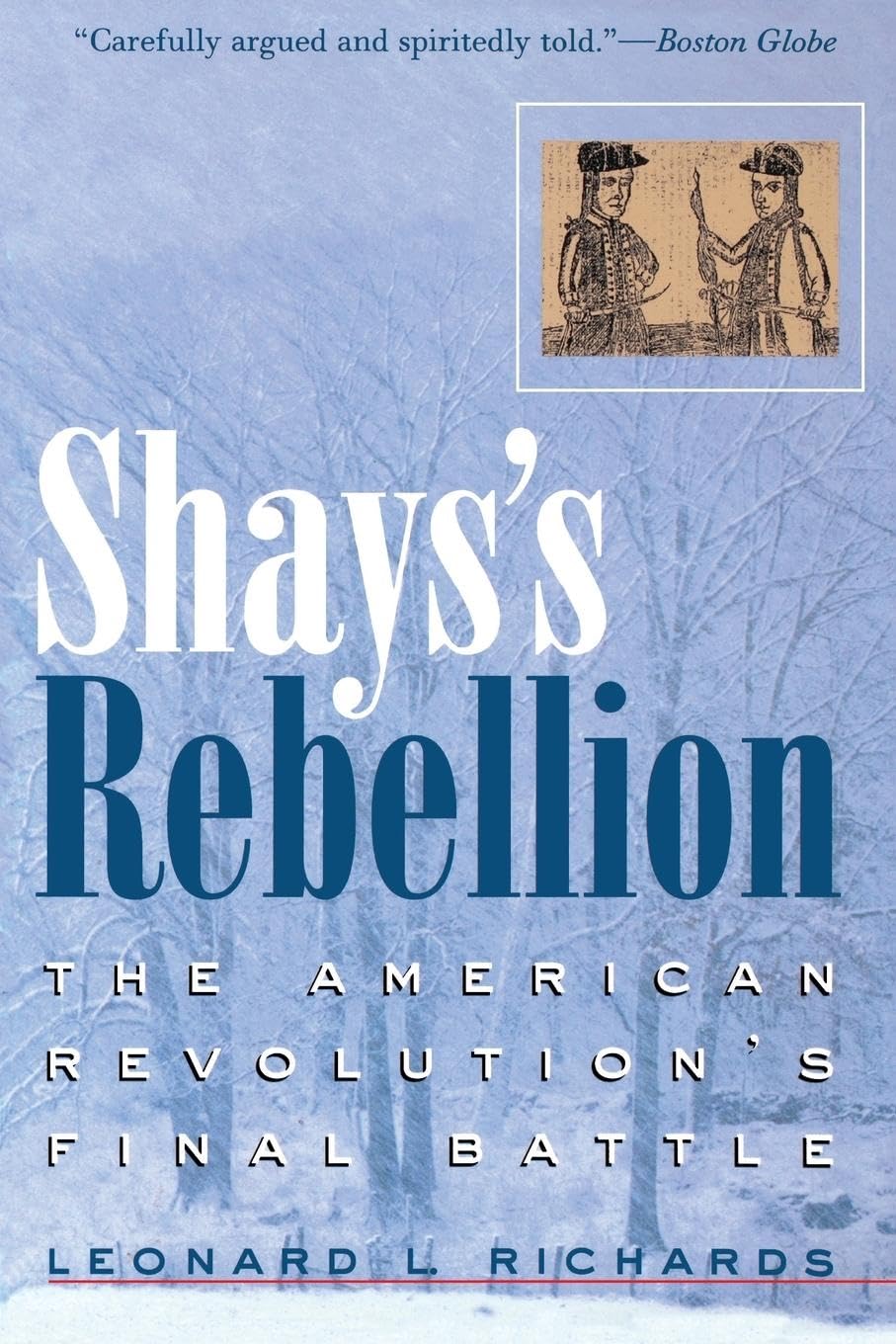
Shays’s Rebellion: The American Revolution’s Final Battle (2002) by Leonard Richards is one of those rare books that genuinely surprises. I can’t recall being as engrossed by a monograph on early American history since reading The Elusive Republic (1980) by Drew R. McCoy. Richards takes a familiar yet often overlooked episode – the 1786 uprising in western Massachusetts known as Shays’s Rebellion – and, through careful research and fresh interpretation, recasts it in a way that feels both original and persuasive. Far from a crude attempt at social leveling or debt abolition, the rebellion emerges as a more focused protest: a movement driven by the indignation of rural farmers at the harsh terms imposed to retire Massachusetts’s wartime debt, and at the enrichment of a small, Boston-based financial speculator elite at the expense of struggling farmers in the west.
The central argument of Shays’s Rebellion is that the standard narrative – a band of impoverished, debt-ridden farmers resorting to violence to escape their creditors – does not withstand close scrutiny. Drawing on the backgrounds and experiences of the roughly four thousand men who signed loyalty oaths after the uprising was suppressed, Richards shows that the rebels were neither universally destitute nor similarly motivated. The rebellion itself was crushed by a privately funded army, financed largely by Boston merchants and led by General Benjamin Lincoln, whose earlier surrender at Charleston had marked one of the most devastating defeats of the Revolutionary War. Richards argues that the conventional interpretation portrayed the rebels as a motley collection of ill-bred malcontents driven by extreme “leveling” ambitions against their social and economic superiors. This view was shaped early on by George Richards Minot, a minor member of the Boston elite, whose 1788 pamphlet The History of the Insurrections in Massachusetts presented the events from the perspective of Governor James Bowdoin and the propertied class who were eager to redeem drastically depreciated wartime currency at face value. In contrast, through meticulous research and a careful reassessment of the evidence, Richards offers a far more nuanced – and ultimately more persuasive – account of the rebellion.
By the mid-1780s, western Massachusetts had become a largely self-governing frontier that paid little heed to directives from Boston. Town governments formed the core of political life. When residents did engage with the state, it was typically to lodge complaints—about their inability to pay debts and taxes in scarce hard currency, the multiple layers of courts that imposed burdensome fees, and a system of government that seemed designed primarily to enrich the Boston merchant elite. Their broader aim was to reform the state constitution in hopes of creating a more responsive government.
In 1786, communities across western Massachusetts acted by shutting down local courts. When militias were called to defend them, many soldiers failed to appear, while others openly joined the insurgents. As tensions escalated – particularly around fears that the 7,000 new muskets and 1,300 barrels of gunpowder at the federal arsenal at Springfield would be seized – the Confederation Congress authorized an expansion of the army by 1,340 troops, ostensibly to counter a potential conflict with Indians in the Ohio Territory, though few believed that explanation. By January 1787, only about one hundred soldiers had been recruited.
Governor James Bowdoin responded to the failure of the central government to support his state by raising a private force of his own without legislative approval. The goal was a private army of 4,400 supported by £6,000 from private donors, primarily wealthy merchants and financial speculators from the Boston area. In the end, only about 3,000 troops were enlisted and 153 men contributed to the fund. Most of the new volunteers lacked Revolutionary War experience – unlike the seasoned insurgents in the west, many of whom, like Daniel Shays, were bonafide war heroes. The creation of this privately funded army only intensified the crisis, pouring fuel on an already volatile situation.
On January 25, 1787, two regiments of roughly 2,000 insurgents confronted 1,200 militiamen under Major General William Shepard at the Springfield arsenal. (A third and potentially decisive regiment did not converge on the arsenal in time because of miscommunication.) After warning shots fired over their heads failed to halt the advance, Shepard’s troops raked the rebel lines with grapeshot, killing four and wounding many more. General Benjamin Lincoln then force-marched his troops through a driving snowstorm at night to capture the remnants of the rebellion at Shays’s hometown of Pelham. In Boston, Lincoln was celebrated as a hero.
On February 16, the Massachusetts legislature passed the Disqualification Act, barring rebels from serving on juries, holding office, or voting for three years. Yet while the rebellion, as Richards writes, “just died away with a whimper,” Governor Bowdoin’s political fortunes collapsed as well. In April, he was decisively defeated – by a three-to-one margin – by John Hancock. Following Hancock’s victory, the new legislature restored voting rights to the roughly four thousand Shaysites who had taken an oath of allegiance.
Around the same time, the state’s highest court sentenced eighteen Shaysites to death by hanging. In the end, only two sentences were carried out – both against low-level insurgents convicted of crimes against personal property rather than treason. Several hundred indictments were issued, and roughly four thousand confessions of wrongdoing were obtained. Many of the principal leaders, including Shays himself, had already fled to Vermont under the protection of Ethan Allen.
Richards cautions against assuming that the relatively well-known leaders of the uprising were representative of the rank-and-file insurgents – a mistake he considers potentially fatal to understanding the movement. What makes Shays’s Rebellion distinctive is the unusually rich record of its participants, in contrast to most riots and popular uprisings, where those involved typically remain obscure.
Among the Shaysites, thirty had served as officers in the Massachusetts Line of the Continental Army, and three were full members of the Society of the Cincinnati. Indeed, Richards notes that Revolutionary War veterans were ten times more likely to take up arms in support of the rebellion than in defense of the state. In the case of Northampton and the surrounding area, over six hundred Revolutionary War veterans were called to arms to put down the rebellion and only 23 showed up. They simply sat on the sidelines and refused to answer the call, Richards says. According to the author, most veterans opted out either because they had no family or personal relationship with the leaders of the rebellion and/or they were swayed by their local clergy, who were almost universally against the rebellion.
The rank and file were neither uniformly nor predominantly men crushed by debt. Richards notes, for example, that none of the 88 individuals imprisoned for debt in the Northampton jail between 1785 and 1786 took part in the rebellion. Moreover, his research shows that for every Shaysite who appeared in court as a debtor, another appeared as a creditor. James White – a Revolutionary War veteran who led the assault on the Springfield Arsenal – appears multiple times in court records, but only as a creditor. Of the towns with the highest levels of participation, only two – Belchertown and West Springfield – ranked among the top ten for debt-related lawsuits. Richards’s conclusion is unequivocal: “there is no correlation – none whatsoever – between debt and rebel towns.”
Participation in Shays’s Rebellion was overwhelmingly a local affair and most often family-driven. What bound the Shaysites together was kinship and a shared cultural identity – particularly Scotch-Irish. Strikingly, the author notes that clear class divisions are almost entirely absent. In the five-county region where courts were shut down in 1786, nearly 40 percent of towns (72 out of 187) did not send a single participant to the uprising. By contrast, just 24 percent of towns (45 in total) accounted for roughly 80 percent of the rebels. In smaller communities such as Colrain and Pelham, participation was especially intense, with more than two-thirds of the town’s men joining the rebellion. In the final analysis, only one out of three backcountry towns actually participated.
Richards’s central argument is that the uneven geographic distribution of the rebels undermines the standard portrayal of Shays’s Rebellion as a movement of debt-ridden farmers trapped in a postwar “debt chain.” According to that account, wholesalers in port cities like Boston imported large quantities of British goods on credit, draining the region of hard currency. They then sold this inventory to inland retailers, also on credit, who in turn extended credit to local farmers. When Britain closed the West Indies to American shipping, wholesalers lost a key outlet for trade and could no longer service their debts. They called in what they were owed from retailers, who in turn pressed farmers for payment. The result, the story goes, was that as many as one-third of men in western Massachusetts were dragged into debt courts.
Richards argues that this conventional account suffers from several flaws. First, the indebtedness of western Massachusetts farmers was hardly unique; backcountry debt was widespread from New England to the Carolinas. Why, then, did it lead to open revolt only in western Massachusetts? Second, the closure of courts in the region was nothing new – it had been occurring since at least 1774. Opposition to the state judiciary persisted throughout the Revolution and continued afterward, fueled by dissatisfaction with the 1780 state constitution, which was ratified by representatives from just 47 towns, nearly all within 15 miles of Boston. To many, the document appeared designed to enrich a narrow elite at the expense of the broader population. As Richards writes, “it shifted power from the rural backcountry to Boston, from the poor to the rich, and from the town meetings to the state senate and the governor’s office.” After 1780, decisions made in Boston carried real and often unwelcome consequences for small towns in western Massachusetts.
Those who joined Shays’s Rebellion did not see themselves as dissident debtors but, as Richards argues, as “Regulators” exercising a natural right to resist a tyrannical government. The term Regulator had a long lineage: it appeared in England as early as 1680 among reformers seeking constitutional change, resurfaced among backcountry farmers in the Carolinas in the 1760s opposing corrupt officials and land speculators, and was later adopted in New York and Vermont by settlers resisting the dominance of great Hudson Valley landlords such as the Livingstons, Cortlandts, and Van Rensselaers. In short, as Richards writes, there was an established tradition that when distant authorities overreached – or when outsiders threatened legitimate settlers’ landholdings – the people had an obligation to restore communal order.
In the late 1780s, nearly every state government confronted the same dilemma: they had issued wartime notes they could no longer afford to redeem at face value. The central question was how to consolidate this debt – and at what valuation. Many states effectively wrote down their obligations; Virginia, for example, devalued its currency at forty to one. Massachusetts, however, took a different approach. Its mercantile-dominated legislature insisted on honoring the notes at their full original value.
By the time consolidation and redemption were proposed, Richards notes that more than 80 percent of these notes were held by speculators in or around Boston, with roughly 40 percent concentrated in the hands of just 35 individuals. Many had acquired the notes at steep discounts from farmers who were desperate for liquidity. No other state, Richards argues, offered such favorable terms to public creditors – and the disparity did not go unnoticed. Cries of injustice were common, Richards says, with Revolutionary War veterans especially angry.
To honor its obligations, Massachusetts needed to raise several hundred thousand dollars in tax revenue quickly. The result was a dramatic increase in the tax burden – by a factor of five or six for the average citizen, far exceeding what anyone had paid under British rule. Compounding the strain, the 6 percent interest on the state’s notes was to be paid in specie. In effect, the state committed to retiring its entire debt by the end of the 1780s, and to do so in hard currency.
Raising such sums required a new fiscal regime: a poll tax on all males over sixteen, expected to generate roughly one-third of total revenue, and a property tax accounting for more than half. Import duties and excise taxes would supply the remaining 10 percent. Richards argues that this system was highly regressive – “biased against farm families with grown sons,” he notes – while its primary beneficiaries were Boston-based speculators. He also observes that Governor Bowdoin, who held a low opinion of backcountry farmers, was himself among the most prominent land and note speculators in Boston.
On the one hand, Shays’s Rebellion failed outright. On the other, judged against its underlying aims – curbing speculation and preventing the transfer of wealth from the backcountry to Boston – it achieved a substantial measure of success. The heavy reliance on poll and property taxes was largely replaced by indirect taxation; between 1786 and 1790, revenues from direct taxes fell by roughly 90 percent. Excise and import duties were expanded to fund both general state expenses and interest on public debt.
Under these new conditions, speculators’ best hope for repayment shifted to a broader solution: reforming the Articles of Confederation so the federal government would assume state debts. Richards argues that Shays’s Rebellion “provided the spark” for advancing the nationalist cause, amplifying fears of anarchy and debt abolition. National leaders such as George Washington and Henry Knox embraced this interpretation and shared a dim view of backcountry farmers. Washington’s alarm at the uprising is widely seen as a key factor in his decision to come out of retirement to lead Virginia’s delegation to the Constitutional Convention in the summer of 1787. As Richards writes, the rebellion also “crystallized antidemocratic sentiment” among emerging American elites. Ultimately, its impact was embedded in the Constitution itself, which granted the federal government the power to suppress insurrections, protect states from domestic violence, and suspend habeas corpus in cases of rebellion or invasion.
Richards argues that the ratification of the Constitution was “a dirty process.” Opponents – labeled Anti-Federalists – were also frequently disparaged as “Levellers” and “Shaysites.” The backcountry communities across the country who were saddled with these epithets remained deeply distrustful of elites. In Massachusetts, that distrust was not abstract: Boston’s wealthiest merchants had financed a private army and sent it into the countryside against yeoman farmers and Revolutionary War veterans. Of the 52 towns where support for the insurgency had been strongest, not one sent a delegate to the state’s ratifying convention who favored the Constitution. To many, the proposed government appeared to be the creation of a narrow, self-interested elite, far removed from “We the People.”
For speculators, however, ratification proved highly beneficial. In the roughly nine months between the Constitution’s completion in Philadelphia and its ratification, the value of securities rose by more than 60 percent. Richards contends that binding the “rich and well-born” to the new federal system was a deliberate strategy of Alexander Hamilton, who sought to strengthen the national government by loosening creditors’ ties to individual states and linking their interests to the central authority. As Hamilton himself observed, “Men will naturally go to those who pay them best.” His approach reinforced that alignment by rolling over, rather than retiring, the public debt – issuing new bonds to replace those redeemed. By 1792, the Treasury required just $4.6 million in federal tax revenue – raised almost entirely through indirect means such as import and excise duties – to service interest on a consolidated federal and state debt of roughly $75 million, which accounted for 82 percent of federal spending. Meanwhile, direct taxes, including poll and land taxes, fell by 97 percent. The heavy tax burden that had helped spark Shays’s Rebellion in 1786 had effectively disappeared.
In the end, Hamilton’s program worked to Massachusetts’s advantage. Its consolidated debt exceeded $5 million in the new national currency – fully a quarter of the total state debt assumed by the federal government. More than 90 percent of that debt was paid out to just 1,480 individuals in a state with a population of roughly 380,000, with the top 35 holders alone receiving 37 percent of the total.
The effect of the redemption program on note values was dramatic. Massachusetts’s consolidated notes, which had traded at roughly 20 percent of par in July 1789, were trading at 72 percent just three years later. Over the same period, national securities rose from 24 percent of par to 112 percent.
In closing, Shays’s Rebellion: The American Revolution’s Final Battle is a true gem – deeply researched, persuasively argued, and elegantly written, with a thoughtful and nuanced analysis. Anyone seriously interested in the formation of the early American republic would do well to read it closely.
 What's Tim Reading Now?
Leave a comment