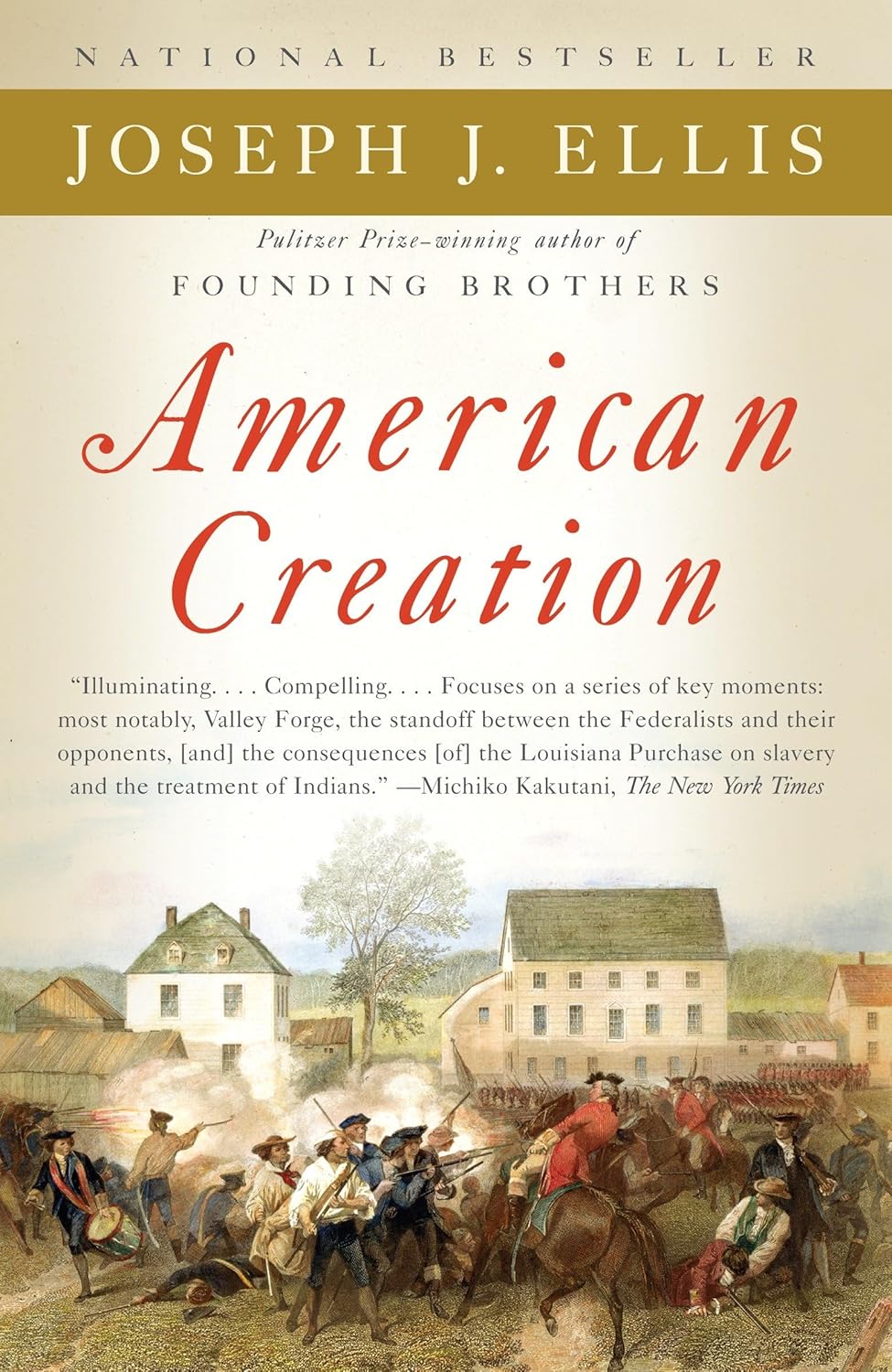
How did the American founding actually happen? That is the central question Joseph Ellis takes up in American Creation: Triumphs and Tragedies at the Founding of the Republic (2007). Rather than treating the founding as a single moment, Ellis stretches the period across twenty-eight formative years – from the Declaration of Independence in 1776 to the Louisiana Purchase in 1803 – and argues that it was during this extended, turbulent era that both the nation’s defining achievements and its most enduring failures were essentially locked in place. At the heart of these early struggles was a fundamental and, in Ellis’s view, irresolvable tension between advocates of a strong, sovereign federal government and defenders of state authority over domestic affairs. By refusing to settle this conflict decisively, the founders did something more subtle and, in Ellis’s telling, more consequential: they embedded ambiguity within the constitutional order itself, creating an “ingenious” framework for perpetual argument – one that has allowed the American system to remain both stable and adaptable as successive generations reinterpret the balance between state and federal power.
Ellis argues that the Founding Fathers were fortunate in two decisive respects: timing and space. They inherited the accumulated intellectual capital of the Enlightenment, carried across the Atlantic and applied in a distant and new setting. At the same time, they occupied what Ellis describes as “the most extensive and richly endowed plot of ground on the planet,” such that the United States began, in effect, with “the largest trust fund of any emerging nation in recorded history.”
Ellis argues that the founding of the United States produced five core achievements. First, it marked the first successful war for colonial independence in the modern era. Second, it established the first nation-sized republic. Third, it created the first wholly secular state. Fourth, it challenged the prevailing assumption that political sovereignty must be singular and indivisible, instead introducing a system of overlapping authority with deliberately blurred lines between federal and state power. Finally, it legitimized political parties as institutional channels for dissent and debate, creating a durable framework for ongoing dialogue that became a defining feature of the modern liberal state. Ellis gushes that “there can be little doubt that the late eighteenth century was the most politically creative era in American history” and that the story of the founding is “an extraordinary tale of monumental achievement.”
Historian Gordon Wood has observed that the founders operated in a political environment that was at once post-aristocratic and pre-democratic – one that made the best talent available for leadership while largely insulating it from the direct pressures of popular opinion, which many elites regarded as volatile, shortsighted, and easily swayed. In a similar vein, Bernard Bailyn argues that the founders benefited from something akin to a startup advantage: they were not burdened with reforming entrenched institutions or inherited traditions, but instead had the rare opportunity to build anew. Ellis, for his part, emphasizes that the founding was fundamentally a collective enterprise, shaped by a wide range of perspectives and experiences, and ultimately forged through compromise, contingency, and carefully calibrated ambiguity.
Ellis examines six discrete episodes in the founding of the republic and argues that four central themes emerge from them. First, the founding was largely improvisational: many of the most creative and enduring decisions were pragmatic responses to rapidly unfolding events beyond anyone’s control. Second, the founders recognized that the vast scale of the American landscape – what Ellis calls “space” – was a decisive strategic advantage, both in securing independence and in sustaining the republican government that followed. Third, unlike the leaders of the French Revolution they helped inspire, the American founders adopted a strategy of deferral on the most intractable issues – what Ellis calls “pace” – producing an evolutionary rather than revolutionary trajectory of political and social change. Finally – and relatedly – while they proved remarkably innovative in envisioning a secular state and a large-scale republic, the founders remained completely incapable of imagining anything like a genuinely multiracial society.
The first case study is “The Year,” by which Ellis refers to the fifteen months between the Battles of Lexington and Concord in April 1775 and the signing of the Declaration of Independence in July 1776. His central argument is that independence was not a foregone conclusion, but a high-stakes gamble taken under mounting pressure. It was, as Ellis puts it, “an explosion in slow motion,” one that allowed the American Revolution to avoid the mass bloodshed that later characterized revolutions in France, Russia, and China. At this early stage, the only meaningful expressions of national unity were the Continental Congress and the Continental Army, led by John Adams and George Washington, respectively – both of whom favored a strategy of patience and proceeding with “all deliberate speed.” Ellis contends that the Revolution itself was “eminently avoidable” had the British government possessed the imagination to embrace some form of shared sovereignty, or federalism – a failure he calls “perhaps the greatest blunder in the history of British statecraft.” Events, however, were moving faster than either Adams or Washington would have preferred. The Prohibitory Act of late 1775, which declared the colonies in open rebellion, stripped them of the King’s protection, and imposed a total trade blockade while authorizing the seizure of American property, marked a decisive turning point. In effect, it shifted British policy from coercion to outright hostility – amounting, in Ellis’s telling, to King George III’s declaration of independence from the colonies and forcing the Continental Congress toward the same conclusion.
In April 1776, in response to the Prohibitory Act, Adams published Thoughts on Government, in which he argued that the colonies should establish republican governments grounded in the rule of law, with a clear separation of powers – legislative, executive, and judicial – to guard against tyranny. He also advocated for a bicameral legislature and a system of checks and balances to ensure stability while restraining both elite overreach and popular excess. The pamphlet helped spur Congress to urge the states to draft new constitutions. For the rest of his life, Adams regarded himself as the true architect of independence, dismissing Thomas Jefferson’s Declaration as “a theatrical sideshow”—an “ornamental afterthought,” which Ellis describes as “an epilogue…to the main story.” Only later did the Declaration come to be recognized, in Ellis’s words, as “the seminal statement of the American creed,” “the most potent and consequential words in American history—perhaps in modern history.”
The second case study is “The Winter,” the brutal months at Valley Forge in late 1777 and early 1778, when the Continental Army came close to disintegration. Ellis calls it the “American Gethsemane”—the Revolution’s moment of agony and decision, when the cause might have collapsed but instead emerged hardened and renewed. Two widely held assumptions proved false. First, that a force of virtuous amateur volunteers could not defeat a professional army. Second, that in a prolonged conflict, time favored the British. As these assumptions were turned on their head, so too did American strategy. Ellis’s central insight is that the greatest threat to the Revolution was not the British Army, but internal collapse. At the same time, the Americans’ greatest advantages were time and space. Contrary to early expectations, the patriot cause could prevail simply by not losing. In this sense, the Revolution was not primarily a conventional contest between armies. The only way the Americans could truly lose was by overreaching in an attempt to win decisively. Instead, the conflict more closely resembled an insurgency, in which the decisive arena was public opinion, the countryside was the critical theater, and there was no single geographic center of gravity.
The great irony of the starving winter at Valley Forge is that Washington’s army of roughly twelve thousand men – of whom perhaps only a quarter to a third were fit for duty – was encamped in one of the richest and most productive agricultural regions on the Atlantic coast. It was here, Ellis argues, that Washington and others who would later emerge as leading Federalists – including Alexander Hamilton and John Marshall – first fully grasped the inherent inadequacies of a loosely organized, state-based confederation. Washington came to see that the army’s supply crisis posed a more existential threat than General Howe’s British forces in nearby Philadelphia. In response, he placed his most capable and trusted subordinate, Nathaniel Greene of Rhode Island, in charge of the quartermaster department.
The Continental Army’s starvation amid such abundance was no accident. Local farmers, acting rationally, preferred to sell their goods to the British, who paid in hard currency at favorable rates. While many sympathized with the patriot cause, few were willing to do so at the expense of their own families’ survival. As Ellis notes, the countryside around Valley Forge became a microcosm of the tangled loyalties and competing interests that defined the mid-Atlantic during the war. Washington was thus confronted with an agonizing choice: seize supplies by force or watch his army dissolve. In the end, the fate of the Revolution would hinge not simply on battlefield victories, but on winning a broader contest for allegiance and support in the countryside – a true hearts-and-minds campaign.
The Continental Army’s other major problem was discipline – specifically, its inability to maneuver effectively in formation and maintain cohesion when spread out over long distances. Washington’s answer was to appoint the largely fraudulent Baron von Steuben as inspector general. By 1777, Ellis observes, the patriotic fervor of ’76 was waning among the broader population, while the officer corps was increasingly consumed by questions of rank and what he describes as a “juvenile competition” over status and reputation. This dysfunction was compounded by a shift in the nature of the war itself. The conflict moved away from set-piece battles like Germantown toward a series of smaller, decentralized engagements, often related to contests over foraging for supplies, as Washington pivoted to a defensive strategy aimed at controlling the countryside rather than defeating the British in open battle, as Horatio Gates had done at Saratoga.
To many, this Fabian strategy seemed dishonorable, but the size and fragility of the Continental Army left Washington little choice. From this point forward, survival became the central objective. The true strategic center of the rebellion was not a place, but the army itself. By marching his forces out of Valley Forge intact, Washington demonstrated that the Revolution’s soul remained alive. The new strategy prioritized control of the countryside over decisive battlefield victories. Valley Forge, Ellis argues, was “the pivotal moment when [Washington] first glimpsed the strategic reality” that made a Yorktown of some kind all but inevitable.
The third case study, “The Argument,” focuses on the constitutional debates of 1787–88, when a new “spirit of ’87,” emphasizing the supremacy of the national government, collided with the original “spirit of ’76,” rooted in individual liberty and local control. Indeed, the inherent weakness of the Articles of Confederation was very deliberate and stood as a shining example of republican principles that eschewed strong and distant central governments. According to Ellis, “the Articles of Confederation accurately reflected both the ideology that justified the American Revolution as well as the mentality and experience of most American citizens, for whom grand visions of a powerful nation-state with imperial pretensions floated far above their daily lives.” Indeed, weakness is precisely what most Americans wanted. Ellis’s central insight is that the American system ultimately endures not because it resolves these tensions, but because it accepts and institutionalizes them. It was a stunning victory for a small, powerful and dedicated minority of nationalists against a broad-based majority who were staunch confederationists who would come to view the new United States Constitution a betrayal of the principles and values that shaped the American Revolution.
Ellis argues that the two-year period from 1786 to 1788 was “the most creative moment in all of American political history,” driven by a convergence of crises in the fall of 1786 that convinced nationalists the young republic faced an existential threat. First, the Confederation Congress considered surrendering navigation rights on the Mississippi River for twenty-five years in exchange for a favorable commercial treaty with Spain, a move that advantaged New England at the expense of western interests. Second, Congress failed to support Massachusetts with militia during Shays’s Rebellion, exposing the weakness of the central government and supposed anarchy in the American countryside. Third, the Annapolis Convention collapsed without producing even modest reforms to the Articles of Confederation around the facilitation of interstate commerce. Finally, James Madison’s October visit to Mount Vernon persuaded George Washington to come out of retirement and lead Virginia’s delegation to a proposed convention to revise the Articles. Taken together, these events convinced nationalists that incremental reform was no longer sufficient – the Articles did not need revision, but replacement.
Shy and diminutive, James Madison was nonetheless the driving engine of the Constitutional Convention. His close study of history convinced him that political confederations were inherently fragile and temporary. In Madison’s view, the 1780s had exposed the fatal weaknesses of the Articles of Confederation: the inability to meet tax and pension obligations, to coordinate internal improvements or currency reform, to unify the legal system, or to manage relations with Native American tribes. He also challenged several deeply held political assumptions. Most notably, he argued that the federal government would be the creation of and in service to a united American people, not a collection of states. Madison further distinguished between the “will of the people” – what a majority may desire – and the “interest of the public” – what best serves the common good. He further argued that large republics, rather than small ones, were better suited to republican government because they diffuse factional conflict across a broader array of interests. A more extensive republic, he wrote, creates “a greater variety of interests, of pursuits, of passions, which check each other,” thereby improving governance. Ellis calls this Madison’s “most brilliant contribution to modern political science,” later enshrined in Federalist No. 10 as a foundational statement of pluralist politics.
Madison set both the agenda and the tone of the Convention by arriving better prepared than anyone else. His Virginia Plan was carefully constructed and highly nuanced, proposing a bicameral legislature with representation based on population, broad national powers to tax and regulate commerce, a veto over state laws, and separate executive and judicial branches. Ellis describes it as a “radical agenda,” one that forced the moderates in attendance to scramble for a response, while the most ardent defenders of the Articles of Confederation, such as Virginia’s Patrick Henry, were completely absent. At the heart of the debate was a fundamental question: where would sovereignty reside – with the states or with the national government? In the end, the issue proved irreconcilable. Madison secured only a partial victory: a system of qualified national sovereignty that fell short of his goals, lacking both a sweeping veto over state legislation and proportional representation in both houses of Congress, which he considered essential. The resulting compromise, shaped in part by the New Jersey Plan, struck Madison as a “throbbing disappointment,” in Ellis’s words. Yet, ironically, what he saw as the Constitution’s greatest weakness – the ambiguity surrounding ultimate sovereignty – would, Ellis argues, become its enduring strength.
Ellis is never shy about trumpeting the historical scale and significance of the early republic. Here he writes breathlessly that “during the ten months after the Constitutional Convention, the most far-reaching and consequential political debate in American history raged throughout every state in the union.” The Federalists entered the ratification struggle with several notable advantages. First, they successfully saddled their opponents with the label “Anti-Federalist,” which had already existed as a sort of political epithet. Second, they framed the choice before the electorate as stark and binary: accept the new Constitution or risk the dissolution of the Union. Third, although two of the largest and most influential states – Virginia and New York – contained strong Anti-Federalist majorities, their ratifying conventions were scheduled late, by which point the Constitution was likely to have already secured the necessary state ratifications.
The two sides were driven as much by fear as by hope. For the Federalists, the overriding danger was “anarchy”; for the Anti-Federalists, it was “consolidation.” Ellis contends that the Anti-Federalist position reflected the preference of “a clear majority of the population,” though he offers little firm evidence to substantiate the claim. In essence, opponents of the Constitution argued that they were defending ordinary Americans against what they saw as a hostile takeover of the Revolution by an elite minority intent on financial speculation and the consolidation of power. They held fast to the traditional view that sovereignty must reside in a single locus – preferably the states, as the political institutions closest to the people. “Gradually and grudgingly,” Ellis writes, Madison shifted his position, becoming the leading advocate of a framework he had resisted in Philadelphia: a system of shared sovereignty, in which the national government exercised only certain enumerated powers necessary to preserve the Union, while all residual authority remained with the states.
Ellis argues that the true climax of the story was not the Constitutional Convention in Philadelphia in 1787, but the Virginia Ratifying Convention in Richmond in 1788, where the central and opposing issues were fully aired and sharply contested. He describes the exchange between Madison and Patrick Henry as “the most consequential debate in American history.” Henry warned that Virginians were being asked to endorse a system eerily similar to the British model that patriots had sacrificed so much to escape – it was “the Spirit of ’76 all over again.” Madison, by contrast, defended the Constitution’s deliberately blurred lines of sovereignty between the federal and state governments as its greatest strength and enduring innovation. The crowning irony, Ellis observes, is that in the decades that followed, Madison himself became the leading critic of the very Constitution he had done more than anyone to create – invoking many of the same arguments Patrick Henry advanced at the Virginia Ratifying Convention.
The fourth case study Ellis presents is “The Treaty,” which examines the highly controversial – and now largely forgotten – 1790 Treaty of New York with the Creek Nation. His central argument is that the survival of the fledgling United States required a willingness to prioritize pragmatic compromise over ideological purity – even at significant political cost. He begins, however, with what he regards – after the failure to end slavery – as “the greatest failure of the revolutionary generation”: the inability to protect Native American communities. Ellis notes that President Washington, Secretary of State Jefferson, and Secretary of War Knox were united in treating Indian policy as a branch of foreign policy, recognizing Native nations as sovereign entities with legitimate claims to their lands and certain inalienable rights. In the end, however, as Ellis puts it, “demography trumped diplomacy.”
After the Treaty of Paris in 1783, there was technically no recognized Indian territory; by right of conquest, the United States claimed all land from the Atlantic to the Mississippi River. The underlying logic of the Northwest Ordinance of 1787 reinforced this position, implying that any Native presence within that vast region was provisional and subject to eventual removal. Ellis singles out Henry Knox for his principled – and, in his words, “stunning” – argument that such removal was both legally indefensible and morally wrong, amounting to a direct repudiation of the ideals of the American Revolution. Knox’s moral and economic case persuaded President Washington, who concluded that the issue was too consequential to delegate. The administration accordingly adopted a republican approach to Indian policy, grounded in treaties based on mutual consent and backed by the authority and honor of the federal government. This vision explicitly rejected the supposed inevitability of demographic displacement. Knox and Washington imagined a future in which Native enclaves east of the Mississippi would retain their political and territorial integrity under federal protection – a model of westward expansion that coexisted with the continent’s original inhabitants. The powerful Creek nation in the Southeast, led by the formidable (but also alcoholic and syphilitic) Alexander McGillivray, appeared to offer the most promising test of this more humane approach. The outcome, however, was, as Ellis puts it, “part fiasco, part comedy.”
Ellis likens McGillivray to a Cold War–era Third World dictator, adept at playing rival powers against one another to extract maximum advantage. He portrays him as a complex and contradictory figure: “part Indian, part white; part defender of Creek rights, part southern slaveholder; part statesman, part corrupt power broker.” Despite this hybridity, McGillivray was firmly anti-American, convinced that the fragile confederation of states would soon dissolve. For US leaders, a diplomatic solution was the only viable path – Knox estimated that a full-scale war against the southern tribes would cost $15 million, a sum the fledgling treasury could not afford – and McGillivray, whom Ellis calls “the most effective Indian leader of his time,” was perceived as the indispensable partner to achieve a diplomatic breakthrough. The objective was to secure a treaty that reaffirmed federal control over Indian policy and nullified the Yazoo land claims advanced by Georgia.
In July 1790, McGillivray led a large and colorful Creek delegation to New York City for a month-long negotiation that became something of a multicultural spectacle. The resulting Treaty of New York pledged federal protection of Creek lands against encroachment by states and settlers, while quietly appointing McGillivray a brigadier general in the U.S. Army with a salary intended to replace his Spanish stipend. The treaty passed the Senate by a vote of 15–4. Yet Washington and Knox quickly discovered that their promises were no match for the relentless tide of westward migration. “Knox sent a detachment of federal troops to police the border,” Ellis writes, “but it was like stopping a flood with a bucket of sponges.” McGillivray soon turned back to Spain, though the Creek-Spanish alliance proved equally incapable of stemming American expansion. “[Washington and Knox] had made a heroic effort and failed,” Ellis concludes, “though it is difficult to imagine what they might have done differently.” The outcome was driven by a powerful demographic surge pushing west from the Atlantic seaboard. In the end, any policy reliant solely on federal authority was bound to falter; as Ellis starkly observes, “Indian removal was the inevitable consequence of unbridled democracy in action.”
The fifth case study, “The Conspiracy,” centers on Thomas Jefferson’s quasi-paranoid worldview that the country was being deliberately but secretly undermined by a small cabal of would-be monocrats. Ellis uses the episode to highlight the rapid emergence of the two-party system – an institution initially viewed with deep suspicion but ultimately one of the most important and enduring features of American politics. In the late eighteenth century, “party politics” was a term of reproach, evoking factionalism and self-interest rather than legitimate opposition. Yet the development of a two-party system may well be the founders’ most lasting contribution to modern political thought. As Ellis argues, it effectively channels “the combustible energies of a wild-and-woolly democratic culture into a coherent and disciplined framework,” providing “a safe and structured location for ongoing dissent.”
The story begins in May 1791, when Jefferson and Madison embarked on a tour of the northern states that was ostensibly a botanical excursion but in reality a discreet fact-finding mission aimed at laying the groundwork for a national opposition party. Their target was the Washington administration’s emphasis on strengthening federal authority and its expansive interpretation of the Constitution’s enumerated powers – especially as embodied in Alexander Hamilton’s financial program, including the assumption of wartime debts and the creation of a national bank. Ellis notes that many southerners viewed the northern commercial elite “as vampires sucking the blood out of the agrarian South.” While he concedes that Jefferson and Madison’s concerns sometimes bordered on the hysterical, he insists they were “wholly sane and thoroughly rational men” who believed the same forces once emanating from Whitehall were now reappearing domestically in the form of an aristocratic merchant class. In their view, a conspiracy – albeit, as Ellis wryly observes, “a very strange kind of cabal,” one elected by a broad majority – was taking shape. Hovering over the entire debate was an unspoken but potent fear: that once the open-ended federal government power asserted control over domestic policy, the institution of slavery would inevitably come under threat. Indeed, Ellis asserts that the slavery issue itself created an environment conducive to a conspiratorial mentality, “a political world in which the unspoken was all-important, secrecy was an essential attribute for success, suspicion was wholly justified, mutual trust was foolishly naive, and one’s deeper motives were presumed to be hidden.”
A pivotal moment in the emergence of the American two-party system was James Madison’s improbable transformation from chief architect of the federal government to its most formidable critic. Ellis likens it to Martin Luther declaring his allegiance to the Vatican. What explains such a dramatic reversal? Ellis outlines three competing interpretations. First, that Madison was deeply influenced by Jefferson, whose states’-rights perspective prevailed once he returned from France to serve as secretary of state; Ellis finds this unpersuasive, noting that Madison’s views began to shift even before Jefferson’s return in the spring of 1790. Nevertheless, throughout the 1790s Madison was known as the “General” of the nascent Republican Party and Jefferson its “Generalissimo.” Second, that Hamilton’s Report on Public Credit (1790), with its assertive vision of federal control over public finance, alarmed Madison – particularly the implication that the national government might eventually threaten Virginia’s distinctive “species of property.” Third, and most charitably, that Madison possessed a keen sensitivity to the need for balance between federal and state authority, and deliberately aligned himself with whichever side appeared at risk of overreach—first supporting federal power against dominant states under the Articles, then defending states’ rights during the expansive federalism of the 1790s, and later returning to a stronger national stance during the Nullification Crisis.
After resigning as Secretary of State on the last day of 1793, Jefferson spent three years in what might be called pseudo-retirement at Monticello. Three developments ultimately drew him back into political life to confront the Federalists and led to the organization of the opposition party known as the Republicans. First, Jefferson favored an embargo in response to British predation on American shipping, while the Federalists preferred accommodation, given that roughly 75 percent of American trade was with Great Britain and generated nearly 90 percent of federal revenue. At the same time, less than 10 percent of British trade flowed to the former colonies, limiting the leverage of any American embargo. Second, the Whiskey Rebellion of 1794 demonstrated the fate awaiting regional resistance to a federal government now capable of enforcing its authority with a standing army – led, in this case, by President Washington himself. Finally, Jay’s Treaty of 1795–96 prioritized the economic benefits of Anglo-American alignment over ideological and historical ties to France. In fairness, Jay secured the three objectives he had been sent to achieve: avoiding war with Britain, restoring trade, and resolving outstanding issues from the Treaty of Paris. Ellis ultimately sides with Jay, arguing that he “probably got the best deal possible.” Jefferson, however, believed the United States was backing the wrong side in the European conflict and would ultimately find itself on the wrong side of history – a judgment he later sought to obscure by editing his correspondence. Nonetheless, it was his fierce opposition to the Jay Treaty that pulled him back into public life. The election of 1796, the first to feature a fully articulated opposition party, confirmed that partisan politics had become not only unavoidable, but essential to the American republican experiment.
Finally, “The Purchase” focuses on the 1803 acquisition of Louisiana. Ellis’s central takeaway is that the success of the American experiment often depended on leaders’ willingness to set aside their own deeply held political convictions when circumstances demanded it. In retrospect, he argues, the Louisiana Purchase – costing roughly $260 million in today’s dollars—was a triumph on par with the Declaration of Independence and the creation of the Constitution. It secured what Ellis calls “the most fertile tract of land of its size on the planet,” and Jefferson’s largely unilateral decision to proceed ranks, in his view, as “the most consequential executive decision in American history,” rivaled only by Harry Truman’s authorization of the atomic bomb in 1945. Yet the opportunity itself arose largely through a combination of American patience and dumb luck. At the same time, the purchase effectively entrenched two of the founding generation’s greatest failures: the persistence of slavery and the inability to protect Native American communities east of the Mississippi.
Jefferson came to office in 1801 with a clear mandate grounded in republican principles: reduce the national debt, cut federal spending, return authority over domestic policy to the states, and curb the power of the executive. “He was about to violate every one of them,” Ellis writes. Jefferson’s vision of the American West was, in Ellis’s words, “breathtakingly bold, presumptively imperialistic, and thoroughly racist.” Unlike Washington, he did not believe the federal government could – or should – restrain the surge of westward settlement; it should simply step aside. The greatest threat to that vision was the possibility that Spain’s waning North American empire would be replaced by a more formidable power, namely Napoleonic France – which is precisely what Napoleon intended. Along with Talleyrand, he envisioned transforming Spain’s former territories into a French analogue of Australia: a vast colonial domain that would absorb debtors and criminals while supplying agricultural goods to the metropole and checking American expansion.
That vision collapsed in Haiti, where a slave revolt and yellow fever devastated a French expeditionary force of some 50,000 troops under General Charles Leclerc, Napoleon’s brother-in-law. What was expected to be a swift six-week campaign turned into a catastrophe, with French casualties reaching roughly 80 percent. Plans to consolidate French control over Haiti and then move on to New Orleans were quietly abandoned. Instead, the territory fell unexpectedly into American hands, to the consternation of Spain, which was powerless to resist. Jefferson seized the opportunity with what Ellis calls “the most aggressive executive action ever by an American president,” a striking move for a leader previously fanatically committed in principle to limited executive authority. Moreover, he vested full responsibility for federal policy in the Louisiana Territory, including the appointment of all government positions, in the presidency – the very kind of expansive executive authority that had once made him apoplectic as a leader of the opposition to the Federalists.
The Louisiana Purchase had direct implications for the founding generation’s two greatest failures: Indian removal and slavery. The vast new territory created space to relocate Native communities from east of the Mississippi, while also offering a means to finance the acquisition itself. The $15 million cost of the Purchase had to be repaid, and by removing Native populations and selling their lands to settlers in small parcels, the federal government could generate the necessary revenue. As Ellis puts it, “The Purchase had made Indian removal possible, and Indian removal would provide the revenue required to pay off the Purchase.”
On the question of slavery, Ellis argues that the Purchase presented a theoretical opportunity for gradual emancipation. Congress could have prohibited slavery in the new territories and used proceeds from western land sales to compensate southern slaveholders and fund the relocation of freed people to Africa or the Caribbean. But the estimated cost—roughly $900 million for 1.5 million enslaved people, more than sixty times the price of Louisiana—rendered such a plan politically and financially implausible. Ellis contends that Jefferson’s avoidance of the issue was not mere oversight but a deliberate decision to sidestep a divisive national debate. “Jefferson believed,” Ellis writes, “that [slavery] was akin to an inoperable cancer, and that any effort by the government to remove it would only end up killing the patient.” Jefferson’s later argument that slavery might be weakened by allowing it to diffuse westward, Ellis adds, amounted to a “bizarre claim”—akin to suggesting that spreading a cancer would somehow reduce its lethality.
The Louisiana Purchase not only secured the nation’s continental future but also set a precedent for the expansive use of federal and executive power in later crises, from the Civil War to the Great Depression. Other historians have argued that Jefferson was motivated by a desire to preserve a republic of yeoman farmers and to resist the commercial-industrial model associated with Hamilton, though Ellis does not engage directly with that interpretation. He does, however, emphasize Jefferson’s deeply pessimistic view of the nation’s future: that white and black Americans could not coexist in harmony, that Native peoples were destined for extinction, and that the problem of slavery defied any peaceful resolution.
In sum, American Creation is an excellent book for anyone interested in the early American republic. While it did not introduce much that was entirely new to me, I have rarely seen familiar episodes – the privations at Valley Forge, the drama around the ratification of the Constitution, and the executive overreach required to secure the Louisiana Purchase – represented in a way that so clearly illuminates the foundations and enduring contours of American political life and culture.
 What's Tim Reading Now?
Leave a comment