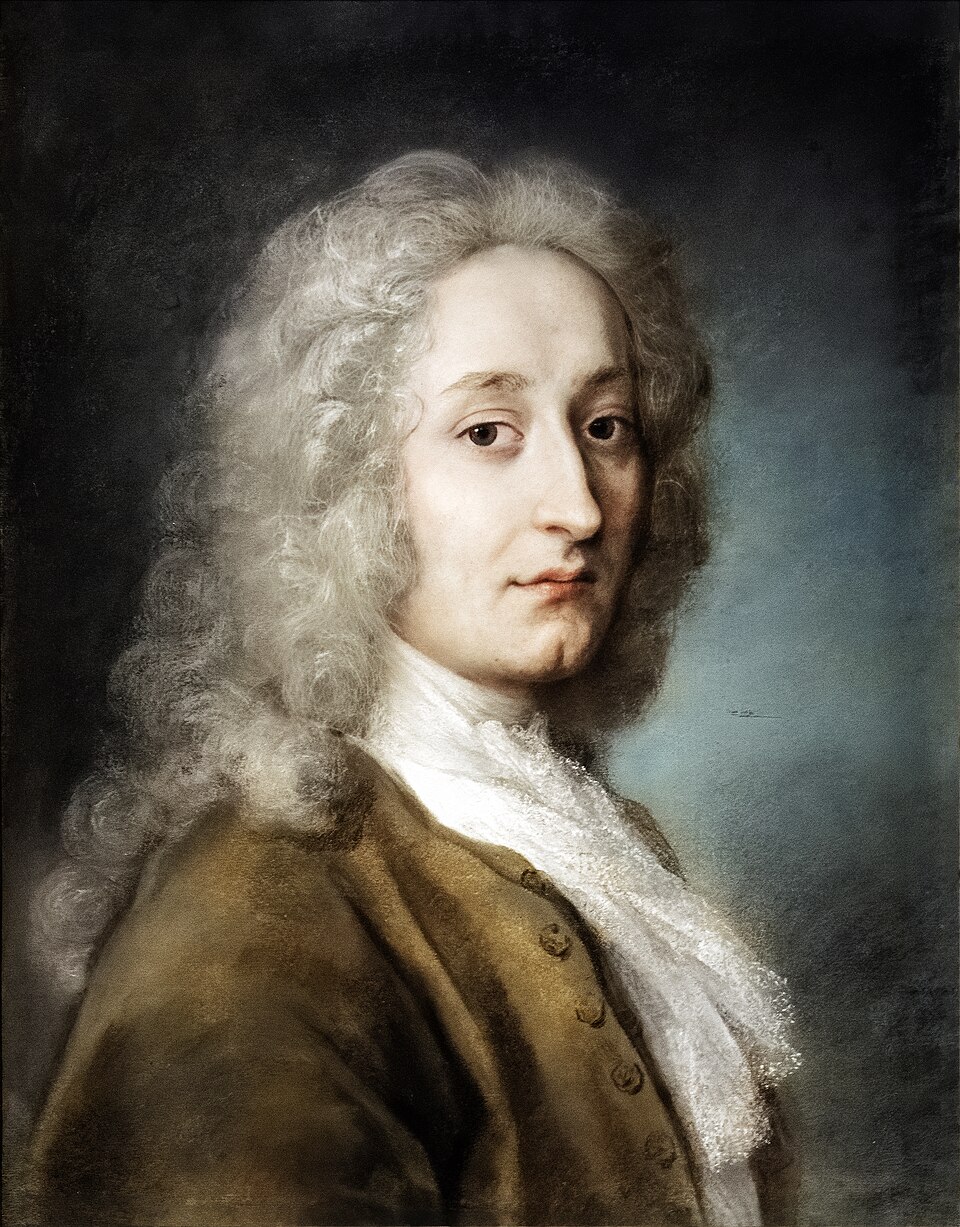
The Sun King, Louis XIV, died in 1715 after 70 years on the throne. In partnership with his aide Jean-Baptiste Colbert, he set out to establish royal control over all aspects of life. Rigid regulations and etiquette dominated all aspects of French life in the late seventeenth century, including art. The Royal Academy of Painting and Sculpture, founded in 1648, laid down the principles of French that had to be met to receive lucrative commissions.
The Academy imposed a doctrine now called French classicism. The Ancient Greeks and Romans were held up as embodying the laws of eternal beauty. The ideal was Raphael and Nicolas Poussin, arguably the greatest French painter of the seventeenth century, although he spent much of his career in Rome, serving briefly as King Louis XIII’s First Painter. Poussin died in Rome in 1665 just as Louis XIV was rising to power.
The Sun King and Colbert had to select a new man to play the role of royal decorator, something akin to Minister of Cultural Affairs. They selected Charles Le Brun, who commissioned, controlled and corrected all aspects of artistic life at Versailles via the Art factory at Gobelins, which produced everything from carpets to candleholders, all in a classic and ornate style.
The death of the Sun King ushered in a period known as the Regency, led by the late King’s nephew, the Duc d’Orleans. The change was evident in every aspect of French life. Gravity was replaced by lightness, the large with the diminutive, the somber with the gaily colored. Watteau would come to epitomize the Regency even though he only lived six years beyond Louis XIV and would come to define eighteenth century art even though he worked two decades into it. Throughout his life remained outside the reach of the French court and official commissions. Watteau became the hinge figure between Louis XIV’s late Baroque aesthetic—grand, classical, heroic—and the intimate, sensual Rococo that defined early 18th-century France. The shift was accompanied by a rise in the social status of artists, from glorified valets under the Sun King to aristocrats of mind on equal footing with aristocrats of blood.
Watteau was active from 1702 until his early death in 1721, but only really achieved his unique and mature style between 1714 and his premature death at age 37. He left behind a body of work whose exact size varies by scholarly source, but the consensus is that about eighty to one hundred paintings can be firmly attributed to him, a relatively small output for one of the eighteenth century’s most influential and celebrated French painters, a century known as one of elegance and refinement. Although he produced thousands of drawings during his short career, fewer than seven hundred surviving sheets are accepted today by specialists.
Watteau was from Flanders and from mean circumstances. He left home penniless and unsupported at 17 to pursue a career as a painter. His greatest artistic influence would be Rubens and the great Venetian artists Titian, Giorgione, Veronese, and Correggio. He would create the style known as French Rococo, a separation from the sober classicism of Louis XIV’s circle that was lighter in spirit and color, less formal and static. It combined realism, theatrically, and sensuous elegance, which he developed over his short career working for costume designers and interior decorators.
For his first decade in Paris, Watteau was a member of the artistic proletariat, churning out copies of famous works and sketching photos for tourists. He developed skill as a genre artist painting scenes from everyday live like Brueghel, which was largely popular with the common man on a limited budget.
Watteau’s fêtes galantes (literally “galant party”) were a new, immediately recognizable genre of painting he invented in the early 18th century—poetic scenes of elegantly dressed men and women, often aristocrats or actors, gathered in lush, dreamlike outdoor settings. Always set outdoors, they captured a sense of grace and harmony, a balance between reality and illusion, often including a juxtaposition of a statue and living people. The combination of dreams, reality and love was Watteau’s genius. (Before his death he destroyed his nudes.) He often portrayed children in his works, as scaled down versions of adults, addled by love and innocence.
Watteau’s art fit no conventional categories. His works, by an artist known as withdrawn and unsociable, somehow captured courtly love, social graces, and tender romance. They lounge, flirt, dance, play music, or drift toward gondolas in overgrown gardens and parklands that feel both theatrical and slightly unreal. Watteau changed European painting not through grand history narratives but by showing that small moments—tender, ambiguous, transient—could hold profound artistic power. But his works were implicit: he never showed kissing, embracing or drinking the way follow artists in the style did, like Pater and Lancret. Watteau’s license was purely poetic; his works had no object and did not narrate.
In a sense, with his fêtes galantes Watteau invented an entire fashion, elegance and set of manners — how to sit, stand, walk, talk, and even how to smile and be witty. Social graces and politeness were exalted. Much of Watteau’s style was shaped by his love of theater, which captured the juxtaposition of reality and illusion and became a French national obsession in the eighteenth century. In sum, his fêtes galantes created Le Monde — society. Indeed, the eighteenth century would become the era of portraiture, salons and society, dominated by the artists Maurice Quentin de LaTour (1704–1788), renowned pastel portraitist; Jean-Baptiste Perronneau (1715–1783), pastel portraitist and contemporary rival of LaTour; and Jean-Baptiste-Siméon Chardin (1699–1779), celebrated painter of still lifes and quiet domestic genre scenes. All three were masters associated with the Académie Royale and known for elevating intimate, everyday subjects and portraiture over grand historical themes, which Watteau had done much to introduce and popularize.
Watteau invented the language through which the 18th century expressed itself — elegance, wit, light colors and brushwork. Although the style of the Regency lasted but 50 years and then was scoffed at, Watteau’s work was never mere period pieces.
He also captured the spirit of the age and the dramatic acceleration of change that characterized the post–Sun King world of the early eighteenth century. “News” and “fashion”—including the newly elaborated concept of the coiffure—emerged as cultural phenomena, intensifying the sense of perpetual novelty and flux. Artistic tastes, too, began to shift with unprecedented speed. In all things, the aristocracy set both the direction and the tempo of fashion. Watteau was the first artist to observe, engage with, and ultimately shape this new culture of style. The permanent beauty embodied in the works of Poussin and Le Brun suddenly appeared neither timeless nor absolute. Watteau’s art was infused with a conscious sense of impermanence.
Contemporaries remarked of Watteau that “only his palette was rosy.” Brooding and misanthropic, he was also modest, preferred obscurity, and showed little interest in money. He never married and was never linked to any woman. Unusually for the period, he was among the first public figures to insist on a private life. Despite living in a relatively well-documented age, Watteau’s biography is scarcely better known than that of Giotto, who lived four centuries earlier. During the final decade of his short life, he slowly wasted away from tuberculosis. He died at thirty-seven—the same age as Raphael and Van Gogh.
The age that Watteau helped usher in soon slid from sentiment and amorousness into sensuality and outright eroticism. An idle, bored aristocracy came to treat lovemaking as a refined pastime. “For the present moment, always a pleasure; for the coming hour, always a desire,” became the unspoken motto of the age. Amorality hardened into a social norm. The reign of Louis XV marked a true golden age of vice, with his longtime mistress, Madame de Pompadour, serving as the great patron of the arts, the so-called “Queen of Arts and Taste” —and François Boucher, her favored painter, as its most emblematic artist. In return Boucher received every earthly reward: positions, honors, favors, wealth.
Boucher marked an important step away from the Renaissance conception of art as the mirror to the world and toward the modern notion of art as an independent force whose primary function is not to mean, but to be.
Louis XV began his reign as the Well-Loved and ended it as the Ill-Loved. “The virile century of Louis XIV had wielded the sword; the frail, feminine century of Louis XV could do no more than lift a fan,” Schneider writes. He was succeeded by his grandson, Louis XVI, a man of simple tastes and even a strain of prudishness. The new king ordered the libidinous paintings of Boucher at Bellevue destroyed. Almost overnight, sin went out of fashion, replaced by virtue. The sensuous curves of the Rococo gave way to the perpendicular lines of neoclassical art. In short, after 1760, antiquity had won the day. Sentimentality and melancholy suddenly became fashionable. Ironically, virtue was the one fashion Boucher and his circle could not accommodate.
The artists who came to define the new age were Jean-Baptiste Greuze and Jean-Honoré Fragonard. Fragonard stood to Boucher as Boucher had stood to Watteau; together they form the great triptych of eighteenth-century French art. Fragonard painted scenes of virtuous wedlock and family life as effortlessly as Boucher had depicted the embraces of lovers. Just as Watteau is remembered because he came too early, Fragonard is remembered because he came too late. Arguably the grandfather of modern art, Fragonard exalted the act of painting over fidelity to subject. Yet for all his preoccupation with erotic love, he never neglected domestic virtue. Like Chardin, he painted scenes of idealized family life – but he did so in a radically new way. Rococo died with the Revolution, and with Fragonard himself, yielding to the severe neoclassicism of his pupil, Jacques-Louis David.
In the end, Antoine Watteau’s influence on eighteenth-century French art was both immediate and enduring. With his invention of the fête galante, he shifted the center of gravity away from the grand, moralizing narratives of history painting toward mood, intimacy, and the poetry of everyday pleasure, helping to define the sensibility that would become known as the Rococo. His delicate brushwork, atmospheric color, and emphasis on fleeting emotion shaped artists as varied as Lancret, Pater, Boucher, Fragonard, and even the quieter realism of Chardin, while his ability to fuse theater, landscape, and psychology expanded what subject matter could be considered serious art. More broadly, Watteau’s work marked a turning point in art history: it opened the door to modern notions of painting as an expression of feeling and perception rather than doctrine or grandeur, making him not just a stylistic precursor of the eighteenth century, but a foundational figure in the long evolution toward modern art.
 What's Tim Reading Now?
Leave a comment