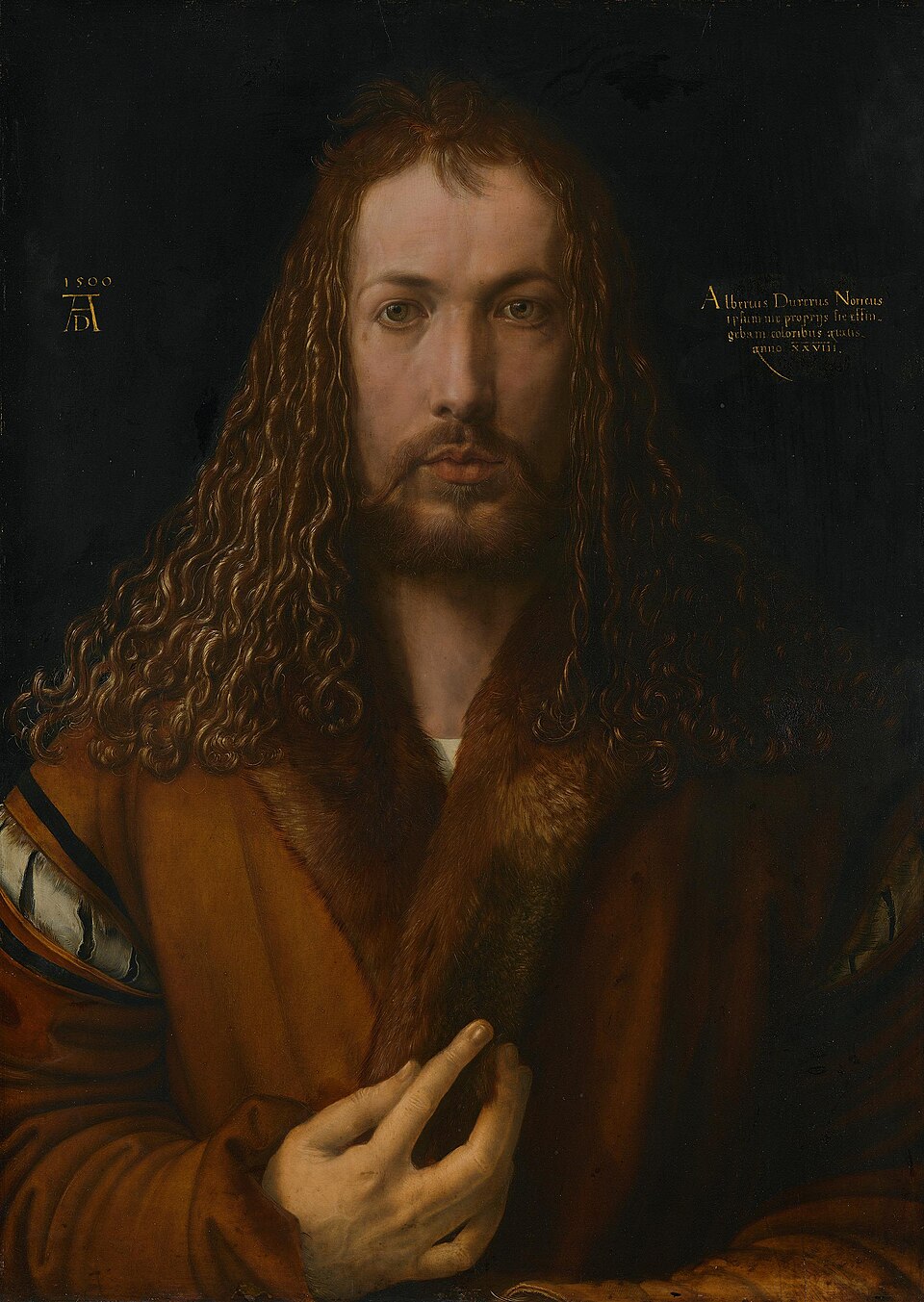
Born the son of a Nuremberg goldsmith, Albrecht Dürer learned the demanding art of engraving with a burin at an early age, a discipline that trained both his hand and his eye. His talent was quickly recognized, and he was apprenticed to the painter Michael Wolgemut, who would become a second father and introduce him to the workshop practices of large-scale production. Yet Dürer would go far beyond his German predecessors. He was the first major artist north of the Alps to fall fully under the spell of the Italian Renaissance – and, in doing so, became arguably the first modern artist of Northern Europe.
By his late twenties, Dürer was already celebrated as a master of the graphic arts. He harnessed the power of the printing press to transform woodcut and engraving into vehicles of mass communication. In this sense, Dürer was the first great artistic genius of reproducibility. His major woodcut cycles – The Apocalypse (1498), The Large Passion (1511), and The Life of the Virgin (1511) – circulated widely across Europe and were eagerly collected by rich and poor alike. These works demonstrated that even the humblest subject – a blade of grass, a clouded sky – could possess religious and symbolic resonance. Dürer fused the emotional intensity of the late Gothic tradition with the emerging humanism of the Renaissance, producing images that were both spiritually charged and empirically observed.
By his thirties, Dürer was famous throughout Europe and hailed as “the new Apelles,” proclaimed by admirers to be the greatest painter in the world – even as Leonardo, Raphael, and Michelangelo were all at the height of their powers. His productivity was extraordinary. His surviving body of work includes roughly 1,500 to 1,700 pieces: some 350–400 prints (woodcuts, engravings, and etchings), nearly 1,000 drawings and watercolors, and 70–90 paintings. Remarkably, an estimated 80–90 percent of his major works have survived – an unusually high rate for any Old Master. In 2022, a rediscovered Dürer drawing, Virgin and Child, sold privately for approximately $32 million, making it one of the most expensive Old Master drawings ever sold.
Dürer’s early formation was shaped by the lingering influence of the International Gothic style, which flourished across Europe from roughly 1375 to 1425. This courtly, pan-European aesthetic – linking France, Burgundy, Italy, Bohemia, England, and Iberia – served as a bridge between medieval art and the Renaissance. It emphasized refined detail, elegant line, increased natural observation, and early experiments in spatial depth. The style remained particularly strong in Nuremberg during Dürer’s youth and provided a crucial foundation for his later synthesis of Northern precision and Italian form.
In 1494, Dürer traveled to Venice, where he encountered the mature Renaissance firsthand and met Giovanni Bellini. At the time, Titian and Giorgione were apprenticing under the aging master, though there is no evidence that Dürer met them. The Venetian experience profoundly influenced Dürer’s approach to color and landscape, though he never fully mastered the idealized human proportions that obsessed Italian artists. This tension – between empirical observation and classical idealism – would remain a defining feature of his work.
Like many Renaissance artists, Dürer benefited from powerful patrons. His career accelerated when Frederick the Wise, Elector of Saxony, was deeply impressed by the artist shortly after his return from Venice. Dürer later attracted the attention of the Holy Roman Emperor Maximilian I, with whom he formed one of the most important artist–ruler relationships of the era. From 1512 until Maximilian’s death in 1519, Dürer worked as a court artist, producing ambitious propagandistic projects such as the monumental (if ephemeral) Triumphal Arch and designs for the Triumphal Procession. These vast works, printed on paper rather than carved in stone, were intended to project imperial glory across Europe. In exchange, Dürer received an annual stipend and unparalleled prestige, freeing him to pursue increasingly ambitious artistic experiments.
Yet Dürer was also a master of self-promotion. His most revolutionary achievement came in 1498 with The Apocalypse, a series of fifteen woodcuts depicting the Book of Revelation. Produced entirely on his own initiative and sold at fairs and markets, the series represented a radical departure from patron-driven art. The Apocalypse was a triumph of narrative compression and visual drama, reflecting all that Dürer had absorbed during his Italian travels. It became an immediate bestseller across Europe, from France to Russia.
Dürer’s range of subject and medium was astonishing. He worked in woodcut, engraving, oil, watercolor, and drawing, capturing whatever seized his attention: plants, animals, landscapes, fabrics, faces. His portraits aim neither at flattering likeness nor cold objectivity, but at revealing the inner character of the sitter – an attempt to give visual form to psychological presence.
Throughout his life, Dürer remained fascinated by Platonic ideals of beauty and the mathematical foundations of form. He devoted immense effort to perspective and proportion, attempting to reduce the human body to geometric principles that verge on the cubistic. Late in life, he published three technical treatises, most famously The Four Books on Human Proportion, which sought to define ideal form through mathematical ratios. The work went through fifteen editions and influenced artists such as Rubens and Rembrandt, though Michelangelo reportedly dismissed it as a waste of time. Like Leonardo, Dürer also published mathematical studies on fortifications and defensive architecture.
The year 1513 marked the peak of Dürer’s engraving career, with the creation of Knight, Death, and the Devil, St. Jerome in His Study, and Melencolia I (1514). The latter, inspired by the death of his beloved mother, stands as one of the most enigmatic and intellectually dense images in Western art.
Dürer’s final years in Nuremberg were unsettled by the upheavals of the Protestant Reformation. Though he never met Martin Luther, Dürer was deeply moved by his ideas and sent the reformer prints and engravings. Nevertheless, his art remained fundamentally Catholic, and he took no active role in religious controversy. His close friend Willibald Pirckheimer was excommunicated for Lutheran sympathies, and several of Dürer’s associates embraced radical beliefs. The artistic culmination of this period was The Four Apostles, one of Dürer’s final masterpieces and a somber meditation on faith, authority, and moral responsibility.
Dürer’s influence was immense. Raphael, Tintoretto, El Greco, and Rembrandt all studied his work closely, and he sketched Erasmus on multiple occasions. Alongside Goethe, Dürer came to be seen as a defining embodiment of the German spirit. Though he had no true successor – perhaps only Hans Holbein the Younger approached his stature – his legacy shaped generations of artists, including Albrecht Altdorfer, Lucas Cranach the Elder, Hans Burgkmair, and the fiercely original Baldung Grien.
Dürer stands not merely as a great German artist, but as one of the pivotal figures in the history of Western art: a bridge between medieval devotion and Renaissance humanism, between unique object and mass image, between the local workshop and the pan-European imagination.
 What's Tim Reading Now?
Leave a comment