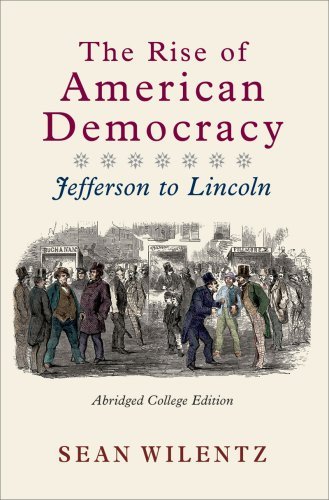
Princeton University’s Sean Wilentz’s The Rise of American Democracy (2005) is an ambitious work of U.S. political history. It is a dense but readable and deeply researched account of how democratic politics took shape from the age of the Revolution through the Civil War. At nearly a thousand pages, the book is far more than a chronicle of elections or political personalities. It is a study of democracy as a lived, contested, and often violent process, shaped by social movements, economic change, institutional innovation, and moral struggle. I found that I could only digest Wilentz’s narrative in small chunks of ten to fifteen minutes of concentrated reading. It took me half a year to finish The Rise of American Democracy, but I’m glad I powered through it.
What makes Wilentz’s interpretation distinctive is his refusal to present democracy’s rise as either inevitable or uncontested. Instead, he paints a picture of an American democracy that advanced only through fierce conflicts – at times expanding participation and political equality, at other times accommodating or even reinforcing the nation’s deepest injustices. Four interlocking themes stand out in Wilent’z expansive narrative: first, the emergence of partisan politics was the engine of democratic life, not its destruction; second, there was a steady process of democratization of political participation across class and social groups; third, there was a volatile and contradictory relationship between democratic expansion and slavery; and, finally, it was the transformation of national politics through popular movements that culiminated in the crisis of the Union.
Wilentz is perhaps best known for his argument that political parties were not a corruption of democracy but a vital mechanism of it. This is one of the central and most original insights of the book. For Wilentz, democracy was not born fully formed out of philosophical ideals or constitutional design; rather, it emerged out of bitter struggles between competing visions of the republic, most notably between the Federalists and Jeffersonian Republicans in the 1790s.
He emphasizes that early Americans, especially the economic and political elite, did not initially welcome the idea of organized parties. Founding Fathers like George Washington viewed parties as dangerous factions, and even Jefferson publicly lamented their emergence. But Wilentz argues that partisan conflict forced citizens to clarify their political commitments, mobilize supporters, and create organizational structures – such as newspapers, committees, and caucuses – that brought ordinary people into public life.
Wilentz paraphrases Jefferson’s own retrospective assessment that once parties emerged, Americans quickly recognized that organized opposition was essential to freedom. Rather than being a disease in the body politic, parties became the “great instruments” through which democracy expanded.
The election of 1800 serves as Wilentz’s early case study: a moment when peaceful partisan competition survived its first real test. This, he argues, showed that democracy – rooted in partisanship – had become a durable feature of American politics.
A second major theme of Wilentz’s book is that democracy developed not only in the halls of Congress but through the lived experiences and demands of ordinary people. Between the Revolution and the Jacksonian era, states steadily loosened or abolished property qualifications for voting. Wilentz shows how a cross section of white men – yeoman farmers, urban laborers, frontier settlers, and self-educated artisans – insisted on greater inclusion in political life in the early nineteenth century.
One of Wilentz’s strengths is his ability to narrate the democratic ferment of this period – town meetings filled with mechanics debating tariff policy, volunteer political clubs printing broadsides, crowds attending stump speeches, and petition drives sweeping across states. These were not merely colorful anecdotes; they illustrated the emergence of what Wilentz calls “democratic self-assertion,” a belief among ordinary citizens that they had both the right and the capacity to shape public life.
The rise of Jacksonian Democracy is portrayed not as the triumph of one man but as the culmination of decades of agitation from below. When Wilentz describes mass meetings at which thousands gathered to hear political oratory, he emphasizes that these events were as important to democracy’s rise as any legislative reform. The democratization of politics required the democratization of political culture, he says.
Yet he is careful not to romanticize this process. The very mechanisms that brought many workingmen into politics – public rallies, partisan newspapers, charismatic speakers – also deepened divisions, heightened political instability, and sometimes led to violence. Democracy expanded, but so did the opportunities for demagogues and for popular passions to overwhelm deliberation.
A third major theme – and arguably the heart of Wilentz’s historical interpretation – is the paradoxical relationship between the rise of democracy and the entrenchment of slavery. This is where Wilentz is both provocative and careful. He argues that the same democratic energies that empowered white men often excluded or even subjugated Black Americans, creating a democracy that was at once expanding and tragically constricted.
Wilentz traces how, in the 1790s and early 1800s, antislavery sentiment was surprisingly strong in parts of the South. He recounts how figures like St. George Tucker and even some Virginia Republicans contemplated gradual emancipation. This early moment is crucial for Wilentz because it reveals that slavery’s expansion resulted from political choices made within democratic institutions.
As democratization accelerated in the Jacksonian era, Wilentz argues, it hardened racial boundaries. In the South, the expansion of white male democracy was effectively predicated on the exclusion of enslaved people from any form of political belonging. In the North, new democratic currents did little to challenge racial prejudice; indeed, some states rescinded Black voting rights even as they broadened participation for white men.
Wilentz is especially forceful in his discussions of the Missouri Crisis of 1819–1820 and the escalating national disputes over slavery’s expansion. These conflicts, he emphasizes, were democratic crises. They revealed a nation struggling to define whether political equality could coexist with a system built on racial bondage.
By the 1840s and 1850s, Wilentz shows how the political system became increasingly strained. A variety of burgeoning democratic procedures – electoral competition, congressional bargaining, partisan organization – proved unable to contain the moral and constitutional contradictions of slavery. The very democracy that had grown so rapidly now threatened to tear the republic apart.
Wilentz’s final major theme is the role of popular movements in reshaping national politics, culminating in the collapse of the Second Party System and the coming of the Civil War. He devotes substantial attention to movements that challenged or disrupted the political mainstream: abolitionism, free soil agitation, labor protests, anti-bank activism, temperance crusades, and nativism.
Some of these movements Wilentz sees as constructive forces; others he treats with more skepticism. But all demonstrate, in his view, that democracy is not simply electoral competition but a continual process of mobilization and contestation.
The emergence of the Republican Party in the mid-1850s is the culmination of several strands of Wilentz’s narrative. He emphasizes that the party succeeded because it combined moral energy with political pragmatism, channeling outrage over the Kansas-Nebraska Act into an electoral coalition capable of winning national power.
Lincoln’s election in 1860 becomes, in Wilentz’s telling, the moment when American democracy faced its severest test. Southern secession was not merely a rebellion; it was a rejection of democratic outcomes. Wilentz argues that the Civil War should be understood, in part, as a war to defend democratic self-government against those who insisted that democratic majorities had no authority to restrict slavery’s expansion.
In conclusion, The Rise of American Democracy is a significant achievement – sweeping in scope, rich in detail, and animated by a clear interpretive vision. Wilentz brings together political theory, electoral history, social movements, and constitutional conflict to tell a story that is both inspiring and sobering. His core insight – that democracy in America emerged not through smooth progress but through conflict, improvisation, contradiction, and constant reinvention – gives the book its lasting power.
Perhaps most importantly, Wilentz forces the reader to confront democracy’s ambiguities. It expanded participation while deepening racial exclusion; it empowered ordinary citizens while creating new opportunities for demagoguery; it was both the agent of progress and the defender of entrenched injustice. Yet Wilentz also shows, with clarity and conviction, that democracy proved resilient. It survived partisan turmoil, regional conflict, and institutional crises. By the time of the Civil War, it had become not only a form of government but a set of expectations and habits that millions of Americans were willing to defend at extraordinary cost.
Few works better demonstrate how democracy is built: not by philosophers or framers alone, but by generations of citizens struggling – often imperfectly, often fiercely – to define what equality and political participation truly mean.
 What's Tim Reading Now?
Leave a comment