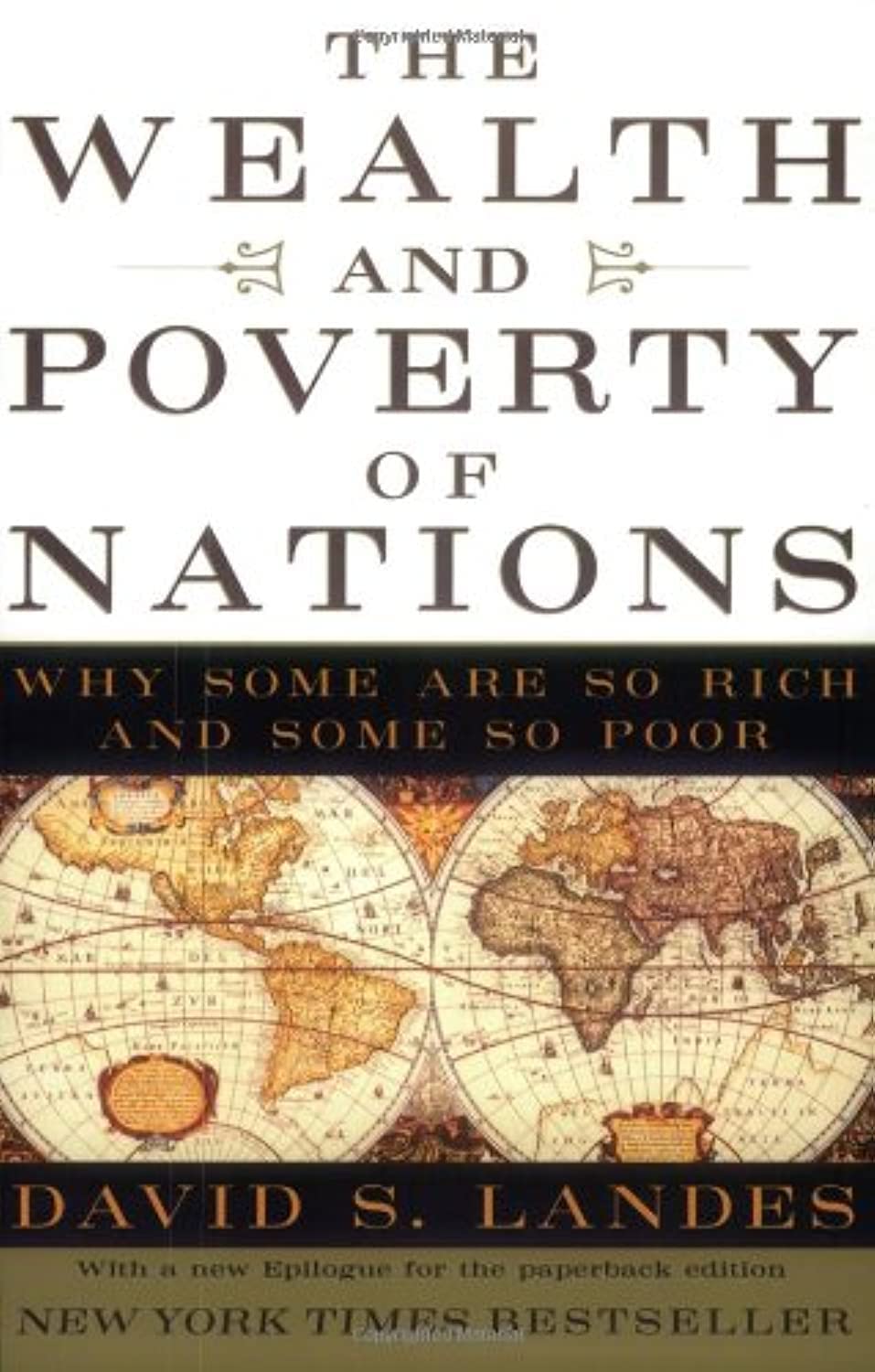
When David Landes published The Wealth and Poverty of Nations in 1998, he entered one of the most enduring debates in world history: why some societies become rich while others remain poor. Landes’s answer was simple and blunt: “If we learn anything from the history of economic development, it is that culture makes all the difference.”
His unabashed focus on cultural, institutional, and moral factors made his book both an international bestseller and a lightning rod. Few works of economic history have provoked as much admiration and discomfort. To read it today is to encounter a sweeping, impassioned argument about the making of the modern world – and the habits of mind that sustain it.
Landes was a Harvard economic historian with a mission, He was already renowned for The Unbound Prometheus (1969), his magisterial study of the Industrial Revolution. But The Wealth and Poverty of Nations was more ambitious: it sought not only to recount industrialization but to explain the divergence – why Western Europe, a cultural backwater in the year 1000, came to dominate the globe by 1900.
The book blends history, economics, and anthropology in a learned but at times challenging narrative. Landes writes as though lecturing a large seminar of bright but skeptical students. He has no patience for relativism. “Some cultures,” he insists, “are more conducive to growth than others. That is a fact, not an opinion.
Landes’s central thesis is that culture – the constellation of values, norms, and behaviors surrounding work, thrift, education, and authority – determines the trajectory of nations. Geography and resources matter, but they are not destiny. “If riches were determined by resources,” he quips, “Africa would be the richest continent in the world.”
The qualities that propelled Western Europe ahead were, in Landes’s view, distinctly cultural: respect for craftsmanship, belief in progress, emphasis on punctuality and discipline, curiosity about nature, and a willingness to question authority. These attitudes, he argues, created fertile ground for technological and institutional innovation.
One of the book’s most memorable examples is the invention of the mechanical clock in medieval monasteries. To Landes, this small device symbolizes the Western obsession with measurement, precision, and mastery of time itself. “The clock,” he writes, “embodied a new kind of discipline – time as resource, time as money.” By contrast, in much of the Islamic world, China, and India, time remained tied to the rhythms of nature or religion, not to mechanical regularity.
Landes’s narrative unfolds as a long comparative history of success and stagnation. In his telling, the “European miracle” was not inevitable but the result of centuries of competition and fragmentation. Unlike China’s unified empire, Europe’s patchwork of rival states created what he calls a “market of ideas.” When one prince persecuted innovation, another welcomed it. When one city banned heretics, another hired them.
This pluralism proved decisive. It allowed the Italian city-states to invent banking, the Dutch to pioneer capitalism, and the English to perfect industrial enterprise. The same dynamic prevented the kind of bureaucratic sclerosis that slowed China’s Ming and Qing dynasties or the Ottoman Empire’s increasingly rigid administration.
Landes’s admiration for Europe is not uncritical. He recognizes that imperialism and slavery were stains on its record, but he insists they were not the causes of Western dominance. Exploitation enriched nations temporarily, he argues, but it was technological ingenuity, scientific curiosity, and institutional freedom that produced sustained growth.
In a brilliant chapter titled “The Invention of Invention,” Landes describes how Europe transformed curiosity into an enduring system of innovation. The key was the Scientific Revolution and the rise of a culture that valued empirical testing and the open exchange of knowledge. European scientists and tinkerers corresponded across borders, published findings, and built on one another’s discoveries.
This collaborative spirit stood in stark contrast to the secrecy of other civilizations. In China, technological achievements such as gunpowder and printing were closely guarded or ignored by officials; in Islamic empires, religious conservatism sometimes curtailed scientific inquiry. “The West learned to learn,” Landes writes. “Others learned to remember.”
That “first prize” was Britain’s Industrial Revolution. Landes sees it as the culmination of cultural evolution: a society that combined secure property rights, free inquiry, and the Protestant work ethic. The British, he notes, had no monopoly on genius, but they had institutions that allowed genius to flourish. The revolution was more or less there for the taking, Landes argues. “To have had the Industrial Revolution was to have won first prize in a lottery in which many nations had bought tickets.”
Landes is equally interested in failure. His case studies of Spain, China, Japan, and sub-Saharan Africa illustrate how nations can squander opportunity.
Spain, he argues, is the archetype of decline. The influx of New World silver made it rich but lazy. Nobles disdained commerce; the Inquisition drove out Jews and Muslims, who had been among the kingdom’s most skilled artisans and financiers. Landes writes with dry contempt: “The Spanish gentlemen preferred to live like rentiers, not merchants.”
China, meanwhile, represents the tragedy of arrested development. Once the world’s most advanced civilization, it turned inward under the Ming dynasty, prioritizing bureaucratic order over innovation. When Zheng He’s vast fleets returned from their ocean voyages in the fifteenth century, they were dismantled – not because of failure, but because of official suspicion. Landes’s verdict is acerbic: “The empire that had everything decided it had nothing to learn.”
Japan, in contrast, earns his full admiration. After the Meiji Restoration, Japan modernized with astonishing speed, importing Western technology and expertise while preserving social cohesion. To Landes, Japan proves that modernization is not synonymous with Westernization – it is about attitude: curiosity, adaptability, and pride in workmanship.
Landes closes his story in the late twentieth century, when globalization seemed to promise convergence. Yet he remains skeptical. Technology spreads quickly, he notes, but the habits that make it productive – honesty, reliability, patience, foresight – do not. Corruption, cronyism, and short-term thinking continue to trap many nations in poverty. “Institutions,” he reminds readers, “are like trees: they take root slowly, but once rooted, they are hard to transplant.”
The Wealth and Poverty of Nations has been both celebrated and contested. Its scope and literary power won admiration from historians like Niall Ferguson and Joel Mokyr, but others have accused it of Eurocentrism – of overstating Western virtues and downplaying the complexities of non-Western societies. Kenneth Pomeranz, in The Great Divergence (2000), offers perhaps the most famous rebuttal. He argues that Europe’s rise owed as much to geography and resource luck as to culture. Access to New World colonies and abundant coal, Pomeranz contends, gave Britain the ecological and material edge that China lacked. Landes, he says, “underestimates contingency and overestimates virtue.”
Even Landes’s admirers note his nostalgia for the Protestant virtues of thrift and hard work. Critics in postcolonial studies have accused him of celebrating Western rationality while overlooking the exploitative aspects of empire and trade. Landes anticipated some of these critiques, insisting that colonial plunder “made the rich richer” but did not cause industrial progress. Still, for modern readers attuned to global inequities, his cultural confidence can feel uncomfortably close to cultural superiority.
At its heart, The Wealth and Poverty of Nations is a moral book. Landes believes that prosperity must be earned through work, discipline, and integrity. His tone is occasionally direct but never cynical or offensive. “The world,” he writes, “is not an equal opportunity employer. It never has been.” Yet he insists that no culture is doomed – Japan’s rise and East Asia’s growth show that societies can change when they choose to value knowledge and accountability.Landes ends with a wry warning from economist John Maynard Keynes: “In the long run the optimists may be right. But in the long run, we are all dead.” Progress is not inevitable; civilizations rise and fall by their own choices. The Wealth and Poverty of Nations endures not because every argument has held up but because its central question remains urgent. What makes societies flourish? Landes’s answer – that culture, discipline, and openness to learning matter most – continues to resonate amid globalization, technological change, and populist backlash.
 What's Tim Reading Now?
Leave a comment