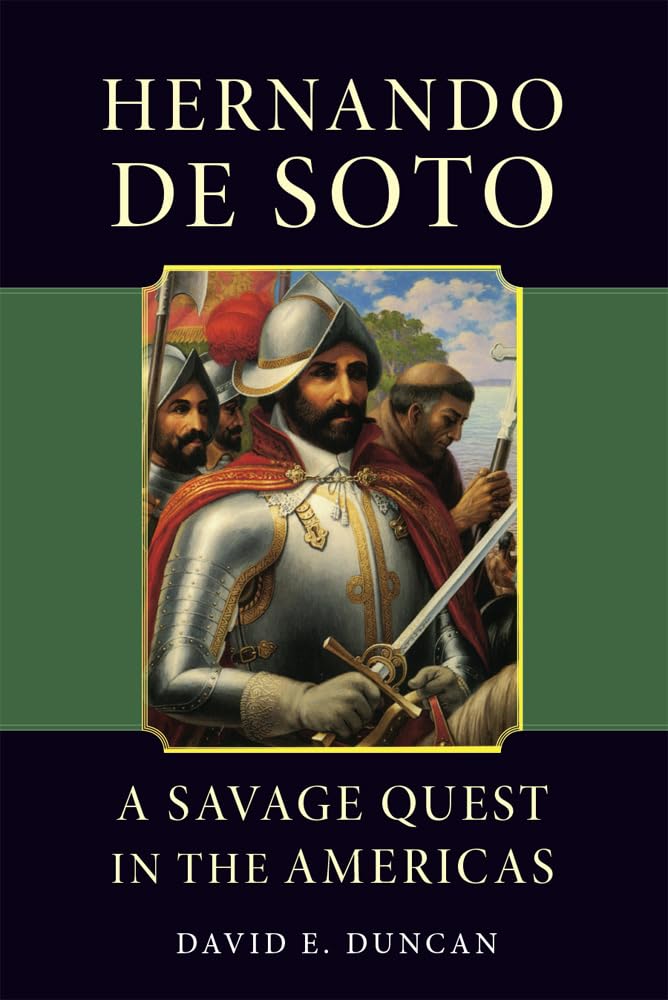
Few figures from the Age of Discovery embody both ambition and brutality as starkly as Hernando de Soto (1500-1542), the conquistador who carved a bloody path through the southeast of North America in search of gold and glory. In Hernando de Soto: A Savage Quest in the Americas (1997), David Ewing Duncan strips away the romantic veneer of conquest to reveal a man consumed by greed, pride, and the myth of his own destiny. Drawing on vivid storytelling and meticulous research, Duncan transforms what could have been a mere chronicle of exploration and exploitation into a arresting study of how personal obsession and empire feed on each other.
De Soto possessed all the traits of a driven entrepreneur. Had he been born three or four centuries later in the United States, he might have risen as a titan of industry. “A man of thunder and passion, of towering ambition and brutal resolve,” Duncan writes, “he epitomized everything epic, petty, grand, and horrific about the conquista.” Born into rural poverty in Spain’s western province of Extremadura – the cradle of other conquistadors like Balboa, Cortés, and Pizarro – he left for colonial Panama at just fourteen, a penniless youth who quickly became a sensation. As Duncan observes, De Soto personified the Spanish hidalgo ideal: brave, fiercely loyal to comrades and faith, merciless toward his enemies, and consumed by a need to defend his honor and climb the rigid social hierarchy of imperial Spain. He embodied the citizen-warrior caste later satirized by Cervantes in Don Quixote.
Still in his teens, Soto proved himself a loyal and capable lieutenant to the notorious colonial governor of Panama, Pedrarias Dávila, known as “El Furor Domini” (Wrath of the Lord), who led the Spanish campaign to conquer and control the Darien region of the Panamanian isthmus – believed by many to be overflowing with gold (the hopefully named the province Castilla del Oro – Castle of Gold). Nearly three decades after Columbus’s first voyage in 1492, the Indies had failed to deliver the earthly paradise he had promised. Yet King Ferdinand pressed ahead with his mission to “civilize” the New World and extract its riches – above all, gold – with unrelenting zeal. The young De Soto became a front-line soldier in this campaign of conquest and conversion. As Duncan observes, Dávila quickly turned “Ferdinand’s grand plans into a travesty.”
Vasco Núñez de Balboa emerges in Duncan’s narrative as something of a hero – “firm, energetic, and cunning,” yet also a man of principle, “beloved by both Spaniards and Indians.” Balboa would exert a powerful influence on the young De Soto. Pedrarias, by contrast, was the dark mirror image of the noble warrior ideal – “a cold-blooded and spiteful man” in the image of El Cid, the eleventh century Castilian knight and military leader who became Spain’s national hero for his role in the Christian reconquest of Muslim-held territories through pillage and terror. Duncan frames the two as archetypes: “the charming fighter and can-do organizer versus the dour, petty, yet thorough tyrant.” Balboa favored a long-term, sustainable approach to colonization, while Pedrarias embraced a brutal, strip-mining pursuit of immediate wealth. Consumed by envy of Balboa’s success in discovering the Pacific – and his growing pretensions to local authority – Pedrarias had him arrested and summarily executed for treason in 1519.
Duncan notes that another conquistador, Gaspar de Espinosa, served as a powerful role model for De Soto. Espinosa, he writes, balanced “friendship and cruelty, patience and sudden, unremitting violence in dealing with Indian leaders.” His no-nonsense style of conquest would later define De Soto’s own approach toward Indian diplomacy and pacification. In Panama and afterwards for forty months (1519 to 1523) in Nicaragua, where many believed there was more gold than Mexico, De Soto cut his teeth on colonial warfare, rising by his mid-twenties to become wealthy, a respected warrior, and trusted lieutenant – a true rising star of imperial Spain. De Soto’s most dangerous adversary was not the multitude of abused natives, but rather his fellow rapacious conquistadors.
In the early years of New Spain, connections and noble pedigree were everything. But when the common-born Hernán Cortés conquered Mexico in 1519 – an audacious act of insubordination that was quickly forgiven once he delivered staggering amounts of treasure – he inspired a new generation of bold young adventurers eager to amass fortunes and vault themselves up Spain’s rigid social hierarchy by seizing new, resource-rich territories in the Americas. This free-for-all spirit soon degenerated into the War of the Captains (1523–1527), as rival conquistadors fought one another for control of Central America – a lush but disappointing region, far poorer in gold and silver than legend had promised. It was during this chaotic period that the 24-year-old De Soto received his first significant encomienda, a royal grant allowing him to demand labor and tribute from Indigenous people in exchange for their supposed protection and conversion to Christianity. De Soto initially remained loyal to the aging governor Pedrarias Dávila, then 84 and, as Duncan describes him, a “master manipulator” of Spanish imperial politics in Panama City.
Over De Soto’s eight years in Nicaragua, he and his two partners – Hernán Ponce de León (a distant cousin of the famed explorer who sought the Fountain of Youth in Florida) and Francisco Componón (who died in 1528) – amassed thousands of Indigenous vassals to labor in their mines and fields. Grann notes that De Soto’s rise in Nicaragua coincided with a native apocalypse: within a single decade, the region’s Indigenous population plummeted from well over one million to perhaps 200,000.
In 1529, rumors of immense wealth to the south, in a fabled land called “Biru,” began to captivate De Soto and his partner Ponce de León. Though they already possessed some of the largest encomiendas in the region and commanded the most powerful ships, both men were drawn to reports of Francisco Pizarro’s upcoming expedition. De Soto had served under Pizarro in Panama and held him in high regard. The aging governor Pedrarias, now in his nineties, forbade them from leaving the province – but in March 1531, El Furor Domini finally died, leaving behind a “record of cruelty and pettiness … virtually unequaled in the bloody annals of American history,” Grann says. His death gave the restless conquistadors the opportunity they needed to slip away in search of even greater riches. Believing that Pizarro had offered him the position of second-in-command, De Soto eagerly joined the expedition. But his enthusiasm quickly turned to resentment when he discovered that Pizarro’s brother, Hernando, had been appointed lieutenant general, while De Soto was given only the lesser title of lieutenant of the chief city of Peru – a slight that soured his relationship with the Pizarros.
Pizarro’s invasion force was relatively substantial for its time, though still astonishingly small by the standards of the empires it confronted. Hernán Cortés landed in Mexico in 1519 with barely 500 men and 16 horses, while a few years later Francisco Hernández de Córdoba led roughly 200 men and only a dozen horses to establish Spain’s first settlements in Nicaragua. In 1532, Pizarro invaded the Inca Empire with just 180 men, but by the time his force reached Cajamarca, he commanded as many as sixty horses. Adding to his advantage, he placed Hernando de Soto, one of the finest cavalry officers in the Americas, in charge of his vanguard of mounted troops, and “a man as skilled at the arts of persuasion diplomacy as he was with a sword,” according to Grann.
The Inca Empire – known to its own people as Tahuantinsuyu, or “the four quarters of the earth” – was barely a century old when the Spanish arrived in 1532. It had been forged by the first two great Inca emperors, Pachacuti and Tupac Inca, whom Grann compares to Alexander the Great in terms of the territory they conquered and controlled. At the dawn of the sixteenth century, the Inca were second in size only to the Ottoman Empire, earning the moniker “the Romans of America.” Yet by the time Pizarro appeared, this vast empire was reeling from twin catastrophes: a devastating smallpox epidemic that may have killed as many as 200,000 people – including the godlike emperor Huayna Capac – and a bloody four-year civil war over succession that claimed tens of thousands more. The conflict had just concluded with Atahualpa’s victory in the north over his half-brother Huascar in the south.
The Spanish were outnumbered by as many as 80,000 Inca soldiers. Facing impossible odds, their only hope was to separate Atahualpa from his entourage, seize him, and hold him for ransom. Grann writes that the plan was “breathtakingly simple” yet “an audacious long shot even for gamblers as foolhardy as Pizarro, Soto, and the other Spanish leaders.” In the ensuing clash, it is conservatively estimated that the 168 Spaniards killed some 7,000 Inca warriors – a staggering rate of forty per Spanish soldier. Within hours, they had captured gold equal to roughly a fifth of all that had been extracted from Panama over nearly two decades. Atahualpa then promised to fill a room 22 feet long, 17 feet wide, and 8 feet high with gold and treasure drawn from across his empire. De Soto was appointed military governor of Cajamarca and placed in charge of collecting the ransom. The coup de main – and its astonishing aftermath – made De Soto a sensation throughout the Hispanic world.
The plunder taken from the Inca was staggering. Nine forges blazed day and night, melting down exquisite works of art into crude bars of gold and silver. When the work was done, the Spanish possessed more than 13,000 pounds of 22-carat gold and 26,000 pounds of pure silver – worth roughly $750 million at today’s prices. In 1532, the treasure was valued at 1.3 million pesos. Francisco Pizarro claimed 57,220, his brother Hernando 31,080, and De Soto – third in line – received 17,740. Yet even this immense fortune could not mask his resentment at once again being ranked behind Pizarro’s brother.
De Soto played no part in what became perhaps the most disgraceful act of Pizarro’s entire campaign – no small distinction, given the campaign’s many atrocities. As the Spanish spent eight months collecting and melting down treasure from across the vast Inca Empire, a rumor reached Cajamarca that Atahualpa had secretly sent an order for his rescue. Word spread that a massive Inca army was marching to free him and annihilate the tiny Spanish garrison guarding both the emperor and his ransom. Pizarro dispatched De Soto to investigate. Before he could return with confirmation that the rumor was false, Pizarro and his panicked lieutenants ordered Atahualpa’s execution by strangulation – moments after he agreed to convert to Christianity. De Soto thus escaped any share of blame for an act of cowardice and cruelty that would stain Spain’s reputation for generations.
Next, De Soto led a breakneck march of 350 Spanish troops across 750 miles of rugged Andean terrain from Cajamarca to the great Inca capital of Cuzco – a city of 100,000 nestled in a valley 11,000 feet above sea level. At one point, his vanguard covered 250 miles in just five days, advancing at a pace Pizarro deemed insubordinate – an achievement Grann ranks among “De Soto’s most impressive feats.” His skill as both fighter and leader made him indispensable to Pizarro, but by the time the Spaniards reached Cuzco, Grann writes, his days were numbered. Thirty-three-year-old De Soto entered the city on November 15, 1533. He was, the author says, “the quick, daring, and resourceful man of action, and Pizarro the steady, tenacious plodder with a will of iron.” Even the Incas marveled at the Spaniards’ accomplishment. Another 600,000 pesos of gold was seized as the conquistadors indulged in a month-long bacchanal of drink, games, and sex. For the next six months De Soto would serve as lieutenant governor with the mandate of bringing stability to the Inca capital while distributing property and encomiendas to the conquistadors.
Meanwhile, Pizarro shrewdly allowed De Soto’s most loyal followers to leave the province with their treasure, deliberately weakening his brilliant cavalry commander’s control over his elite troops and eroding his political base. When Diego de Almagro arrived in Cuzco, asserting suzerainty over the city under the authority of Charles V, De Soto finally broke with Pizarro and allied himself with the ambitious Almagro, who was preparing an expedition south into present-day Chile in search of more Inca-like riches. But to De Soto’s surprise, Almagro announced that there was no place for him in the venture. Disowned by Pizarro and then rejected by Almagro, De Soto was disillusioned but immensely wealthy and renowned. He returned to Spain with all the spoils an ambitious conquistador could desire – gold, glory, and fame. Yet like El Cid, he remained restless, forever in pursuit of greater fortune.
De Soto arrived in Seville in 1536 as a 36-year-old national hero – “a dashing young man renowned as a warrior in a warrior’s culture,” as Grann puts it. Blunt, confident, and ambitious, he met with Emperor Charles V in April 1537 to request command of his own expedition of discovery and conquest. His sights were set on Florida, a land reported to hold fantastic riches, but already notorious as cursed ground after three disastrous attempts at exploitation. Juan Ponce de León had tried twice, in 1513 and 1519; Lucas Vázquez de Ayllón launched an expedition from Hispaniola to present-day Charleston in 1526 that collapsed within a year; and Pánfilo de Narváez, infamous for his failed bid to arrest the insubordinate Cortés in 1520, had led four hundred men and eighty horses inland from Tampa Bay in 1528 – never to be seen again. Three survivors of the expedition wandered for six years across six thousand miles of what would become the southern United States, earning among Native Americans a reputation as powerful shamans. Their tight-lipped replies when questioned by Spanish officials about what they had seen fueled speculation that untold riches awaited discovery.
North America remained the Dark Continent to Europeans in 1539. Undeterred, De Soto was set on mounting a fourth attempt – this time with overwhelming force and wielding the full resources of Cuba behind him, which he would control as imperial governor. It would become one of the largest and most expensive expeditions of the conquistador era – six times more expensive than Pedrarias’s campaign to Darién and Panama twenty-three years earlier. It is reported that De Soto financed most of it himself. Over four months, he ruthlessly stripped Cuba of horses and provisions to outfit his Florida enterprise. In the spring of 1539, nine ships carried 600 men and 240 horses from Havana to what is believed to be Tampa Bay. The invasion force dwarfed those of Cortés in Mexico and Pizarro in Peru. De Soto expected to discover a golden empire that would dwarf that of Aztec and Inca – and his men shared his supreme confidence in the mission and his leadership.
Little is known with certainty about De Soto’s three-year odyssey through the American Southeast. Two major theories dominate the debate: the De Soto Commission (Swanton) Route and the Hudson Map, each grounded in different research methods and evidence. John Swanton, a Smithsonian ethnologist and historian, led a federally commissioned study in 1935 that sought to trace the expedition’s path using early chronicles (Ranjel, Elvas, Biedma, and Garcilaso de la Vega), ethnographic data, and Native American place names. His 1939 map became the “official” version for decades, though later scholars challenged its speculative nature. In the 1990s, Charles Hudson, an anthropologist at the University of Georgia, proposed a new route based on more rigorous archaeological, geographical, and ethnohistorical data, which is now the most widely accepted among historians and archaeologists. Fundamentally, Swanton’s route follows a more coastal trajectory derived largely from textual accounts, while Hudson’s reconstruction shifts inland along known Mississippian chiefdoms supported by material and cultural evidence. Grann generally follows the route suggested by Hudson and leans heavily on the campaign chronicle called La Florida del Inca published in 1605 by García de Castellanos, known as “El Inca.” The author wrote this account based on Spanish sources and testimonies, though he never personally participated in the expedition.
De Soto and his band plunged into the Florida wilderness, marching north toward the Indian stronghold of Ocale, rumored to be a city of immense wealth. But, as Grann notes, “there was no gold, no great city, and certainly no Inca-like empire.” This pattern – rumor, forced marches, and bitter disappointment – would repeat again and again over the next three years, across their four-thousand-mile journey of haphazard discovery. Remarkably, De Soto never seemed to lose faith that a vast civilization, richer than the Aztec or Inca, lay just over the next hill. Indeed, Grann accuses him of “chronic overenthusiasm.”
Although De Soto occasionally massacred local tribes, such as the Apalachee in north Florida early in the campaign, the expedition was mostly on the move. Local tribes did their best to accommodate the Spaniards, guiding them out of their territories and toward the next village – often promising vast wealth and gold or simply hoping the fearsome Spanish cavalry would defeat a neighboring rival tribe. Often the Indians were forced to provide hundreds of porters and women to support the expedition, but most accommodated if it ensured the Spanish and their accompanying swineherd kept moving on. The Spanish were especially encouraged when they reached the foothills of the Appalachian Mountains, believing, from their experience with the Aztec and Inca, that precious metals were linked to mountains. At times, guides deliberately led them on wild goose chases, claiming to know the way to the vast civilization De Soto sought in exchange for the trinkets and baubles the Spaniards offered. By the end of the first year, the most valuable prize De Soto had seized was a handful of pearls from coastal South Carolina – hardly the treasure he or his men had envisioned. Yet, De Soto put a positive spin on the experience: the land and crops were bountiful and the Indians were relatively peaceful and accommodating. “De Soto had every reason to be content,” Grann says, “if not satisfied.”
In October 1540, De Soto’s expedition clashed with the inhabitants of Mabila in central Alabama, north of Mobile Bay. In a grim reversal of the Spanish capture of Atahualpa at Cajamarca in 1532, De Soto and his vanguard were invited into the fortified town by the physically imposing Chief Tuskaloosa – only to be ambushed in a brutal battle that left thousands of Native defenders dead and the town in flames. Although the Spanish were surprised, they survived, but suffered heavy losses, making the Battle of Mabila “one of the bloodiest fought in five centuries of warfare between Europeans and Indians on what would become United States soil.” Perhaps a thousand of Mabila’s three thousand inhabitants were killed; twenty-five Spaniards died and 250 were wounded. Grann notes that the wounded received a total of 760 arrow strikes. Twelve horses were killed, and nearly the entire Spanish baggage train – including the pearls from the Carolinas – was destroyed in the fire. “Nothing in Soto’s career,” Grann writes, “so far equaled the blunder of losing his equipment and treasure at Mabila.” De Soto had the chance to rendezvous with a Spanish fleet at Mobile Bay after the battle and return his weary expedition to Cuba, but he refused to abandon hope that a glittering civilization lay somewhere ahead in the vast American interior. His 450-man army nearly mutinied.
On May 8, 1541, De Soto and his expedition reached the Mississippi River at a spot just south of present-day Memphis, Tennessee. The men spotted a fleet of Mississippian warships unlike anything they had ever seen, which once again sparked hope that a great civilization lay nearby – much as the sighting of a resplendent Inca ship off the coast of Peru in 1530 had signaled the existence of the fabulous Inca Empire. The Spanish crossed the Mississippi and plunged into what is now Arkansas. They came within three hundred miles of the expedition led by Francisco Vázquez de Coronado, which had departed from Mexico, though neither group knew of the other.
The region was in the grip of the Little Ice Age: Arkansas was blanketed in snow, and the Spanish began dying in large numbers, including De Soto himself. He passed away on May 22, 1542, at the age of forty-two, after three years of almost aimless searching without uncovering precious metals or establishing a single mission village, garrison, or trade route. By the time the survivors finally returned to safety in Mexico in September 1543, only 311 men remained alive, long thought to have perished.
In closing, David Ewing Duncan’s Hernando De Soto is a compelling blend of biography, adventure story, and historical analysis that brings one of the most audacious figures of the Age of Exploration vividly to life. Duncan captures both De Soto’s relentless ambition and the human cost of his expeditions, weaving together the political intrigue of Spain, the resilience of indigenous societies, and the brutal realities of conquest. The book succeeds in illuminating the man behind the legend and the extraordinary, often tragic, impact of his personal quest for glory and fortune.


Leave a Reply