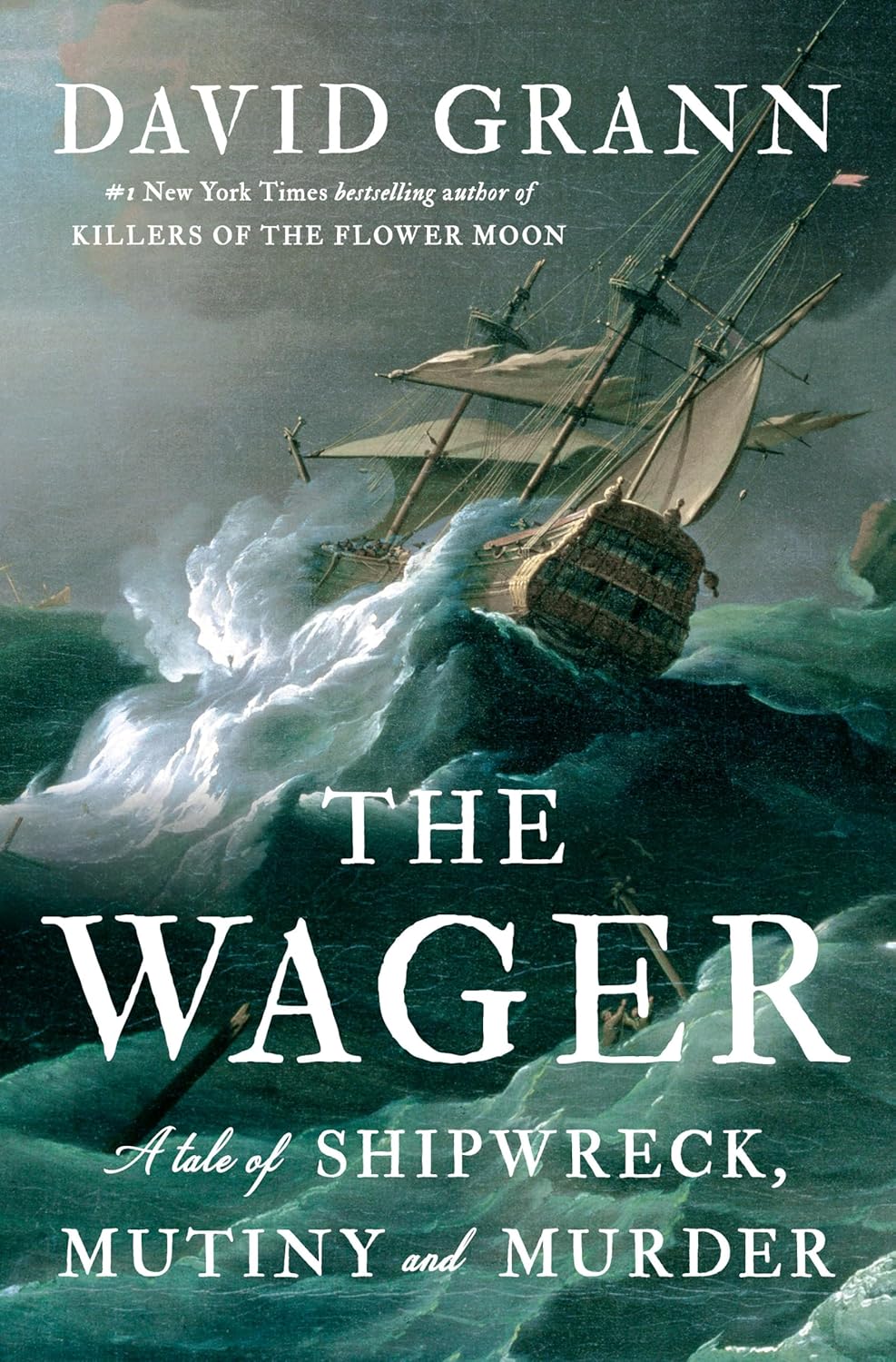
David Grann’s The Wager: A Tale of Shipwreck, Mutiny and Murder has been a publishing phenomenon, especially for an historical non-fiction account of an event that happened 300 years ago. Since its initial release in 2023, the book has dominated bestseller lists, sold more than a million copies worldwide, and cemented Grann’s reputation as one of the foremost popular narrative historians of his generation. The Wager combines the energy of an adventure novel with the rigor of archival research, reconstructing the harrowing true story of an eighteenth-century British naval disaster that spiraled into chaos, survival, and moral reckoning.
In January 1740, Britain was mobilizing for war against its long-time imperial rival, Spain, in a now-forgotten conflict known as the War of Jenkins’ Ear. The war’s curious name came from an incident in 1731, when British captain Robert Jenkins claimed that a Spanish coast guard officer had sliced off his ear—a grisly token later displayed before Parliament as proof of Spanish barbarity and used to inflame public opinion. When war finally came, Britain launched two bold strikes against Spanish colonial power in the Americas. The first was a massive amphibious assault on Cartagena, the fortified Spanish stronghold on the coast of present-day Colombia, carried out by a Royal Navy armada of 186 ships, a campaign that would end in defeat and the loss of ten thousand men, mostly from yellow fever. The second was a clandestine expedition: a five-ship squadron ordered to slip around Cape Horn, capture the annual Manila galleon that crossed the Pacific twice a year, and then continue westward to complete a global circumnavigation, returning the stolen treasure to London. The Admiralty directed that the plan be executed in “the most secret, expeditious manner.” Thus was set in motion one of the most audacious tales of ambition, endurance, and betrayal in the annals of maritime history.
The five-ship squadron was commanded by Commodore George Anson. Among them, the ill-fated Wager was, in David Grann’s words, “the bastard of the fleet” – a converted East Indiaman merchant vessel, a “123-foot eyesore.” Designed for hauling cargo across long distances rather than for combat, the tubby, unwieldy ship was hastily refitted as a sixth-rate, 28-gun man-of-war and assigned the additional burden of serving as the squadron’s supply ship for munitions. Her crew numbered roughly 250 – about twice the normal complement. Grann notes that the Wager carried “an unusual number of unwilling and untrustworthy crewmen,” whose presence would be deeply felt once tragedy struck. The expedition was plagued early on by typhus, an epidemic that claimed nearly ten percent of the squadron’s 2,000 men within the first month at sea. To make matters worse, the Wager endured a rapid succession of three captains in just a few weeks before command finally fell to an ambitious upstart, Captain David Cheap – his first time commanding a man-of-war. It was determined complete his mission no matter the obstacles.
The voyage around Cape Horn is perilous even in the best of conditions. As the Wager and her squadron-mates pressed southward through the Roaring Forties, the Furious Fifties, and the Screaming Sixties, the crew clung to the rigging for dear life as they faced the infamous “Cape Horn rollers” – hundred-foot swells capable of swallowing a ship whole. This was sailing at the edge of the world. Herman Melville likened it to a descent into Dante’s Inferno; Rudyard Kipling called it “blind Horn’s hate.” Into this maelstrom sailed the inexperienced Captain Cheap, commanding a third-rate ship and navigating only by dead reckoning. His orders were simple and unforgiving: get around the Horn by any means necessary and, if separated, rendezvous with Commodore Anson on the Patagonian coast of Chile – a separation that soon seemed inevitable. Then came scurvy. One by one, the crew, including Cheap himself, began to waste away. For an entire month the Wager battled the furious seas of Cape Horn and Drake’s Passage with a dwindling, desperate crew, falling ever farther behind the squadron until she was alone. Captain Cheap, half-mad with exhaustion and pride, drove his men mercilessly onward, refusing counsel or rest. To many aboard, his persistence no longer seemed courage – it seemed madness.
The Wager smashed against the rocks of an uncharted island in the Golfo de Penas – aptly named the “Gulf of Pain.” Captain Cheap had managed to wreck his first man-of-war barely a month into his command. Of the ship’s original complement of 245 men and boys, only 145 staggered ashore on what would come to be known as Wager Island. The loss of the vessel meant that, for most of the survivors, their pay had likely stopped the moment the ship was declared lost. Cold, hungry, and despairing, they began to question Cheap’s leadership – his poor decisions, his secrecy, and his refusal to consult his officers. Yet Cheap clung to the remnants of authority, insisting on strict discipline and rigid order, insisting that the Royal Navy’s code still applied on this desolate shore.
A few weeks after the castaways built a small village of eighteen huts, they were visited by a roving band of some fifty Kawesqar natives. The Kawesqar – known as the “Nomads of the Sea” – taught the men to fish and gather sea urchins and mussels, offering a brief reprieve from starvation. But as suddenly as they appeared, they vanished, leaving the survivors once again to fend for themselves. Hunger and despair soon tore through the camp. The weakened company began to splinter into rival factions, and open contempt for Captain Cheap grew louder by the day. Several murders were suspected. “The shipwreck had laid waste to the old hierarchies,” Grann writes. “Every man had now been dealt the same miserable hand.” It was, he observes, a “democracy of suffering.” Thieves pilfered the meager stores; Cheap’s inability to stop them only deepened the collapse of his authority. Even brutal punishments failed to restore order. Discipline gave way to chaos, and even the officers began to defy him. The tension finally erupted a little over a month into their exile, when Cheap shot a defiant crewman who later died of his wounds. To many, it looked like nothing less than murder. Moreover, it seemed to provide a firm basis for arresting the unpopular captain.
The marooned crew of the Wager were almost certainly familiar with Daniel Defoe’s Robinson Crusoe, published in 1719. The novel fictionalized and expanded the true story of Alexander Selkirk, a sailor who spent more than four years in solitary exile on a remote Pacific island some 400 miles off the coast of Chile. But unlike the men of the Wager, Selkirk’s island offered abundant food and, most importantly, no hostile factions of his fellow man.
Cheap’s plan was to salvage a few small boats from the wreck of the Wager and sail north some 350 miles to the Spanish settlement on the island of Chiloé. There, he intended to seize supplies, capture a vessel, and continue on to the rendezvous point to rejoin Anson and the rest of the squadron. To most of the crew, the scheme seemed sheer madness. But for Cheap, who by this point retained the loyalty of only a handful of officers, it still held the faint promise of glory – and redemption.
Crew members hostile to Cheap, led by the charismatic senior warrant officer and gunner John Bulkeley, devised an even more audacious plan. “Unrelenting, ingenious, and cunning,” Grann writes, “[Bulkeley] had emerged as a leader on his own merits.” Cheap, by contrast, relied almost entirely on positional authority and the chain of command. Bulkeley’s scheme was daring: sail 400 miles south to the western entrance of the Straits of Magellan, thread eastward for over 300 miles, and then follow the coast of present-day Argentina through hostile Spanish waters until reaching a friendly port in Brazil – a journey totaling roughly 3,000 miles. After nearly 150 days on the island, only 91 of the original 145 castaways remained alive. On October 14, 1741 – five months after the wreck and more than a year since leaving England – Bulkeley’s party boarded three small boats and departed Wager Island, leaving Captain Cheap with fewer than ten men, including an earnest teenaged midshipman named John Byron, grandfather of the great poet, Lord Byron.
It took Bulkeley a month to reach the Straits of Magellan. Along the way, he lost two boats and dozens of men. Soon he too faced mutiny as the enormity of the journey set in. In a remarkable feat of seamanship, Bulkeley navigated his weather-beaten boat – aptly named the Speedwell – through the straits in just 31 days, a week faster than Magellan himself had managed in 1520. But even then, 1,600 miles of hostile Spanish coastline still lay between them and the nearest Portuguese outpost at Rio Grande. Three months after departing Wager Island with 81 men, only 29 gaunt survivors finally glided into the Brazilian port of refuge. “I believe no mortals have experienced more difficulties and miseries than we have,” Bulkeley wrote in his journal. In a letter to the British naval liaison in Rio de Janeiro, he added pointedly that Captain Cheap had “at his own request, tarried behind.”
When the survivors of the Wager finally returned to England, they moved quickly to align their stories. Their account cast Captain Cheap as a man unhinged – descending into madness until he unjustifiably shot and killed a crew member. Bulkeley submitted his extensive journal as evidence in his defense. While he and his party languished in a kind of bureaucratic purgatory as the Admiralty sorted through the competing claims, they did not sit idle. Six months after his return, Bulkeley published his own version of events in a sensational bestseller, A Voyage to the South-Seas, in the Years 1740–41. The story was also serialized in The London Magazine – an early form of subscription media. According to Grann, the book did much to sway British public opinion in Bulkeley’s favor, even if many in polite society bristled at the spectacle of a lowly gunner publicly impugning his captain’s honor.
Meanwhile, on the far side of the world, Commodore Anson – reduced to just 227 men from his original crew of 2,000 – had not yet abandoned his quest to find and capture the Spanish treasure galleon Our Lady of Covadonga. In a final act of resolve, he set course for the waters off the Philippines, determined to intercept his elusive prize. Anson’s ship, the Centurion, carried 60 cannons firing twenty-four-pound shot, outgunning the Covadonga’s 32 twelve-pounders. Yet the British were vastly outnumbered, 227 to roughly 530 Spanish sailors and marines. In the ensuing battle, the Centurion annihilated her opponent, losing only three men compared to the Spanish seventy. The victory yielded the richest treasure ever seized by a British naval commander – the equivalent of some $80 million today.
The Centurion did not return to England for more than a year, finally reaching home in June 1744. It took thirty-two heavily guarded wagons to carry the treasure to London. Each of Anson’s surviving crew received £300 – nearly twenty years’ pay – while Anson himself was awarded £90,000, about $20 million in modern terms. The War of Jenkins’ Ear had been a bloody stalemate; the capture of the Covadonga stood as Britain’s lone triumph. The scandal of the Wager seemed to fade into memory – until, two years later, in March 1746, Captain Cheap reappeared in England, as if risen from the dead. He had been away from England for five-and-a-half years.
Three months after leaving Wager Island, a small band of officers under Captain Cheap were captured by Spanish soldiers along the Chilean coast and taken inland to Valparaíso. Seven months later, they were transferred to Santiago as prisoners of war, where they would remain in captivity for two and a half years – finally released only after the messy and largely pointless War of Jenkins’ Ear drew to a close. Their shocking return home seemed to open old wounds.
The case against nearly all of the men of the Wager looked overwhelming. The crew seemed to experience a complete breakdown of naval order and hierarchy. No one disputed the Bulkeley tied up his commanding officer and left him on the island. The crew of the Wager had violated many Articles of War. It seemed almost certain that men would hang.
In April 1746, thirteen judges convened to hear the case. Whenever a Royal Navy ship was lost, an inquiry was customary to determine whether any officers or crew bore responsibility. In the case of the Wager, the man most at risk was Lieutenant Baynes, who had apparently failed to relay a reported sighting of land to Captain Cheap – an omission that set off the chain of events leading to the ship’s wreck. Baynes ultimately received only a mild reprimand, and the matter was left at that. There was never a hearing to determine whether any of the men were guilty of desertion or insubordination. Senior naval officials seemed eager for the embarrassing episode to fade quietly into history. The war had gone poorly, cost a staggering forty-three million pounds, and yielded little beyond Anson’s £400,000 windfall in the Pacific. The Admiralty simply wanted to move on. The official inquiry into the Wager affair was permanently closed – “the mutiny that never was.”
“Empires preserve their power with the stories that they tell,” Grann writes, “but just as critical are the stories they don’t.” Such was the case with the affair of the HMS Wager.
 What's Tim Reading Now?
Leave a comment