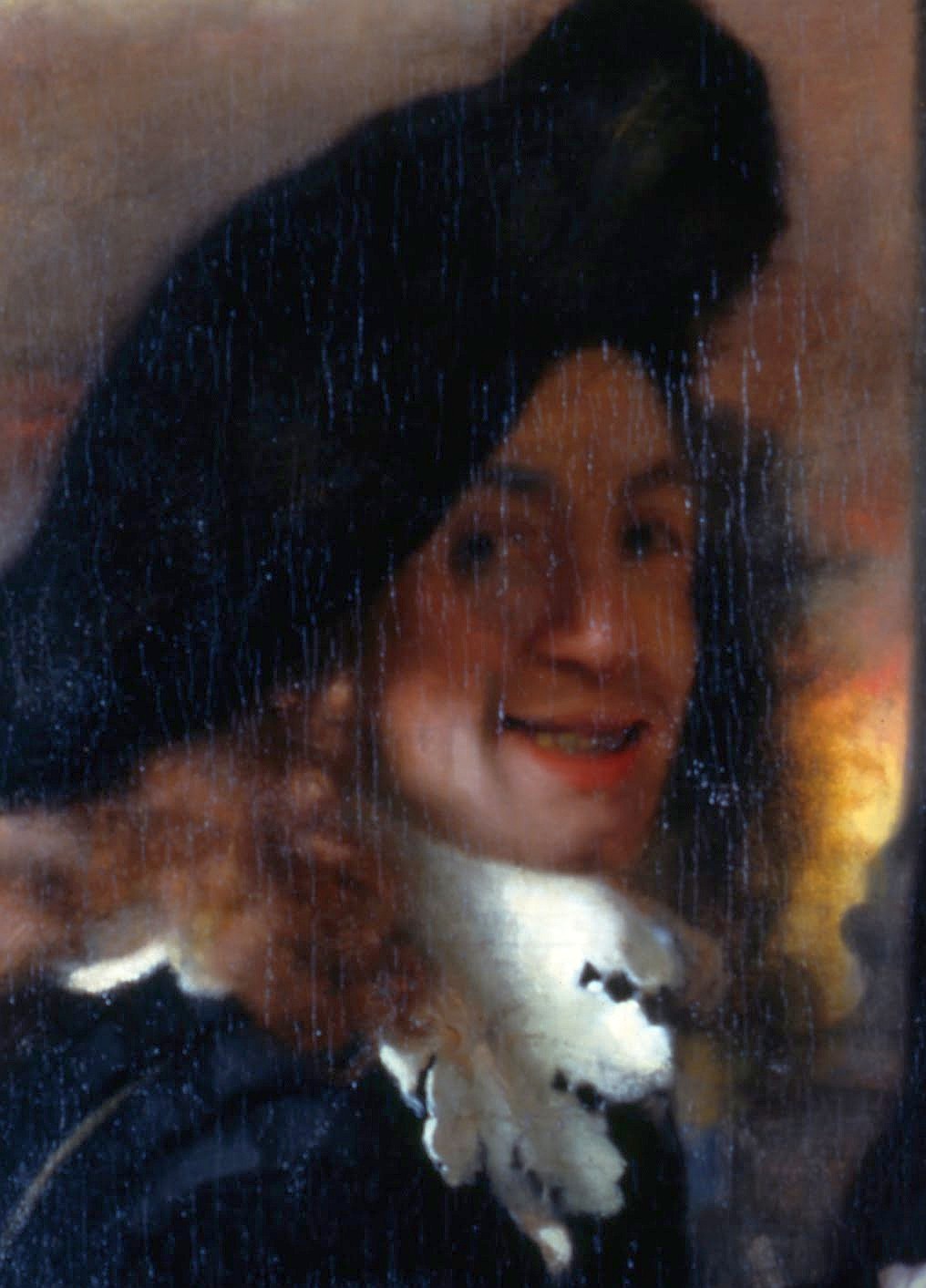
o little is known about Jan Vermeer, his goals and influences. He died unknown, penniless with 8 minor children, at age 43 and remained forgotten for 200 years. Today he is known as the “Sphinx of Delft,” a sobriquet attached to him by the French art critic Thore-Burger, who rediscovered his genius in the 1860s and did much to identify and popularize his work (two-thirds of all verified Vermeer paintings today were identified by Thore-Burger).
Vermeer was the last of the great Dutch renaissance artists of the seventeenth century (1600-1672). They portrayed what they saw around them with unblinking directness, reflecting the rationalistic spirit of the Age of Reason. A hallmark of Dutch art during this period was its humanity, often portraying only brief but hard-won moments of leisure, often drinking, brawling or whoring. His paintings often had no story to tell, no moral teach; he found beauty in the banal.
The Dutch Golden Age was short, with Hals, Rembrandt, and Vermeer often representing the early, middle, and late periods even though they all died within nine years of each other. The popular themes were genre (everyday life), landscapes (they invented the panorama), still life (Vermeer is not known to have produced any), architecture, and group portraits. They glorified both the everyday and the Good Life made possible by Dutch economic exploitation. The themes were often vanity and the impermanence of life (e.g. bones, hourglasses, snuffed out candles), as well as the mysteries of love and desire.
Three themes run through Vermeer’s work: letter-writing; letter-reading; and music-making. What ties them all together is the leitmotif of love.
Vermeer has been called the greatest realist painter of all time, a genius who could capture time standing still. His art produces an aloof, mysterious stillness, a suspended, timeless effect. His pieces are also known for their serenity despite being produced during a turbulent and violent age. He was deeply influenced by Caravaggio (1571-1610), who focused on realism dramatically accentuated by bold colors, strong highlights and deep shadows, and Carel Fabritius (possibly his mentor who studied under Rembrandt, killed in the Delft gunpowder explosion of 1654), whose paintings (e.g. Goldfinch, 1654), like Vermeer’s, reflect poetic, rather than photographic, reality (although his pieces did have a photographic sense).
Vermeer is perhaps best known for his depiction of light pouring through a window to illuminate an everyday domestic scene, especially his uncanny ability to capture the play of light on textured surfaces. He was also a master of perspective, often situating the viewing point of his paintings at unusual angles, which gave his work a “photographic perspective.” Many critics believe that Vermeer may have used a crude mechanical device called a camera obscura to create this perspective.
Vermeer’s verified oeuvre is less than 40 works. Most of his paintings are set in the same two rooms in his house with the same table, chairs, and rug and often featuring the same woman. His specialty was genre painting; he was a master of light and color.
In the 1930s and during WWII, a failed Dutch artist named Han van Meegeren began forging Vermeer paintings that for a decade fooled the world art community. He was only caught because he was charged with collaboration after the war for selling one of his six recently discovered “Vermeer” paintings to Nazi General Hermann Goering. He had to confess to fraud to save himself from treason. The skills of art verification made important improvements in the wake of the van Meegeren scandal.
 What's Tim Reading Now?
Leave a comment