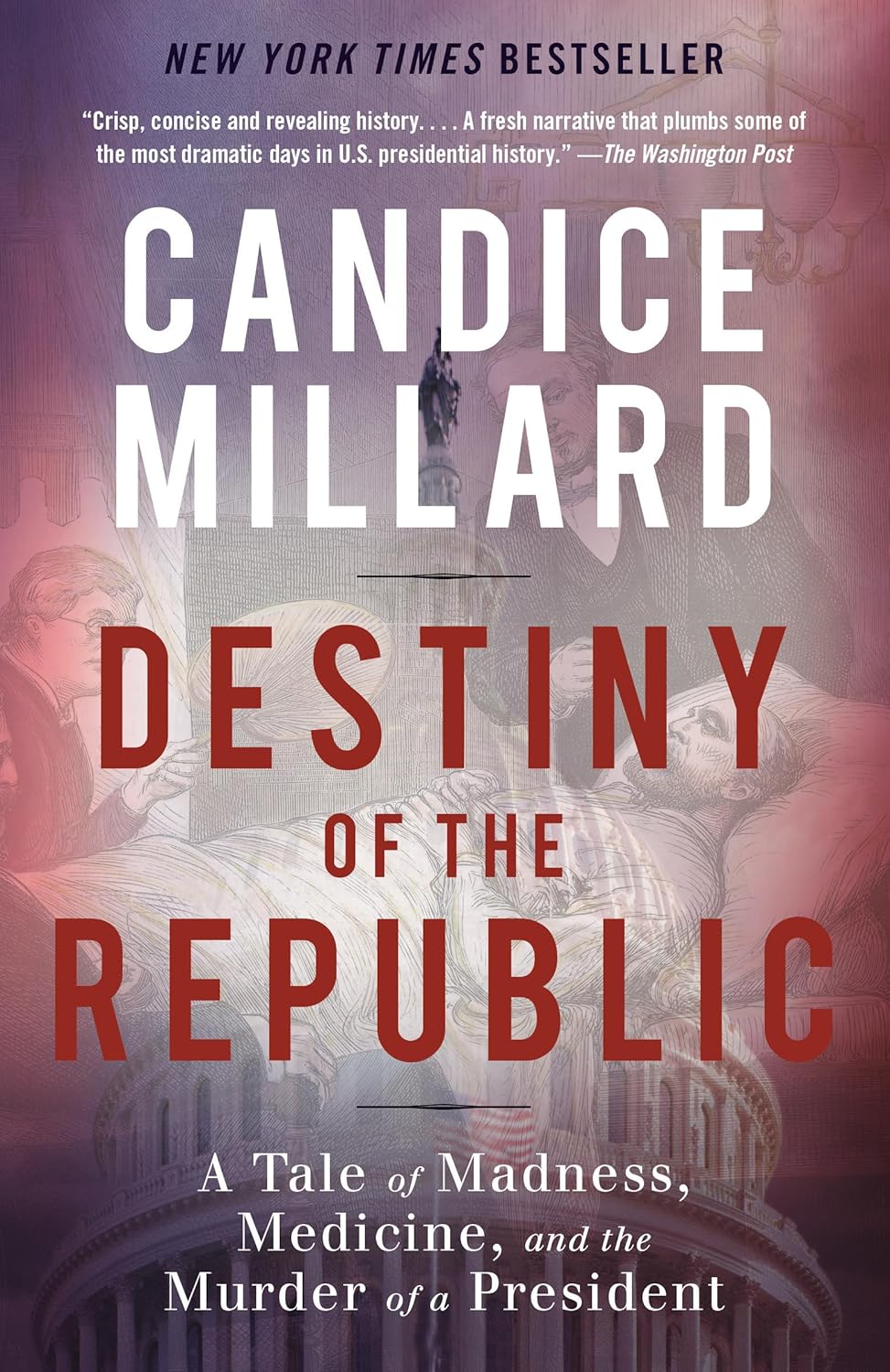
Lots of popular history books claim to “read like a novel”; this one actually does. Author Candace Millard takes a random, Jeopardy!-Trivia-question event in American history (“He shot President Garfield in July 1881.” “Who is Charles Guiteau?”) and turns it into a delightful page-turning read. “Destiny of the Republic” likely isn’t great history in the academic sense, but it is great entertainment.
James Garfield of Mentor, Ohio and the 20th president of the United States is ostensibly the subject of the story (and, boy, is he ever lionized by the author). However, he is far from the most compelling character in the narrative of his own murder. Two villians, New York Republican senator Roscoe Conkling and attending physician Dr. Doctor Willard Bliss (yes, his given first name was “Doctor”), end up stealing the show in this sharply crafted page-turner.
Conkling was one of the most powerful men in the country in the 1870s and undeniably the most powerful man in New York. He was the leader of the so-called Stalwart faction of the Republican Party, which included former president General Grant and future vice president Chester Arthur. Millard writes that the Stalwarts stood unabashedly for the spoils systems of distributing lucrative government jobs based on patronage rather than merit. It was just such a political worldview that made the Grant administration perhaps the most corrupt in American history.
A progressive faction formed within the Republican Party that aimed to reform civil administration. These earnest reformers, according to Millard, known as “Half Breeds” were led by the venerable senators James G. Blaine from Maine and John Sherman of Ohio, the Civil War general’s brother, both rivals for the 1880 GOP presidential nomination. The “Half Breeds” also included among their ranks an obscure but honest and affable congressman from Ohio, James Garfield. Born into poverty and experienced working dangerous jobs along the canals of the Midwest, Garfield educated himself, attended Williams College in Massachusetts and became a college president all before the age of 30. A brilliant rhetorician and committed abolitionist, Garfield left a powerful and positive impression on nearly everyone he met. He was also notoriously self-effacing and loathed gutter politics. “I am a poor hater,” Millard quotes him as confessing. Unfortunately, his eventual political rivals were great at it. He emerged from the Civil War a hero because of his victory at Middle Creek, KY and embarked on a political career, which met with rapid and sustained success.
Garfield was nominated for president in 1880 as a dark horse compromise candidate. Conkling and the Stalwarts had lined up behind General Grant for a third term. The Half Breeds were split between their leaders, Blaine and Sherman. Garfield’s eloquent and dispassionate endorsement of fellow Ohioan Sherman’s candidacy inadvertently kicked off his own unwanted candidacy for the nomination. Rather than receiving it as a tremendous honor, Garfield viewed his candidacy as a “bleak mountain” that he was obligated to ascend. Meanwhile, Conkling, for one, was incredulous and bitter that such a non-entity as Garfield was nominated, let along over his objections. The feud would only get worse. However, Conkling was able to get a significant consolation: Chester Arthur, a man who owed his entire political career to Conkling, having been named to the most plum political sinecure in the country, head of the customs house of New York, thanks to Conkling, was added to the GOP ticket as vice president.
Charles Guiteau, the demented man upon whose actions the whole narrative turns, is less villain and more pathetic mental case. What I loved about Millard’s biographical treatment of Guiteau is that the reader gets to view the life and times of a character outside of the historical norm, a ne-ar-do-well who bounced from utopian commune living to self-styled evangelist to shady lawyer, all while skimping on his bills. It’s a fascinating insight into the life and times of such people (which we obviously still have with us today) in the nineteenth century, before the Internet and credit reports constrained the latitude of such perpetrators. What Millard makes abundantly clear is that Guiteau was certifiably nuts. Originally a staunch supporter of Garfield’s candidacy for president, he claimed that he was then visited by God and told to kill the president, but only after his repeated importunate requests for high political assignment (he felt he should be made ambassador to France, thank you very much) were ignored and then finally quashed by Secretary of State Blaine. Guiteau comes across as every bit the 1880s version of John Lennon killer Mark David Chapman: obsessed, delusional, psychotic…and unexpectedly dangerous.
All of this brings us to the true villain of the story and, as the author argues, the true murderer of President Garfield: Dr. Doctor Willard Bliss. Guiteau’s pistol attack, delivered at the train station in Washington D.C. on July 2, 1881, was serious but by no means critical, the author writes. “Even had Garfield simply been left alone, he almost certainly would have survived,” she says. It was his medical care, led by Dr. Bliss, that killed him.
Millard describes Bliss as an arrogant and ambitious man who craved fame and wealth nearly as much as the delusional Guiteau. He saw Garfield’s tragedy as his moment to shine. He unilaterally took over care of the president, barring any other physicians from even viewing the wounded executive. Millard describes with gut wrenching vividness Garfield’s two month convalescence as Bliss slowly killed him with incompetence – rectal feedings, alcohol treatments that worsened his dehydration, multiple unsanitary probings of the bullet pathway that introduced bacteria and infection, etc. – all of which the president bore with uncommon dignity and poise. Indeed, “ignorance is Bliss,” as one contemporary physician remarked sardonically. Garfield withered away under Bliss’s care, dropping from a robust 210 lbs. to just 130 lbs by the time of his death two-and-a-half months after being shot. Adding insult to injury, after the president succumbed to the septic infection that Bliss introduced, the quack billed Congress $25,000 for his services. Congress authorized only $6,500, a sum that offended Bliss and which he refused to accept.
There was one silver lining to the needless death of the twentieth president: “his countrymen mourned not as northerners or southerners, but as Americans,” the first time in generations that an event galvanized the fragile Republic.
I found one of Millard’s storylines a bit puzzling. She traces the role that telephone inventor Alexander Graham Bell played in trying to develop a primitive X-Ray-like machine to locate the bullet lodged in Garfield’s torso. First, despite valiant efforts, he never succeeded in finding the bullet, largely because Bliss only allowed him to use his contraption where he believed the bullet to be (and, of course, he was wrong). Second, and perhaps more importantly, Millard demonstrates conclusively that the bullet itself posed no threat to the president whatsoever. It was Bliss’ unsanitary operations that were the problem. In that sense, NOT finding the bullet was undoubtedly in Garfield’s best interests. Perhaps the story of Bell applying his energy and mind to saving the president and experimenting on him in the White House was just too good of an historical anecdote to ignore.
Finally, there is something of an unlikely hero in this tale: the bumbling and undeserving Chester A. Arthur. Far from proving to be Conkling’s lackey (who was out of the Senate because he had resigned in a huff over Garfield’s appointment to replace Arthur at the customs house in New York, only to be denied reinstatement by the New York legislature as senate seats were then not popularly elected), he turned active reformer mainly because of the positive and inspiring words of encouragement from a 30-year-old single invalid woman in New York, Julia Sand, who sent repeated letters of support to Arthur when nobody else believed in him. Or so the author claims.
All in all, what a great read on a largely forgotten moment in our national life!
PS: Who is the only person present at three of the four U.S. presidential assassinations? Answer: Robert Todd Lincoln. He was at Ford’s Theater; was Garfield’s secretary of war and was at the train station when he was shot; and was with McKinley in Buffalo in 1901. Unbelievable.
 What's Tim Reading Now?
Leave a comment