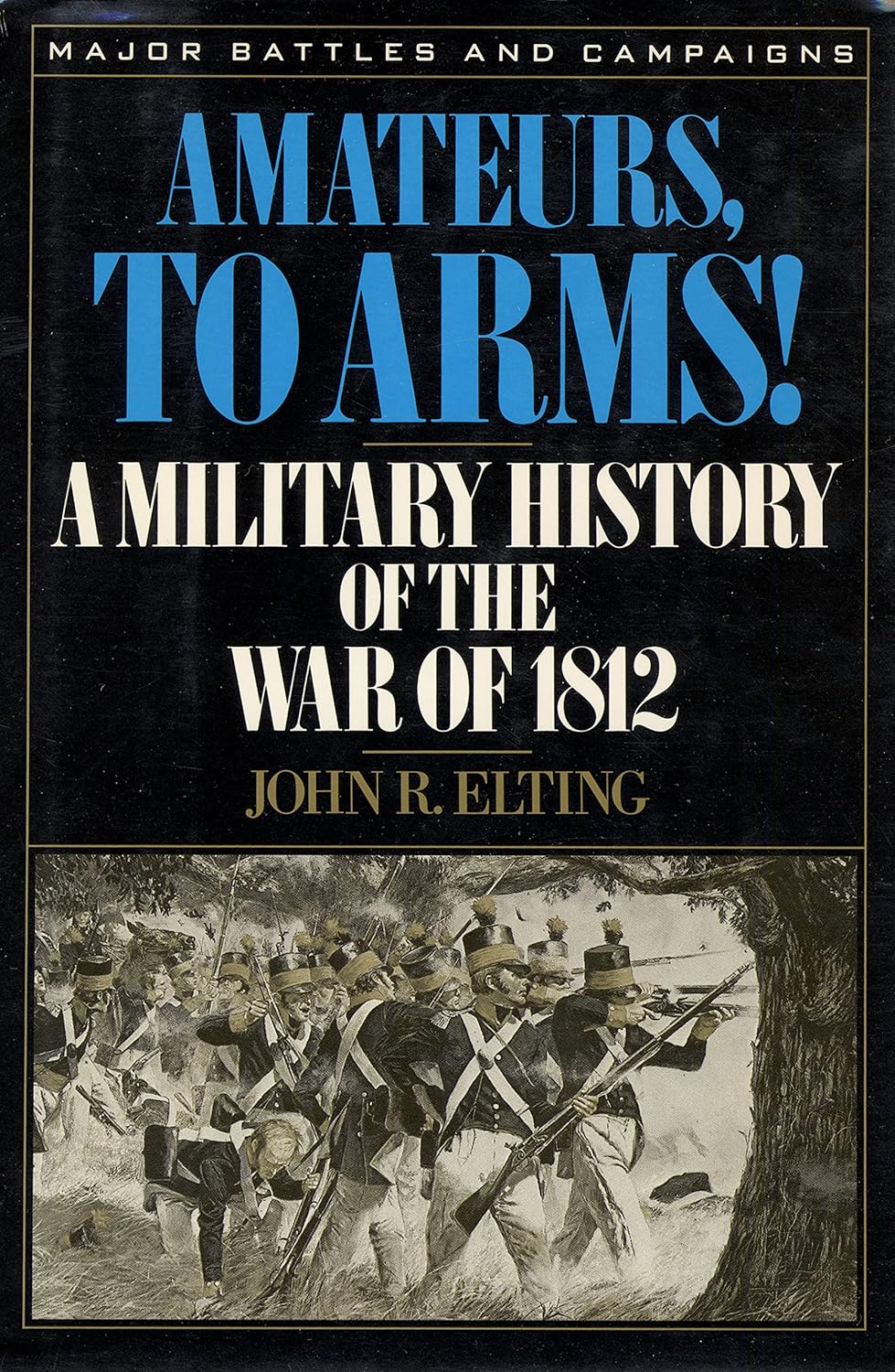
“The United States swaggered into the War of 1812 like a Kansas farm boy entering his first saloon. And, like that same innocent, wretchedly gagging down his first drink, the new nation was totally unprepared for the raw impact of all-out war.”
So begins this no-holds-barred military history of one of the most purposeless, indecisive, poorly managed and poorly fought wars in American history. The author, John Elting, who has carved out a rather respectable niche as a historian of Napoleonic wafare (e.g. Swords Around a Throne), weaves a truly engaging, tightly structured narrative, freely pointing fingers, assigning blame, and tossing out stinging insults to long dead Americans, military and civilian, most of them forgotten to history, all along the way. His brass knuckles style may rub some readers the wrong way; but for this reviewer it added a certain punch that gave the whole story a greater sense of immediacy and vitality. It was a much better book than I had expected, probably because I bought it from a clearance bin at Costco many years ago.
Consider a few of these tart assessments offered up by Elting, all from the campaign season of 1813:
- “[The] whole plan was a piece of strategic imbecility.” (On the plan to attack Fort George and Fort Erie on the western shore of Lake Ontario before a massed attack on the strategic British harbor at Kingston.)
- “Age and fatuity were being replaced by age and imbecility.” (On John Armstrong’s relief of Henry Dearborn’s command.)
- “A fit subject for a comic opera.” (On Wilkinson and Wade Hampton’s disastrous, failed campaign to take Montreal.)
- “A rare piece of stupidity and unthinking brutality.” (On the senseless American burning of Newark and Queenston on the Canadian side of the Niagara River.)
There aren’t many heroes in this book, although Oliver Hazard Perry, Winfield Scott and the British general Amos (who burned Washington in 1814 and was killed in action at Baltimore shortly thereafter) come off reasonably well, brave and professional officers who performed their duties competently. Interestingly, two future presidents, William Henry Harrison and Andrew Jackson, who held generals ranks in the war, are generally dismissed by the author. The primary villains are the Washington politicians who led the United States into war with a thoroughly third class army and navy, mostly due to their politically inspired policy: irresponsible budgeting during the early nineteenth century and the feckless personnel selection of senior officers based almost solely on political loyalty once the war began.
Thomas Jefferson and James Madison, in particular, are singled out for Elting’s salty opprobrium from beginning to end. Jefferson for making a mendicant of the Army and then foolishly investing almost exclusively in small gunboats as the strategic answer for the US Navy; Madison for selecting senior military officers, nearly all of whom were catastrophic failures, based wholly, if not entirely, on their unimpeachable Republican credentials (modern Democratic party).
From the Boston Massacre to 9/11, with “Remember” the Maine, the Lusitania, and Pearl Harbor in between, Americans have often been galvanized — and motivated to fight and die — by a sudden, tragic, bloody, and presumably unfair attack. How about “Remember the Raisin!” I don’t recall ever hearing that phrase before reading “Amateur to Arms!” — and I read a lot of American history. It is a reference to the January 1813 combined British and Indian assault on American soldiers at Frenchtown on the River Raisin in modern day Michigan. After surrendering, the British did nothing to prevent nearly 400 Americans from being massacred and scalped by their Indian allies, under Chief Tecumseh. News of the tragedy became a lightening rod during the War of 1812. For me, learning about Raisin and many other long forgotten aspects of this war underscored just how far removed from the national consciousness this conflict has become.
And, in fairness (if Elting and many other historians are to be believed), there isn’t much worth remembering about the War of 1812, at least not anything that adds to our collective national self-esteem. The performance of the US military, the one federal institution that retains high marks with contemporary Americans, performed dreadfully. As Elting explains in a typically pointed expression: “England would see Americans as contemptible opponents – not only cowardly but ridiculous.” American soldiers, particularly militia, lacked discipline, were quick to flee in battle, were thoroughly unreliable, and, worse yet, disposed to irresponsible behavior. Indeed, the British burning of Washington (and intended burnings of Baltimore and New Orleans) were very much motivated by retribution for the American burning of York (modern Toronto) and several towns on the Canadian side of the Niagara River.
There were many theaters in the War of 1812 (Alabama, Florida, New Orleans, the mid-Atlantic, modern Wisconsin) but only one front really mattered, according to Elting: The Great Lakes. From Montreal, down the St. Lawrence to Lake Ontario, along the Niagara River to Lake Erie and on to Detroit. Perry’s victory at Put In Bay secured Lake Erie in 1813 for the Americans and made the British position at Detroit untenable, ensuring that the conflict would focus on the belligerents’ main bases on Lake Ontario: Kingston for the British and Sacketts Harbor for the Americans. US Navy commander on Lake Ontario, Isaac Chauncey, is ridiculed relentlessly by Elting for his failure to risk his precious fleet at Sackett’s Harbor.
Finally, many of the numbers in this history surprised me: How large the British/Canadian forces were by the time of the armistice when they had started to shift Napoleonic war veteran forces from Europe to North America; how skimpy the American forces were even after the burning of the capital; and how many battles resulted in scores of casualties (there were an estimated 2,000 American battlefield killed-in-action, not including death from disease), a small fraction of the wars in Europe against the Emperor but far bloodier than modern “battles” like Fallujah and Ramadi.
In closing, this is a fun, sharp narrative on an important conflict from a hazy part of our history, with plenty of forceful arguments to make.
 What's Tim Reading Now?
Leave a comment