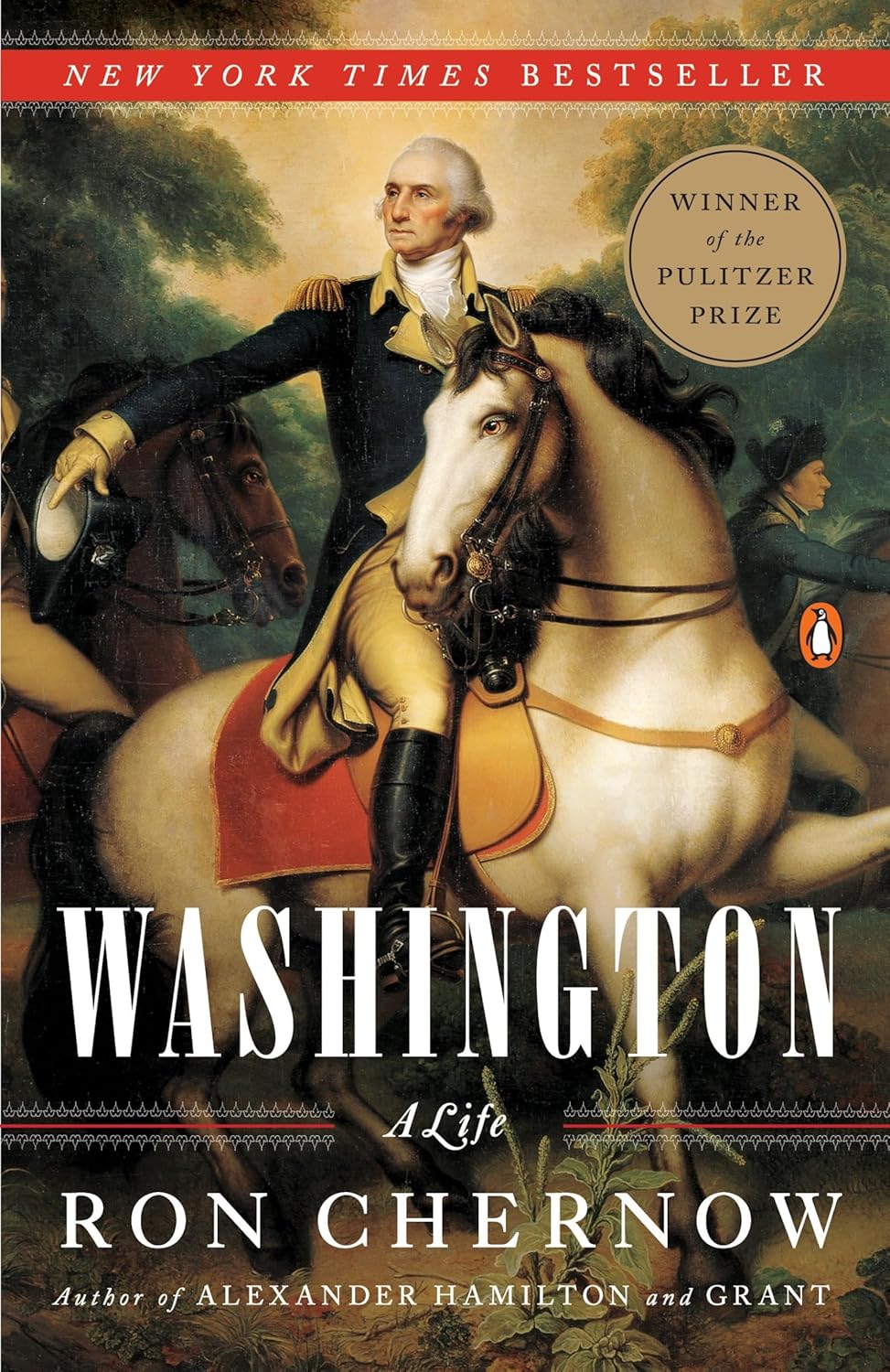
The year 2020 is a rough time to be a slaveholding Founding Father. As the mob indiscriminately tears down statues across America, I would argue there is no better time to read a book like this, an honest, richly textured Pulitzer Prize-winning biography from the celebrated Ron Chernow that brilliantly puts George Washington’s enormous contributions to his country’s welfare in proper historical perspective.
Born into the lower gentry of Tidewater Virginia in 1732, George Washington grew up fatherless after the age of 10, raised by a stern and, according Chernow, supremely self-centered mother and a beloved older half brother, Lawrence. From an early age, he was recognized as conspicuously talented and ambitious, truly “a sight to behold,” Chernow says. A self-educated surveyor, he was an inveterate speculator in land who had a lifelong insecurity about his lack of formal education. He benefited from the untimely deaths of several family members to inherit an estate of thousands of acres of prime agricultural land and dozens of slaves. His marriage to the wealthy widow Martha Dandridge Custis put Washington in the top echelon of Virginia society. Nevertheless, Washington would struggle financially throughout his entire life, often desperately short of cash due to failed crops and the inherent inefficiency of the slave economy. “Throughout his life he cherished the pose of noblesse oblige in public service,” Chernow writes, “even if he could scarcely afford it.” By the age of 30, he was one the foremost citizens of the colony, his reputation burnished by gallant service as a senior officer in the militia when he was only in his early 20s.
Chernow makes much of Washington’s service during the French and Indian War. “In Braddock’s crushing defeat,” he writes, “Washington had established an indelible image as a fearless young soldier who never flinched from danger and enjoyed a special intimacy with death.” Washington burned for a regular commission in the British Army and was aggrieved at how colonial officers were treated as second-class citizens. By the end of the conflict, “he had acquired a powerful storehouse of grievances that would fuel his later rage with England.”
When conflict with Britain came, Washington was, in Chernow’s estimation, “a militant to his fingertips.” When awarded the role of commander in chief in 1775 he was genuinely worried that he lacked the experience and skill to fulfill the enormous responsibility and was unashamed to tell people so. And the truth is, Chernow says, Washington was a rather mediocre military commander: “His military triumphs had been neither frequent nor epic in scale. He had lost more battles than he had won, had botched several through strategic blunders, and had won at Yorktown only with the indispensible aid of the French Army and fleet.” But battlefield prowess is not what made Washington great, according to Cherow. Rather, “Washington’s greatness as a general lay in his prolonged sustenance of his makeshift army.” For eight long years, against long odds, a stingy Continental Congress and political in fighting with other leading generals, Washington had maintained an “army in being.” So long as the Continental Army survived – and it rarely numbered more than 10,000 ill-clad, ill-fed and ill-disposed citizen soldiers – the Revolution lived. No one paid a heavier price and earned a greater right to claim credit for ultimate success than Washington. In return, he was virtually deified by a grateful nation, yet “he was neither intoxicated by power nor puffed up with a sense of his own genius.”
It must be noted that Chernow doesn’t shy away from slavery’s long and intimate role in Washington’s life. Far from it. In fact, slavery and the story of his slaves are woven into the entire narrative. “All the talk of liberty clashed with the reality of widespread bondage,” he writes. Washington owned literally hundreds of slaves, some of whom, such as the manservant Billy Lee, were close and trusted longtime companions. Chernow writes that Washington was conflicted by slavery. On the one hand, he saw it as the nation’s original sin and in certain circles talked often about abolition. On the other hand, slavery was the foundation of his entire (perilous) economic existence. One side story says a lot, I think, about Washington’s relationship with the peculiar institution. When the temporary capital was relocated to Philadelphia in 1790 Washington had to contend with a local ordinance that freed slaves who remained in the city for six consecutive months. To get around this threat to his household party of enslaved servants he had to quietly cycle them back to Mount Vernon on a regular basis to “reset the clock” on their six months residency. Even still, two of the family’s closest and most trusted slaves, Martha’s servant Ona Judge and the house chef Hercules, both successfully fled captivity while in Philadelphia. Washington would free his slaves upon his death, an act Chernow calls “more glorious than any battlefield victory as a general or legislative act as president.” Nevertheless, Chernow concludes, “[Washington’s] failure to use the presidency as a bully pulpit to air his opposition to slavery remains a blemish on his record.”
Slavery aside, Chernow writes glowingly about Washington’s performance as president, another role he felt ill-prepared for and genuinely thought of turning down to remain at Mount Vernon, his own personal Eden, whose upkeep and maintenance was never far from his mind. But Washington was a natural born politician and relatively easily slipped into the role of national chief executive. “It is a grave error to think of George Washington as a noble figurehead presiding over a group of prima donnas who performed the real work of government,” Chernow says. Washington led his administration admirably and set many precedents that helped establish a robust and independent executive branch of government. He deliberated slowly and carefully on important decisions, such as Hamilton’s economic programs, consulting a wide variety of advisors, none perhaps more regularly and intimately, at least early on, than James Madison, who eventually grew disenchanted with the president during his second term. He was, simply put, a paragon of integrity and objectivity.
The accomplishments of the Washington administration were many, Chernow says: “[Washington] had restored American credit and assumed state debt; created a bank, a mint, a coast guard, a customs service, and a diplomatic corps; introduced the first accounting, tax, and budgetary procedures; maintained peace at home and abroad; inaugurated a navy, bolstered the army, and shored up coastal defenses and infrastructure; proved that the country could regulate commerce and negotiate binding treaties; protected frontier settlers, subdued Indian uprisings, and established law and order amid rebellion, scrupulously adhering all the while to the letter of the Constitution.” It is an admirable legacy indeed.
In closing, Ron Chernow is a national treasure. His monumental works of biography never fail to disappoint and “Washington” might be his masterpiece.
 What's Tim Reading Now?
Leave a comment