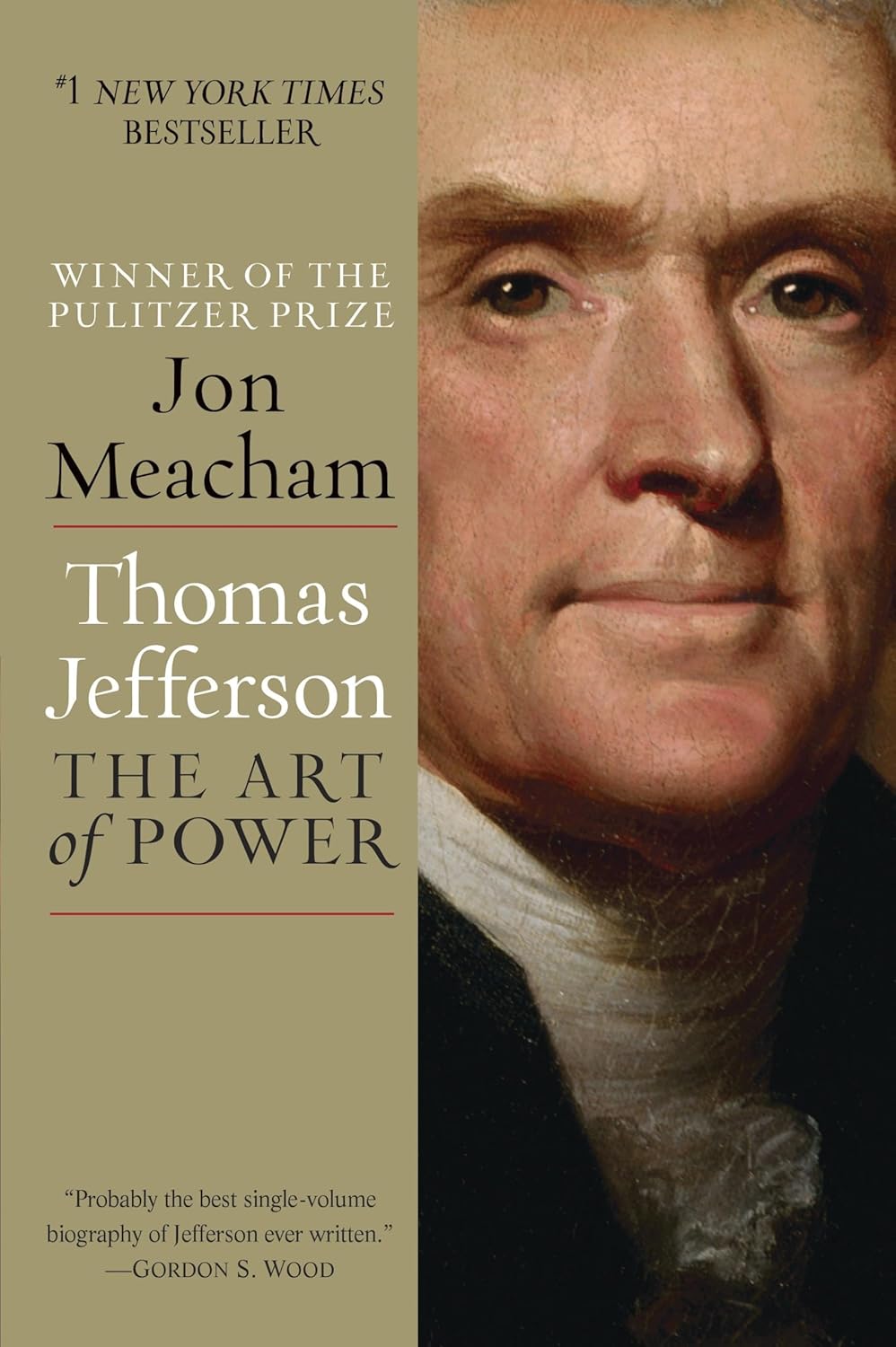
I must confess: I’ve never been much of a Thomas Jefferson fan. Much of my understanding of our third president has come by way of his generally unfavorable presentation in popular biographies of his esteemed contemporaries, such as Washington & Hamilton (Chernow), Adams (McCullough), Franklin (Isaacson) and Marshall (Smith). From the perspective of these prominent Federalists, Jefferson was dangerous – a self-righteous, disingenuous, atheistic demagogue. I picked up Jon Meacham’s highly acclaimed piece of scholarship (#1 New York Times Bestseller) hoping to get a fuller and (frankly speaking) more favorable picture of Jefferson the man, the politician and the statesman. Meacham’s effort is undeniably sympathetic to his subject; yet he wasn’t able to completely erase the stains on his character developed by the works cited above, at least not in this reviewer’s opinion.
Jefferson’s contribution to the American cause was certainly vast. Elected to the Virginia House of Burgesses at age 25, he was a delegate to the Second Continental Congress (where he authored the Declaration of Independence), wartime governor of Virginia at age 36, Congressman to the Confederation Congress in Annapolis, five-year envoy to France, the first secretary of state, second vice president and, finally, third president of the United States. Indeed, who else in American history can claim a more robust and varied contribution to public service?
But what is Jefferson’s legacy? What indelible imprint did he leave on our national life? From the perspective of over two hundred years, what did he get right and what did he get wrong? These were the questions I was hoping that Meacham would answer in, “Thomas Jefferson: The Art of Power.”
Unsurprisingly, Jefferson emerges from these pages triumphant. “Judged by the raw standard of the winning and the keeping of power,” Meacham writes, “Thomas Jefferson was the most successful political figure of the first half century of the American republic.” Politically speaking, Jefferson had no rival in the early republic. He had, Meacham says, “a remarkable capacity to marshal ideas and to move men, to balance the inspirational and the pragmatic.”
Meacham argues that the American conflict with Britain inalterably informed Jefferson’s worldview. With the perspective of hindsight, he says, “Jefferson lived and governed in a Fifty Years’ War” with the British, from the Sugar Act of 1764 to the Treaty of Ghent in 1815. “Anything that happened in either foreign or domestic politics was interpreted through the prism of the ongoing conflict with Britain.”
Jefferson perceived British threats to the fragile American Republic everywhere. “He judged political life in the context of the British threat to democratic republicanism,” Meacham writes. His domestic opponents were, in Jefferson’s mind, “Monocrats” — incorrigible villains determined to subvert the Constitution and replace it with a British-style aristocratic monarchy, none more diabolical than the ambitious Alexander Hamilton. Jefferson’s fears of Federalist rule and its supposed objectives were intense—perhaps even irrational and largely unfounded, though Meacham does not necessarily agree. “A fear of Jefferson’s—one made all the stronger the more time he spent in proximity to the court of Louis XVI—was that the United States might tack toward hereditary power, up to and including the installation of a monarch.” Meacham quotes liberally from contemporary sources to capture the raw emotion animating the political upheavals of the 1790s. Yet for the twenty-first-century reader, it remains difficult to fully grasp the depth of political hatred that consumed Jefferson and his adversaries at the turn of the nineteenth century.
A central theme in Meacham’s work is Jefferson’s political pragmatism. “For him, politics was informed by philosophy, but one could achieve the good only by putting philosophy into action. To do so required the acquisition of power.” Once that power was secured, Meacham observes, “it is not too much to say that Jefferson used Hamiltonian means to pursue Jeffersonian ends.” The Louisiana Purchase exemplified this paradox. Jefferson, the strict constructionist, chose to acquire Louisiana without seeking a constitutional amendment—an act that, as Meacham notes, “expanded the powers of the executive in ways that would likely have driven Jefferson to distraction had another man been president.” The later Embargo Act of 1807 revealed a similar pattern. In both cases, Jefferson’s devotion to republican principle yielded to the imperatives of governing, illustrating what Meacham calls his “flexibility and capacity to adapt his professed ideology to present realities.”
“The Federalists believed Jefferson’s Republicans to be every bit as dangerous as Jefferson’s Republicans believed the Federalists to be,” Meacham observes. Yet how, precisely, did the Jeffersonians transform the government fashioned by Washington and Adams? Meacham credits Jefferson with reducing the national debt from $83 million to $57 million and cutting military expenditures, including shrinking the Navy to just thirteen frigates—this despite persistent threats from both Britain and France. He also claims that Jefferson sought to return control over domestic affairs to the states, though he offers little in the way of concrete evidence to support this assertion. On the symbolic front, Jefferson eliminated the silver buckles from the presidential carriage and received guests at the President’s House in his slippers—gestures meant to signal a humbler, more egalitarian style of leadership. Yet beyond such theatrical displays of republican virtue, Meacham provides scant analysis of how Jefferson’s administration substantively altered the Federalist foundations of government.
Jefferson’s two-term presidency occupies roughly one hundred pages—about one-fifth of Meacham’s text—but it feels as though the subject deserves deeper treatment. Meacham underscores Jefferson’s extraordinary national popularity at both the beginning and end of his presidency—a remarkable political achievement by any measure—yet he never fully explains the sources of that enduring appeal. The portrait that emerges is of a leader who often sacrificed republican principle for political expediency, vastly expanding executive power while alienating the radical Republicans known as the Tertium Quids. Meacham acknowledges these contradictions but tends to smooth their edges, portraying Jefferson’s flexibility as prudence rather than opportunism. The result is a sympathetic account that underplays how his policies left the nation strategically and institutionally unprepared for the European turmoil that culminated in the War of 1812.
What of Jefferson the man? What does Meacham reveal about the human being behind the philosopher and statesman? Jefferson, by all accounts, was thin-skinned and profoundly averse to direct confrontation. “I find the pain of a little censure, even when unfounded, is more acute than the pleasure of much praise,” he once confessed. His troubled tenure as governor of Virginia during the Revolution—which Meacham concedes “was widely seen as little less than disastrous” and even led to an official inquiry—left emotional scars that never fully healed. This aversion to conflict became a defining feature of his political character. His style, Meacham writes, was “smooth rather than rough, polite rather than confrontational,” and “avoiding overt conflict was a Jeffersonian specialty.” Yet this temperament, while masking an inner intensity, also shaped the contradictions of his public life: Jefferson sought harmony and consensus even as his ideas polarized the nation. Beneath the calm surface lay a man who, as Meacham aptly puts it, “longed for order, control, affection”—an impulse that colored both his philosophy of government and his careful management of image and legacy.
Jefferson’s family life was marked by deep personal loss. He buried four of his six children in infancy and lost his beloved wife, Martha (“Patty”), when she was only thirty-three. Yet in retirement at Monticello, he found solace in the company of his surviving daughter, Patsy, and a lively household of grandchildren. Also present, of course, were Sally Hemings and the children Jefferson fathered with her—an unacknowledged family whose existence casts a long moral shadow over his legacy. Meacham regrets Jefferson’s illiberal stance on slavery but treats it with a gentleness that may strike modern readers as overly forgiving. Jefferson recognized that slavery was morally corrosive and ultimately unsustainable, yet claimed helplessness to act against it. His own comfort and status were too deeply bound to what he euphemistically called “the peculiar institution.” Convinced that the races could never coexist, he envisioned the eventual expatriation of freed Black Americans to Africa. In the end, Jefferson died heavily in debt and without freeing the people he enslaved—a tragic coda to a life spent preaching liberty while living amid bondage.
In closing, Meacham delivers a highly readable and largely sympathetic portrait of Jefferson, blending biographical detail with rich historical context. While the narrative illuminates many facets of Jefferson’s character and accomplishments, it occasionally shies away from probing the deeper emotions and personal anxieties that fueled the political conflicts of the 1790s and shaped his presidency. A more penetrating exploration of these inner dynamics might have offered an even fuller understanding of the man behind the public persona. It succeeds in presenting Jefferson not only as a towering figure of American history but also as a complex, often contradictory human being whose life continues to provoke admiration, debate, and reflection.cover the depths of emotions underlying the political conflict of the 1790s and his presidency, but the end result is a marvelous edition to any library of presidential biographies.
 What's Tim Reading Now?
Leave a comment